
Michael Jackson Ordered Brother Randy Shot during Drug Binge?
An outrageous story printed in today’s UK tabloid The Sun claims Michael Jackson – in the midst of drug-fueled paranoia – once ordered a hit on his younger brother Randy during a time they were in a vicious feud.
British martial artist Matt Fiddes, who worked as a bodyguard for MJ and recently claimed to be the biological father of Michael’s youngest son Blanket, tells The Sun that Michael became something of a paranoid wreck by 2005, surrounding himself with Nation of Islam bodyguards and even barring members of his family from his Neverland Ranch.
Fiddes was quoted saying the feud came to boiling point when Michael heard “Randy was trying to force his way past the bodyguards to speak to him in one of his rented homes. Michael ordered him to be shot dead.”
Fiddes said no one took him seriously because he was “out of his mind on drugs” at the time.

OWN Reportedly Bleeding $330M, But Ratings are Improving
Oprah Winfrey has a steep financial hill to climb in the struggle to keep her cable channel afloat.
Bloomberg Businessweek reported last week that OWN may have lost a whopping $330 million since it began in 2008. An analyst told the magazine that it was the most “successful failure in television today.”
The report follows a steady stream of setbacks for Winfrey, including low ratings, staff firings and the colossal mishap called “The Rosie Show.”
“If I were writing a book about it, I might call the book ’101 Mistakes,’” Oprah told CBS’s “Early Show” in April.
While Oprah does not have a personal financial stake in the company, it is still undoubtedly a black eye for her. However, in some good news for the network, the Wall Street Journal reported today that ratings for the network have ticked up recently. Part of that is due to “Oprah’s Next Chapter,” the new show that has seen Oprah nab major exclusives, like her sit-down with Whitney Houston’s family.
Moreover, the network will get millions of dollars in new revenues from cable operators.
Mavado fined
Dance Hall artiste Mavado was this morning found guilty on two charges and fined when he appeared in the Montego Bay Resident Magistrates Court.
The artiste, whose real name is David Brooks, was found guilty by Resident Magistrate Wilson Smith and fined $100,000 or six months.
He was fined $80,000 or six months on the charge of assault and another $20,000 or six months for malicious destruction of property.
Both sentences are to run concurrently the RM also ruled.
The conviction came out of an incident that took place in rural St James in July last year.
Brooks had injured a man who he claimed was blocking his way by using the wheel of his Sports Utility Vehicle to squeeze the man between his car door and the car the man was driving, causing swelling to his foot and a cut to his shoulder.
The court also heard that the damage to the car was about $25,000.
Ja.Observer
Next year’s Carnival from April 19 until May 3
St. Maarten Carnival 2013 will run from Friday, April 19 until Friday May 3. “Preparations for Carnival 2013 start now,” President of the St. Maarten Carnival Development Foundation (SCDF) Stuart Johnson proclaimed yesterday, urging the public to “save the dates” for next year’s festivities.
Fresh off what it dubbed a “very successful fete”, the SCDF is wasting no time in laying the groundwork in place for 2013. Preparations for the recently concluded festivities started in June 2011, “But for next year we are not stopping, we are going straight into the preparations while wrapping up some items from Carnival 2012,” Johnson said.
The dates as outlined for 2013 will give Carnival enthusiasts, residents and visitors alike, 15 days of Carnival activities for the official period. However, as Easter 2013 falls on March 31, the SCDF has the entire month of April for pre-Carnival activities and other initiatives currently being looked at. “We will get creative,” assured Johnson.
Johnson added that every Carnival year offers the opportunity to tweak events and policies for the overall improvement of the Carnival product. “We have been at this for quite some time, but the team of the SCDF takes away something from every Carnival year. As usual we will evaluate Carnival 2012, we will change what needs changing and even eliminate what isn’t working. We are constantly improving or adapting the product,” he said.
“One aspect that we will look to expand is our overseas marketing initiatives once funding is received from government. We have a plan in place for Carnival marketing through trade show attendance etc and we are looking forward to exposing our festival to the world through any viable means,” Johnson added.
The SCDF team will host a press avail during the course of next week to provide a public wrap-up of Carnival Festivities and additional insight into Carnival 2013.
Court document says Olint gave JLP US$5m and PJ denies getting US$1m from OLINT
The Jamaica Labour Party (JLP) has admitted that Olint’s David Smith was one of its contributors for the 2007 election campaign.
But the JLP says it will be investigating the claim made here in the Turks and Caicos Supreme Court document that Smith had donated US$5 million.
The Court has issued a Confiscation Order that mentions the gift to the JLP and other groups and individuals.
Meanwhile, Former Prime Minister of Jamaica P. J. Patterson has denied ever receiving US$1,000,000 from David Smith of Olint.
His comments follow news of a Confiscation Order issued by the Supreme Court of Turks and Caicos that mentions a gift of US$1,000,000 by David Smith to one “P.J Patterson.”
“I deny categorically ever soliciting or receiving any such gift,” Patterson said in a statement a short while ago.
According to Patterson, during the last few days before the 2007 General Elections, he had a telephone conversation with Smith pertaining to reports that in addition to the donations he had already given to both political parties, Smith had made hefty contributions to the Jamaica Labour Party campaign in Central Manchester because he was determined to see the People’s National Party’s (PNP) Peter Bunting defeated.
Patterson says Smith admitted to doing so because he claimed that Bunting had orchestrated the raid on his Kingston offices.
Patterson says Smith also said he had heard that should the PNP win, Bunting could become the Minister of Finance and he feared that Bunting was out to destroy him.
“I told him that to my certain knowledge, Peter Bunting had denied any such involvement and while I was in no position to anticipate where Cabinet members would be assigned, I assured him that in any case, the traditions of the party and the guidelines for Cabinet conduct would not allow any Member to pursue a vendetta or discriminatory treatment against any person or group engaged in business. Anything done would be in accordance with the law.”
Patterson said Smith expressed great relief with that assurance.
“He stated that he had already made contributions to both parties, but he was disposed to increasing what he had previously given to the Party’s Campaign Fund,” said Patterson.
However, the former Prime Minister said Smith did not disclose to him a specific amount.
“I told him that I was not an officer in the Campaign and he was free to contact Comrade Danny Buchanan, the General Secretary and Campaign Director regarding whatever further contribution he desired to make.”
Patterson says he then informed Buchanan of the conversation and the general secretary promised to speak with Smith.
“I do not know what was the outcome of those discussions and how much more if any was contributed to the coffers of the campaign,” the former Prime Minister said.
Patterson concludes: “What I can assert is that no money came into any account owned or controlled by me nor was there any cheque signed by me, nor did any other financial transaction take place which required or obtained my sanction.”
On August 11 last year, former Olint boss, David Smith, was sentenced to 30 years in prison.
He was accused of operating a ponzi scheme which bilked investors out of more than 200 million US dollars.
Smith had pleaded guilty to four charges of wire fraud, one case of conspiracy to commit money laundering and 18 cases of money laundering.
Last August Smith was sentenced to 30 years in prison for operating a ponzi scheme which defrauded investors more than 200 million US dollars.
Source-Gleaner Jamaica
Google breached Oracle's Java copyright, US jury finds
A US jury has found that internet giant Google breached copyright in a case brought by Oracle over its Java programming language.
But the jurors were unable to agree on whether Google's actions constituted "fair use" under copyright law.
Oracle was asking for $1bn (£630m) in compensation in one of the biggest such technology lawsuits to date.
The language is used by many business applications as well as other software, such as the video game Minecraft.
'Zero finding of liability'
The jury in San Francisco were asked to consider four questions on Oracle's claim that Google violated several of its patents and copyrights, but could only agree on three. It found in Google's favour on two of them.
Google was found to have infringed Oracle's copyright on nine lines of Java code that is in Android, its mobile operating system.
But Oracle can only seek statutory damages, ranging from $200 to $150,000.
Google is asking for a mistrial to be declared.
"There has been zero finding of liability on any copyright so far," US District Court Judge William Alsup told lawyers for both firms after the jury left.
"The affirmative defence of fair use is still in play."
The same jury will now hear evidence in the next phase of the trial, covering Oracle's allegations that Android violates two Java patents.
Oracle claimed Google's Android system infringes intellectual property rights relating to the programming language.
Java history
The case did not centre on Google's use of Java itself - which is free for anyone to use without licence - but rather the Android-maker's use of 37 application programming interfaces (APIs) that allow developers to write Java-compatible code.
Java was first released in 1995 and allows software to be run across computer platforms, rather than just being limited to one type of operating system.
Oracle - a business hardware and software provider - inherited the intellectual properties when it took over Java's original developer, Sun Microsystems, in 2009.
Oracle argued that by using its intellectual property, and then giving Android away for free, Google undermined the possibility of it licensing Java to mobile phone makers.
Shares recover as election fears prove short-lived
European shares finished higher as investor concerns about government austerity plans following weekend election results proved short-lived.
Pro-bailout parties in Greece performed poorly, while Francois Hollande won the French presidency, promising to focus more on growth rather than austerity.
In Paris, the Cac 40 recovered to trade up by 1.65%. In Germany, the Dax fell by more than 2%, but closed up 0.1%.
The euro also fell against both the dollar and the pound.
The euro fell as low as $1.295, its lowest since January, later recovering to $1.305, and dropped to three-year lows against the pound.
But shares in Athens fell by as much as 8.3%. In London, markets were closed for a bank holiday.
In New York, the Dow Jones opened down by 0.3%.
The interest rates on some government debt has also gone up, indicating a fall in investor confidence. The yield in the secondary markets for Greek 10-year bonds has gone up from 20% to 22.2%.
Asian markets also fell, with the Nikkei in Tokyo dropping 2.8%. South Korea's Kospi shed 1.8% and Hong Kong's Hang Seng dropped 2.4%
'Chaos in Greece'
In Greece, the socialist Pasok party saw an unexpectedly poor result, while Syriza, which has opposed austerity measures, had a strong performance.
The result has cast doubt on whether the country's policies that currently include large spending cuts, tax increases and state job losses, can continue.
"The knee-jerk reaction was a little strong, but there's chaos in Greece, and [politicians] being against the deal that was already agreed upon is almost like progress being set back a year and a half," said Scott Freeze, president of StreetOne Financial.
BBC Europe editor Gavin Hewitt says Greece faces political turmoil.
"Pro-austerity parties were punished at the polls. The country will struggle to form a coalition that has the support in parliament for new spending cuts that are a pre-condition for receiving funds from a bailout," he said.
"There will be fresh doubts as to whether Greece can remain in the euro. The new political reality in Europe is that voters appear no longer willing to accept spending cuts, low growth and unemployment."
While the French result was expected, there is still concern about whether Mr Hollande will be able to work as closely with German Chancellor Angela Merkel as his predecessor Nicolas Sarkozy did.
The two were the driving force behind the eurozone's fiscal compact.
Mr Hollande stood on a platform of promoting growth rather than concentrating on austerity.
"The global financial markets aren't thrilled by the idea that France and Greece have voted for governments less willing to work with the Germans on a consistent approach to addressing their fiscal deficits," said Dick Green at Briefing.com.
During the campaign, Mr Hollande pledged to renegotiate the fiscal pact in which European countries agreed to strict controls on their budgets.
But following his victory, and the defeat of the governing coalition parties in Greece, Mrs Merkel said that the deal was "not up for grabs".
"It is a matter of principle in Europe that following elections, be they in small or large countries, we do not renegotiate what's already been agreed," she said.
"Otherwise we could not work together in Europe."
The ratings agency Standard and Poor's, which downgraded France from its triple-A rating in January, said the election result would have no immediate impact on its credit status.
"We will analyse the policy choices of France's president elect and the new government, taking into account the outcome of the parliamentary elections in June," the agency said.
"The chances are that the next move is going to be down. The chances are it's going to be slightly earlier than it would have been otherwise, but the agencies themselves will have a measured response," said Georg Grodski, head of credit research at Legal and General.
"There is still hope that Mr Hollande will tone down some of his rhetoric and accept that you can't fix an economic problem by living on other people's money."
BBC
GE in tie up with XD Electric as it eyes China's market
General Electric (GE) has announced a tie-up with China's XD Electric to tap into China's fast growing market for electric transmission and distribution.
GE has agreed to buy a 15% stake in XD, one of China's largest makers of power transmission and distribution equipment.
Beijing is looking to expand its electricity infrastructure to cater to rising demand as China's economy grows.
China is the world's second-largest economy.
"This is the beginning of an important relationship between two companies with complementary product lines and commitments to technology," Bob Gilligan, president and chief executive of GE's Digital Energy business said in a statement.
"It will enhance GE's ability to provide end-to-end transmission and distribution solutions and expand our presence in the fastest growing regions of the world."
Though GE did not provide details of the amount it will pay for the stake in XD, the Financial Times and Reuters news agency reported that the figure was close to $535m (£330m).
Global demand
The demand for electricity transmission and distribution equipment is expected to grow in the coming years, driven both by developing as well as developed economies.
As emerging and developing economies such as China and India grow, more people are expected to move from rural to urban areas, increasing demand for power.
There is also a push to develop rural and interior areas, which is expected to result in more demand for electricity and the need for adequate equipment to transmit and distribute it.
At the same time many developed economies are also looking at ways to upgrade their distribution systems.
The two firms said the tie-up will help ensure that they are able to get a substantial share of this increasing global demand.
Airbus and Boeing hit by plane cancellations
Airlines have cancelled a total of 32 orders for planes so far this year, according to data from the world's two major plane makers.
US giant Boeing said it had 25 orders of its flagship plane, the 787 Dreamliner, cancelled by airlines without naming who they were.
European rival Airbus has had seven A350 orders cancelled by Etihad Airways, the Abu Dhabi-based airline.
The cancellations reflect the difficult travel market and weak global economy.
The numbers emerged in both firms' end-of-month order figures.
For Boeing, the 25 Dreamliner cancellations compare with 19 orders so far this year, meaning the plane maker is in negative territory for its flagship plane.
Based on list prices, it would cost the airline about $193.5m (£119m).
But in terms of total orders for all planes this year, Boeing retained a large lead over Airbus.
Boeing's order book stood at 415 on 1 May, against 95 for Airbus on 30 April.
It is Etihad's second cancellation in four months and takes its order of 25 A350-1000 planes, made in November last year, down to 12.
The seven aircraft are worth $2.3bn at listed prices.
Francois Hollande to set France on new course after win
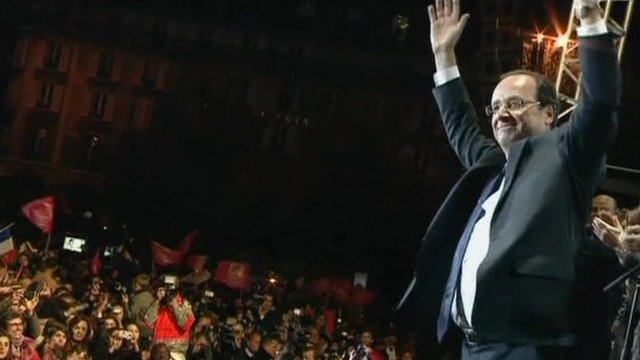 French President-elect Francois Hollande is to start work on forming a new government, after telling supporters his victory gave hope of an end to austerity.
Mr Hollande has vowed to rework a deal on government debt in eurozone member-countries to focus on promoting growth.
The Socialist leader won just under 52% of votes in Sunday's run-off election.
Centre-right incumbent Nicolas Sarkozy is the first French president since 1981 not to win a second term.
He will hand power to Mr Hollande on 15 May, following talks between the two camps, the presidency has said.
Mr Hollande must act quickly to reassure other eurozone countries he is up to the considerable challenge he faces, the BBC's Christian Fraser reports from Paris.
Invitation to Berlin
Mr Hollande has called for a renegotiation of a hard-won European treaty on budget discipline championed by German Chancellor Angela Merkel and Mr Sarkozy.
Mrs Merkel congratulated the president-elect by phone and invited him to Berlin to hold talks soon, but she warned the fiscal compact was "not up for grabs".
"The core of the discussion is really all about... whether we are going to have again programmes for growth which are on the back of debt or indeed whether we are going to have programmes for growth that are sustainable and indeed rely on the competitiveness of the countries," she told a news conference in Berlin.
In Washington, a White House spokesman said the alliance between France and the US was "as strong today as it was last week".
Spokesman Jay Carney said President Barack Obama had called Mr Hollande to congratulate him on the victory, adding that the US leader was looking forward to welcoming the president-elect to a Nato and G8 summit in the US later this month.
Mr Carney also said that President Obama had telephoned Mr Sarkozy to thank him for his "strong leadership and for his friendship and partnership in challenging times".
UK Prime Minister David Cameron also called Mr Hollande to congratulate him.
Mr Hollande feeds a renewed sense of hope in the country - particularly among the young - that amid the austerity, there can be jobs and salaries, our correspondent says. However, the debt problems for France are still the same.
Jubilant Hollande supporters gathered at the Place de la Bastille in Paris - a traditional rallying point of the Left - to celebrate.
Mr Hollande - the first Socialist to win the French presidency since Francois Mitterrand in the 1980s - earlier gave his victory speech in his stronghold of Tulle in central France.
He said he would push ahead with his pledge to refocus EU fiscal efforts from austerity to "growth".
"Europe is watching us, austerity can no longer be the only option," he said.
After his speech in Tulle, Mr Hollande headed to Brive airport to fly to Paris to address supporters at the Place de la Bastille.
"I am the president of the youth of France," he told the assembled crowd of tens of thousands of supporters.
"You are a movement that is rising up throughout Europe," he said.
'Clique' warning
Mr Hollande capitalised on France's economic woes and President Sarkozy's unpopularity.
The Socialist candidate has promised to raise taxes on big corporations and people earning more than 1m euros a year.
He wants to raise the minimum wage, hire 60,000 more teachers and lower the retirement age from 62 to 60 for some workers.
In his concession speech, Mr Sarkozy told supporters: "Francois Hollande is the president of France and he must be respected."
The outgoing centre-right president said he was "taking responsibility for defeat".
"My place will no longer be the same. My involvement in the life of my country will now be different."
Mr Sarkozy also held a meeting with senior members of his UMP party, warning against infighting after the electoral defeat.
"For the future, avoid banding into cliques," he was quoted as saying by a participant of the meeting.
Mr Sarkozy also reportedly said he would give more details in September about what he intended to do in the future.
During the campaign, the outgoing president had said he would leave politics if he lost the election.
Mr Sarkozy, who has been in office since 2007, had promised to reduce France's large budget deficit through spending cuts.
He becomes the latest European leader to be voted out of office amid widespread voter anger at austerity measures triggered by the eurozone debt crisis.
France is due to hold a parliamentary election in June.
Source-BBC