
Battleship stays afloat in UK box office chart
Battleship has topped the UK and Ireland box office chart for a second consecutive week.
The film, which stars Liam Neeson and Rihanna in her first major acting role, took £1.28m.
Despite a 66% drop in box office takings from last week, it was enough to hold off new entry Salmon Fishing In The Yemen, which opened with £1.17m.
Ewan McGregor, Emily Blunt and Kristin Scott Thomas star in the adaptation of Paul Torday's novel.
The Hunger Games climbed back up one spot to three in its fifth week of release, bringing its total box office haul to £21.3m.
Horror film Cabin In The Woods fell one place to four.
Salmon Fishing In The Yemen's new entry has meant independent distributor Lionsgate has achieved the rare feat of having three films in the top five.
The 3D re-release of James Cameron's Titanic was at five, taking just under £926,000.
In a week where takings on current releases were all down, there were two other new entries in the chart.
Guy Pearce thriller Lockout opened at seven, while Amanda Seyfried's Gone scraped in at 10, taking £275,000 from 253 cinemas.
Meanwhile Kevin Macdonald's music documentary Marley, about Bob Marley, opened at 11 taking £164,000 across 64 screens.
UK & IRELAND BOX OFFICE
- 1. Battleship - £1.28m
- 2. Salmon Fishing In The Yemen - £1.17m
- 3. The Hunger Games - £1.07m
- 4. Cabin In The Woods - £1.03m
- 5. Titanic 3D - £925,740
Source: Rentrak

DIGICEL TCI CEO E. JAY SAUNDERS, TELLS LATIN AMERICAN OPERATORS WHY THEY ARE BETTER POSITIONED TO BENEFIT FROM 4G LTE
E. Jay Saunders, CEO of Digicel TCI returned home late last week from the LTE Latin America 2012 Conference, which was held in Rio de Janeiro, Brazil on 17-18 April 2012. At the conference, E. Jay spoke on the topic of “Leveraging the Need for Internet Connection: How are operators preparing their customers to want all the traffic growth that LTE will bring” and he was also part of a CEO Panel discussing the topic “How Will the Operator Business Model Be Transformed with the Introduction of LTE.”
During his presentation, E. Jay stated that since Latin American operators are not constrained by the same issues facing USA operators they are better positioned to financially benefit from LTE. E. Jay highlighted this fact with examples of value added services with high customer experience levels that Latin American and Caribbean operators can roll out in conjunction with LTE that will generate new revenue streams and greater ARPU’s – a win win situation for both the operator and the customer. According to E. Jay, when it comes to LTE, business model innovation is going to be critically important due to its large capital requirements, with some USA operators expecting to spend up to US$20 billion dollars to rollout their LTE services.
“At LTE Latin America 2012 in Brazil, E. Jay Saunders gave an insightful speech, raising important issues regarding the new technology. Regulators should be more opened to discuss the excellent points raised by Saunders.” stated Marceli Passoni, research analyst at Informa Telecoms & Media, the company that hosted the conference. Informa estimates that in 2016 LTE will account for 42 million users in Latin America, representing 5% of total subscribers. According to Informa, “LTE is the next mobile change-out which will enable mobile operators to better and more cost-effectively transport the rapidly growing data traffic on their networks. LTE will help Latin American operators to deliver new applications and value-added services, boosting data revenues.”
E. Jay, who is scheduled to speak next at the LTE World Summit 2012 being held in Barcelona, Spain at the end of May, stated that “…there are companies that are currently spending hundreds of millions of dollars, and in some cases billions of dollars to rollout LTE, and they are not going to make back their investments with the old voice centric business models. With data traffic growing at a faster rate than voice traffic, operators are now experiencing higher costs to support mobile data than the revenues that they are making from it. This trend is not sustainable, and the only way they can reverse it is by innovating on the business model side.”
Some of the other speakers at the 2 day conference were:
Ajay Joseph, CTO, iBasis;
Anderson André, Latin America Service Provider Director, CISCO Systems;
Chris King Sr, Director, Oracle;
Daniel Borras, Director Business Development, Samsung;
Daniel Locklear, Sr. Director Business Development, Alcatel-Lucent;
Emmanuel Coelho Alves, Wireless Product Line Senior Manager, Huawei;
Hanna Maurer Sibley, Product Manager LTE, ERICSSON, Sweden;
Philippe Leon, Worldwide OSS Director, HP;
José Geraldo de Marco, Latin America Technical Marketing, MOTOROLA MOBILITY;
Marcelo Gonçalves, Portfolio Planning Manager Latam, NOKIA MOBILE.
FortisTCI Submits Annual Regulatory Filing For The Year Ended December 2011
In March 2012, FortisTCI and AEP Limited submitted their Annual Regulatory Filings for the year ended December 31, 2011 to the Electricity Commissioner including corresponding audited financial statements. FortisTCI and AEP Limited (the “Company” or “FortisTCI”) are required to submit their Annual Regulatory Filings and audited financial statements each year.
Reflecting continued economic weakness of the local economy, on a consolidated basis FortisTCI had marginal overall growth of 0.3% in energy demand for the year ending December 31, 2011.
The Company registered year-over-year growth only during the months of November and December 2011, with overall annual sales remaining relatively
flat at 170.4 GwH in 2011 compared with sales of 170.1 GwH in 2010.
All sectors showed a year-over-year decline in electricity sales except for commercial and small hotels, driven primarily by a strong 2011 tourist season.
Electricity sales for large hotels decreased by 1% mainly due to extended closures for restoration following the passage of Hurricane Irene in the third quarter, while residential sales decreased by 2% as residents increased energy conservation efforts.
The Company continues to manage its controllable expenses well. Although the company reported a 4% increase in operating expenses against prior year, this was
partially offset by decreased energy costs, lower maintenance expenses, and decreased wages and compensation expenses resulting from improved engine heat
rate and efficiency at the generating plant. Other influences were, upgraded preventative maintenance procedures, the results of the Company’s 3-year salary
freeze and improved unit man-hour productivity.
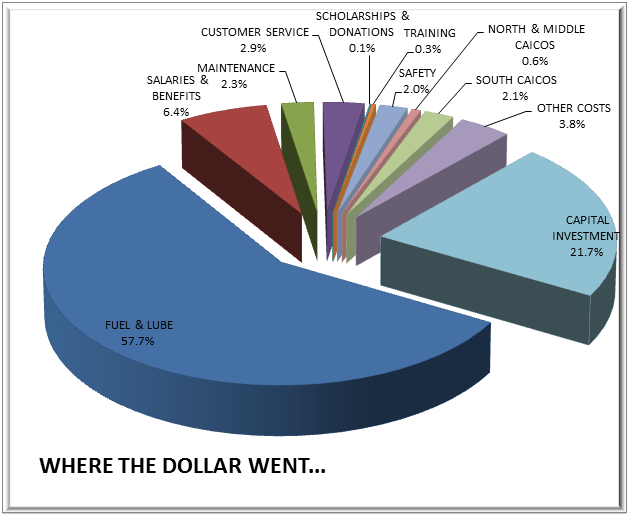
The Company’s continued capital investments combined with the current period of low sales growth and no increase in customers’ basic tariff rates, resulted in a lower Return on Rate Base (RORB) and an increase in aggregated Rate Base to $165.7 million, up by 17% from 2010. For year ended December 31, 2011, RORB was 7.5% with an average return over the last 5 years of 9.7%. The Company earned profits of $8.7 million for 2011.
FortisTCI Capital Investments totalled $26.37 million in 2011, which incorporated the commissioning of its second Wartsila engine that contributed to improved generating efficiency, reduced maintenance costs, and improved reliability. Other major projects included completion of the corporate headquarters and customer service centre, and the construction of a state-of–art 800,000 gallon fuel storage facility which significantly increased on-site storage capacity and improved fuel supply security. In addition, the Company invested in a comprehensive Groundwork Management System, the first of its kind in the Turks and Caicos Islands. One of the primary purposes of the Groundwork Management System is to mitigate the amount of water, in a severe rain event, entering Leeward Highway from the Company’s site, a problem that persists up and down Leeward Highway.
“Although we had an extremely busy year, the Company and its employees rose to the challenge. Major headwinds included the continuing global recession and the impact of Hurricane Irene which resulted in the temporary closure of some of our commercial customers. Our employees did a magnificent job at restoring service in the aftermath of the hurricane and our annual Average System Availability Index (ASAI) remained above 99.9%. Despite the economic recession, we continued to be a significant investor which provided much needed buoyancy to the local economy. Our investments in both physical and human assets are part of the Company’s long term strategy to ensure that the TCI has one of the best electricity systems in the world.” stated Eddinton Powell, CEO.
Mr. Powell added that “the current spike in fuel prices, which has driven up the cost of electricity to our customers, remains one of our biggest challenges. Nevertheless, we have been able to reduce the number of gallons we consumed in the generation of electricity from 12,917,651 gallons to 12,666,431 gallons, year-over-year, through efficiency improvements up and down our system value chain. We are committed to increasing fuel efficiency even further”.
TCHTA’s Members and Community Partner for Earth Day to make TCI SHINE!
Members of the Turks and Caicos Hotel and Tourism Association (TCHTA) and the community across Providenciales, came out on Saturday 21 April 2012 to make “TCI SHINE” in commemoration of Earth Day, which is recognized to as a day to raise awareness of issues that affect the earth.
TCHTA’s 4th annual cleanup campaign, “TCI Shines”, attracted the participation of approximately 240 persons, who came out with one objective, to clean up the highways and byways of Providenciales, and to bring an awareness to Earth Day and keeping Mother Earth litter free. The initiative, spearheaded by the Association and its Project Committee, focused on involving the community at large. Some groups where amazed at how much trash was being collected, quotes like; “I will now think twice before tossing anything from my car”, and “I now know the beer of choice in TCI”, due to the amount of bottles collected.
Association Executive Stacy Cox noted, “This year’s objective was to involve the wider community through various organizations, like Churches, Schools and Civic Groups, or just to have people clean up around their homes on this day”. The event for us is always bittersweet and we are happy to clean up our communities but disappointed that we are still collecting so many bags of garbage, after hosting “TCI Shines” twice a year for the past three years. We collected approximately 750 bags of garbage in addition to microwaves, golf clubs, drums and shopping carts.
Cox added, “For this cleanup we focused on awareness and outreach in the community, as the more people involved in a cleanup campaign the more people will begin to think twice about littering”
Special thanks to the members of the TCHTA, BEST Institute, Enid Capron Primary School, Mills Institute, TCI Middle School, TCI Youth Department, Gods Gem, Power 92.5 FM and 102.5 KISS FM, Harvest Bible Church, The Church of God of Prophecy and members of The Filipino Community for doing their part to help TCI Shine.
POLICE NAME DIVING VICTIM
POLICE have today named a teenage American tourist who died following a diving accident off Grand Turk, earlier this month.
Bhavish Zinzuwadia, 17, a passenger on the cruise ship, Carnival Pride, lost consciousness in the water during a Carnival Cruise Lines-sponsored SCUBA diving excursion on April 4.
He was treated at the scene by diving instructors before being rushed to the Cockburn Town Medical Centre.
The victim was then transferred to a hospital in South Florida where he died on April 8.
The incident is currently under investigation.
POLICE ENTER THE WORLD OF SOCIAL MEDIA
RTCI Police has unveiled a new tool in the fight against crime.
Officers are turning to social media networks in a bid to catch criminals and engage with local residents.
The police have set up Facebook and Twitter accounts and have appointed a specialist social media officer, PC Kevin Clarke.
PC Clarke, who has just returned from an intensive training course and conference in Canada, said the initiative could save lives.
He explained: “This is a major step forward for the RTCI Police and one we are very excited about. The power of social media is immense, with millions using it every minute of the day.
“Facebook and Twitter not only helps us to communicate instantly with local residents, but it also assists in solving crimes and tracking down criminals.
“It can be used in so many ways and its value in police terms has been proven time and time again.
“Say for instance a young child goes missing. Within minutes we can issue a photograph via social media and instantly we have an army of people on the lookout for that child.
“Social media, coupled with the ongoing support of the Press and the co-operation of the general public, is a huge asset and it can ultimately save people’s lives.”
He added: “Law agencies all over the world are achieving successes with social media tools in areas and we are delighted to be at the forefront of this technology here in the Turks and Caicos Islands.”
Supporting the initiative is communications giant, LIME.
The company has donated two Galaxy tablet computers to the RTCI Police to enable officers to update information to social media sites from crime scenes and other locations.
LIME’s Delleriece Hall said: “Here at LIME we put the community first and we fully support this latest police initiative. Social media is hugely popular and certainly the way forward.
“We endorse anything that improves the quality and safety of people’s lives here in the TCI and we are delighted to assist by donating two tablet computers to the force.”
Meanwhile PC Clarke, who is responsible for implementing the force’s social marketing presence, today urged people to follow the RTCI Police online.
“It’s so easy”, he added. “Facebook users just need to like our page while Twitter users simple have to follow us.
“It’s a great service with traffic updates, crime prevention tips and all sorts of other useful information available.
“But it’s a two-way process and therefore we are absolutely dependent on comments, feedback, information and suggestions from the public.”
You can follow the RTCI Police at www.facebook.com/RTCIPF and on Twitter @royaltcipolice.
ENDS
FINANCIAL SERVICES COMMISSION PUBLISHES ACTION PLAN
The Financial Services Commission is pleased to announce that following extensive consultation with the industry and other stakeholders it is today publishing its Action Plan 2012-16 outlining its core areas of activity for the next five years, today, 25 Apr 2012.
The Action Plan draws together and addresses the recommendations contained in recent reports from the International Monetary Fund; the Toronto Centre; and the Caribbean Financial Action Task Force, and was given renewed impetus following the closure of TCI Bank in April 2010. These reports, plus earlier work performed in the 2009 Foot Review of the Opportunities and Challenges facing the British Crown Dependencies and Overseas Territories, highlighted areas of the regulatory and supervisory regimes in the TCI that required development, and were used as the basis in drawing up the Action Plan, which will be made available on the FSC’s web site and be periodically updated.
His Excellency Governor Ric Todd said: “I congratulate the FSC on this initiative. The publication of an Action Plan is an important step in demonstrating the commitment of the Financial Services Commission, and by extension the Interim Administration, to the future of financial services in the Turks and Caicos Islands. The Action Plan charts a positive way forward for the sector and describes the steps that will be taken to ensure the TCI keeps pace with the latest international regulatory standards. I am sure the private sector will rise to the challenges ahead and work with the FSC to ensure that TCI’s reputation as a financial services centre is enhanced.”
Errol Allen, Chairman of the FSC, added: “The Action Plan is the culmination of a great deal of work by the FSC and its partners in the financial services sector, and represents a summary of our objectives for the next five years. Completion of these objectives will provide the TCI with an extremely robust and practical legislative and regulatory framework designed to support the industry into the future.”
FSC Action Plan: 2012-2016
Introduction
The Financial Services Commission (FSC) was established in 2001 as an independent statutory body with responsibility for the administration of the regulatory framework for all financial services in the territory.
As a result of the Caribbean Financial Action Task Force (CFATF) Report in 2008 and the Foot Review in 2009 it was recognised that there was a need for significant institutional strengthening if the FSC was to meet international regulatory standards.
The closure of TCIB in April 2010 resulted in several focused reviews of the FSC; firstly, the Non-Executive Directors Report on the FSC’s supervision of TCIB and secondly, the Toronto Centre Report of the Assessment of Supervisory Methodology and Practices for Banks. In addition the IMF conducted two missions in March 2011 (Exploring Depositor Protection Options) and September 2011 (Establishing a Special Bank Resolution Regime and Deposit Insurance Follow-Up).
The Action Plan that follows is designed to address the recommendations contained in the above reports. The Plan organised by regulatory departments viz Banks and Trusts, Insurance (Domestic and International) and Securities (Mutual Funds and Investment Dealers) under the headings of “the Supervisory Methodology, the Legal Framework and the Professional Resources”. The final section deals with the overall administration of the Commission itself.
Banks & Trusts Department
Supervisory Methodology
-
Supervisory Manual- The existing manual requires review and updating. Current best practices utilised by the FSC will be documented and areas such as “Problem Bank Resolution and Crisis Management” will be added.
-
Regulatory Reporting- The current suite of statistical returns for banks requires revision. For example, there is a need to provide for more detailed reporting on Liquidity, in particular mis-matched positions, to clearly define the instruments that constitute liquid assets as well as to specifically provide for the banks reporting of their compliance or non-compliance with the prevailing regulatory minimum Liquidity Ratios.
-
Secondary Source Reporting- There is a need to institutionalise the use by the FSC of the banks’ existing internal information sources. In addition to the annual audited financial statements, the FSC will require the submission of reports by the banks’ Internal Auditors, Compliance Officers etc. to facilitate its own off-site surveillance processes.
-
Guidelines- The FSC will complete its framework of guidelines to the industry covering such issues as Licensing, Capital, Liquidity, Loan Classification, Loan Loss Provisioning, Interest Non-Accrual etc.
-
Market Information- The FSC will produce a Quarterly Statistical Report containing the consolidated figures for the banking industry, based on the regulatory returns, for website publication.
Legal Framework
The present legal framework for banking in the territory is out dated. The FSC proposes to have the following new legislation enacted:
-
Financial Services Commission Ordinance
-
Banking Ordinance
-
Bank Insolvency Ordinance
-
Deposit Insurance Ordinance
-
Trustees Ordinance
Professional Resources
-
Recruitment- The FSC expects to seek to expand its existing Banking & Trust team through the recruitment of additional experienced bank and trust regulators.
-
Training- The FSC is applying for membership in the two premier regional institutions that provide professional training in supervision and regulation viz ASBA (The Association of Supervisors of Banks of the Americas) and CEMLA ( The Association of Caribbean and Latin American Central Banks) to allow its staff to have access to the most advanced training resources in the region. In addition, the FSC will incorporate the completion of online training programs into the performance evaluation of entry level staff members.
-
External Expertise- The FSC will continue to utilize external experts to bolster its regulatory processes, particularly in such areas as the preparation of industry guidelines and the conduct of its on-site examination program.
Insurance Department
1. Domestic
Supervisory Methodology
-
Supervisory Manual- The FSC does not presently have a manual for supervision of the insurance sector. It is proposed that a manual based on the International Association of Insurance Supervisors (IAIS) core principles will be commissioned to document procedures for both off-site surveillance and on-site examinations.
-
Regulatory Reporting- In 2010 the FSC introduced quarterly reporting for domestic insurers however such returns remain rudimentary. It is proposed to utilise the suite of returns developed by CARTAC for the Caribbean Association of Insurance Regulators (CAIR) to improve the comprehensiveness of the data collection effort.
-
Secondary Source Reporting- In addition to the submission of the annual audited financial statements, the FSC will institutionalise the submission of reports by Actuaries, Internal Auditors and Compliance Officers etc. in order to enhance its off-site surveillance methodology.
-
Guidelines- The FSC will commence the development of a framework of industry guidelines for domestic insurers dealing with such issues as Licensing, Capital, Restricted Deposits, Solvency, Eligible Assets etc.
-
Market Information- - The FSC will produce a Quarterly Statistical Report containing the consolidated figures for the domestic insurance industry, based on the regulatory returns, for website publication.
Legal Framework
The present legal framework for domestic insurers proved inadequate when faced with the failure of CLICO and British American in 2009. In addition to developing a network of Memoranda of Understanding with regional insurance regulators it is therefore proposed to enact a new modern domestic insurance ordinance.
Professional Resources
-
Recruitment- The FSC proposes to expand its regulatory team with the recruitment of additional insurance analysts and senior insurance regulators.
-
Training- The FSC will utilise the IAIS online training modules for on-going staff training and the Toronto Centre Leadership Program for more advanced technical education.
-
External Expertise- The FSC will continue to utilise external expertise to ensure that the new laws and regulations are IAIS compliant as well as to provide guidance when it commences the introduction of on-site examinations for insurers.
2. International
Supervisory Methodology
-
Supervisory Manual-There is a need to clearly document the current regulatory practices for Captive insurers and PORCS. In particular there is a need for greater clarity in the definitions for each category of insurer and reinsurer.
-
Regulatory Reporting- There is a need to ensure that each insurance manager is providing current information on international insurers for which they are responsible and it is proposed to introduce quarterly reporting for insurance managers.
-
Guidelines- The FSC will issue industry guidelines dealing with such issues as the Role of the Insurance Manager, Restricted Deposits etc.
Legal Framework
-
The industry has requested amendments to the existing ordinance in connection with the definitions of PORCS.
Professional Resources
-
Recruitment- The FSC expects to recruit additional insurance administrators.
-
Training- The FSC will utilise the online options available (IAIS) as well as the annual educational offerings of the Offshore Group of Insurance Supervisors (OGIS).
Securities Department
Supervisory Methodology
-
Supervisory Manual- The FSC does not presently have a manual governing the supervision of the securities sector. It is proposed that a manual based on the IOSCO core principles will be commissioned to cover both on and off-site supervision procedures.
Legal Framework
-
The FSC will seek amendments to the ordinance to facilitate the licensing of Investment Advisors.
-
The FSC will seek amendments to the securities ordinances to bring them in line with IOSCO recommendations.
-
The FSC will seek membership in IOSCO.
Professional Resources
-
Training- The FSC will utilise the annual educational offerings of IOSCO to upgrade the skills of existing staff in the department.
The Commission
The Commission has completed Phase 1 of its relocation exercise with the transfer of the Banks & Trusts department and the Finance & Administration department to the Providenciales offices. It has now commenced Phase 2, the relocation of the Insurance department. To date the Domestic Insurance Unit has been transferred while the International Insurance Unit’s transfer is awaiting the acquisition of additional office space in Caribbean Place.
Appendix I: FSC Project Priority List
|
|
|
|
|
Project |
Priority High/Medium/Low |
Estimated Completion Date |
|
|
|
|
|
Banks: risk-based framework, incl Manual and guidance |
H |
Dec 2012 |
|
Banks: regulatory reports update |
H |
Dec. 2012 |
|
Banks internal & external audit |
M |
June 2013 |
|
Market information – banks & insurers |
M |
December 2013 |
|
FSC Ordinance amendments |
M |
June 2013 |
|
Banking Ordinance - new |
M |
June 2013 |
|
Bank insolvency and resolution |
M |
Dec. 2013 |
|
Deposit Insurance |
M |
June 2014 |
|
Private Trustee regime |
M |
Dec. 2013 |
|
Trustee Licensing Ord - new |
L |
June 2015 |
|
Domestic Insurers – manual and guidance |
M |
Dec. 2013 |
|
Domestic insurers – supervisory reporting |
M |
June 2013 |
|
Insurance Ordinance (domestic) |
H |
June 2012 |
|
International Insurers – manual, guidance and reporting |
M |
Dec. 2013 |
|
International Insurers – new Ordinance |
L |
Dec. 2015 |
|
Investment Business licensing amendments |
M |
Dec. 2014 |
|
Investment Business manual and guidance |
M |
Dec. 2014 |
|
Investment Business – new legislation |
L |
June 2016 |
|
|
|
|
Caribbean Tourism Industry decision makers to debate investment opportunities at hotel & tourism investment conference
Some of the Caribbean tourism industry’s top decision makers will share their perspectives on investment opportunities in the region at the 16th Annual Caribbean Hotel and Tourism Investment Conference (CHTIC), which gets underway here in earnest tomorrow with an official opening ceremony.
Four members of the Caribbean Tourism Organization (CTO)’s Council of Ministers and Commissioners of Tourism – the highest decision making body of the region’s tourism development agency – will help set the stage for discussion on challenges facing the sector, as well as the potential for development.
The CTO chairman, Hon Ricky Skerritt, who is also the minister of tourism and international transport for St. Kitts and Nevis, will be part of a panel discussing the Caribbean on the world tourism stage. The presenters, including a corporate finance expert and a tourism researcher, will seek to provide tools and vital data to help frame the discussion during the conference.
They will also identify opportunities for tourism development in the Caribbean.
The 90-minute session dubbed, Setting the Scene: Challenges, Potential and Opportunities – The Caribbean on the World Tourism Stage, will be followed almost immediately by a session on public and private sector partnerships. This session will feature Hon. Karine Roy-Camille, the president of the Martinique Tourism Authority; Hon. John Maginley, Antigua & Barbuda’s minister of tourism and civil aviation; and Hon. Vincent Vanderpool-Wallace, the minister of tourism and civil aviation of The Bahamas.
They will share their vision of investment opportunities in the region and the policies that are required to encourage expansion.
Both sessions will take place on Wednesday April 25 and are among the highlights of the 24- to 26 April conference, which is being held organized by the Caribbean Hotel & Tourism Association (CHTA) and the CTO.
Venezuela denies rumors Chavez died in Cuba
Officials in President Hugo Chavez’s government denied rumors that the leftist leader may have died while undergoing cancer treatment in Cuba six months ahead of an election in South America’s top oil exporter.
In the nine days since he left for Havana to have two final radiation sessions for an undisclosed cancer, Chavez has only addressed Venezuelans by short messages on Twitter to cheer supporters and hail the advances of his socialist “revolution.”
His unusually long silence – during previous trips to Cuba the verbose Chavez has made phone calls to state television – has stirred speculation about his health and doubts over his condition as he campaigns for re-election in an October 7 vote.
In the past, Havana published pictures and video of him meeting his mentor, former Cuba leader Fidel Castro. There have been no images released from this visit, so far.
Opposition candidate Henrique Capriles leapt to the attack and complained that Chavez was running the country remotely by Twitter from a hospital on the communist-led Caribbean island.
Chavez’s political ally and president of the National Assembly legislature Diosdado Cabello dismissed the rumors in a tweet: “The truth is that these embittered people don’t learn. They’ve been saying for days that the Comandante died.”
“The only thing that is lifeless here is that loser,” Cabello said, referring to Capriles, the opposition’s best hope for defeating Chavez and ending his 13 years in power.
Cabello said on Sunday that the president was recovering and would return this week to Venezuela, where he is expected to sign a new labor law that shortens the work week and extends workers’ benefits and is due to go into effect on May 1.
Even opposition journalist Nelson Bocaranda, who has often broken news on Chavez’s treatment in the absence of official details from the government, helped to cast doubt on the rumors.
Bocaranda tweeted that the 57-year-old leader watched the Barcelona-Real Madrid soccer game on Saturday with his daughters in Havana.
Venezuelan government officials insist Chavez is fully in touch and capable of governing the country from Cuba.
Science and Technology Minister Jorge Arreaza said on Twitter that he and Foreign Minister Nicolas Maduro worked with Chavez on Sunday and the president approved various projects.
‘GOVERNING BY TWITTER’
Capriles, a youthful state governor who is the opposition’s “unity candidate” to face Chavez, sharply criticized the all-dominant leader for not doing his job properly.
“Governing by Twitter, approving laws by Twitter without consulting anybody, is an insult to our people. The country’s problems cannot be resolved by Twitter,” Capriles said.
Before leaving for Cuba on April 14, Chavez acknowledged that radiation therapy was physically tiring and he skipped the Summit of the Americas in Colombia that weekend on the advice of his doctors.
Chavez’s opponents have criticized him for keeping the country in the dark about the extent of his illness, raising suspicions that his cancer may have spread from an initial baseball-sized tumor that was removed from his pelvis.
Despite his cancer, Chavez is seeking a new six-year term at an election that is shaping up to be the toughest political fight of his career due to his ill health and a serious opposition challenge.
His government faces potentially embarrassing revelations about links to drug trafficking from a former Supreme Court justice who fled the country and has reportedly become a U.S. Drug Enforcement Administration informant.
Chavez remains very popular among poorer Venezuelans who have benefited from his social programs, which redistribute some of the country’s vast oil wealth.
Almost all recent opinion polls have given Chavez a comfortable double-digit lead over Capriles, and his frequent trips to Cuba for treatment appear not to have changed that.
A survey released on Monday by local pollster Hinterlaces showed 53 percent of Venezuelan voters planning to back Chavez in October, versus 34 percent for Capriles, a one-percentage point gain for the president since a similar poll last month.
“Although President Chavez is not present in the media, his illness is the talk of the nation,” said Hinterlaces director Oscar Schemel, who added that emotional factors are working in Chavez’s favor in the run-up to the election.
Antigua Observer
St Vincent PM admitted to hospital in Barbados
The prime minister of St Vincent and the Grenadines (SVG), Dr Ralph Gonsalves, was admitted to the Queen Elizabeth Hospital in Barbados at the weekend after complaining of feeling unwell.
Investigations and tests conducted by medical staff at the hospital disclosed that there seemed to be a focus of infection somewhere, which was manifested as a persistent fever, among other symptoms. It was subsequently discovered that there was a skin infection resulting in the formation of an abscess. The abscess has been drained and other necessary treatment initiated.
“Since then the PM is feeling much better and on the road to a speedy recovery. He is overly anxious to be out of the hospital and to continue his duties, but we are all insisting that he uses the opportunity to get some well needed rest,” Dr Douglas Slater, SVG minister of foreign affairs, said in a statement.
“We wish to thank all of the many persons who have called and otherwise expressed their concerns, prayers and best wishes for his speedy recovery. The PM has asked to convey his gratitude and appreciation to all Vincentians and others for their demonstration and expressions of support and goodwill. He especially asked to express thanks to all for the prayers offered on his behalf. We will follow his progress closely and report accordingly as deemed necessary,” Slater added.
Gonsalves was in Barbados en route to the Middle East as part of an official tour.
By Caribbean News Now contributor