
Colombia Farc rebel leader says group is not weakened
One of the leaders of Colombia's biggest rebel movement, the Farc, says it remains ready for battle.
The leader, known as Ivan Marquez, denied claims by the Colombian military that the guerrillas had been weakened.
In a video message, he defended the Farc's actions and rejected accusations that they were acts of terrorism.
Just hours after the message was uploaded, Farc rebels killed at least six soldiers at a military checkpoint in north-western Choco province.
The soldiers were manning a checkpoint on the road leading from the provincial capital, Quibdo, to Colombia's second largest city, Medellin.
Army General Hernan Giraldo said the soldiers were killed by explosive devices.
He said his men killed three of the rebels in the clashes.
'Not defeated'
In the Farc video, believed to have been recorded on 24 March, Luciano Marin Arango, better known as Ivan Marquez, said claims that the end of the guerrilla movement had come were wrong.
"There is an intense political and military confrontation and a growing mobilisation of the social sectors," he said sitting at a table in front of a large image of the late Farc leader Manuel Marulanda.
Ivan Marquez, a member of the Farc's secretariat, the group's ruling body, said the rebels were trying to "enlist the solidarity of the people of the world" in their struggle.
Colombian President Juan Manuel Santos had said last month that recent military strikes had weakened the guerrilla movement.
More than 60 rebels were killed in attacks in eastern Meta and Arauca province in March.
The attacks were part of a new strategy by the security forces aimed at eliminating the rebels' regional commanders and hitting their logistics and supplies.
President Santos had ordered the new strategy after the killing over the past two years of the rebels' top two commanders, Mono Jojoy and Alfonso Cano.
Middle ranks
The president said the military had to widen its list of targets to prevent middle-ranking rebels raising through the hierarchy and taking the places of their killed leaders.
"For an organisation like the Farc, the middle ranks, those who are just below the Secretariat, are the most important people," President Santos said.
"They are the ones making the decision on the ground, and these operations hit them at the very heart of their structure," Mr Santos told a security meeting in Chaparral, in central Tolima province in March.
Farc rebels have been fighting to overthrow the government since the 1960s.
Over the past decade they are thought to have lost about half their strength, with about 8,000 guerrillas remaining.
But they remain a powerful force in large areas of rural Colombia, thanks in part to money gained from the cocaine trade.

Communist Cuba marks Good Friday with public holiday
Communist Cuba is marking Easter with a public holiday on Good Friday, for the first time in decades.
This follows Pope Benedict's visit to the country last week, where he requested the move.
Religious holidays in Cuba were cancelled after the 1959 revolution, and fewer than 10% of Cubans are practising Catholics.
Nonetheless, the Church is the most influential organisation outside the Communist government.
The Cuban government said it granted the request as a mark of respect, and to commemorate the "transcendental nature" of the pope's visit.
Live service
The Pope's predecessor, John Paul II, made a similar request before the last papal visit to Cuba in 1998, successfully persuading then-leader Fidel Castro to recognise Christmas as a public holiday.
A service at Havana Cathedral will be broadcast live on Cuban television, indicating the improving relations between the Church and the government, says BBC Havana correspondent Sarah Rainsford.
Religious or not, Cubans have welcomed the day off, and hope that the change will be permanent, our correspondent says.
Some described it as a sign that Cuba was opening up to the world.
"I think almost all Cubans think it's a very good idea," one told the BBC.
The holiday has only been declared for this year, but the government says it will take a decision later on whether to make it permanent.
Haiti: 20 Dead in Accident on Morne Tapion
At least 20 people have died in Haiti after a large lorry overturned on a highway south of the capital, Port-au-Prince, officials said.
Some 40 others have been hospitalised with injuries, doctors said.
A local radio station said the nearby town of Petit-Grove was "overwhelmed" and underequipped to deal with them.
Road accidents are common in Haiti, where traffic regulations are rarely enforced and vehicles are often overloaded.
One witness told the AFP news agency that the road was known for being dangerous. At least four people were killed in an accident in the same area last week.
The lorry, which was carrying retail traders, many of them women, was said to have lost its balance as it climbed a steep incline, according to a local judge who witnessed the incident.
Joel Charles, hospital director in the town of Petit-Goave put the death toll at 27 and said 17 of the victims were found dead at the scene.
"Some of the injuries are critical, a lot of head trauma and broken bones. We need surgeons, other medical specialists and ambulances," Mr Charles said. "The victims need to be transported to hospitals in Port-au-Prince."
Venezuelan Leader Prays for Life Before Cancer Treatment
Venezuelan President Hugo Chavez says he's heading back to Cuba late Saturday for a third round of radiation therapy as part of his cancer treatment.
Little is known about the 57-year-old socialist leader’s condition, including what type of cancer he has. Mr. Chavez has undergone three operations in less than a year, and received two sessions of radiation treatment.
He says the latest surgery was successful, and that he will be fit to win a new six-year term in October. On Thursday, a day after returning from Cuba, Mr. Chavez became emotional during a Mass held in his home state of Barinas.
Flanked by family members, Mr. Chavez asked God: "Please don't take me yet." In a breaking voice, he said he still has "things to do for my people and my country."
Mr. Chavez underwent an operation in February in Cuba to remove a tumor from his pelvic region. A tumor was extracted from the same area last year. He has also undergone two rounds of radiation therapy.
Pakistan President Zardari visits India for talks
The President of Pakistan, Asif Ali Zardari, is due to travel to India in the first visit there by a Pakistani head of state for seven years.
Mr Zardari will meet Indian Prime Minister Manmohan Singh, before travelling to an important Muslim shrine in Rajasthan.
Officials say the trip is a private visit, but there is hope it could boost economic ties between the two nations.
However correspondents say little progress is expected on other issues.
Officials say Mr Zardari is coming for private religious reasons - to visit the shrine of Sufi saint Moinudin Chishti in Ajmer, 350 kilometres (220 miles) southwest of Delhi.
The president was due to land in Delhi at 11:00 (05:30 GMT) and meet Mr Singh at his residence before flying south to Ajmer and then returning to Islamabad in the evening.
Pilgrimage spot
Relations between the two countries have been gradually improving since peace talks were derailed after the Mumbai attacks in 2008.
Mr Zardari recently backed the lifting of trade restrictions on India, and Pakistan is also talking of dropping a restrictive list of what products it will buy from India.
But tensions remain over more sensitive issues, such as the disputed region of Kashmir, and Pakistani militant activity against India.
Only this week, India again called for Pakistan to hand over Hafiz Saeed, the man it alleges planned the Mumbai attacks, after Washington announced a $10m bounty for his arrest.
Pakistan has again refused, asking to see proof for the allegations.
Correspondents say few expect any headway with these issues during Mr Zardari's visit.
The BBC's Andrew North in Delhi says it used to be cricket that gave Indian and Pakistani leaders the cover they need to meet.
The last time a Pakistani leader met Mr Singh was in 2005 when then Pakistan President Pervez Musharraf happened to be at the same cricket match as the Indian prime minister in Delhi, our correspondent says.
The shrine of Sufi saint Moinudin Chishti is one of the most popular pilgrimage sites in the region, receiving a constant flow of devotees.
BBC
Mali’s Interim President Returns to Mali
Mali's interim president arrived in Bamako to take office after military coup leaders agreed to hand power to a civilian government in a deal with neighboring countries announced Saturday.
Former speaker of parliament Dioncounda Traore will serve as president with a transitional government until elections are held. He flew into Mali Saturday from a temporary exile in neighboring Burkina Faso.
Ivory Coast official Adama Bitongo said a regional 15-member bloc was lifting the sanctions imposed on Mali to force the military to return power to civilian leaders after reaching an agreement with coup leaders late Friday.
“As a consequence the president of ECOWAS, Ivory Coast President Alassane Ouattara, in agreement with his peers,
has decided to immediately lift the sanctions against Mali.''
President Ouattara currently heads the Economic Community of West African States. The bloc also pledged to help Mali fight the Tuareg rebels who have seized much of the country's north and proclaimed an independent state there.
Coup leader Amadou Sanago has said the junta is stepping aside for an interim government of national unity, in order to lift the total embargo ECOWAS has imposed on the landlocked nation.
In Mali's capital Bamako relieved civilians gathered in the streets Saturday, holding up signs calling for peace.
The coup on March 22 plunged Mali into chaos and led to big gains by Tuareg rebels battling Malian forces in the northern part of the country. Ironically, the coup leaders had justified their takeover by denouncing what they said was the former government's ineffectual campaign to suppress the Tuareg rebellion.
Under the agreement, President Amadou Toumani Toure who has been in hiding since the coup, is entitled to live in safety wherever he chooses. He was ousted just months before a scheduled presidential election when he was due to step down.
Mali's neighbors all criticized the military takeover and the removal of President Toure. They also oppose the new “Azawad” state declared by the northern rebels. In their advance against the Malian army and seizure of Timbuktu and other areas, the Tuaregs have been fighting alongside members of the radical Islamist group Ansar Dine.
The self-styled National Movement for the Liberation of Azawad controls Timbuktu, Gao city and other areas in the north. It declared itself independent Friday and said its military campaign was over. The heavily armed Tuaregs, former based in Moammar Gadhafi's Libya, began fighting in northern Mali in mid-January.
There has been nearly unanimous international rejection of the MNLA rebels' proclamation. In addition to ECOWAS and other African states, the United States, France and other European powers have said they do not recognize Azawad.
The agreement with ECOWAS is said to call for a transitional government led by a consensus prime minister, and it calls for the lifting of all sanctions against Mali and an amnesty for coup leaders.
135 People Feared Dead in Pakistani Avalanche
Up to 135 people, mostly Pakistani soldiers, are feared dead after a massive avalanche engulfed a high-altitude military complex in mountainous Kashmir near the Indian border early Saturday.
In a statement late Saturday, Pakistan's military said up to 135 people — 124 army soldiers and 11 civilians — were buried under the wall of snow more than 20 meters thick in the Siachen Glacier region, with no sign of life more than 12 hours later. Both Pakistan and India have military outposts in the region, known as the world's highest battlefield.
The military launched a huge all-day search on the remote 6,000-meter peak involving helicopters, search dogs, troops, doctors and paramedics, but the rescue operation was called off late Saturday as darkness set in and the weather worsened. The search is due to resume early Sunday.
Pakistan's High Commissioner in Britain, Wajid Shamsul Hasan, said about 150 people were in the military base at a time of the avalanche. The base is located in a high risk area where the inhospitable climate and avalanche-prone terrain have claimed more lives than gunfire.
The snowslide hit on the eve of a scheduled meeting between Pakistan President Asif Ali Zardari and Indian Prime Minister Manmohan Singh Sunday. It will be the first visit to India by a Pakistani head of state since 2005.
Pakistan and India each have thousands of troops stationed in Kashmir, which both nations claim in full. Territorial disputes over control of the rugged, mountainous region have sparked two wars between the nuclear-armed neighbors.
Since 1984, there had been skirmishes along the border until both sides agreed to a cease-fire in 2003.
Malawi’s New President Calls for Peace, Unity
Malawi's new president, Joyce Banda, has called for peace and unity as the nation mourns for her predecessor Bingu wa Mutharika, who died suddenly on Thursday.
Ms. Banda spoke on Saturday after being sworn in in the capital, Lilongwe, as Malawi's first female president.
“I call upon all Malawians to remain calm and to keep the peace during this time of bereavement. Further, I wish to direct that all national flags at public buildings be flown at half-staff, and that the Malawian broadcasting corporation and private media will play sombre music as we honor this mourning period, which is for 10 days. I would like to ask all Malawians that we mourn the father of this nation with dignity.”
President Banda served as vice president in Mr. Mutharika's government, but was expelled from the ruling political party in 2010. She formed an opposition party, but remained vice president. She succeeds Mr. Mutharika as mandated by the constitution. In her inaugural speech, she called for national unity, saying “there is no room for revenge.”
The United States sent condolences to the people of Malawi and the family of President Bingu wa Mutharika following his death. In a statement issued Saturday, National Security Council spokesman Tommy Vietor said the United States welcomes the announcement that Vice President Joyce Banda has been sworn in as president.
Mr. Mutharika died of a heart attack he suffered at home on Thursday, despite emergency treatment at a hospital in Lilongwe. The government delayed official confirmation of Mr. Mutharika's death until Saturday, giving rise to concerns that his supporters were maneuvering to install a member of the late president's ruling party as Malawi's new leader.
More than 100 Dead in Syria Ahead of Peace Deadline
At least 100 people were reported killed across Syria Saturday, as government forces pounded opposition strongholds three days ahead of a deadline to halt all military action.
The Syrian Observatory for Human Rights, a group that tracks the violence in Syria, said about two-thirds of those who died were civilians and that many of the casualties were in the central village of Latamneh.
Rights groups and witnesses said military shelling and clashes between pro-government and opposition forces erupted in several regions.
Ausama Monajed, a spokesman for the opposition Syrian National Council, said the government was trying to crush dissent ahead of the April 10 deadline.
“We've seen this over and over again. This will never bear any fruit and the regime will always try to escalate the level of violence before any deadline.”
Also Saturday, thousands of Syrians rallied in Damascus and several other cities to mark the 65th anniversary of the creation of the ruling Baath Party. Many waved red, black and green Syrian flags or pictures of President Bashar al-Assad.
The Syrian government has promised to stop all military action by April 10 under terms of a peace agreement brokered by U.N.-Arab League envoy Kofi Annan. The agreement calls for the opposition to lay down its arms within 48 hours after the government fulfills its promise.
Monajed says the Syrian National Council backs the peace plan but doubts President Assad will abide by its provisions.
“Despite the fact that we supported the plan — and we still do — we do not think it is going to bear any fruit.”
U.N. Secretary General Ban Ki-moon on Friday sharply criticized the Assad government for its continued assault on civilians and said the cease-fire deadline “is not an excuse for continued killing.”
The U.N. says more than 9,000 people have been killed in Syria since the uprising began 13 months ago.
France arrests Islamist suspects in fresh raids
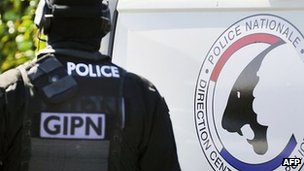 Police in France have conducted new raids on Islamist suspects in the wake of the multiple killings by gunman Mohamed Merah.
At least 10 people were arrested as police conducted operations in Marseille, Roubaix, Carpentras and a number of other locations.
Thirteen people arrested in raids last week face terrorism charges.
President Nicolas Sarkozy vowed to crack down on suspected radical Islamists after the Merah killings.
Most of Wednesday's raids were in the south and south-west, notably in Marseille but also in Carpentras, Valence and Pau, police sources told Agence France-Presse news agency.
There was also a raid in Roubaix, close to the Belgian border.
The operation comes less than a week after raids that targeted men who are believed to be associated with a radical group called Forsane Alizza, which was banned last month.
Police have been careful not to link the raids to the killings by Merah in Toulouse and Montauban.
The self-confessed al-Qaeda gunman was shot dead by police in Toulouse, following attacks in which he murdered seven people, including three children.
After last week's raids, Mr Sarkozy, who faces a presidential election this month, said the crackdown on radical Islamists "would continue and that will allow us to expel from our national territory a certain number of people who have no reason to be here".
On Monday, the French interior ministry announced the expulsion of five radical Islamic preachers as part of the crackdown.