Portugal in US$3.5b utility stake sale to China
Portugal is selling the state’s 21.35 per cent stake in national utility Energias de Portugal to China Three Gorges Corporation for euro 2.7 billion (US$3.5 billion), officials said Thursday. Three Gorges Corporation beat rival bids from German gas and electricity company E On AG and Brazilian utilities Eletrobras and Cemig SA in what was Portugal’s biggest-ever privatisation. The deal announced was the first in a raft of sell-offs that aim to earn at least €5 billion and ease Portugal’s crippling debt burden. The country needed a €78 billion (US$102 billion) bailout earlier this year to avoid bankruptcy. Cash-rich Chinese companies have in recent years made a string of investments in European countries hit by the continent’s sovereign debt crisis.
Luis Marques Guedes, a spokesman for the Portuguese Cabinet, said Three Gorges Corporation gives EDP “a financial strength and ability to invest ... that it didn’t have.” The Chinese company promised to invest in developing EDP’s manufacturing capacity for renewable energy equipment and in Portugal’s green energy sector, potentially lifting its total investment to €8 billion, Secretary of State for the Treasury Maria Albuquerque told a news conference. Three Gorges Corporation will also help EDP find business in new markets, Albuquerque said. She said Three Gorges Corporation paid a 53 per cent premium on EDP’s share price on Wednesday. The Chinese company becomes EDP’s largest shareholder. EDP’s share price surged 3.5 per cent Thursday before the Lisbon Stock Exchange suspended trading in its stock.
The deal is subject to regulatory approval. Details of the other bids were not made public. EDP runs electricity and gas operations in 13 countries, including six European countries outside Portugal, Brazil and the United States. It has also developed green energy projects, especially wind energy, through its subsidiary EDP Renovaveis. Its turnover last year was euro 14.2 billion, which generated a net profit of just over €1 billion. It had net assets of €40.5 billion and around 12,000 employees, according to its 2010 annual report. It also has €16.3 billion in net financial debt. The purchase follows a pattern of European business investments by Chinese companies in recent years.
In January, Sinopec bought around US$7 billion worth of Brazilian oil assets held by Spanish energy company Repsol, giving birth to one of Latin America’s largest energy companies. Last year, Internet service provider Tiscali SpA and Zte, a Chinese maker of telecommunications equipment, signed a deal for the development of ultra-wideband in Italy and French companies won deals with China worth US$22.8 billion

Tortuga Rum Companies unite
The shareholders of Tortuga CRC Jamaica Ltd, Tortuga Rum Company Ltd of the Cayman Islands, Tortuga Imports Inc, of Miami, Florida, and Tortuga Barbados/Baker’s Choice have consolidated their regional interests into a new international food group — Tortuga International Holdings, Limited. At the same time, Jamaica Producers Group Ltd (JP), an established international specialty foods group, has made a strategic investment in Tortuga International which is expected to make Tortuga a truly global brand. The founders of Tortuga Imports Inc will lead the new company with Marcus Simmonds as chief executive officer and Monique Hamaty-Simmonds the chief marketing officer for Tortuga International.
The board of Tortuga International Holdings includes representatives from each of its operating subsidiaries in Cayman, Miami and Barbados as well as Jamaica Producers Group. Founded in 1925, JP is a vertically integrated, international food company with operations in agriculture, manufacturing, marketing and distribution. Though its subsidiaries and associated companies, JP operates the leading processor of Blue Mountain coffee, the leading producer of fresh juice in The Netherlands and Jamaica’s leading producer of tropical snacks. The company’s specialty food brands include JP (fresh produce), St Mary’s (tropical snacks), Hoogesteger (fresh juice), and Jablum (coffee). It is a publicly traded company on the Jamaica Stock Exchange (JSE).
“We are very excited about this partnership and adding the Tortuga brand to our portfolio,” said Jeffrey Hall, managing director of Jamaica Producers Group. “Having Marcus and Monique as shareholders and managers gives this new business the solid foundation needed to take Tortuga global.” Tortuga International Holdings Ltd now owns the Tortuga intellectual property rights (the brand, including cake and rum), recipes, bakeries, international marketing rights and other properties associated with the previous entities. “Merging our companies and partnering with Jamaica Producers is a vital step to achieving our vision for Tortuga to become a $100-million global brand,” said Marcus Simmonds. “This gives us economies of scale to have a much greater impact in developing the business. Having a well-established partner like Jamaica Producers further enhances our capacity to build and manage distribution of the Tortuga brand throughout the world.”
Jamaica Observer
Pope Benedict XVI attacks Christmas consumerism at Mass
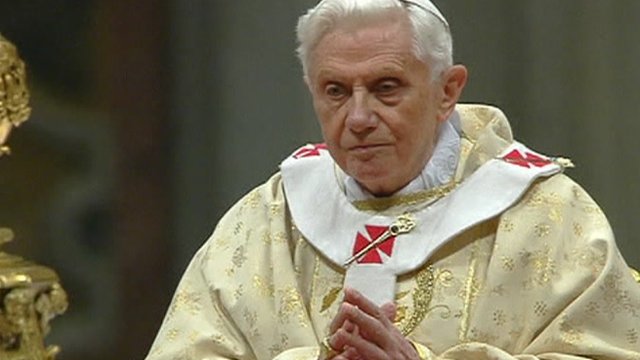 Pope Benedict XVI has attacked the commercialisation of Christmas as he held the traditional Christmas Eve Mass at St Peter's Basilica in Rome.
In his homily, he urged worshippers to "see through the superficial glitter of this season and to discover behind it the child in the stable in Bethlehem".
Benedict, 84, used a moving platform to cater for his mobility issues.
The pontiff will deliver his annual Urbi et Orbi (To the City and the World) speech in a few hours.
Meanwhile, Christian pilgrims and tourists from around the world last night converged on Bethlehem for Christmas.
Celebrations culminated in Midnight Mass at the 1,700-year-old Church of the Nativity, built on the spot where it is believed Jesus was born.
About 120,000 visitors were in the Palestinian West Bank town, 30% up on last year, officials said.
Christmas Eve Mass in Rome was brought forward two hours to 22:00 local time (21:00 GMT) from midnight - in order to spare Benedict a late night.
Wearing cream and gold vestments, the Pope proceeded slowly up the aisle of St Peter's on his mobile platform.
In his homily, he urged the faithful to focus on the story of Jesus' birth, saying this would help "find true joy and true light".
He also lamented the enduring presence of violence in the world and prayed for those who would spend this Christmas in poverty and suffering.
Even if he is physically more frail now, his message was firm, the BBC's Alan Johnston in Rome says.
In a few hours, the pontiff will give his traditional blessing and message in St Peter's square before tens of thousands of people from around the world.
Reconciliation plea
In Bethlehem, the Latin Patriarch of Jerusalem, Fuad Twal, led the Midnight Mass.
He passed through the massive gate in the controversial Israeli security barrier that separates Jerusalem from Bethlehem and arrived in Manger Square, where he was greeted with a bagpipe band.
Patriarch Twal, a Palestinian who is a Jordanian citizen, has expressed concern for Christians in the current upheavals in the Middle East and asked them to support moves towards freedom and democracy.
His midnight homily urged "the return of calm and reconciliation in Syria, in Egypt, in Iraq and in North Africa".
It reads: "O Child of Bethlehem, in this New Year, we place in your hands this troubled Middle East and, above all, our youth full of legitimate aspirations, who are frustrated by the economic and political situation, and in search of a better future."
American visitor Irma Goldsmith told Associated Press: "I watch Christmas in Bethlehem each year on TV, but to be here in person is different. To be in the spot where our saviour was born is amazing."
Palestinian President Mahmoud Abbas attended the celebrations.
He said: "I wish for the Palestinian people that next year will be the year of implementing peace in the occupied Palestinian lands."
Bethlehem Mayor Victor Batarseh also said he hoped the festivities would bring Palestinians closer to their dream of statehood.
Moscow protest: Thousands rally against Vladimir Putin
Tens of thousands of people have rallied in central Moscow in a show of anger at alleged electoral fraud.
They passed a resolution "not to give a single vote to (PM) Vladimir Putin" at next year's presidential elections.
Protest leader Alexei Navalny told the crowd to loud applause that Russians would no longer tolerate corruption.
"I see enough people here to take the Kremlin and [Government House] right now but we are peaceful people and won't do that just yet," he said.
Demonstrators say parliamentary elections on 4 December, which were won by Mr Putin's party, were rigged. The government denies the accusation.
A spokesman for Mr Putin, currently Russian prime minister, later said that "the majority of the population" supported him, describing the protesters as a minority.
In a BBC interview, spokesman Dmitry Peskov said he was confident that Mr Putin would win the presidential elections in March, saying he was "beyond the competition".
'We're the power'
On Saturday, a sea of demonstrators stretched along Sakharov Avenue, a few miles from the Kremlin, in sub-zero temperatures.
Rallies were taking place across Russia, with the first big protest in the far eastern city of Vladivostok.
At least 28,000 people turned out in the capital, according to the Russian interior ministry, but rally organisers said the true number was around 120,000.
President Dmitry Medvedev announced political reforms this week, but many demonstrators say it is not enough.
They are demanding a re-run of the poll, which was won by Vladimir Putin's party - but with a much smaller share of the overall vote.
Mr Putin poured scorn on protesters during a recent live chat on Russian TV, calling them "Banderlog" after the lawless monkeys in The Jungle Book, and likening their protest symbol, a white ribbon, to a condom.
However he also said protesters had the right to demonstrate if they kept within the law.
In Moscow, many protesters clutched white balloons and banners with the slogan "For Free Elections" while some mocked Mr Putin with images of condoms, to the extent that the first speaker, music journalist Artyom Troitsky, dressed himself up as one.
The resolution passed at Saturday's rally built on demands expressed at an earlier rally in Moscow on 10 December.
Another new point was a call for the creation of a new election monitoring body - the Moscow Voters' Association - to investigate ballot-rigging.
Mr Navalny, a prominent anti-corruption blogger who was jailed for 15 days over a street protest just after the elections, greeted the crowd with the words "Greetings to the Banderlog from the net hamsters [internet activists]".
Condemning Russia's leaders as "swindlers and thieves", he listed victims of injustice including imprisoned former tycoon Mikhail Khodorkovsky and anti-corruption lawyer Sergei Magnitsky, who died in custody.
"Who's the power here?" he shouted to cries of "We are" from the crowd.
He promised that the next protest rally would be a "million strong".
Alexei Kudrin, who recently resigned after serving a decade as Mr Putin's finance minister, was booed when he took the microphone to call for early parliamentary elections and urge a dialogue between the Kremlin and the opposition.
"There needs to be a platform for dialogue, otherwise there will be a revolution and we lose the chance that we have today for a peaceful transformation," he said.
A total of 22 speakers were lined up for the Moscow rally, with rival opposition figures addressing a crowd which mixed liberals with nationalists.
- In a video message, Russian rock musician Yury Shevchuk urged protesters to maintain their dignity and avoid "competing in hatred for the authorities"
- Billionaire and Putin election challenger Mikhail Prokhorov had been expected to address the rally but stayed in the crowd, saying he had heard presidential candidates were "not supposed to speak"
- Another presidential candidate, veteran liberal Grigory Yavlinsky, did speak, and called for a free electoral system
- Former Soviet leader Mikhail Gorbachev, 80, did not attend after all, sending a message of support instead. He later told Moscow Echo radio that Mr Putin should not stand for another term in office
Saturday's rally in Moscow ended peacefully, with the last speaker a Grandfather Frost (Russian Santa Claus) figure who wished citizens of a "free Russia" a Happy New Year.
"People were scared before the first big demonstration on 10 December," protester Andrei Luzhin told AFP news agency.
"Now they no longer have fear."
Sudan army 'kills' key Darfur rebel Khalil Ibrahim
It says Khalil Ibrahim was killed in fighting in the Wad Banda area in North Kordofan.
The claim has not been independently verified.
Khalil Ibrahim is known as the leader of the Justice and Equality Movement in conflict-torn Darfur. Earlier this year, he returned from exile in Libya after the fall of Col Gaddafi's regime.
Sudanese army spokesman Sawarmi Khaled Sa'd told the BBC Arabic Service that Mr Ibrahim was killed at dawn.
The spokesman also told Sudan's state TV that Mr Khalil Ibrahim and other rebel leaders had been trying to enter South Sudan, which seceded from Sudan in July.
Khartoum had accused Jem of fighting for Col Gaddafi in his attempt to hold on to power.
Col Gaddafi's fall in Tripoli was a blow to the rebels as he gave them sanctuary and financial and military aid, analysts say.
The rebels signed a ceasefire with the Sudanese government in February 2010 but abandoned peace talks soon after, accusing Khartoum's forces of launching new raids in Darfur.
About 300,000 people have died in the conflict in Darfur since it began in 2003, the United Nations says.
Queen visits Prince Philip in hospital
Prince Philip has spent a second night in hospital after undergoing a procedure on his heart.
The 90-year-old Duke of Edinburgh had a coronary stent fitted after he was taken to hospital on Friday suffering chest pains.
The BBC's Royal Correspondent Peter Hunt says he is, by all accounts, very eager to leave Papworth Hospital in Cambridgeshire.
The Royal Family are gathering at their Sandringham estate in Norfolk.
The Queen's Christmas broadcast this year has as its theme the strength of family, friends and the community working together.
Our correspondent says the royals will be greeted by well-wishers when they attend a church service on the estate.
He says the focus will be on the presence of the Duchess of Cambridge - celebrating her first Christmas with her in-laws - and on the absence of the duke from the Queen's side.
Dr Simon Davies, a consultant intervention cardiologist at the Royal Brompton Hospital in London, said the Duke could have suffered a heart attack before the stenting procedure was performed.
He explained how the stent worked: "What they have done is they put a miniature sausage-shaped balloon down the artery, pushed the balloon into the narrowed section and then blown it up.
"That forces the material that is blocking the artery outwards and then gets the blood flowing down the artery again."
Under observation
The Queen visited him in hospital on Christmas Eve and he remains under observation.
She was accompanied on the 45-minute visit by their sons Edward and Andrew, and daughter, Anne.
They arrived by helicopter for the visit, where they were met by the hospital's chief executive and Professor John Cunningham, chief physician to the Queen.
After they left, the Prince of Wales and the Duchess of Cornwall arrived by car from Highgrove.
BBC royal correspondent Nicholas Witchell said the fact the Queen had visited her husband so promptly suggested it was a "moment of real anxiety" for the Royal Family, albeit one which appeared to have passed.
Good spirits'
Speaking outside the hospital, Buckingham Palace spokeswoman Ailsa Anderson said on Saturday: "The Duke of Edinburgh had a good night and is in good spirits but he is eager to leave.
"Sunday's church service is going ahead as planned and we don't anticipate changes to the Royal Family's Christmas celebrations."
The duke is not expected to attend that Christmas Day church service at Sandringham.
The "minimally invasive" coronary stenting procedure he underwent involves pushing a balloon into the artery and inflating it to remove the blockage.
The stent is a mesh sleeve fitted over the balloon, which remains fixed in position inside the body when the balloon is removed.
Prince Philip would have remained conscious during the procedure.
He was flown to the hospital by an RAF helicopter. No other member of the Royal Family travelled with him.
Papworth is the UK's largest specialist cardiothoracic hospital and the country's main heart and lung transplant centre, treating more than 22,800 inpatient and day cases and 53,400 outpatients each year.
Senior members of the Royal Family, including the Prince of Wales and the Duke and Duchess of Cambridge, arrived at Sandringham on Saturday for Christmas.
The family traditionally travel to St Mary Magdalene Church on the royal estate for a service on Christmas Day, while the duke was due to be leading Sandringham's Boxing Day shoot.
Prince Philip, who arrived at Sandringham on Monday, is the longest-serving royal consort and celebrated 64 years of marriage to the Queen in November.
He was last in hospital in April 2008, when he spent three days in London with a chest infection. On that occasion, the Queen did not visit him.
Speaking ahead of his 90th birthday, in June, the duke said he wanted to slow down. He stepped down as president or patron of more than a dozen organisations.
Royal biographer Penny Junor said the duke was generally in good health for his age.
"He is an extraordinarily fit man. He takes a lot of exercise, he does an awful lot of work. He's in very good shape generally. So with luck this is a blip and he'll be back fighting fit and back with the family for Christmas."
The Queen's Christmas Day broadcast to the nation will highlight the importance of the family unit. The speech, taped on 9 December, reflects on a year in which her grandson Prince William got married and her husband turned 90.
Nigeria conflict: Boko Haram sect battles kill scores
Nearly 70 people have died in days of fighting between Nigerian forces and suspected Islamist gunmen in the country's north-east, officials say.
More than 50 Boko Haram militants were killed in a lengthy gun-battle in the town of Damaturu, said army chief of staff Lt Gen Azubuike Ihejirika.
Separately, at least 11 people died in a clash in the city of Maiduguri.
Boko Haram, whose name means "Western education is forbidden", often targets security forces and state institutions.
Residents scared
The fighting had erupted in Damaturu - the state capital of Yobe - on Thursday afternoon, Police Commissioner Tanko said earlier.
Lt Gen Ihejirika said his forces had killed more than 50 suspected militants.
He told local radio: "They came with sophisticated and heavy weaponry... and bombs but our trained soldiers subdued them".
Seven policemen and two soldiers died in the clashes, Yobe's Police Commissioner Lawan Tanko told the BBC.
One eye-witness told the BBC that bomb blasts and shooting could be heard around Damaturu for several hours.
"People are scared and they are just moving out of the town now," said the witness, who gave his name as Suliman.
In Maiduguri, the capital of Borno state, at least 11 people were killed in another shootout, officials and medics say.
The city - on the threshold of the Sahara desert - is described by Nigerian authorities as Boko Haram's heartland.
The sect first came to prominence in 2009 when hundreds of its followers were killed when they attacked police stations in Maiduguri.
Its founder, Mohammed Yusuf, was arrested but died in police custody.
Boko Haram resumed its attacks - mostly in Maiduguri - a year later and has since staged deadly raids across the mostly Muslim north, as well as central areas such as Jos and Abuja.
Under Yusuf's leadership, the group demanded that Nigeria become an Islamic state but it is now believed to be made up of several factions, with various demands.
Protesters take to Moscow streets, calling for fair elections
Tens of thousands of people took to the streets Saturday in Moscow, braving bitterly cold weather to demand fair elections after what they claim were rigged results earlier this month that returned Vladimir Putin's party to power.
The protest, organized primarily through social media and word of mouth, comes on the heels of an announcement by President Dmitry Medvedev of sweeping political reforms, an effort to address discontent following the December 4 parliamentary elections.
The latest mass protest follows one earlier this month, when tens of thousands of people across Russia turned out to protest the election results that kept Putin's ruling United Russia party in power, albeit with a smaller majority. Police estimated crowds in Moscow at 25,000, while organizers said at least twice as many participated.
The protests were considered -- among analysts and political observers -- the largest in Russia in the past two decades.
Turnout at Saturday's protests was even greater, organizers said.
Besides blasting election results, demonstrators spoke about the presidential vote scheduled next year, repeating a popular refrain: "Russia without Putin."
Dozens of protesters were detained across Russia on Saturday, the state-run RIA Novosti news agency reported. Ten activists were held in St. Petersburg, 22 in Nizhny Novgorod, and about 20 in Barnaul, it said.
Police put the number of protesters in central Moscow at 29,000, but organizers and RIA Novosti correspondents estimated the real number was several times higher, the news agency reported.
Speaking this week before the newly elected parliament members in the Kremlin's St. George Hall, Medvedev proposed that Russia return to direct elections of regional governors; simplify the registration of political parties and presidential candidates; and establish a new editorially independent national public TV channel.
Medvedev also called for lifting many of the political restrictions imposed in the past several years by his predecessor, Putin, Russia's current prime minister and a candidate in the March 2012 presidential elections.
He also announced a number of new anti-corruption measures and called for the redistribution of power and financial resources from the federal government to local governments across the country.
At the same time, he rejected widespread public criticism of the parliamentary elections, which critics say were marred by fraud and other irregularities, and blamed anti-Kremlin opposition figures for their "attempts to manipulate the people and foment social discord."
"We will not allow instigators and extremists to involve society in their reckless schemes, nor will we tolerate interference in our internal affairs from the outside," Medvedev said.
"Russia needs democracy, not chaos. We need to have a faith for the future and justice. It is a good sign that society is changing, and citizens are expressing their position more actively, setting legitimate demands to the authorities. It is a sign that our democracy is growing more mature."
Protest organizers said Medvedev, who announced the reforms during his fourth and final state-of-the-nation speech Thursday, failed to address what authorities are planning to do about the recent alleged voting fraud, as well as whether fair and free elections are guaranteed in the future.
Bolt, Suarez leading Latina poll
Jamaican sprinter Usain Bolt and Uruguayan footballer Luis Suarez have so far topped the poll for Sportsman Of The Year in Latin America and the Caribbean conducted by the Cuban news agency Prensa Latina.
World record holder Bolt and ace striker Suarez shared the lead with 27 votes apiece earlier this week.
It’s the fourth end-of-year award for which Bolt is being considered following a season in which he regained the 200 metres World title, helped Jamaica to another record in the men’s 4x100 relay, and ran unbeaten, although his copybook was marred by his false start in the 100 at the World Championships in Daegu, South Korea.
Suarez scored four goals for Uruguay as they won a record 15th Copa América earlier this year in Argentina. He was chosen Player Of The Tournament. Nicknamed “El Pistolero” (“The Gunslinger”), Suarez has also been in good form for English Premiership giants Liverpool.
In third place with 12 votes is Argentinian player Lionel Messi, star striker of the Spanish club Barcelona, European champions and winners of the World Club Championship.
Other sportsmen being considered are Brazilian Cesar Cielo, swimming World champion in short course pools and winner of four gold medals at the Pan Am Games Guadalajara 2011, with five votes.
Strangely, Jamaican sprinter Veronica Campbell-Brown did not get into the frame although she won a gold medal at the World Championships in the 200 and ran consistently well. (CMC)
NBA reduces player suspensions
The NBA has reduced suspensions for the Lakers' Andrew Bynum and the Pistons' Charlie Villanueva by one game because of the shortened season.
The league on Friday trimmed one game off the five-game ban Bynum was given for knocking the Mavericks' J.J. Barea to the court in the second round of last season's playoffs. The center will now miss the first four games and be eligible to return Dec. 31 against Denver.
Villanueva was originally suspended five games for instigating an altercation with Cleveland's Ryan Hollins and attempting to escalate it by entering the Cavaliers' locker room. He served a game of it last season and will have to miss the first three of this season, and is also eligible to play to New Year's Eve against Indiana.
AP