
Lady Gaga releases holiday EP
Like many a pop star before her, Lady Gaga is debuting her own holiday (mini) record.
The 25-year-old digitally released the four-track "A Very Gaga Holiday" on Wednesday, reports Billboard. Below is Gaga's swingy rendition of "White Christmas," the classic that she admits to adding an extra verse to.
"As you can tell I'm very outgoing," she says. "I've decided that this song is too short, it's such a beautiful Christmas song but it's only one verse, so I added one extra one." She had to make it her own, somehow.
The holiday album - on sale for $3.99 via Amazon and iTunes - also includes "Orange Colored Sky," as well as "You and I" and "Edge of Glory." All of the songs are pulled from her ABC Thanksgiving special, "A Very Gaga Thanksgiving," which aired on the network lastnight at 9:30.

BG Heading To Trial In December; Associate Gets 22 Years
Former Cash Money Records rapper BG will stand trial for gun and obstruction of justice charges early next month.
A search of the vehicle uncovered three guns and two loaded magazines and two extended clips, resulting in charges for BG and the vehicle’s two other occupants.
In May of 2011, prosecutors charged BG, Fedison and a third man named Demounde Pollard, with conspiracy.
Earlier this week one of the three men, 29-year-old Jerod Fedison, was sentenced to 22 years in prison for the incident.
BG and Fedison are accused of attempting to coerce Pollard into taking the blame for possession of all three guns.
Of the three men, Pollard, who was 17 at the time of his arrest, was the only one without a criminal record.
Prosecutors claim they caught Fedison on a recorded call from prison, instructing Pollard’s girlfriend to take the charges the importance of the issue.
Pollard eventually agreed to take the charges, but he later began cooperating with authorities.
He is currently serving 30 months in prison.
BG is a convicted felon who has been arrested multiple times over the years.
The rapper, who has a lenghy rap sheet for drugs and other charges, will stand trial on December 12.
BG has pleaded not guilty. If he is convicted he faces up to 10 years in prison.
ALLHIPHOP
Nelly’s Production School To Open In Saint Louis Next Week
Nelly’s new recording school will open at the end of this month in St. Louis, Missouri.
The rapper’s Vatterott College ex’treme Institute by Nelly-St. Louis will begin classes on November 28.
The 9,000 square-foot facility, which is located at Laclede’s Landing in downtown St. Louis, houses a recording studio, a music engineering space, and a design studio.
Students enrolled in the program create album covers, recordings and other merchandise and music related material.
The school seeks those who wish to become professionals in a variety of sectors in the music business.
“Working with Nelly and his team has been an exciting opportunity for us at Vatterott College,” said Pam Bell, Chief Executive Officer and President of Vatterott Educational Centers, Inc. “Nelly has shown such commitment to the people of St. Louis and is taking great steps in training the next generation of music producers. We couldn’t be more excited to partner with one of St. Louis’ most celebrated music artists.”
For more information and a complete list of the offered courses, visit www.eibynelly.com.
Jill Scott, Chaka Khan, Erykah Badu, and Mary J. Blige on Stage for VH1 Concert
VH1 has an incredible line up for the upcoming “VH1 Divas Celebrates Soul” event with Chaka Khan, Erykah Badu, Estelle and Marsha Ambrosius on the roster.
Other performances include Mary J. Blige, Jennifer Hudson, and Jill Scott (pictured above).
This year’s event will be dedicated to the cities that have contributed to soul music, including Chicago, Detroit, London, Memphis, and Philadelphia.
Besides the great music and righteous honor, the event’s primary cause is to help bring music back to public schools.
The concert will air on Dec. 19 at 9 p.m.
Trinidad PM Kamla Persad-Bissessar in 'security threat'
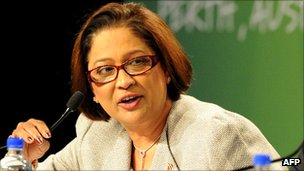 Trinidad and Tobago Prime Minister Kamla Persad-Bissessar says police have thwarted a plot to assassinate her.
Around 12 people have been arrested, including members of the army and police.
Ms Persad-Bissessar blamed the alleged plot on "criminal elements" acting in "reprisal" for a state of emergency she declared in August.
She said the Trinidadian government remained in control, with the security forces on full alert.
'Treason'
Police and government officials in the Caribbean nation have released few details of the alleged plot, saying they did not want to jeopardize ongoing investigations,
In an address to the nation, Ms Persad-Bissessar condemned the alleged conspiracy against her and several members of her cabinet as "an evil, devious act of treason".
She linked the security threat to the state of emergency she declared in August to counter a surge in violent crime linked to drugs gangs, saying she was not surprised that "criminal elements" were bent on "reprisals".
But the prime minister said the threat would not deter her government from pursuing its campaign against crime and insecurity.
She also reminded Trinidadians of a coup attempt in 1990, when a local Islamist group tried to overthrow the government.
Sex workers say: ‘Tax Us’
It has been called the oldest profession in the world and now head of the Caribbean Association of Sex Workers, Miriam Edwards, says sex workers throughout the region would be willing to pay taxes if respective governments started recognising what they do as a job.
“We are willing to pay taxes if they give us the right to work and if they accept sex work as a job,” she told delegates at the 2011 HIV Conference earlier this week at the Atlantis, Paradise Island Bahamas.
Edwards added that sex workers want to pay taxes so they can have access to benefits which other workers are eligible to receive.
“We are not prepared to stop sex work and we don’t want anybody to ask us to stop. We just want our job to be accepted just like that of the police and the nurses,” she told delegates.
The Guyanese national said she was forced to enter the commercial sex trade at age 14 as that was the only available option which allowed her to be able to remain in school and subsequently take care of her seven children.
Edwards, who proudly noted that none of her children had followed in her footsteps, said the way to keep young people out of the sex trade is to afford them proper parental support.
“When we talk about keeping young people out of sex work we have to ensure their parents are alive and there for them because there are lots of parents living with HIV and cannot work and the neighbour who gives rice and flour will start having sex with their 13 year old,” she said.
Edwards, at the same time, requested that more funding be allocated for prevention work tailored specifically to meet the needs of sex workers.
“Sex workers are being left out of these special programmes and so we need more programmes and more funding,” she said.
Princess Brown, president of the Jamaica Association of Sex Workers, said sex workers do not want to be accepted and put in a corner but be treated as any other worker.
“We don’t want them to put us away in a secluded place in some bush and say they accept us,” she said.
Although the HIV prevalence rate is high among commercial sex workers, Brown said sex workers have the right not to disclose their HIV status to their partners/clients.
“Sex workers are human beings and for any human being it is their right not to tell someone that they are HIV positive and so if a sex worker does not want to say then that is their right,” she argued.
She said that although she has several certificates and a diploma those never provided job opportunities for her as did sex work.
She said she is the mother of five daughters, one of whom is now in London studying medicine, and another studying to become a flight attendant.
Speaking to some of the challenges facing sex workers, Brown said she has lived many of them first hand, as she cited an experience when she worked at a night club in the Bahamas two years ago.
“Immigration here is terrible to migrant sex workers and I can tell you because I almost broke my neck trying to hide in a ceiling from immigration officers,” she said.
She said often times the human rights of sex workers are violated when they are caught. “When they catch us they will send you home in whatever they catch you in. They will carry you to the prison in whatever costume you were wearing, without any panty, in your G-string whatever you are wearing,” she said.
“I sprained my foot and was afraid to go to doctor because I was told if you can’t say what you are doing here they will call the immigration on you,” she said.
Caribbean 360 News
Britain and Cayman Islands sign new fiscal responsibility agreement
Britain’s Foreign Office Minister for the Overseas Territories, Henry Bellingham, and McKeeva Bush, premier of the Cayman Islands, signed a framework for fiscal responsibility for the Cayman Islands on Wednesday in London.
The framework records the Cayman Islands government’s (CIG) commitment to prudent and transparent fiscal management through effective medium-term planning and putting value for money considerations at the heart of CIG decision making. It also includes a commitment to effective risk management and delivering improved accountability in all public sector operations.
Speaking after the signing, Bellingham said, “The agreement of a framework for fiscal responsibility with the Cayman Islands government is a strong example of the UK government’s strategy towards the Overseas Territories in action. The strategy aims to help territories strengthen public financial management and economic planning and this framework is a clear sign of the Cayman Island government’s commitment to those goals. I am sure this development, and returning the public finances of the Cayman Islands to a sustainable footing, will be welcomed in the Cayman Islands and internationally.”
The framework for fiscal responsibility sets out a range of measures to strengthen public financial management in the Cayman Islands. The provisions of the framework will be reflected in a revision of the Cayman Islands Public Management and Finance Law, which will enter into force by July 2012.
The Cayman Islands government and the UK government agreed that immediate compliance with the limits on public borrowing specified in the framework cannot reasonably be achieved. The framework therefore provides for full compliance to be achieved by the end of 2015-16.
Caribbean News Now
Bahamas PM says Caribbean will follow demands from France
Prime Minister Hubert Ingraham believes that Caribbean countries named by France as tax havens, will have no choice but to comply with the measures outlined by the Paris-based Financial Action Task Force (FATF).
“The reality is...the developed world has to fund their social systems and revenue becomes less and less available for them to do so, more efforts will be made to find additional sources of revenue and we have to see that places where some of the wealthy of the world hide their monies. The reality is the developed world doesn’t really believe we ought to be in financial services as we are and they are taking every step to drive back on shore the things we are doing on shore, “ he told the Caribbean Media Corporation.
Earlier this month, French President Nicolas Sarkozy, speaking at the end of the G20 summit in France named 11 countries, including Trinidad and Tobago, Antigua and Barbuda and Barbados, as tax havens for failing to meet transparency standards.
The three Caribbean Community (CARICOM) countries have dismissed the French position and former regional diplomat Sir Ronald Sanders said that the Caribbean needed to adopt a united position on the issue.
However, Ingraham told CMC while he was not surprised at the French position, he could recall a similar position in which The Bahamas found itself leaving Nassau in the end with no choice but to comply and sign a tax agreement with the United States.
“I was not surprised by the comments of President Sarkozy in relation to the countries in the region, but i did not he included Switzerland and that gave me some comfort.
“In the Bahamas, for instance, we virtually swore we would never sign a tax information agreement (TIEA), the Americans used their might and we ended up signing with them. We firmly said we will not do so with anybody else in the world, that was a one off deal just because of our relations with them ...we ended up signing with everybody”.
Ingraham said that while Barbados took the view that it has double taxation treaties and had no need for TIEAs and when the OECD issued its black list of countries, Bridgetown was not included, while The Bahamas were.
“So it is ironic that Barbados is now been categorised by the French in that way, but Barbados will do what is necessary to comply and so will all,” he added.
Ingraham told CMC that the economy of his country had improved over the past few months, adding “we are making some progress, there has been some stabilisation...revenue is beginning to climb back up....and the government has been able to stimulate the economy significantly”.
He said the public investment programme has been “huge” in getting the economy moving , with tourism doing “fairly well”.
Haiti gets $50 million IDB grant for education
The Inter-American Development Bank (IDB) announced today the approval of a US$50 million grant to support the education reform Haiti launched in 2010, seeking to expand access to free, quality education for all Haitian children.
“The IDB has offered to support the ambitious five-year plan with US$250 million from its own resources and to raise US$250 million more from other donors,” the bank said in a statement “Among other goals, the reform calls for the construction of thousands of schools, training tens of thousands of teachers and free education for millions of children.”
An initial grant for US$50 million was approved last November and the IDB has worked to enlist other international agencies, bilateral donors, philanthropic institutions and companies interested in supporting education in Haiti after last year’s devastating earthquake.
Counting the financial assistance provided by the IDB and its partners, the support now involves about $150 million.
Haiti’s Ministry of Education (MENFP) and its Economic and Social Assistance Fund (FAES) are the executing agencies of the new grant, which will contribute to expanding children’s access to schools, improve the quality of education, expand vocational training opportunities for young people and strengthen the ministry’s execution and regulation capacities.
IDB resources will be used to finance the construction and equipment of 20 public schools in areas where there are no educational services.
They will also support the rehabilitation of 15 schools damaged by the earthquake and the equipment of eight schools built by the United States Southern Command.
To expand access to education, the grant will support a school tuition waiver programme backed by the Haitian government, the World Bank, the Canadian International Development Agency and the Caribbean Development Bank, among other donors.
The IDB said its contribution would enable 35,000 children to attend classes without paying tuition and would cover the cost of school kits and text books for 30,000 students and 2,000 teachers.
CMC
France and Germany plan changes to EU treaties
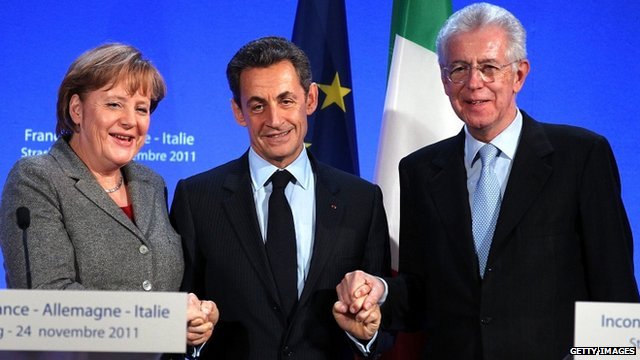 Germany's Angela Merkel and France's Nicolas Sarkozy are to propose modifications to EU treaties designed to improve governance of the eurozone.
The announcement came after their first meeting with Italian Prime Minister Mario Monti since he took office.
Mr Sarkozy said they would "propose modification of treaties to improve eurozone confidence so there is more integration and convergence".
Mrs Merkel said they would not change the role of the European Central Bank.
The modifications are to be proposed over the next few days, but no details have yet been released.
France and Germany disagree about whether the ECB should act as lender of last resort and whether bonds should be issued by the whole of the eurozone instead of individual countries.
Mr Monti laid out his economic programme to his French and German counterparts, including undertaking to balance Italy's budget in 2013.
At 118% of annual economic output, Italy has a high level of overall debt, but the country has managed to service similarly high debt levels for the past 20 years.
The main problem with the Italian economy is weak growth - the country has averaged 0.75% growth a year over the past 15 years.
The yield on Italian 10-year bonds has jumped back above 7%, which is seen as the point at which the cost of borrowing becomes unsustainable.
It had dropped below that level the day after Silvio Berlusconi stood down.
The three leaders have agreed to meet again in Rome soon.
German bonds
The meeting came a day after a German bond auction failed to raise the target amount.
On Wednesday, Germany sold just 3.6bn euros ($4.8bn; £3bn) worth of 10-year bonds, from 6bn euros on offer.
In an unusual move, Germany's central bank, the Bundesbank, said on Thursday that reports it had bought up some of the remaining bonds were incorrect.
"We do not finance the government, that is absolute rubbish," Bundesbank board member Joachim Nagel told the Reuters news agency.
In an official statement, the bank said: "The Bundesbank serves as a technical service provider in the issuance of federal government bonds and does not hold any German government bonds on its own account.
"Underbiddings have occurred from time to time in recent months and cannot be seen as a general mistrust in government securities".
It said bonds that were not taken up by investors in an auction were sold later on the secondary market.
Eurobonds
"In my conversations with analysts, traders and officials I'm finding more and more of them are talking about the end game for the euro. Not the end, necessarily, but a moment of truth very soon that will either force a big leap forward, or a wrenching break-up," said BBC economics editor Stephanie Flanders.
"Even Germany cannot be a safe haven if this crisis goes critical."
On Wednesday, European Commission president Jose Manuel Barroso launched a consultation on whether the 17 eurozone countries could issue joint stability bonds.
But Mr Barroso stressed that the creation of the bonds would require much greater scrutiny of the budgets and economic policies of individual members.
Germany opposes both the issuing of joint bonds and greater involvement for the European Central Bank (ECB) in bailing out troubled economies.
Its government is concerned that joint bonds would reduce pressure on member states to reduce their debt burdens.
On Thursday, French Foreign Minister Alain Juppe said that it was important that the ECB should be allowed to intervene in the debt crisis.
"It's urgent. It will be discussed this very day in Strasbourg," he told France Inter radio.
Gavin Hewitt, the BBC's Europe editor, said that Mr Sarkozy and Mrs Merkel seem to have made "a truce" on the role of the ECB.
There was, he said, "a deal to agree to disagree. President Sarkozy said that in order to ensure the independence of the ECB 'no positive or negative demands should be made of it.' That seemed to be a temporary declaration of a cease-fire between France and Germany."
Portuguese strikes
Also on Thursday, Portugal had its debt rating cut by Fitch to so-called "junk" status, and warned it could be cut again.
Fitch made the downgrade because of its "large fiscal imbalances, high indebtedness across all sectors and adverse macroeconomic outlook".
Portugal, along with Greece and the Irish Republic, has received bailout funds from the eurozone.
The news came as a 24-hour general strike in Portugal brought the country to a halt in protest against austerity measures.
BBC