
Credit Suisse to hand over US account tax details
Swiss bank Credit Suisse has sent letters to some US clients, saying their account details may be given to the Internal Revenue Service.
It is unclear how many US clients have been notified, but it covers accounts open from 2002 to the end of last year.
Clients are told they can either agree to the handover of data to Swiss tax authorities who can send it to their US counterparts, or contest the process.
The letter concerns a demand from the Swiss Federal Tax Administration.
"In connection with the IRS Treaty Request, the SFTA has issued an order directing Credit Suisse AG to submit responsive account information to the SFTA," Credit Suisse said in a statement to the BBC.
This concerns a request for administrative assistance from the IRS to the SFTA under the 1996 double tax treaty between the two nations.
In February the US indicted four Credit Suisse bankers for helping taxpayers hide money in secret bank accounts.
Switzerland is trying to reach a deal with the US that would cover its entire banking system.
Tax crackdown
In recent years US authorities have pressured several global banks to help them fight tax evasion.
The US Department of Justice's initial target was Switzerland's other major bank, UBS.
It threatened UBS with legal action if the Swiss bank failed to hand over the details of 4,450 US customers suspected of tax dodging.
Following years of intense pressure from the United States, in June last year the Swiss parliament passed legislation permitting the country's banks to share customer details with the US authorities.
UBS ended up paying a $780m fine, but more importantly the new legislation put an end to Switzerland's famed banking secrecy.

Record fine of $92.8m for insider trader Raj Rajaratnam
The jailed insider trader, Raj Rajaratnam, has been handed a record fine by the SEC in a civil case.
A judge ordered the former founder of Galleon Group, a hedge fund, to pay $92.8m (£57.6m; 67m euro) in penalties.
This comes on top of the $63.8m lawyers say he has already paid out in the criminal case.
Rajaratnam was sentenced in October to 11 years in jail for one of the biggest insider trading cases in American history.
Sri Lankan-born Rajaratnam was convicted of 14 counts of securities fraud and conspiracy charges in May after a two-month trial.
The Securities and Exchange Commission requested that the fine be equal to three times the alleged profits made by Rajaratnam through his illegal trades, or the maximum fine permitted under law.
"The penalty imposed today reflects the historic proportions of Raj Rajaratnam's illegal conduct and its impact on the integrity of our markets," the SEC's Robert Khuzami, said in a statement.
Rajaratnam is due to start his prison sentence in December.
Canada delays balancing its budget
Canada's finance minister says he will not be able to balance the country's budget by 2014-15 as promised.
Jim Flaherty blamed the European debt crisis for damaging Canada's outlook.
The government set the date for achieving a budget surplus during the May election campaign, but has now moved its target back a year.
Canada was hit by the global economic slowdown in 2008, but its economy has remained stronger than most of its peers.
The country's debt-to-GDP ratio was 33.9% in 2010-11, well below that of many major economies.
Prime Minister Stephen Harper's Conservative Party won a majority of seats in an historic election in May that saw the left-leaning New Democratic Party become the official opposition.
Forecasts
"The government is increasing the adjustment for risk to take into account these heightened short-term concerns and, for fiscal planning purposes, provide the cushion the still uncertain environment demands," Mr Flaherty said on Tuesday.
The government lowered its forecast for the 2011-12 deficit from 32.3bn Canadian dollars ($32.0bn; £19.9bn) to 31bn.
But it has raised its forecast for the 2012-13 deficit from 18.4bn Canadian dollars to 26.4bn.
A deficit of 15bn Canadian dollars is expected in 2013-14, followed by 3.5bn in 2014-15 and a small surplus of 600m Canadian dollars in 2015-16.
China's inflation rate eases for third straight month
China's inflation rate has slowed for a third straight month in October, as the government continues to try to cool economic growth.
Consumer prices rose 5.5% in October compared with the same month a year earlier, the National Bureau of Statistics said.
That is down from 6.1% in September, and a three-year high of 6.5% in July.
The government has identified inflation as one of the main threats to the country's economic stability.
It started implementing policies earlier this year aimed at slowing economic growth of more than 9% to what it sees as more sustainable levels.
At the same time, it wants to ease pricing pressures that have pushed the cost of food higher and made life more expensive for consumers.
October's inflation figure is in line with analyst's expectations.
It is widely predicted that inflation will continue to ease in the coming months.
The latest release confirms that "headline inflation is on a downward trend", said Zhang Zhiwei, an economist at Nomura in Hong Kong. He added that Nomura now forecast the rate of inflation would fall below 5% in November.
Mr Zhiwei said that as inflationary pressures ease the government may be able to loosen monetary policy by cutting interest rates and reducing the amount of money banks need to keep in reserve.
High food prices
A key sign that the pressure on prices is cooling is evident in the data for food prices.
It showed that prices fell 0.2% from the previous month.
However, that may be a temporary dip as pointed out by Premier Wen Jiabao.
In a speech before the inflation data was released, he said that the winter could pose a challenge because it is a time of high demand, and low food production, according to state news agency, Xinhua.
Tightening measures
Chinese authorities began tightening monetary policy in an effort to cool prices in October last year.
The People's Bank of China has since raised the interest rate five times, and increased banks reserve requirements nine times.
Analysts believe that although inflation appears to be moderating, it is too soon for any major shift in government policy.
"I see no big change in the rest of this year and little possibility of a cut in banks' required reserves," says Lin Songli, economist at Guosen Securities in Beijing.
A clearer idea of which direction the government will take could come in December when it holds its annual economic working conference.
Vote Pushes Italian PM Toward Resignation
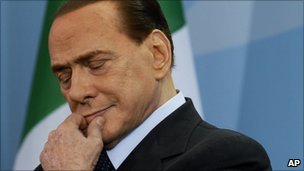 Italy, the world's seventh largest economy, is emerging as a new threat to the stability of the 17-country single currency zone. On Tuesday, Italian President Giorgio Napolitano announced that Prime Minister Silvio Berlusconi would resign, following a crucial budget vote in parliament. He won that vote, but lost the support of a majority of lawmakers.
Prime Minister Berlusconi departed his Rome residence for parliament knowing that the coming hours could decide his future as Italy’s leader.
A procedural vote in the lower house on the budget was used by Mr. Berlusconi’s growing number of political opponents to signal the end of his parliamentary majority.
Despite a wide margin in favor, 320 lawmakers did not vote at all. Opposition leaders claimed victory. "The vote showed that this government does not have a majority, said opposition leader Pierluigi Bersani.
The opposition demanded Mr. Berlusconi’s immediate resignation. But, as he has done so many times in his nine years in power, the prime minister initially refused.
Italy has been pummelled by the eurozone debt crisis in recent days. Investors see its deficit, 120 percent of GDP (gross domestic product), as unsustainable. The yield on Italian bonds, the interest rate Italy must pay to borrow money, soared to nearly 7 percent.
When rates reached similar levels in Greece, Ireland and Portugal, they were forced to seek bailouts from the EU (European Union) and the IMF (International Monetary Fund)
Traders in Germany, Europe’s strongest economy, expressed disappointment that Mr. Berlusconi has not already resigned.
"Mr. Berlusconi has proved to be a politician with a long, long life, and, therefore, we are expecting that we have to negotiate more or less with Mr. Berlusconi in the future, and that's why the markets are kind of disappointed because we need stability, and stability with Mr. Berlusconi is not yet guaranteed," said Oliver Roth of Close Brothers Seydler AG.
EU finance ministers met in Brussels to try to find ways of building a firewall around the two-year-old debt crisis. But Europe’s politicians are rapidly being overtaken by events.
Italy is Europe’s third largest economy. A debt crisis there would dwarf the problems caused by Greece.
The message from the markets is that Prime Minister Berlusconi is part of the problem, not the solution.
Cain Again Denies Sexual Harassment Accusations
U.S. Republican presidential candidate Herman Cain has again denied allegations of sexual harassment and says they will not force him to drop his bid for his party's nomination.
During a news conference Tuesday in Scottsdale, Arizona, the presidential contender told reporters that chances of giving up his presidential bid “ain't gonna happen” and that “we will get through this.” Cain said he has never acted inappropriately with anyone and said the alleged incidents “simply did not happen.” Cain said he called his news conference because he wanted to speak directly to the American public.
Cain also said he would be willing to take a lie detector test if he had a good reason to do so.
Four women have accused Cain of sexual harassment. Two of them have spoken publicly about their accusations.
One of the women, Sharon Bialek, went before television cameras Monday as she accused him of inappropriate sexual behavior. Bialek says she was sexually harassed by Cain after seeking his help on an employment issue while he was head of the National Restaurant Association several years ago. She is the first person to publicly detail her claims.
During his news conference Tuesday, Cain said he does not know who Bialek is and does not recognize her name.
The second woman to speak publicly is Karen Kraushaar, who said she was one of two women who settled a claim against Cain with the restaurant association back in the 1990s.
Kraushaar is now a spokeswoman at the U.S. Treasury Department. Kraushaar tells The New York Times she was upset that her name was leaked in some media reports but decided to come forward now that her identity was known publicly. Kraushaar told the paper that “when you are being sexually harassed in the workplace, you are extremely vulnerable. Kraushaar also said, “You do whatever you can to quickly get yourself into a job some place safe, and that is what I thought I had achieved when I left.”
In a separate interview with The Washington Post newspaper, Kraushaar said she is interested in a joint press conference with the other women who have accused Cain of sexual harassment.
Cain has acknowledged he was the subject of such complaints but denied any wrongdoing.
Cain is a conservative African-American businessman whose only foray into politics ended in a failed bid for a U.S. Senate seat in Georgia. He has been at or near the top in recent national polls.
Large Asteroid Passes Close to Earth
An asteroid the size of an aircraft carrier has flown by Earth in the closest encounter by a massive space rock in more than 30 years.
The asteroid, named 2005 YU55, came within about 325,000 kilometers of the planet Tuesday evening . The U.S. space agency, NASA, said there was no chance that the spherical rock would collide with Earth or the moon. The asteroid was traveling at more than 46,670 kilometers per hour. It passed closer to Earth than the moon.
The last time an object the size of the asteroid traveled so near to Earth was in 1976. Scientists say it will be 2028 before another space object this large will fly by the planet.
A scientist at the University of Arizona discovered the YU55 asteroid in 2005.
NASA scientists planned to bounce radio waves off the asteroid and analyze the radar echoes. Those images should reveal details about the rock's surface features.
YU55 is about 400 meters in diameter. Scientists believe it has been passing by Earth for thousands of years. It is one of about 8,500 near-Earth objects that NASA has catalogued.
New Greek coalition 'to be announced on Wednesday'
The make-up of Greece's interim government will be announced later on Wednesday, a government official said.
The announcement came as talks dragged into a third day without any sign of progress.
The official said PM George Papandreou, who has agreed to step down, would meet the president in the morning before talks with party leaders.
Greece is under mounting pressure from Europe to end its political crisis and pass a key bailout package.
'Affirm commitment'
Negotiations have been taking place between Mr Papandreou and Antonis Samaras, leader of the largest opposition party New Democracy, since Monday.
It is unclear whether any agreement was made during talks on Tuesday, with some reports suggesting leaders remain undecided on who will lead the new coalition.
Lucas Papademos, a former vice-president of the European Central Bank (ECB), was widely seen as the front-runner to replace Mr Papandreou, but there are unconfirmed reports his candidacy has run into trouble.
"The Papademos candidacy has hit problems that have to do with both parties," one of the sources told Reuters, on condition of anonymity.
Other possible candidates named in the Greek media include Nikiforos Diamandouros, Greece's European ombudsman, and Panagiotis Roumeliotis, Greece's representative to the International Monetary Fund (IMF).
Filipino workers banned from eleven Caribbean countries including TCI
 The government of the Philippines has announced a ban on the deployment of overseas Filipino workers (OFWs) to 41 countries, including 11 in the Caribbean which includes the Turks and Caicos Islands .
The Philippine Overseas Employment Administration (POEA) last week adopted the recommendation of the Department of Foreign Affairs (DFA) to stop the deployment of OFWs to countries that lack laws to protect their rights.
The deployment ban decision was made to comply with the Migrant Workers and Overseas Filipinos Act or Republic Act (RA) 10022, which only allows the government to send Filipinos to “countries where the rights of Filipino migrant workers are protected.”
Philippine Embassies and/or Missions have certified that the following host countries in the Caribbean are not compliant with guarantees for the protection of the rights of migrant workers: Antigua and Barbuda, Barbados, Cayman Islands, Cuba, Dominica, Haiti, St Kitts and Nevis, St Lucia, St Vincent and the Grenadines, Turks and Caicos Islands and US Virgin Islands.
Chicken from US ‘a threat’
THE CARIBBEAN’S POULTRY industry is under threat from the importation of chicken leg quarters from the United States of America.
And the situation is becoming untenable, says Dr Desmond Ali, executive director of the Caribbean Poultry Association (CPA) which represents 15 poultry companies and three national associations in nine Caribbean Community (CARICOM) countries.
Ali was speaking at the Barbados Yacht Club yesterday during a Trade Agreements and Trade Negotiations Seminar hosted by the CPA, the Barbados Egg and Poultry Producers Association (BEPPA) and the Barbados Agricultural Society.
He said the Caribbean was in “the unfortunate position of being located between Brazil to the south and the United States to the north who are the two largest exporters of poultry products in the world”.
(Nation News)