
$700,000 in ganja, shotgun seized at makeshift camp
A police exercise in San Juan on Sunday has resulted in the seizure of more than $700,000 in narcotics and a homemade shotgun. Police said the drugs were discovered off Bagatelle Extension Road, San Juan, at a makeshift camp s et up by marijuana cultivators. The exercise, which began around midday, lasted several hours and was conducted by officers of the North Eastern Division Task Force, led by Sgt Roger Alexander and Cpl Sunil Bharath.
According to police reports at around 1 pm, the officers, acting on information, went to the camp where they discovered 66 kilos of the illegal drug which was stored in plastic bags. The shotgun and five 12-gauge cartridges also were found but no arrests were made. A drying rack, used by the cultivators to dry marijuana, was also found and later destroyed, along with other items found at the camp.
Police said they also discovered several hundred marijuana seedlings. The exercise was spearheaded by Superintendent John Daniel and included PCs Marvin Forde, Nicholas Martin and Clint Dass.

Roger Federer beats Potito Starace in Swiss Indoors first round
Roger Federer beat Italian Potito Starace in the first round of his hometown Swiss Indoors event in Basle.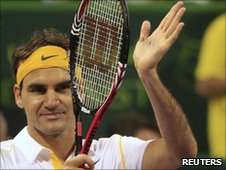
The 30-year-old, who was playing in his first match for six weeks, started slowly before winning 7-6 (7-3) 6-4.
Federer, now ranked fourth in the world, admitted he was not as sharp as he hoped after his break.
"Rust showed more on the returning side, trying to see the pace of the ball or being there and anticipating maybe was just missing a bit," he said.
Starace, ranked 54, created the only break point in the first set, which Federer saved before winning the set on a tie-break.
He immediately broke his opponent at the start of the second set and held on for victory.
Federer added: "In the second set I started to feel a bit better with confidence [with the] first set in the pocket, but I still thought Potito played a good match and made me work extremely hard."
It is the first match the Swiss star has played while ranked outside the top three since winning Wimbledon in 2003.
Meanwhile, Cyprus's Marcos Baghdatis beat eighth seed Viktor Troicki of Serbia 4-6 7-6 (8-6) 6-2.
And Kazakhstan's Mikhail Kukushkin, ranked 113th, used his reprieve as a lucky loser in qualifying to beat Donald Young of the United States 6-4 6-2.
Melbourne Cup: Dunaden beats Red Cadeaux in thrilling finish
French raider Dunaden denied Britain a first Melbourne Cup victory by beating the Ed Dunlop-trained Red Cadeaux in a photo finish at Flemington.
The five-year-old, saddled by Mikel Delzangles and ridden by Christophe Lemaire, got home by a nose to win 'the race that stops a nation'.
Lucas Cranach was third in the $6m (£4m) two-mile event watched by 100,000 people at the Australian racecourse.
Last year's winner Americain was a fast-finishing fourth.
It was the closest finish in the 151 runnings of the famous race.
Delzangles said: "I'm still shaking. It's amazing. I thought I was beaten so it's even better.
"It's a great moment for me. This will be one of the great moments of my career."
Lemaire only stepped in for the ride at the last minute after Craig Williams was ruled out of the race through suspension.
Williams rode Dunaden to win the Geelong Cup in his prep race earlier this month and Delzangles said: "I know it was hard for Craig Williams but it's part of a jockey's life and I know he will win the race one day."
Dunaden is owned by Sheikh Fahad Al Thani under his Pearl Bloodstock banner.
Windies batsman hits maiden Test hundred
Darren Bravo made the breakthrough, collecting his maiden Test hundred to put West Indies in a near impregnable position in the second Test against Bangladesh yesterday.
The stylish left-hander promised much in the past, but finally delivered with an even, undefeated 100 that propelled West Indies to 207 for three in their second innings for an overall lead of 331 after three days in the final match of the two-Test series at the Sher-e-Bangla Stadium.
This came after leg-spinner Devendra Bishoo claimed two of the last three Bangladesh wickets, finishing with three wickets for 62 runs from 23 overs, as the host were bowled out for 231, replying to West Indies' first innings total of 355, about an hour before lunch.
Obvious relief
Bravo, the younger brother of West Indies all-rounder Dwayne Bravo, reached his milestone from 165 balls, cutting the short, wide last delivery of the day from left-arm spinner Suhrawadi Shuvo through point for two, naturally sparking a leap of joy in obvious relief.
He added 151 for the third wicket with Kirk Edwards.
West Indies were set back early, when Brathwaite was run out off the second ball, when he failed to beat a direct hit at the bowler's end from Naeem Islam.
Edwards joined Powell and they settled down into the job with the left-handed opener drilling Nasir Hossain straight back past the bowler for the first boundary of the innings.
The two batsmen, however, got tied down when Bangladesh captain Mushfiqur Rahim turned to an all-spin attack after six overs, as West Indies reached 27 for one at lunch.
After the interval, Edwards started confidently, driving Nasir Hossain through cover for four, but Powell remained circumspect before he was skied a delivery from Shakib Al Hasan and was caught at mid-on for 12.
This brought Bravo to the crease and he got into stride with a lofted straight drive for four off his second delivery from Shakib.
SCOREBOARD
WEST INDIES 1st Innings 355
(K. Edwards 121; Shakib Al Hasan 5-63)
BANGLADESH 1st Innings
(overnight 204 for seven)
| Tamim Iqbal c Bravo b F. Edwards | 14 |
| Imrul Kayes c Brathwaite b F. Edwards | 29 |
| Shahriar Nafees c Bravo b F. Edwards | 7 |
| Raqibul Hassan lbw b F. Edwards | 0 |
| +Mushfiuqur Rahim c Chanderpaul b F. Edwards | 0 |
| Shakib Al Hasan b Bishoo | 73 |
| Naeem Islam run out (Chanderpaul/Bishoo/+Baugh) | 45 |
| Nasir Hossain c Edwards b Samuels | 42 |
| Suhrawadi Shuvo c Brathwaite b Bishoo | 15 |
| Shahadat Hossain b Bishoo | 4 |
| Rubel Hossain not out | 2 |
| Extras | 0 |
| TOTAL (all out, 68 overs) | 231 |
Fall of wickets: 1-14, 2-36, 3-46, 4-46, 5-59, 6-143, 7-95, 8-225, 9-225.
Bowling: F. Edwards 13-0-63-5; Roach 9-0-52-0;Sammy 10-3-32-0; Bishoo 23-4-62-3; Samuels 13-2-22-1.
WEST INDIES 2nd Innings
| K. Brathwaite run out (Naeem Islam) | 0 |
| K. Powell c Nasir Hossain b Shakib Al Hasan | 12 |
| K. Edwards b Suhrawadi Shuvo | 86 |
| D.M. Bravo not out | 100 |
| K. Roach not out | 4 |
| Extras (lb2, nb3) | 5 |
| TOTAL (3 wkts, 71 overs) | 207 |
Fall of wickets: 1-0, 2-33, 3-184
Bowling: Rubel Hossain 9-2-22-0 (nb2); Nasir Hossain 16-3-49-0; Shakib Al Hasan 17-1-62-1; Naeem Islam 7-2-13-0; Suhrawadi Shuvo 15-2-32-1; Shahadat Hossain 3-0-15-0 (nb1); Raqibul Hasan 4-0-12-0.
Position: West Indies lead by 331 runs with seven second innings wickets standing.
Umpires: K. Dharmasena, N. Llong
TV umpire: Nadir Shah
Matchreferee: A. Pycroft
Reserve umpire: Enamul Haque
Source-CMC
Gayle overlooked for Indian series
Chris Gayle was overlooked for the West Indies Test side that will face India in three Tests next month.
This follows the decision of the regional selection panel to persist with the same 15-member squad that is currently engaged in Bangladesh, with Lendl Simmons returning home to nurse his back injury.
Gayle remains estranged from the regional side, following his dispute with the West Indies Cricket Board (WICB) over his comments on a Jamaican radio station last May.
Apology ISSUES
The WICB has demanded an apology from Gayle for his remarks, but the opener refused, requesting to know for what should he apologise.
Gayle remains an enormously popular figure among West Indies fans, gaining loud cheers from spectators in Guyana where he led Jamaica to the Clive Lloyd Trophy for winning the Regional Super50 tournament last Saturday at the Guyana National Stadium.
However, West Indies will persist with the young pair of teenager Kraigg Brathwaite and left-hander Kieran Powell, with Adrian Barath considered fit enough to make the trip over the border.
Barath has recovered from the hamstring injury that sidelined him during the one-day international (ODI) series in Bangladesh.
He did not return home, remaining with the team in Dhaka, where he has been under the eye of West Indies coach Ottis Gibson and team trainer C.J. Clark.
West Indies leave Bangladesh on November 3 for India, where the first Test starts next Monday in Delhi. Matches in Kolkata and Mumbai follow with a series of five ODIs bringing the trip to a close.
Squad: Darren Sammy (captain), Adrian Barath, Carlton Baugh, Devendra Bishoo, Kraigg Brathwaite, Darren Bravo, Shivnarine Chanderpaul, Fidel Edwards, Kirk Edwards, Kieran Powell, Denesh Ramdin, Ravi Rampaul, Kemar Roach, Marlon Samuels, Shane Shillingford.
TT host Digicel youth Academy
THE HASELY Crawford Stadium in Mucurapo will be the venue for the 2011 Digicel Kick Start Academy, which will culminate six weeks of the Digicel Kick Start Clinics throughout the Caribbean, North and Central America region.
The Kick Start Academy will be launched today at the Aura Restaurant, Cipriani Boulevard, Port-of-Spain, but the on-field action will run from tomorrow until Saturday.
And the closing ceremony will be held on Sunday afternoon at the Hasely Crawford Stadium, Mucurapo.
A total of 37 aspiring young footballers will attend the Academy, made up from the original Digicel Kick Start Clinics winners, along with boys chosen in Antigua and Trinidad through separate selection processes.
Throughout the week, the boys will train extensively under Sunderland’s “Academy of Light” coaches, Kevin Ball and Carlton Fairweather, as well as ex-Liverpool and England great John Barnes, and will also be treated to cultural and educational outings.
The once-in-a-lifetime experience will see the youngsters train as professional footballers for a week, and will also teach them invaluable life skills such as personal discipline, teamwork and good sportsmanship. Speaking of his hopes for the Digicel Academy, Fairweather commented: “it’s a huge honour for me personally and of course, for Sunderland Football Club, to be playing a part in the ongoing development of football across the Caribbean and Central America. We are looking forward to working with this talented group of youngsters and seeing just how far they can go.”
In addition, the Digicel Academy will also host “coach the coaches” sessions, with one local football association coach from each region travelling to receive training and tips from the world class Sunderland coaches, with an aim to improve their own standard of coaching upon returning home.
The Digicel Kick Start Clinics officially began on September 18 in Haiti, before travelling on to Panama, New York, St Kitts/Nevis, Grenada, Suriname and Jamaica.
In related news, on Saturday morning, the Hot Shot competition will be staged at the Queen’s Park Savannah, Port-of-Spain, opposite Casuals Corner. The Hot Shot contest is a skills-based shooting event with participants gaining points for shots netted through a cover over the goal.
Source-Newsday
Kim Kardashian Files for Divorce from Kris Humphries
 After denying it over and over, even though nobody believed her, Kim Kardashian is filing for divorce from Kris Humphries.
The implosion of the marriage comes just 72 days after they tied the knot in a lavish ceremony that was taped for her reality show.
“Yes @kimkardashian is filing for divorce this morning,” Tweets Ryan Seacrest, who produces her reality show. “I touched base with her.”
Reports say Kardashian, 30, has hired celebrity lawyer Laura Wasser and will cite the usual “irreconcilable differences.” The date of separation will be listed as today, Oct. 31, 2011.
The filing comes after weeks of speculation of trouble in their brief marriage.
Here’s what a source told TMZ about the couple’s problems:
One of the main points of contention in the marriage was where the couple would live after all of the wedding madness finally died down.
We’re told Kris was passionate about eventually settling down in Minnesota, where he’s from … and believed Kim was on board with the plan. She wasn’t.
Sources tell us Kim — who’s from L.A. — wants to stay near her family … and she also feels that staying in town is the best thing for her career.
It makes you wonder why a super important item like that wasn’t discussed long before the wedding.We also wonder if all the drama was captured for her reality show. In fact, we wouldn’t be surprised if it was.
Jackson's doctor didn't follow protocol
A prosecutor grilling a defence expert got the veteran anaesthesiologist to acknowledge yesterday that Michael Jackson's doctor deviated from the standard of care.
Dr Paul White was repeatedly questioned about the ways in which Dr Conrad Murray had broken guidelines and rules in his treatment of Jackson.
White acknowledged that the type of pulse monitor that Murray was using on Jackson's finger was inadequate to properly monitor the singer when the physician left the room.
Murray, who has pleaded not guilty to involuntary manslaughter, has acknowledged he was giving Jackson doses of the anaesthetic propofol in the singer's bedroom as a sleep aid. He told police that he left Jackson's room for two minutes on June 25, 2009, and returned to find the pop superstar unresponsive.
White also said he would not leave the room if he were treating a patient who had indicated he liked to inject propofol into himself, as Murray claims that Jackson had told him.
Superior Court Judge Michael Pastor had to interrupt testimony and admonish White after the researcher repeatedly referenced conversations he had with Murray. The judge has excluded testimony about those discussions.
"Dr White is trying to offer a response he thinks is helpful," Pastor said of White's comments. At one point yesterday, White said he had been told that Jackson had his own stash of propofol beyond the hundreds of the drug that Murray had purchased and shipped to his girlfriend's apartment.
Pastor warned White not to try to bring up the conversations or other excluded information again.
"It's deliberate and I don't like it," Pastor said. "It's not going to happen again."
Deputy District Attorney David Walgren pointedly questioned White, a retired professor and clinical researcher, about the circumstances of Murray's care based on his interview with police two days after Jackson's death. White told jurors last week that he believes all the evidence in the case shows that Jackson must have self-administered propofol when Murray left the room.
Walgren and White noted the unique circumstances of the case.
"Have you ever administered propofol in someone's bedroom?" Walgren asked.
"No, I have not," White replied.
"Have you ever heard of someone doing that prior to this case?" the prosecutor asked.
"No, I have not," White responded.
Later, White said Murray's treatment of Jackson was different from how propofol is supposed to be used ... as an anaesthetic used in hospital or clinical settings.
"This was an unusual case because the doctor was trying to allow the patient to achieve a sleep state," White said.
White retired last year after conducting research on propofol before it was approved for use in the United States. He told jurors that he has been paid US$11,000 for his work on the case so far.
At odds
White's testimony has put him at odds with his colleague and longtime friend, Dr Steven Shafer, who testified for the prosecutor. Shafer said White's self-administration theory is not supported by the evidence in the case, in his view, and he called the theory "crazy" during his testimony earlier this month.
White and Shafer were colleagues at Stanford University and conducted research on propofol before it was approved for use in US operating rooms in 1989. Both help edit a leading anaesthesia journal. Until White's retirement last year, both were practicing anaesthesiologists.
Shafer said Murray committed 17 egregious violations of the standard of care and should never have been giving the singer propofol as a sleep aid.
"We are in pharmacological never-never land here, something that was done to Michael Jackson and no one else in history to my knowledge," he told jurors.
New Amy Winehouse album to be released in December
A collection of 12 previously unreleased songs by Amy Winehouse are to be made available as an album on 5 December.
Lioness: Hidden Treasures mixes unreleased tracks, alternative versions of existing songs and "a couple of brand new Amy compositions".
Winehouse's collaborators Salaam Remi and Mark Ronson revisited recordings made by the singer for the release.
Amy's father Mitch has said the album is "a fitting tribute" to his daughter.
'New songs'
The singer's record label Island said the tracks were recorded at various points during her career with some songs made after the release of her second album Back To Black.
It has been officially billed as her "third" album after her 2003 debut Frank and 2006's Back To Black.
It will feature Between The Cheats, a brand new song, recorded in May 2008 with producer Salaam Remi.
In a statement Amy's father Mitch Winehouse said listening to the album "really took my breath away".
"Halftime, I'd never heard before, is just incredibly beautiful," he said.
"If the family had felt that this album wasn't up to the standard of Frank and Back To Black we would never have agreed to release it."
A donation of £1 from every album sold will go towards the Amy Winehouse foundation, a charity set up her father and officially launched in September on what would have been Amy's 28th birthday.
Last week a verdict of misadventure was recorded into the singer's death after an inquest heard she was more than five times the drink-drive limit.
The 27-year-old was found dead at her home in Camden, north London, on 23 July following years of alcohol and drug addiction.
Puss in Boots tops US film chart
Shrek spin-off film Puss in Boots has topped the North American box office chart, early figures have revealed.
The 3D movie, featuring the popular sword-fighting feline voiced by Antonio Banderas, took $34m (£21.2m) in its opening weekend.
The story tells of Puss's adventures with sidekicks Humpty Dumpty and Kitty Softpaws before meeting Shrek.
Low-budget horror film Paranormal Activity 3 was nudged into second place with $18.5m (£11.6m).
Puss in Boots scored highly with family audiences and also drew a large Hispanic crowd, which made up 35% of its audience, research revealed.
The film also features the voices of Salma Hayek, Billy Bob Thornton and The Hangover star Zach Galifianakis.
Justin Timberlake sci-fi thriller In Time opened at three with $12m (£7.5m).
The movie is set in a future where people stop aging at 25 but are engineered to die one year after, while wealthier citizens are able to buy more time.
The remake of 1984 film Footloose was at four, bringing its three-week total to $38.4m (£24m).
Johnny Depp's latest film, the Hunter S Thompson adaption The Rum Diary, opened in fifth place with $5m (£3.1m) - a relatively low figure for a film starring the actor.