
Caribbean Leaders end retreat
 Caribbean Community (CARICOM) leaders have ended their two-day retreat here indicating that the process towards a single economy within the 15-member grouping that would have gone into effect by 2015, will now “take longer than anticipated’.
The leaders from 10 of the Caribbean countries - Trinidad and Tobago, Haiti, Suriname, St. Lucia and the Bahamas prime ministers were absent – said in a statement afterwards that they would now await a restructuring of the Guyana-based CARICOM Secretariat before establishing an over-arching decision-implementation arm to ensure regional policies are adhered to.
“As regards the Single Economy, they recognised that the process towards full implementation would take longer than anticipated and agreed it may be best to pause and consolidate the gains of the Single Market before taking any further action on certain specific elements of the Single Economy, such as the creation of a single currency,” the statement said.
The CARICOM Single Market and Economy (CSME) is intended to benefit the region by providing more and better opportunities to produce and sell goods and services and to attract investment. It will create one large market among the participating member states.
“The main objectives of the CSME are: full use of labour (full employment) and full exploitation of the other factors of production (natural resources and capital); competitive production leading to greater variety and quantity of products and services to trade with other countries. It is expected that these objectives will in turn provide improved standards of living and work and sustained economic development,”” according to the CARICOM Secretariat.
“In respect of Governance, they reaffirmed the decision taken at their Inter-Sessional Meeting in Grenada in February to await the completion of the current review of the CARICOM Secretariat, before taking any firm decisions towards the establishment of the Permanent Committee of CARICOM Ambassadors (PCCA),” the statement said after the retreat held at BK International’s quarry resort at Teperu, Mazaruni. (CMC)

Court injuction puts stop to strike by air traffic controllers
Disgruntled air traffic controllers at Jamaica's airports have been prevented from taking further industrial action due to an injunction issued by the Supreme Court today.
Ministry of Labour says it has received an injunction preventing the air traffic controllers from continuing their industrial action. In a release issued a short while ago, the ministry says air traffic controllers have been restrained from taking action over the next 28 days.
The air traffic controllers went on strike over Government’s failure to address salary issues and include them in ongoing wage negotiations. President of the Air Traffic Controllers Association, Kurt Solomon had said earlier that the members, who have been on strike since last night, would have remained off the job until their demands were addressed by the Government.
They want the Government to implement a ruling by the Industrial Disputes Tribunal regarding a disagreement with the Civil Aviation Authority about overpayments. The workers, who navigate air traffic in Jamaica's air space, have been insisting that they have not been overpaid.
Meanwhile,officials at the Norman Manley International Airport in Kingston say operations at the facility are returning to normal.
The airport’s vice president of commercial development and marketing, Mark Williams says although several flights were delayed as a result of today’s strike action, contingencies implemented by the Civil Aviation Authority have been cushioning the effects.
Premier: ‘Strengthening Regulatory Regime’
In advance of the OECD Global Forum taking place in Bermuda later this month, Premier and Finance Minister Paula Cox on Friday [May 20] tabled a special bill to further strengthen Bermuda’s regulatory environment.
The legislation is designed to further strengthen our regulatory laws and ensure that we meet the highest possible international standards.
“I am pleased to have tabled the Specified Business Legislation Amendment Act 2011 in the House of Assembly,” the Premier told Parliament.
“This legislation is extremely important in that it will strike the correct balance between the internationally agreed standard as set out by the Organisation of Economic Cooperation and Development (OECD) which ensures tax consistency and transparency, while maintaining Bermuda’s unique and successful business model.”
The Bill was drafted following an initial Phase 1 Assessment which was performed by OECD assessors in February of 2010.
During this assessment, a review of Bermuda’s legislative and regulatory framework was undertaken, in order to ascertain whether it could support an efficient and effective exchange of information network for tax purposes.
Bermuda was one of only two jurisdictions to receive the determination of “elements met” on all criteria necessary for effective exchange of information.
However, some inconsistencies where identified in Bermuda’s legislation and regulatory framework, and a set of recommendations were issued by the OECD.
As a result Ministry of Finance officials underwent a detailed consultation process with Bermuda’s industry stakeholders with a view to implement the recommendations without impacting Bermuda’s comparative advantage in the development and provision of financial services to the global community.
In summary, this legislation will establish uniform guidelines for maintaining information and records for all of Bermuda’s financial sectors as outlined in Bermuda’s Peer Review Assessment Report.
“I look forward to the passage of this important legislation in the House which will clearly demonstrate Bermuda’s ongoing commitment to internationally agreed standards,” the Premier said. “This enactment will also allow Bermuda to file its 12 month update to illustrate our progress since the Phase 1 report was adopted in September 2010 and to prepare for our Phase 2 assessment scheduled for the second half of 2012.”
(BERNEWS)
No fuel shortage in Trinidad and Tobago, says minister
Energy and Energy Affairs Minister, Carolyn Seepersad-Bachan, has assured that there is no fuel shortage in Trinidad and Tobago.
In a release issued Saturday evening, the minister assured citizens that the National Petroleum Marketing Company (NP) has continued its distribution, having recorded 80 loads leaving the company’s Sea Lots compound by 2:30 pm and with the assurance of a total of over 140 loads by midnight.
“Let me assure citizens of Trinidad and Tobago that there is no shortage of fuel being supplied to the nation’s service stations. Up to 2:30 pm today, over 80 loads of fuel left the NP compound at Sea Lots. These loads are being distributed nationally.”
The Energy Minister added that NP activated its contingency plan to ensure full operations, saying, “NP’s contingency plan has been fully activated and by midnight tonight, the company would have distributed over 140 loads of fuel. In addition, UNIPET trucks have been and will continue to fill from the Bond at Pointe-a-Pierre.”
“The question of a need to panic-buy simply does not arise. The management team at NP is out in full force doing what needs to be done to ensure delivery.”
Asked about reports that Saturday workers were locked out of the company early on Saturday, the minister stated, “On the issue of workers being locked out, I am advi
GRENLEC donates EC$57,000 in medical equipment
A total of EC$57,000 in medical equipment has been donated to the Ministry of Health by the Grenada Electricity Services Ltd (GRENLEC). The donation, comprising an Ophthalmic Laser and a Blood Mixer, was handed over to Minister for Health, Senator Ann Peters, by GRENLEC’s Managing Director and Chief Executive Officer, Vernon Lawrence.
The Ophthalmic Laser is to be used in performing laser-related surgeries, while the blood mixer will be utilized to make blood homogeneous through proper mixing.
Sen. Peters, in accepting the gift, said GRENLEC is one of the private sector companies that not just “talk the talk, but walk the walk”, especially when it comes to providing assistance to the Ministry of Health.
“So what GRENLEC has done here today is to validate what we, at the Ministry and as a Government, are doing in relations to better collaboration through greater public-private-partnership”, she added.
According to Sen. Peters, the assistance from the electricity utility can best be described as the “sectors working together in the interest of developing Grenada’s health status.’‘ One of the GRENLEC’s previous initiatives was educating its staff on a number of health related issues.
Manager Lawrence said that GRENLEC was extremely happy to make the donation, given the importance of health to the nation and pledged his company’s readiness to assist whenever necessary.
Remarks of appreciation were delivered by Director of Hospital and Medical Services, as well as representatives from the Ophthalmic and Laboratory Departments of the General Hospital.
In recognition of GRENLEC’s contribution towards the development of healthcare in Grenada, Director of Nursing, Priscilla Hopkin presented a plaque to Lawrence on behalf of the Ministry of Health.
Heat top Bulls 96-85 for 2-1 lead
 For the second time in three games, Chris Bosh had a monster night against the Chicago Bulls .
Unlike the first, this one paid off with a win.
And the Miami Heat are two victories from their first trip to the NBA finals since 2006.
Bosh scored 34 points, LeBron James finished with 22 points and 10 assists, and the Heat remained unbeaten at home in the postseason by beating the Bulls 96-85 in Game 3 of the Eastern Conference finals on Sunday night.
Dwyane Wade added 17 points and nine rebounds for Miami, which is now 7-0 at home and handed the team that finished with the NBA's best record its first losing streak since Feb. 5-7. Udonis Haslem sealed it with a jumper with 1:29 left, putting Miami up 93-84.
Bosh scored 30 points in Game 1 against Chicago, when Miami was embarrassed 103-82. The Heat haven't lost since, and only trailed for 3:22 in Game 3.
"I just wanted to be aggressive and just have some kind of imprint on this series," said Bosh, who's in the conference finals for the first time. "I had an aggressive Game 1, Game 2 was so-so, but we still won. But out here on the home floor I just wanted to be aggressive and it turned out to be a good game."
A really good game: It was five points shy of his postseason career best.
Carlos Boozer finished with 26 points and 17 rebounds for Chicago, which had won the first four meetings of the season with Miami. Derrick Rose finished with 20 points, but struggled from the field again, making only 8 of his 19 shots.
Taj Gibson had 11 off the Chicago bench.
The Bulls held James and Wade to a combined 12-for-30 showing from the floor. Problem was, Bosh finished 13 for 18.
"It's definitely frustrating," Rose said. "Our will wasn't there tonight. They still found a way to win."
Boozer made a pair of free throws with 6:39 left to get Chicago within 78-74, the outcome clearly hanging in the balance. Minutes later, that was no longer the case - not after Miami scored nine straight to build more than enough of a cushion.
Bosh and Boozer exchanged words and looks more than once on Sunday night, but Bosh ended up with the upper hand.
"All I care about is winning games," Bosh said. "And we do whatever it takes to get that."
How good was Miami's defense down that stretch? Bulls center Joakim Noah tried a 5-footer with 4:25 left. He shot it over the backboard.
Game 4 is Tuesday night in Miami.
Predictably, given the scene and the stakes, there was an abundance of energy from tip-off.
James, Wade and Rose all tumbled into courtside photographers while trying to make plays in the first five minutes, and Haslem was greeted by a huge roar when he entered - his first home appearance since Nov. 19 - later in the opening period.
Eventually, the emotional swings calmed down, and offense picked up in the second quarter.
Bosh was 5 for 5 in the second quarter on his way to a game-high 16 points by halftime. Boozer only missed one of his five shots in the second period, after going 0 for 5 to begin the game.
As for the past two NBA MVPs, everything was a battle.
Rose finished the first half with no assists, just the 11th time in his career that's happened. He did have 11 points by intermission, when Miami led 43-40 - meaning it held Chicago to 69 points in a 48-minute span dating to the midpoint of Game 2.
And James, who was the MVP in 2009 and 2010 before Rose took the trophy this season, was only 3 for 8 in the first three quarters. He did have 10 assists by the end of the third, though Miami let what was its biggest lead slip a bit in the final moments of that period.
Miami pushed the lead to nine late in the third on a jumper by Haslem, then saw most of that edge disappear quickly. Deng made a 3-pointer to get Chicago within 68-65, then stole Mike Miller's inbounds pass with 5.2 seconds left and got a good look at a jumper that rimmed out with a second left.
"That's obviously not the way we want to finish the quarter," Heat coach Erik Spoelstra said.
The fourth quarter, that was different. And against the NBA's top defensive team all season, Miami scored 53 points after halftime.
Source:sportsillustrated
French Open: Novak Djokovic ready for Paris opener
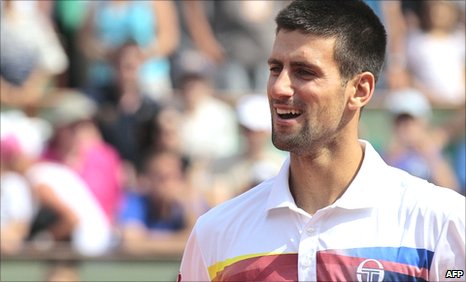 Novak Djokovic will look to extend his incredible winning streak when he begins his French Open campaign against Dutchman Thiemo de Bakker on Monday.
The Serbian, who has won 39 matches stretching back to last November, takes centre stage as he and the likes of Roger Federer, Caroline Wozniacki, Juan Martin del Potro and Francesca Schiavone kick-start the tournament after a low-key opening day.
Britain is represented on day two as Anne Keothavong opens play on Court 16 against Vesna Dolonts, and Heather Watson takes on Stephanie Foretz Gacon in the fourth and final match on Court Seven.
"I like playing first, it means you know what to expect and what time you'll be out there," Keothavong told BBC Sport, who beat Dolonts twice in 2008.
"Both our previous matches were indoors and a few years ago but I know she's a tough opponent who likes clay. On paper it looks like one of the better draws I could have got but she's a tough player."
Watson, 19, has already enjoyed three victories at Roland Garros to qualify for the main draw of a Grand Slam for the first time, where she will face 30-year-old Foretz Gacon of France.
It is Djokovic who will command the attention, however, as his historic run of success arrives in Paris and threatens to trample over more landmarks of the sport in the weeks to come.
The world number two, who turned 24 on Sunday, is only five wins from equalling John McEnroe's record start to a year of 42 in 1984, and seven victories from equalling Guillermo Vilas's all-time winning streak of 46 matches in 1977.
Djokovic has twice lost in the French Open semi-finals to five-time champion Rafael Nadal, but when asked if he thinks he can take the Spaniard's title, the 2008 and 2011 Australian Open champion told BBC Sport: "I believe I can."
He has beaten the Spaniard four times in succession this year, including back-to-back victories on clay, and for the first time he has exposed a chink in the world number one's armour heading into Roland Garros.
One man who has slipped out of the spotlight so dominated by Djokovic in 2011 has been Federer, and the 17-time Grand Slam champion faces a tricky opener against Spain's Feliciano Lopez.
The Swiss star only narrowly beat Lopez in Madrid recently and has looked out of sorts during the clay-court season with just one semi-final appearance in three tournaments.
But he insists that people now "expect more from Rafa and Novak, and that could be a good thing for me".
Argentina's Del Potro is a potentially dangerous third-round opponent for Djokovic, should the 2009 US Open champion get past Ivo Karlovic in round one.
Del Potro missed most of 2010 with a serious wrist injury and had been battling his way back up the rankings this year until a hip injury forced him out again and briefly threatened his participation in Paris.
Women's number one Wozniacki begins another quest for a first Grand Slam title in the fourth and final match on Court Suzanne Lenglen, with Kimiko Date-Krumm standing in her way - the Japanese player twice Wozniacki's age at 40 years old.
Defending champion Schiavone opens proceedings on Court Philippe Chatrier against American Melanie Oudin.
World number one Nadal and Britons Andy Murray and Elena Baltacha play their opening matches on Tuesday.
One million bid for Olympics 100m tickets
London 2012 organisers have received more than one million requests for tickets for the Olympic men's 100 metres final.
The session, at the Olympic Stadium on 5 August next year, is one of the most sought after of the London Games.
Some 40,000 seats are available after the stadium capacity was halved through sponsors, VIPs and the media.
Applicants will find out by 24 June whether they have got any of the 6.6 million Olympics tickets available.
Level of demand
Some 1.8 million people applied, with a total of 20 million ticket applications.
On Friday organising committee Locog said it would not release a sport-by-sport breakdown of figures on ticket requests until next month at the earliest.
Competition to see the 100 metres final - likely to feature Jamaican sprinter and reigning Olympic champion Usain Bolt - was always going to be fierce.
Such was the level of demand in the recent ballot for tickets that the Olympic Stadium in east London could have been sold out at least 20 times over.
BBC sports editor David Bond says those who have applied for Olympics tickets will be watching their bank accounts for a clue to what tickets they have been allocated.
But with other big events likely to be just as over subscribed as the 100 metres final, millions of people could be left disappointed.
Selling method
Olympics organisers are looking to make £500m from ticket sales as part of bid to raise £2bn through private means.
Lord Coe, chairman of Locog, said: "It is really important as 25% of everything that you see out there in terms of the organisation of these Games is our ability to nail our revenues from tickets."
Lord Coe has also defended the method for selling Olympics tickets which sees payments taken from people's accounts before they know which tickets they have been given.
He said: "It was very clear from us, very early on that we would be taking the money out and we would then let people know what they got.
"It is easier to do that all at the same time rather than in dribs and drabs. This was always the way."
The price of Olympics tickets ranges from £20 to £725 for the showpiece 100 metres final, and reaches £2,012 for the opening ceremony on 27 July.
On Wednesday, the first 74 locations on the 2012 Olympics torch relay route were revealed.
Starting at Land's End, it will see the Olympic torch travel 8,000 miles (12,800 km) covering every nation and region in the UK including island visits.
Lara in Queen'sPark Hall of Fame
Legendary West Indies batsman Brian Lara has been inducted into the renowned Queen's Park Cricket Club's Hall of Fame.
The former West Indies captain was one of two inductees, with the other being celebrated cyclist Roger Gibbon, who won three Pan American gold medals during the 1960s.
Lara was honoured for his outstanding contribution that saw him garner 11,953 runs in 131 Tests and 10,405 from 299 one-day internationals during a glittering career.
The 42-year-old said it had been a dream of his to play at the venue.
"Many times I would be there batting on a Sunday morning and the Test match would have already started," he told the induction ceremony.
"I remember just dreaming that one day I would be at the other side of the fence playing cricket at the Queen's Park Oval, not just for Queen's Park or T&T, but for the West Indies."
Outstanding
Gibbon, meanwhile, was an outstanding cyclist who captured one gold at the 1963 Games in Brazil and another two at the 1967 showpiece in Canada.
"I have to say that my career began at the Queen's Park Oval and some of my most memorable international victories were right here," the 67-year-old Gibbon noted.
"Over the years, many of T&T's top cyclists blossomed at this venue."
During the ceremony, the Queen's Park also honoured three of its stalwarts by unveiling the Willie Rodriguez End, the Joey Carew Balcony and the Bryan Davis Indoor Cricket Centre.
Carew, who played 19 Tests for West Indies, passed away in January at age 73.
Pakistan end day on 202 for 3
Pakistan ended the third day of the decisive second Digicel cricket Test against the West Indies at Warner Park here Sunday on 202 for three in their second innings.
After dismissing the West Indies for 223 in reply to their first innings total of 272 to gain a lead of 49 runs, Pakistan consolidated their position, moving from 55 without loss at lunch to 131 for one at tea in their second innings.
Opener Taufeeq Umar guided Pakistan’s batting and was three runs away from his fifth Test century on 97 not out at stumps, while captain Misbah-ul-Haq was13 not out.
Taufeeq, who benefitted from a number of dropped catches by the West Indies fielders has so far struck 10 fours off 231 balls in 304 minutes at the crease. Pakistan's overall lead is 251 runs with seven wickets in hand.
Taufeeq and Mohammed Hafeez, who made 32, shared an opening stand of 82 runs before West Indies’ captain Darren Sammy, who had missed two catches in the slip, bowled the latter off the inside edge.
Azhar Ali joined Taufeeq and hit his second half-century of the match (53 off 90 balls, 6x4) while dominating a second-wicket partnership of 76 runs.
Pakistan, trail 1-0 in the two-match series after the West Indies' 40-run victory in the Guyana first Test.
Earlier, fast bowlers Ravi Rampaul (32 not out) and Kemar Roach (29) featured in a ninth-wicket partnership of 60 runs after the West Indies resumed from their overnight score of 184 for eight. Off-spinners Hafeez (3-23) and Saeed Ajmal (3-56) were Pakistan's most successful bowlers while Marlon Samuels top scored for the West Indies with a knock of 57.
(EZS)