
Pfizer sets aside $772m for drug illness claims
The drugs giant Pfizer has put aside $772m (£476m) to resolve claims its hormone replacement drugs cause serious illness.
Pfizer, which is the world's largest drugmaker, said the money provides "the minimum expected costs to resolve all of the other outstanding" lawsuits over the drugs.
The company did not say how many cases would be settled.
Pfizer has already settled a third of claims relating to the drugs.
At the height of the litigation, the company faced more than 10,000 claims.
Much of the claims were inherited along with Pfizer's 2009 takeover of Wyeth, which makes the menopause treatment drug Prempro.
In 2002 a study linked the drug with breast cancer.
More than six million women took Prempro and related menopause drugs to treat symptoms including hot flushes and mood swings.
Wyeth has won dismissals of more than 3,000 cases before they came to be tried.

Inflation in US food and fuel prices slows
Inflation in the US slowed in April, mainly due to smaller price rises in fuel and food.
Consumer prices rose 0.4% in April, having risen 0.5% in March, according to figures from the Labor Department.
Petrol prices rose 3.3%, down from March's 5.6% increase, while food prices were up 0.4% compared with 0.8% the month before.
Core CPI, which excludes food and energy, rose 0.2%, following March's 0.1% increase.
Rising prices of new vehicles and used trucks were responsible for the core rise.
Spending squeeze
"The real story is that core is edging up. There is a clear acceleration in the core number in recent months," said James O'Sullivan, chief economist at MF Global in New York.
"Clearly the core number has moved away from the deflation zone in the last six months. It's just a matter of time when the Fed will tighten."
Consumer prices were up 3.2% compared with April 2010, following March's corresponding figure of 2.7%.
Core CPI rose 1.3% on the year, up from an annual rate of 1.2% in March.
Rising fuel and food prices are squeezing consumers, whose wages are not keeping up with them.
Average weekly earnings adjusted for inflation fell 0.3% in April, having declined by 0.4% in March, the Labor Department said.
Lil Wayne To Be 'Unplugged' On MTV This June
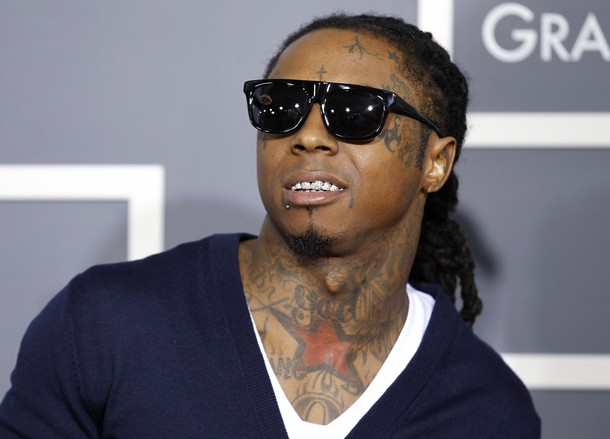
Rapper Lil Wayne will be the latest artist to be featured on MTV's Grammy/Emmy Award winning music series "Unplugged" this June.
Lil Wayne will perform acoustic versions of different songs from his lengthy discography for the "Lil Wayne: Unplugged" special that will premiere on June 12th on MTV2, MTV and MTV.com.
“Lil Wayne is an amazing choice for Unplugged as he is at hip-hop’s forefront - leading a new generation of artists whose appeal spans across music genres and playlists,” Amy Doyle, EVP, Music and Talent, MTV told AllHipHop.com in a statement.
“Lil Wayne’s skills, influence, and catalog are a powerful addition to the legacy of artists who have rocked the Unplugged stage,” Doyle said.
Lil Wayne joins artists like LL Cool J., Jay-Z, Mariah Carey, Bob Dylan, Lauryn Hill, Hole, Alicia Keys and Korn, who have all performed on "Unplugged."
Lil Wayne, who is putting the final touches on his 9th studio album Tha Carter IV, will on "Unplugged" on Sunday, June 12th at 9 PM ET.
TOK, Octane lash out at Kartel
Artistes are now fuming following a Blackberry broadcast message sent out by deejay Vybz Kartel yesterday where he called the names of artistes who he believed also wore hair extensions.
After he had tongues wagging with his new hairstyle and later attempted to convince the public that it was his real hair, deejay Vybz Kartel yesterday sent out a BlackBerry broadcast message which now contradicts his original statement about his shoulder-length braids.
In the broadcast message, the artiste suggested that the recent negative talks about his new hairstyle stem from the 'badmind' of his success as a musician. He also alluded that he is being unfairly targeted as other artistes have worn extensions and they have not come under the scrutiny that he has been subjected to.
The broadcast message read: 'First off I'd like to say that all the fuss about my hair, as with every other thing that I do has nothing to do with anything except plain old badmind. Because when I was involved in the Ninja Man incident a few years ago, I had in extensions then, why didn't the hullabaloo commence then? Because I wasn't on top so the hating wasn't necessary. When I did "Never Love Another Girl" video in 2005, my hair was permed, why didn't the inquisition commence? Because I wasn't on top so the hating wasn't necessary ... What I'm saying is that when you're on top, people find all kinds of faults and flaws to point out in their quest to tear you down but guess what, I couldn't care less what people say or think about Kartel ... P.S. Mavado, Elephant Man, Machel Montano (whose hair is done by the same girl who did mine) T.O.K. etc have all had extensions put in. Talk bout that."
broadcast message
T.O.K. members, however, have not taken too kindly to Kartel's allusions and Bay-C has since sent out a Blackberry broadcast message of his own. It read: 'To all who seem to be confused, T.O.K. has never worn extensions. To each his own, it's not for me to judge. Having said that, make it clear ... mi a Rasta! Lion of the tribe of Judah! Don't confuse the mane of a lion with the tail of a horse! Bombrush dem!'
Although the broadcast message received by The WEEKEND STAR made no reference to I-Octane, an email from the artiste's manager, Ray Alexander, showed him to be included among the above-mentioned names.
I-Octane's camp also issued a release last night in direct response to Kartel's broadcast message.
"I can't control what another artiste chooses to say," said I-Octane in a release sent to The Jamaica WEEKEND STAR. "But I've been growing my locks for several years now and the people at Jus Natural in Portmore can vouch for that."
He went on to say that he won't allow anyone to shift his focus from music and he won't spend time thinking or even talking about this issue.
The photographs of Vybz Kartel's hairstyle - a headshot of him in an orange shirt and another in which he suggestively poses on a bed in yellow and blue gear - have also managed to set off a frenzy of comments on popular overseas-based website mediatakeout.com. Several of the comments were riddled with expletives and expressed the disgust of the viewers with his skin bleaching practices with
Lindsay Lohan sentenced to jail
 Lindsay Lohan has been sentenced to four months in jail over the theft of a gold necklace from a shop in Los Angeles last year.
The actress changed her plea to no contest, which under California law effectively means she admitted taking the jewellery worth $2,500 (£1,529).
Officials say the actress is likely to serve 17 days of the sentence and that will probably be under house arrest.
Lindsay Lohan has until 17 June to report to jail.
The 24-year-old released a statement saying she had already started 300 hours of community work at a women's shelter.
Lohan said: "I hope to be able to fulfil my obligation without any press attention. I think the media spotlight should be on issues such as homelessness and domestic violence instead of on me."
Along with working at the women's shelter, she will do 120 hours of community service at the coroner's office in Los Angeles, have to complete an anti-shoplifting class and will remain on probation for the next three years.
The star was on probation for a 2007 drink-drive case last January when a jewellery store in the Venice area of Los Angeles told police that she'd taken a necklace without permission.
The theft happened three weeks after Lohan was released from rehab.
She had been sent there for three months of treatment after failing a separate drug screening for cocaine and amphetamines.
Lohan also tested positive for alcohol shortly after the theft was reported.
Officials at the pre-trial hearing say the actress, best known for roles in Mean Girls and Ugly Betty, is unlikely to face jail time because of prison overcrowding.
Venus withdraws from French Open
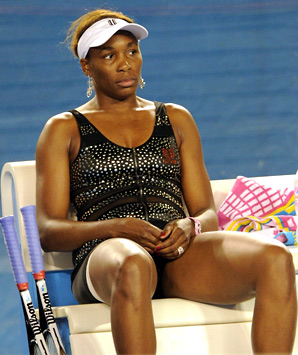 Venus Williams pulled out of the French Open on Friday, 24 hours after her younger sister Serena withdrew, making it the first Grand Slam tournament since 2003 without either Williams.
Venus' agent, Carlos Fleming, wrote in an e-mail to The Associated Press that the seven-time Grand Slam champion notified tournament organizers she wouldn't compete at Roland Garros, where play starts May 22.
The 30-year-old American has been off the tour since January, when she stopped playing only minutes into a match in the third round of the Australian Open because of a hip injury. A left knee injury limited her to just one tournament over the final six months of 2010.
Serena pulled out of the French Open on Thursday; she hasn't entered a tournament since winning her fourth Wimbledon singles championship in early July. A few days later, she cut her foot on glass at a restaurant in Germany, an injury that led to two operations. The second surgery was in October, and she said she spent 10 weeks in a cast and 10 weeks in a walking boot.
She returned to practice last month and said Thursday in a statement issued by her agent that she hopes to "be back competing this summer."
The sisters are among the most dynamic and attention-drawing players in tennis history. Both were ranked No. 1 by the WTA, and they own a combined 20 Grand Slam singles titles -- 13 for Serena, seven for Venus. They have played each other in eight major finals, including at the 2002 French Open, won by Serena.
But a series of health problems have limited them lately, and in this week's rankings, Serena is 17th, Venus 19th.
While the 29-year-old Serena hasn't pointed to a specific target date for her return to action, Venus is entered in a grass-court tournament in Eastbourne, England, that begins June 11. Fleming wrote Friday that Venus "is on track to be ready to play at Wimbledon," which starts June 20.
This French Open will be the third consecutive Grand Slam tournament missed by Serena. Venus, though, had played in the previous 16 in a row, and 30 of the last 32.
The only other time both Williams sisters pulled out of one of tennis' four major tournaments was the 2003 U.S. Open, when Venus had an abdominal injury, and Serena was coming off left knee surgery. Before that, one or the other - and usually both -- participated in every Grand Slam tournament since Serena's first, the 1998 Australian Open.
Grizzlies push Thunder back to OKC for Game 7
Zach Randolph is doing everything he can to keep the Memphis Grizzlies ' memorable playoff run going as long as possible.
Randolph had 30 points and 13 rebounds, and the Grizzlies avoided elimination by beating the Oklahoma City Thunder 95-83 Friday night to push their Western Conference semifinal to Game 7.
The Grizzlies had never won a game before when facing elimination, but that was back in 2004, 2005 and 2006, when they were swept out of the postseason each of those years. These Grizzlies are having not only the best playoff run in franchise history, but they now have won more games this postseason than any other No. 8 seed from the West.
Game 7 will be Sunday in Oklahoma City, with the winner advancing to play the well-rested Dallas Mavericks .
O.J. Mayo, who started in place of Sam Young, scored 16 points for Memphis. Mike Conley had 11 points and 12 assists, and Tony Allen added 10 points as the Grizzlies also improved to 5-1 on their home court in this postseason, with a sellout crowd standing for the entire second half cheering to keep this stunning run going at least one more game.
Memphis outscored the Thunder 51-29 in the second half and 46-38 in the paint.
Russell Westbrook led the Thunder with 27 points, and James Harden had 14. Kevin Durant, the NBA's leading scorer in the regular season, was held to a postseason-low 11 points.
Randolph had been limited to just 19.8 points and 31.9 percent shooting since he scored a career-best 34 points in Game 1. He had been the focus of the Thunder's defense.
But the power forward, named to the All-NBA's third team on Friday, scored 11 in the fourth to preserve Memphis' lead. He scored six straight points, capped by a 12-foot fallaway jumper that sent the fans into a frenzy chanting his nickname.
Oklahoma City just couldn't get to the basket or sink shots in the second half. The Thunder had a fast break with Westbrook driving to the basket, but he just couldn't finish the shot. Randolph came up with the rebound, then Mayo hit a 19-footer to push the Grizzlies' lead to 88-79 with 3:11 left.
The Thunder had their biggest lead at 54-41 just before halftime and looked ready to blow out Memphis, just as they did in Game 5 on Wednesday night in Oklahoma City.
But Shane Battier ended the first half with a 3-pointer, and the Grizzlies used that as the start of an 18-5 run into the third. Randolph's bucket with 5:19 left in the third tied it at 59, Marc Gasol tied it again at 65, and Mayo's three-point play put Memphis ahead to stay at 68-65 with 2:10 left.
Oklahoma City hit only 6 of 22 from the floor in the third compared to Memphis, which hit 10 of 18 after shooting only 38.3 percent in the first half.
Durant picked up his second personal on a questionable offensive foul with 7:37 left in the first quarter and sat for the rest of the period. With Battier defending him most of the night, Durant went 1 of 10 from the floor in the second half.
The Thunder used a 20-7 spurt during which Westbrook scored seven, and Harden capped it with back-to-back 3-pointers for a 52-39 lead with 1:03 remaining. Unlike Game 5, they couldn't build on this lead.
AP
West Indies face Pakistan test
West Indies will look to put the disappointment of the one-day series loss behind them, when they face Pakistan in the opening Test of the two-match series starting here today.
The regional side lost the one-day series 3-2 after trailing 3-0 at one stage; and will be hoping to turn around their fortunes in the game's longer version and walk away from the tour with some form of success.
West Indies start the series with the odds stacked them. They are missing their leading opener in Chris Gayle, who is campaigning in the Indian Premier League, and will also be without their main all-rounder, Dwayne Bravo, who is also playing in the lucrative Twenty20 league.
However, captain Darren Sammy said the 13-man squad had remained focused and was upbeat ahead of the clash at the National Stadium at Providence.
"The guys have been working very hard. We have added some new players and they've been working quite hard. The guys put in some good work in the two-day practice game we had ... we are all confident and ready," said the all-rounder, whose form has been dodgy.
"We believe we can win the series. We believe this because we have worked hard in the build-up to the series and we know we have the ability to perform on home turf and get the better of the Pakistanis.
"We saw an improved batting performance in the last two matches of the one-day series and everyone in the team is feeling confident and fully prepared."
Though encouraged by the comeback in the one-day series, Sammy said it was important his side changed gears as Test cricket represented new challenges.
"It's not like it is in the one-day format. It's about occupying the crease and putting up good totals. Dessie (Desmond Haynes) has been doing some good work (with the batsmen) and the guys look ready to go for the Test match."
The batting will centre around the experienced duo of Chanderpaul and Ramnaresh Sarwan, who is playing his first Test since being overlooked for the Sri Lanka series last November. Recalled opener Lendl Simmons is in form following four successive half-centuries in the one-day series and stylish stroke-maker Darren Bravo is also due runs.
The side has been lifted by the return of fast bowler Fidel Edwards, who is poised to play his first Test in two years after recovering from a back injury that required surgery.
If he plays, he will line up alongside rookie speedster Kemar Roach in the pace attack, with exciting leg-spinner Devendra Bishoo in line for his Test debut following a successful start to his international career in one-dayers.
West Indies have not won a Test match since they beat England in February 2009, while Pakistan have never won a Test series in the Caribbean.
Pakistan have been boosted by the return of strike bowler Umar Gul, but have lost experienced batsman Younis Khan, who was forced to return home following the death of his brother.
They have won just four of the 21 Tests they have played in the Caribbean.
SQUADS:
WEST INDIES - Darren Sammy (captain), Brendan Nash (vice-captain), Devendra Bishoo, Carlton Baugh Jr, Darren Bravo, Shiv Chanderpaul, Fidel Edwards, Ravi Rampaul, Kemar Roach, Marlon Samuels, Ramnaresh Sarwan, Lendl Simmons, Devon Smith.
PAKISTAN - Misbah-ul Haq (captain), Abdur Rehman, Asad Shafiq, Azhar Ali, Hammad Azam, Junaid Khan, Mohammad Hafeez, Mohammad Salman, Saeed Ajmal, Tanvir Ahmed, Taufiq Umar, Umar Akmal, Umar Gul, Wahab Riaz.
CMC
Barbados economy on the rebound, says PM
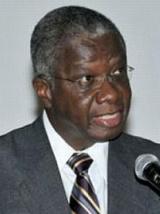 Figures for 2010 show the Barbados economy has stopped contracting and there was evidence of modest advancement, reinforced by a 2.8 percent growth in the first three months of this fiscal year.
Now is the time for all citizens and businesses to be recommitted to the sustainable development of Barbados, "as a just and thriving society", emphasised Prime Minister Freundel Stuart on Wednesday, as he delivered the feature address at the 51st Annual General Meeting and Luncheon of the Barbados Employers' Confederation (BEC).
Stuart said if this country was to function as "a well-oiled, appropriately and highly competitive economy", employers had to find ways of creating wealth and distributing it fairly "in order to satisfy the needs of our people."
Stuart added that other indices, such as the provision of enough foreign exchange to cover 20 weeks of imports, the slender reduction in unemployment to 10.5 percent, and the slight improvement in the fiscal deficit by $90 million, offered "a glimmer of hope for the country's continued performance."
Added to this, he disclosed that government had pledged to guarantee a $50 million loan to the Barbados Investment and Development Corporation and to allocate $1.5 million to Fund Access to facilitate small business development.
The prime minister stated that the abolition of the environmental levy on imports, the reduction of fees paid by private transport operators, and those requiring retail liquor licences, as well as the reduction in water rates for registered farmers, were all measures that were intended to assist the private sector.
Stuart emphasised that his government would continue its policy "of maintaining a reliable, social safety net", while at the same time supporting employers and reaching out to those "who have the courage and foresight to sow the seeds that would lead to meaningful and durable recovery."
The prime minister thanked the private sector, including the BEC, for "holding strain during the past three years and collaborating with all the stakeholders to keep industrial strife in Barbados to an absolute minimum."
He also commended the private sector for creatively using measures to maintain employment for Barbadians.
"In the current prolonged recession, you have found and used innovative ways of maintaining employment levels, despite declining profits, serious cash flow challenges and sometimes actual losses," he noted.
Stuart thanked entrepreneurs for "using the unique mechanism of the Social Partnership" to reach consensus with the Barbados Workers' Union, thus enabling agreement on six collective labour settlements and other wage issues.
"It is to be lauded that there were no reported work stoppages in the private sector during the past year, while there was but one in the public sector," he added.
The prime minister affirmed that government would continue its strategy of supporting existing businesses, injecting certain stimuli to aid survival and expansion, and encouraging new business ventures.
$8m cocaine seized
A couple and a Venezuelan national were arrested by police after officers raided a house in Barataria on Thursday and seized hundreds of rounds in ammunition and $8 million in pure cocaine.
Up to late yesterday, the couple, ages 31 and 36, and a 36-year-old Venezuelan, were in custody at the Morvant Police Station, being quizzed by officers of the North Eastern Division Task Force.
According to police, around 4.30 p.m. on Thursday, Task Force officers and police from the Criminal Intelligence Unit, headed by Snr Supt John Martinez, Supt John Daniel and Sgt Roger Alexander, raided a house at Second Street, Upper Sixth Avenue, Barataria.
Police said after conducting months of surveillance at the house, they executed a search warrant and found 11.5 kilogrammes of pure cocaine; 325 rounds of 9mm ammunition; a Walther 9mm pistol with eight rounds ammunition; a Force 99" 9mm pistol with eight rounds of ammunition; and 315 grammes of marijuana.
The three suspects were immediately taken into custody by the officers. An interpreter was used to interview the Venezuelan national in connection with the discovery of the items.
Police said the suspects are expected to be charged at the weekend in connection with the incident.