
Ex-Goldman Sachs director charged with insider trading
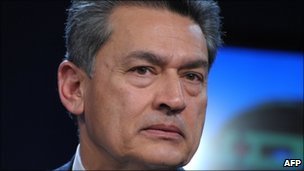 A former Goldman Sachs board member has been charged with insider trading.
The US Securities and Exchange Commission said Rajat Gupta leaked details about Warren Buffett's $5bn (£3bn) investment in Goldman in 2008 to Galleon Group founder Raj Rajaratnam.
The SEC said Mr Gupta had tipped Mr Rajaratnam by phone minutes before the investment by Mr Buffett's Berkshire Hathaway became public knowledge.
Mr Gupta's lawyer called the allegations "totally baseless".
A spokesman for Goldman declined to comment, as did Jim McCarthy, spokesman for Mr Rajaratnam.
'Betrayed trust'
The investment from Berkshire Hathaway helped to ensure Goldman's stability during the financial crisis.
The financial watchdog said that Mr Rajaratnam used the tip-off about the investment from his "friend and business associate" to trade for Galleon funds, generating more than $18m for the hedge fund group.
It also said Mr Gupta invested in some Galleon funds.
"Gupta was honoured with the highest trust of leading public companies, and he betrayed that trust by disclosing their most sensitive and valuable secrets," SEC enforcement chief Robert Khuzami said.
However, Mr Gupta's lawyer denied the allegations.
"Mr Gupta has done nothing wrong," his lawyer Gary Naftalis said in a statement. "There is no allegation that Mr Gupta traded in any of these securities or shared in any profits as part of any quid pro quo."
'Preventing distraction'
Rajat Gupta sat on the board at Goldman from November 2006 to May last year.
He is also charged with giving Mr Rajaratnam confidential earnings information from Goldman and Procter & Gamble, where he had served on the board since 2007.
Mr Gupta resigned from his position on the P&G board on Tuesday after the civil charges were announced.
"He's stepping down in the interest of the company, to prevent any distraction to the P&G board or our business," company spokesman Paul Fox said.
Galleon Group's Mr Rajaratnam has already been accused of generating profits of more than $50m after receiving inside information.
He faces a criminal insider trading trial, scheduled to begin on 8 March. He also faces SEC civil charges.
He has denied any wrongdoing.

Bank of America website suffers outage ... again
Bank of America's online banking system went on the fritz for some users Tuesday, the second such incident this year.
Customers attempting to access the bank's online services were experiencing "intermittent service disruptions," according to Tara Burke, a spokeswoman for the bank.
The bank is working to restore the system to normal as soon as possible, Burke said. The bank's branches and ATM network are unaffected, she said.
In January, the bank experienced a similar problem, caused by an IT glitch.
Tuesday's service disruptions are the result of a routine update performed on the system over the weekend, and no personal personal banking data is at risk, Burke said.
But the outage is particularly ill-timed, hitting on the first of the month -- a day when many customers are scrambling to pay bills. Bank of America "will work with customers on an individual basis" to resolve any problems stemming from that, Burke said.
The problem kept Bank of America's Twitter account, @bofa_help, hopping all day, pumping out a steady stream of messages saying: "We are aware of the issue and are working to resolve it as fast as possible. Please accept our apologies."
Frank Murray, a Bank of America customer in Fort Myers, Fla., said he had trouble logging into his account for much of the day.
"It was off much of the afternoon, and unusually slow before that," Murray said.
Murray said attempts to access his account were met with a screen declaring there was an "outage." Later the message changed to an "upgrade."
"I'm guessing nobody planned an upgrade at mid-afternoon on the first of the month," he said.
Stocks drop more than 1% as oil spikes near $100
U.S. stocks tumbled Tuesday, with all three major indexes down more than 1%, as oil prices spiked to nearly $100 a barrel.
The Dow Jones industrial average (INDU) sank 168 points, or 1.4%, with Alcoa (AA, Fortune 500) and Caterpillar (CAT, Fortune 500) leading the decline. The S&P 500 (SPX) fell 21 points, or 1.6%, and the Nasdaq (COMP) lost 45 points, or 1.6%.
The sell-off came as oil prices for April delivery continued to head higher, climbing $2.66 to settle at $99.63 a barrel amid ongoing uprisings in Libya and the Middle East. In electronic trading, crude prices topped $100 a barrel Tuesday afternoon, after crossing that mark last week for the first time since 2008.
As crude climbed, gas prices rose for a seventh straight day. Meanwhile, gold prices surged $21.30, or 1.5%, to settle at a record high of $1,431.20 an ounce.
Tensions in the Middle East and North Africa will continue to cast a shadow on the market, said Matt King, chief investment officer at Bell Investment Advisors.
Investors also tuned into Federal Reserve Chairman Ben Bernanke's testimony on Capitol Hill. Bernanke warned that a sustained rise in oil prices could pose a danger to economic growth.
"Bernanke's comments reconfirm what the market's fear has been since the Libyan situation started," King said. "Bernanke hasn't been too concerned about inflation, especially in relation to high commodity prices, so this is the first time he's outlining a potential scenario with inflation."
Markets also came under pressure after the Securities and Exchange Commission filed a lawsuit against former Goldman Sachs (GS, Fortune 500) director Rajat Gupta for insider trading.
"It's just another hit to investor confidence, and it's scary to think about potential repercussions," said Dave Rovelli, managing director of U.S. equity trading at Canaccord Adams. "All this insider trading at hedge funds can make individual investors hesitant to come back to the market."
Investors are also looking ahead to the government's monthly payroll report on Friday, which will reveal how many jobs were created in February.
Despite a slight step back last week, stocks closed out February on an upbeat note -- posting their third-straight month of gains. Overall, all three major indexes were up nearly 3% during the month, and have risen more than 5% since the beginning of the year.
Economy: The Institute for Supply Management's manufacturing index rose for a 19th consecutive month, reaching 61.4% -- a level last seen in May 2004. The level signals continuing expansion in the sector.
Companies: General Motors (GM) said total U.S. sales rose 46% last month on an annual basis, while Ford's sales rose 14%. Shares of both U.S. automakers fell about 2%.
Shares of Japanese automaker Toyota (TM) slipped 0.5% after the company said sales rose 42% last month from a year earlier, when monthly sales fell 8.7% on recall problems.
Shares of Las Vegas Sands (LVS, Fortune 500) dropped 6.3% after the casino operator said that it has received a subpoena from the SEC requesting documents related to the Foreign Corrupt Practices Act. The company said it is also being investigated by the Department of Justice.
Shares of J. Crew Group (JCG) rose 1% after stockholders agreed to adopt the previously announced merger agreement with Chinos, an affiliate of private equity firms TPG Capital and Leonard Green & Partners.
World markets: European stocks closed lower. Britain's FTSE 100 lost 0.8%, the DAX in Germany fell 0.5% and France's CAC 40 declined by 0.7%.
Asian markets ended higher. The Shanghai Composite rose 0.5%, the Hang Seng in Hong Kong added 0.2% and Japan's Nikkei jumped 1.2%.
Currencies and commodities: The dollar rose against the euro, was weaker versus the British pound and firmer versus the Japanese yen.
Bonds: The price on the benchmark 10-year U.S. Treasury rose, pushing the yield down to 3.41% from 3.43% late Monday.
Gold price hits record high on Libya unrest
The price of gold has hit a record high as investors worry about the political turmoil in Libya and spreading tensions across the Middle East.
The price on the London Bullion Market jumped more than $14 to $1,434.50 an ounce, topping the previous mark of $1,431.25, set in December.
Gold is traditionally seen as a haven for investors in times of uncertainty.
Unrest across the Middle East and North Africa fuelled a 6% rise in gold prices during February.
Analysts said that the political problems were pushing oil prices higher and fanning concerns about inflation and slower global economic growth.
"What gold needed was a catalyst, and it found it in the form of tensions that are surfacing in the Middle East and rising oil prices," said Mark Luschini from the brokerage Janney Montgomery Scott.
Mr Luschini added that investors saw gold giving them greater protection from inflationary pressures and political instability.
On the New York Comex exchange, the price of gold reached $1,434.40, a record for that market, before pulling back slightly.
Meanwhile oil prices, which have also been on the up since unrest broke out in North Africa and the Middle East, rose again on Tuesday.
In London, Brent crude rose 4.2% to $116.46, while US light, sweet crude rose 3.7% to $100.52.
Bernanke: Sustained oil price rise danger to US economy
The length of time that oil prices remain high will be significant for the US economy, US Federal Reserve chairman Ben Bernanke has said.
He told the Senate Banking Committee that the most likely outcome was a temporary and modest rise in inflation.
But he warned that a prolonged rise in oil prices would pose a danger to economic growth in the US.
Mr Bernanke said he believed the US economy would continue to grow in 2011, but unemployment would remain high.
Monitoring developments
"The most likely outcome is that the recent rise in commodity prices will lead to, at most, a temporary and relatively modest increase in US consumer price inflation," Mr Bernanke said.
"That said, sustained rises in the prices of oil and other commodities would represent a threat both to economic growth and to overall price stability, particularly if they were to cause inflation expectations to become less well anchored.
"We will continue to monitor these developments closely and are prepared to respond as necessary to best support the ongoing recovery in a context of price stability."
US stocks fell as investors focused on the more dangerous scenario mentioned by My Bernanke, with the Dow Jones, the S&P 500 and the Nasdaq all falling by more than 1%.
Mr Bernanke also cited rising food prices and weak home prices as other factors that could prompt US consumers to spend less.
He added that the US still needed the support of the Fed's second quantitative easing programme, known as QE2, under which it has pledged to pump $600bn (£368bn) into the economy to help boost demand.
Data from the Commerce Department on Monday showed that US consumer spending rose by only 0.2% in January, below analysts' forecasts of a 0.4% rise.
More Than 140,000 People Flee Libya
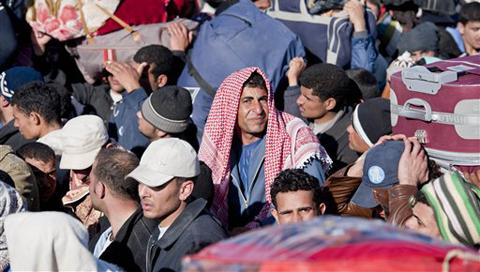 The United Nations refugee agency says over the past 10 days, more than 140,000 people have fled to Egypt and Tunisia from Libya. The UNHCR says tens of thousands of people are stuck at the borders and in urgent need of help.
The U.N. refugee agency says the situation at the Libya-Tunisia border is chaotic. It says 14,000 people crossed the border Monday, the highest number to date.
The agency says it is crucial to move tens of thousands of people away from the overcrowded border to avoid a humanitarian crisis. But transportation is scarce.
UNHCR spokeswoman Melissa Fleming says the agency has erected 1,500 tents, which can shelter 12,000 people. And she says two airlifts planned for Thursday will deliver tents and supplies for up to 10,000 people.
“We have now visited the border entry point to Tunisia. What is unfortunate is that thousands of people are waiting on the Libyan side of the border to enter. Some for as long as three days. They are obliged to spend the night outside in the bitter cold without shelter. We are very concerned that a large number of sub-Saharan Africans are not being allowed into Tunisia at this point. We are in negotiation with self-appointed volunteers from the local community who are guarding the border," she said.
Fleming says nearly 70,000 people have crossed from Libya into Egypt since February 19. She says the majority are Egyptians.
She says the UNHCR is particularly worried about thousands of refugees and asylum-seekers stuck inside Libya. She says the refugees come mainly from Iraq, Palestine, Somalia, Sudan and Eritrea. She says they have been living in Libya for a long time but now are desperate to leave.
Fleming reads a recent message sent by a refugee to UNHCR staff in Libya describing the fearful conditions under which he and his family are living. She says refugees and migrants from sub-Saharan Africa are particularly vulnerable.
“We are under attack by local people who are saying that we are mercenaries killing people. Let me say that they did not want to see black people. There is racism. We need help. Please, please, please, where is the humanity? Where is the United Nations? I am crying. I need help. Our home was burnt down. Ten Somalis were killed in Libya in the last seven days. Why is nobody concerned about the Somali migrants in Libya? We are victims of racism and ruthless exploitation," she said.
Fleming says the UNHCR offers assistance to those refugees who are able to reach its office in Tripoli. She says the agency’s 24-hour hotline continues to receive desperate calls from refugees in Libya and their family members outside. She says they say they feel trapped, threatened and hunted.
Yemeni Cleric Joins Protests, Calls for Islamic Rule
An influential cleric and former mentor of Osama bin Laden has joined tens of thousands of Yemeni opposition activists and called for the government's replacement with an Islamic state.
Sheik Abdul Majid al-Zindani Tuesday praised the anti-government protesters and called for President Ali Abdullah Saleh to step down. Zindani said the Yemeni president had come to power by force and that “the only way to remove him is through the “force of the people.”
The New York Times reported that Zindani, whose word carries considerable weight in Yemen, was guarded by his private security force of 10 men carrying AK-47 assault rifles.
The controversial cleric has been listed as a terrorist by the U.S. since 2004, suspected of fund-raising for al-Qaida and other groups. In the past, Zindani has maintained ties with Mr. Saleh. Until two weeks ago, he had backed the idea of the Yemeni president staying in power until his term ends in 2013.
Zindani's appearance came as Mr. Saleh accused his ally, the United States, for the first time, of fueling the daily protests against him. In an unusual display of anti-American sentiment, Mr. Saleh said the U.S. and Israel have been working together to foment unrest designed to destabilize the Arab world. He said the alleged plot had been orchestrated in Tel Aviv under U.S. supervision.
U.S. State Department spokesman P.J. Crowley said on the social networking websiteTwitter Tuesday that Mr. Saleh “knows better” than to think the protests in Yemen are part of “external conspiracies.” He added that the Yemeni people deserve a better response from their leader.
Mr. Saleh has cooperated with Washington in recent years in fighting al-Qaida militants who have used lawless parts of his impoverished nation to plot attacks against the U.S. and its allies.
Shortly after the president's comments, opposition activists gathered in a square near Sana'a University, chanting anti-Saleh slogans and protesting the killing of at least 24 people by Saleh loyalists since anti-government protests erupted in the country last month. Anti-government protests also took place in cities including Taiz and Aden, where demonstrators carried black flags in memory of those killed in the uprising.
Tuesday's protests were backed for the first time by a coalition of opposition parties who on Monday rejected a proposal from Mr. Saleh to form a unity government. At least 1,000 demonstrators are now permanently camped out on the streets of Sana'a.
Meanwhile, President Saleh fired five of the country's 22 provincial governors on Tuesday. The Associated Press quotes a government official as saying at least three were let go for criticizing Mr. Saleh's crackdown on opposition protesters.
US Lawmakers Press Obama on Trade Agreements
Sixty-seven Republicans in the U.S. House of Representatives have told President Barack Obama they want to work with him to approve long-delayed trade deals with Colombia, Panama and South Korea.
In a letter to the president, the legislators Tuesday said they believe that expanding trade will increase economic growth and create jobs in the United States. They said the three pending agreements have languished while America's partners have pursued negotiations that exclude the U.S. and put American workers at a competitive disadvantage. Their letter said the economy and job market cannot afford anything less than swift and decisive action.
It was made public on the website of the House Ways and Means Committee.
Last month, U.S. Trade Representative Ron Kirk told the committee the president planned to send the U.S.-South Korea free trade deal to Congress in the coming weeks, but that “serious issues” were holding up the deals with Colombia and Panama.
Ambassador Kirk offered no timetable for submitting the Colombia and Panama deals, which were negotiated during the previous administration of U.S. President George W. Bush. Kirk said the U.S. will work to address outstanding concerns relating to those agreements.
The trade deal with Panama has been delayed by U.S. concerns about that country's tax and labor laws. Some Democrats have opposed the Colombia agreement because of the nation's often-criticized record on human rights and labor union activity. Kirk said President Obama has directed him to intensify engagement with those countries to resolve the issues.
Colombia's government insists it has made great strides in human rights and labor protections.
Kirk also said the recently-concluded U.S.-South Korea trade agreement is better for America's auto industry and auto workers. The pact is expected to receive strong bipartisan support in both the House and Senate. It was held up on grounds that the Asian nation had not done enough to open up key markets, especially in automobiles.
House Speaker John Boehner has said Republicans are ready to vote on the three pending accords. A spokesman for Democratic Senate Majority Leader Harry Reid recently told VOA that votes will be scheduled in the Senate once the Obama administration presents the trade pacts to Congress.
The United States signed the agreement with Colombia in 2006. The deals with Panama and South Korea were signed the following year.
US Orders Ships to Libya
The United States has ordered two warships and 400 Marines to the waters off Libya, but top U.S. military officials played down the likelihood that the forces would intervene in the country's growing civil war.
U.S. Defense Secretary Robert Gates said Tuesday he has ordered to the Mediterranean two amphibious assault ships in case they are needed for emergency evacuations or humanitarian relief. The Marines, currently in the U.S., would be deployed to meet the ships, which are scheduled to travel through Egypt's Suez Canal on Wednesday.
Gates said the U.S. is preparing many “options and contingencies” for President Barack Obama to consider in response to the violence in Libya and general instability in the region. Gates did not rule out establishing a no-fly zone to prevent Libyan leader Moammar Gadhafi from carrying out airstrikes against rebel forces. But he said there is no international consensus for military action against the Libyan regime.
The top U.S. military officer, Admiral Mike Mullen, said a no-fly zone would be an “extraordinarily complex” operation. In separate testimony before a congressional panel Tuesday, General James Mattis said it would be necessary to pre-emptively attack Libyan air-defense installations to ensure they could not shoot down U.S. or NATO planes.
Meanwhile, U.S. Secretary of State Hillary Clinton warned Libya could become a “peaceful democracy” or face “protracted civil war.”
The top U.S. diplomat Tuesday repeated calls for Libyan leader Moammar Gadhafi to step down. She told lawmakers in Washington that “the stakes are high,” saying the right combination of U.S. diplomatic, development and defense efforts will be crucial.
Clinton said Washington will continue considering all options on Libya as long as the government continues to “turn its guns on its own people.” She also said the Obama administration may seek the prosecution of Mr. Gadhafi for the 1988 Lockerbie bombing in response to lawmakers' requests.
European foreign ministers meeting with Clinton Monday expressed skepticism that a no-fly zone for Libya could be effective and concern over how it would be viewed by other Arab nations.
Turkish Prime Minister Recep Tayyip Erdogan Tuesday called potential NATO intervention in Libya “unthinkable.”
Home Run King Again Pleads Not Guilty to Perjury
Major League Baseball's home run king, Barry Bonds, has again pleaded not guilty to charges that he lied under oath about using steroids.
Bonds' plea in a San Francisco court Tuesday was his fourth since the charges against him were first presented more than two years ago. Prosecutors have revised the charges several times.
Bonds is accused of making false statements to a grand jury and obstructing justice. Prosecutors allege he lied to a grand jury in 2003 when he said he never knowingly used performance-enhancing drugs.
His trial is set to begin March 21. But it remains to be seen whether the jury will hear testimony from one of the key witnesses, Bonds' personal trainer, Greg Anderson. Anderson already has served a year in jail for refusing to give evidence to the grand jury investigating Bonds, and he could face additional jail time if he refuses again.
Bonds holds baseball's single-season home run record of 73, hit in 2001. He also earned the record for the most home runs in a career in 2007, with 762.
Late in that season, the San Francisco Giants told the seven-time National League MVP they did not want him back. He has not played since.