
Ricky Martin to receive gay honour
Pop singer Ricky Martin is to receive an award from a leading US gay and lesbian organisation after coming out as gay last year.
The Gay and Lesbian Alliance Against Defamation (Glaad) gives the Vito Russo Award to openly gay entertainers who promote equal rights.
"Ricky coming out was a game changer for many gay and transgender Latino children," Glaad said.
"For too long, [they] did not have many out gay people to look up to."
Martin will receive the honour at a ceremony in New York next month.
Tony Award and Emmy Award-winning actress Kristin Chenoweth will also be honoured after criticising a Newsweek article that said gay actors could not convincingly play straight roles.
"When allies like Kristin take such powerful stands against anti-gay sentiments in the media, it sends an important message of equality," Glaad president Jarrett Barrios said.

Elizabeth Taylor treated in hospital for heart failure
Actress Dame Elizabeth Taylor has been admitted to a Los Angeles hospital to treat symptoms of congestive heart failure, her spokesperson said.
The 78-year-old was taken to Cedars-Sinai Medical Center for the "ongoing health problem", spokesperson Sally Morrison said.
It is not clear how long she will be in hospital, Ms Morrison added.
Dame Elizabeth has a long history of medical problems and underwent heart surgery in 2009.
"Her family and close friends are appreciative of the warm support and interest of her loyal fans but have asked that people respect her privacy and allow her medical team the time and space to focus on restoring her back to health," a statement issued on Friday said.
The actress had been scheduled to attend an award at a benefit gala for HIV/Aids charity amfAR on Wednesday in New York, but missed the event.
An award given in recognition of her support to HIV/Aids work was accepted by Sir Elton John on her behalf.
Dame Elizabeth won best actress Oscars for Butterfield 8 in 1961 and Who's Afraid of Virginia Woolf? in 1967.
Egypt rejoices at Mubarak departure
Fireworks lit the skies of Cairo and protesters shed tears of joy in Egypt as they celebrated the end of President Hosni Mubarak's 30 years of power.
Mr Mubarak stepped down as leader on Friday, after 18 days of widespread anti-government demonstrations.
The country is now is the hands of the high command of the armed forces, headed by the defence minister.
US President Barack Obama called Egypt an inspiration, but said it must now move to civilian and democratic rule.
Demonstrators in central Cairo continued to celebrate the departure of Mr Mubarak into the night, dancing, chanting slogans and singing songs.
In Cairo's Tahrir Square - the heart of the demonstrations - the news was greeted with jubilation by a crowd of tens of thousands.
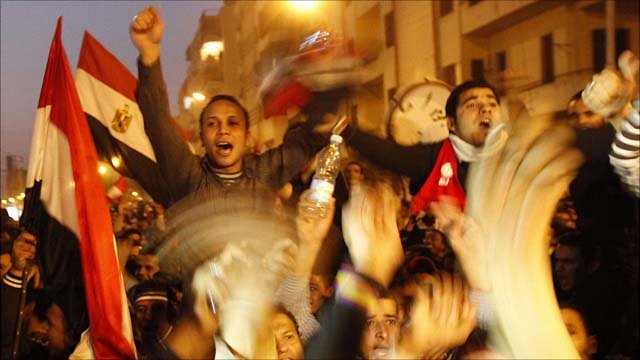 A huge poster hanging in the square read, "Breaking news: The people have brought down the regime."
Free drinks
The BBC's Jon Leyne in Cairo said the announcement caught everyone by surprise: all over the city, drivers honked their horns and people fired guns into the air.
"Egypt is free," Mahmoud Elhetta, a protester, shouted.
"We are a great people and we did something great. This is the expected end for every dictator."
The celebrations continued in other cities, with hundreds of protesters in Alexandria waving flags, whistling and dancing.
In the southern city of Assiut, people fired guns in the air and roamed the streets on motorcycles or pick-up trucks, while coffee houses handed out free drinks.
Eygpt's state television, a bastion of support for Mr Mubarak's government, started reporting the celebrations across the country.
Opposition leader Mohamed ElBaradei described it as "the greatest day of my life."
Announcing Mr Mubarak's resignation on Friday, Vice-President Omar Suleiman said the president had handed power to the army.
Mr Suleiman said on state TV that the high command of the armed forces had taken over, a body composed of high-ranking generals and headed by Defence Minister Mohamed Hussein Tantawi.
"During these very difficult circumstances Egypt is going through, President Hosni Mubarak has decided to step down from the office of president of the republic and has charged the high council of the armed forces to administer the affairs of the country," he said.
"May God help everybody."
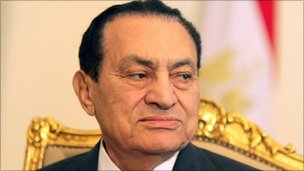 After Mubarak's resignation, a military spokesman appeared on state TV and promised the army would not act as a substitute to a "legitimate government acceptable to the people."
He said the military was preparing the next steps needed to achieve the ambitions of "our great nation" and would announce them soon.
US diplomatic cables published by Wikileaks described Field Marshal Tantawi as "aged and change-resistant", but committed to avoiding another war with Israel.
China warning
There was jubilation throughout the Middle East and North Africa, including in Tunisia, where people overthrew their own president last month.
President Obama described the Egyptian people as an inspiration to the world for carrying out a non-violent revolution, adding: "Egypt will never be the same again."
The BBC's Mark Mardell in Washington says that Egypt is a vital ally of America in the region and some are nervous about what change will mean.
But the message from the White House is that demonstrators represented a broad range of people not dominated by a single ideology, and that there is nothing to fear from democracy, our correspondent says.
A senior Israeli official expressed the hope that Mr Mubarak's departure would "bring no change to its peaceful relations with Cairo".
An official Chinese newspaper however has warned in an editorial that the situation could become "nightmarish" if stability is not restored.
"Social stability should be of overriding importance. Any political changes will be meaningless if the country falls prey to chaos in the end," the China Daily newspaper said.
Mr Mubarak has already left Cairo and is in the Red Sea resort of Sharm el-Sheikh where he has a residence, officials say.
The anti-government protests that began on 25 January were triggered by widespread unrest in Egypt over unemployment, poverty and corruption.
Algeria police deployed ahead of banned democracy rally
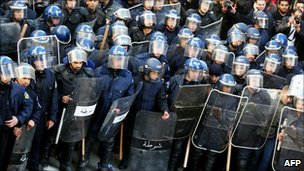 Riot police have been deployed in the centre of the Algerian capital, Algiers, ahead of a planned anti-government rally.
The government has banned the protest, but opposition and rights groups say they intend to go ahead with the march.
Algeria - like other countries in the region - has recently witnessed demonstrations for greater freedoms.
On Friday, police stopped people from gathering to celebrate the fall of Egypt's President Hosni Mubarak.
The BBC's Chloe Arnold in Algiers say the authorities want to avert any popular uprising similar to those in Tunisia and Egypt.
"We are ready for the march," Mohsen Belabes, a spokesman for the small Rally for Culture and Democracy (RCD) opposition party, said.
"It's going to be a great day for democracy in Algeria," he told Reuters news agency.
'Armoured vehicles'
Demonstrations are banned in Algeria because of a state of emergency which has been in place since 1992.
A heavy police presence is normal in Algeria but far more officers than usual were in place hours before the start of the protest at 1100 local time (1000 GMT), Reuters reports.
At least 15 police vans, jeeps and buses were lined up at 1 May Square, where the march is due to start, and about the same number on a nearby side-street outside the city's Mustapha hospital.
Small military-style armoured vehicles were also parked at junctions around the city.
Earlier this month, Algerian President Abdelaziz Bouteflika reportedly said the country's state of emergency would be lifted in the "very near future".
Mr Bouteflika made the announcement at a meeting with government ministers in the capital Algiers, according to the country's state-run media.
He said protests would be allowed everywhere in the country except in the capital.
Colombia's Farc rebels release two more hostages
Colombia's Farc rebels have released two hostages, bringing the number released so far this week to three.
The hostages - a local politician and a marine - were handed over to a humanitarian delegation in the jungles of southern Colombia and flown out on a Brazilian military helicopter.
The rebels have said they will free two more captives on Sunday.
The Colombian government has made the release of all hostages a condition for any peace talks with the Farc.
The two hostages - municipal council member Armando Acuna, 48, and marine Henry Lopez, 25 - were released in separate locations in the southern department of Caqueta.
The guerrillas handed them over to a delegation that included officials from the International Red Cross and the ex-Colombian senator Piedad Cordoba, who helped mediate their release.
Political weapon
Mr Acuna, who was kidnapped in May 2009, emerged from his jungle ordeal in an incongruous suit and tie, clutching the shirt of his local football team.
"It is time to move forward on the road to peace and reconciliation, seeking with dignity a solution to the Colombian conflict," he said.
He also urged an end to the use of kidnapping as a "political weapon" in Colombia and called on the Farc to stop attacks on local government officials.
Marine Lopez - who was captured in May 2010 after an ambush in which nine other marines were killed - did not appear before the media.
Earlier this week the Farc freed another local councillor, Marcos Baquero.
The Farc has been describing the releases as a unilateral "gesture of peace" to the government.
The rebels are still holding at least 15 police and military personnel, who they have been trying to exchange for captured guerrillas.
Some of the hostages have been in captivity for more than a decade.
President Juan Manuel Santos has made the release of all hostages a condition for opening peace talks with the Farc, along with an end to attacks and the use of land mines.
Will Iran change heavy-handed tactics against pro-reform protests?
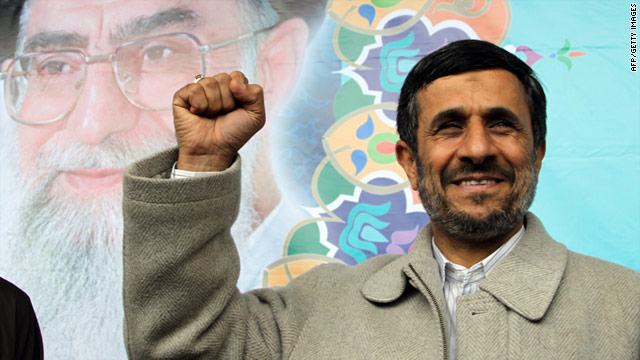 In a few breathtaking weeks, the winds of change whipped from Tunisia east to Egypt and Jordan, bringing down two regimes and putting the third on notice that it must make democratic changes.
Now analysts, and a world suddenly focused on the region, are wondering whether those winds will continue blowing east into Iran and bring real democratic change or, instead, amount to only a whisper.
A year and a half after the Iranian regime brutally suppressed the so-called Green Movement, a new test of its openness to reform and patience may come Monday.
The government -- which Friday said the toppling of President Hosni Mubarak in Egypt "joyfully" coincided with the anniversary of Iran's 1979 Islamic Revolution -- has rounded up activists after Iran's two leading opposition figures called for a rally Monday in support of the uprisings in North Africa and the Middle East.
From all appearances, the regime is not about to loosen its grip.
And, unlike Mubarak, it won't be caught off-guard by the zeal of protesters.
The Obama White House and some observers say Iran may not be as confident as it appears about demonstrations.
"They are scared," press secretary Robert Gibbs said Friday hours after Mubarak stepped down. "That's why they threatened to kill anybody that tries to do this. That's why they have shut off all measure of communication."
Iranian authorities on Wednesday warned against any attempt by the opposition movement to hold the rally, according to the state-run Islamic Republic News Agency. It was unclear whether people will take to the streets, anyway.
"We definitely see them as enemies of the revolution and spies, and we will confront them with force," Revolutionary Guard Cmdr. Hossein Hamedani told IRNA.
The Iranian regime on Friday celebrated the 1979 revolution that dethroned the shah.
Opposition leaders Mehdi Karroubi and Mir Hossein Moussavi asked that the rally take place in Tehran's Azadi Square, the site of mass protests by Iran's opposition movement after the disputed 2009 presidential elections.
The International Campaign for Human Rights in Iran, based in the United States, called Friday for an end to restrictions on the movements of Karroubi and Moussavi.
"The [Iranian] government is doing all it can to intimidate Iranians and deny their right to peaceful assembly," the U.S.-based group said in a statement. "With recent events in Egypt, we see another round of repression in Iran aimed at silencing a people frustrated and dissatisfied by the denial of their human rights."
Observers point to an interesting synergy between protests in Iran and Egypt. They are waiting to see if what's transpired in Egypt will ignite a substantial renewal of protests in Iran.
"I think that's a very substantial possibility," Joshua Muravchik, a fellow at the Johns Hopkins School of Advanced International Studies, told CNN Friday. "I think that the Green Movement in part inspired what has happened in Egypt. Obviously, Tunisia is the most recent inspiration."
"In June 2009, when the Green Movement emerged, the internet was full of chatter by Egyptians sort of beating their breast saying, 'Why are we so lame? Look at that: a million Iranians out on the street standing up to their government. Why can't we do that?' "
"And that sort of stuck with them [Egyptians], I believe," said Muravchik. "They kept having these small demonstrations and somehow it finally started to gather momentum and the snowball turned quickly into an avalanche."
"There's no guarantee though that it will work in the reverse direction," he said, referring to Iran.
The disputed 2009 presidential election sparked widespread outrage within the Islamic republic, thrusting the depths of Iranian society into the global spotlight and inciting violence that hadn't been seen in decades.
Iran quelled the demonstrations with a brutal crackdown against the peaceful street protests and the arrests of hundreds of activists, reformists and opposition figures. A diverse opposition movement -- headed by reform candidates Moussavi and Karroubi -- grew into today's Green Movement, protesting for social justice, freedom and democracy.
Experts interviewed by CNN said they believe Jordan, Bahrain and Yemen will likely see significant democratic changes before Iran, and each face different circumstances.
The United States on Friday slammed Iran's "hypocrisy" for arresting opposition figures and the blocking of world media outlets and websites.
"For all of its empty talk about Egypt, the government of Iran should allow the Iranian people the same universal right to peacefully assemble, demonstrate and communicate in Tehran that the people are exercising in Cairo," National Security Council spokesman Tommy Vietor said.
Iranian leaders praised the Egyptian and Tunisian uprisings and said they were reminiscent of the 1979 Iranian revolution that toppled the shah and ushered in a hard-line and theocratic Islamic republic.
Abbas Milani, director of Iranian Studies at Stanford University, said the Middle East is at a "crucial tipping point."
If democratic voices and a government prevail in Egypt, he told CNN, Iran will feel an uptick in internal pressure to reform.
But, he and others said, there is a singular difference between Egypt and Iran.
The Egyptian military, while key to power in the country, did not clash with its citizens.
Iran's Revolutionary Guard Corps (IRGC) was established after the Islamic Revolution to defend the regime against all threats. The IRGC and its "thugs" have repressed Iranians, Milani said.
The Iranian military is not as well equipped and as politically oriented as the IRGC and played little, if any, part in the 2009 crackdown.
"I think they knew the military could not be depended upon" because they might side with protesters, Milani said of the Iranian government.
The IRGC has "expanded far beyond its original mandate," according to the Council on Foreign Relations, a U.S. foreign policy research center.
"Today the guard has evolved into a socio-military-political-economic force with influence reaching deep into Iran's power structure," the CFR says, noting that several current and former IRGC members have been appointed to positions as ambassadors, mayors, undersecretaries, provincial governors and cabinet ministers.
Mohamad Bazzi, adjunct senior fellow for Middle Eastern Studies at the Council on Foreign Relations, said the IRGC will stand behind President Mahmoud Ahmadinejad, who helped consolidate their influence.
And Supreme Leader Ayatollah Ali Khamenei has shown no signs of abandoning Ahmadinejad, Bazzi said.
Milani doesn't expect the Iranian regime to allow large protests, but he believes "major changes" and an "unstoppable democratic wind" eventually will come to the republic. Iran also must address significant economic problems, he added.
"The Iranian society has profoundly changed,"he said. "The regime has not."
Ali Alfoneh, a resident fellow at the conservative but non-partisan American Enterprise Institute, said he doesn't expect to see major reforms in Iran, at least in the short term, but he believes dissidents were heartened by the Egyptian revolution.
"The Green Movement was almost dead and it has become energized," he told CNN Friday.
The reform efforts will succeed if some principal players in the regime become sympathetic, he said. In Egypt, armed forces helped bring about Mubarak's downfall. That won't likely happen in Iran, Alfoneh said.
"Revolutions take defections," Alfoneh said.
Rapid changes in Egypt and the region make it difficult to predict what might happen in Iran, Bazzi said.
"Surviving the last round [of protests] strengthened the regime's hand," he said. The suppression "put fear in the protesters," he said.
To succeed, the Green Movement will have to reach out to opponents and "to the millions who are silent," said Bazzi, a member of the faculty at New York University.
Real change may not occur until the next presidential election, he said.
Still, the Iranian regime is probably somewhat concerned after what happened in Egypt.
"They are crushing anything that moves," Bazzi said.
Isobel Coleman, a senior fellow for U.S. foreign policy at the Council for Foreign Relations, said one big difference between Iran and Egypt are their economies. Iran has a lot of oil, and it can afford to be "more reactionary and revolutionary."
Meanwhile, the Obama administration will continue to pressure Iran over its nuclear program, human rights and influence with militant organizations that threaten Israel, among other governments.
Former Alaska Gov. Sarah Palin on Friday questioned the White House's handling of Iran.
"Media: ask "Will Obama Admin exert as much 'constructive' pressure on Iranian govt to change & allow freedom -- as they just did for Egypt?," she wrote on her Twitter account.
As the world turns its attention to Iran, especially in the coming days, questions remain on whether governments can change and still hold on to power.
Milani offered his opinion.
"The experience of the last days shows it is almost impossible to ask for democracy and not ask for a regime change," he said.
Rights groups: prominent Chinese activist and wife beaten
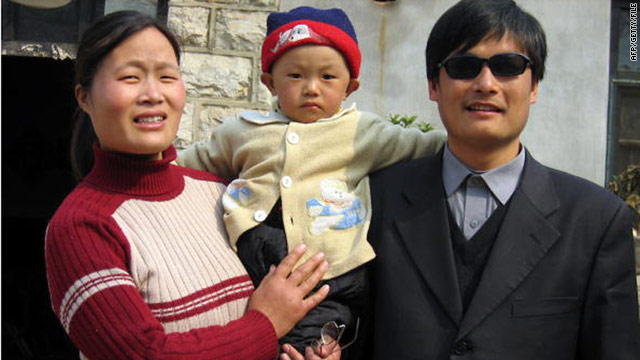 One of China's most prominent activists and his wife are under house arrest and have been beaten by authorities, two human rights groups, China Aid and Chinese Human Rights Defenders said Friday.
In a home video released Wednesday by U.S.-based rights group China Aid, Chen Guangcheng described the dire and frustrating conditions of his house arrest, since he was released from jail in September. He said police have threatened to throw him back in jail without recourse.
"I've come out of a small jail and entered a bigger one (house arrest)," Chen, 39, said in the video, wearing sunglasses and a black jacket. "Those people stand at the four corners of my house and spy on my family and monitor what we do ... floodlights have been installed around my house and surveillance cameras."
Vehicles surround his home, and his land line and mobile phone have been cut off. Chen said anyone in the community who attempts to help him is threatened by the authorities.
"My house is basically under surveillance 24 hours a day and we can't get out of the house and the same thing happens to my wife," described Chen. "Only my mother can go out to get something for us to eat and stay alive."
On Friday, the Hong Kong-based China Human Rights Defenders reported Chen and his wife Yuan Weijin were severely beaten after the public release of the video showing Chen discussing his house arrest at home.
"According to our source, the beating was not light but also was not life threatening," Wang Songlian of China Human Rights Defenders told CNN in a phone interview.
Calls to local authorities went unanswered.
Chen and his wife have not been allowed to visit a hospital or see a doctor, the organization said. Cheng has been ill for several months now with an intestinal infection and he has not been able to seek medical attention, according to CHRD.
"What they do now is is what I call thuggery," Chen said in the video. "First they provoke you through various means and stir up trouble. After all, no matter how they beat me, the judicial organs will turn a deaf ear since it is done on the order of the Party Committee."
Chen is a well-known activist in China.
In 1998, he led farmers in Yinan County, where his hometown is located, to protest against a river-polluting paper factory and persuaded an international donor to fund a deep well for drinking water as alternative to the polluted river water.
He later set up a center for rights of the handicapped and filed a case against a public transport company in Beijing for refusing to honor the law providing free rides to them.
Chen brought class-action lawsuits on behalf of families impacted by China's enforcement of family-planning laws, which limit couples to one child.
After his years of activism, the People's Court of Yinan County sentenced Chen to four years and three months in prison in August 2006 on charges of "willfully damaging property" and "organizing a mob to disturb traffic."
Chen's supporters called the charges preposterous.
Last month, in the lead up to Chinese President Hu Jintao's visit to the United States, Secretary of State Hillary Clinton called for the release of Chen, Nobel Peace Prize laureate Liu Xiaobo, along with other political prisoners who are "enduring enforced disappearances."
Assange extradition hearing ends
A court hearing to determine whether Britain will extradite WikiLeaks founder Julian Assange to Sweden ended Friday.
Assange has not been charged with a crime, but Swedish prosecutors want to question him in connection with sexual misconduct allegations related to separate incidents in August. Assange denies the accusations, and his attorneys are fighting his extradition on procedural and human-rights grounds.
Judge Howard Riddle said he hopes to announce his decision on February 24.
Assange's attorney, Geoffrey Robertson, has argued that Assange would not receive a fair trial in Sweden. They argue that Swedish prosecutors have improperly leaked details of the case.
Robertson said remarks attributed to Swedish Prime Minister Fredrik Reinfeldt have created a "toxic atmosphere" for Assange, who he said is viewed as "public enemy number one" in Sweden. The prime minister suggested that Assange believed women's rights were worthless, Robertson said in court.
The judge said he would consider the prime minister's remarks in his deliberations. He spent two and a half days this week hearing the extradition request.
Assange's website, WikiLeaks, has published tens of thousands of once-secret U.S. documents on subjects ranging from the war in Afghanistan to the inner workings of U.S. diplomacy.
Assange's lawyers have raised the possibility that Sweden would hand over Assange to the United States if Britain extradites him to Sweden. Prosecutor Clare Montgomery, representing Sweden, has dismissed that claim.
I have never activated Belonger Status in TCI-Butch Stewart
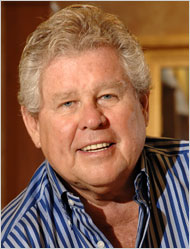 CHAIRMAN of Sandals Resorts International Gordon 'Butch' Stewart says he has not activated or benefited from Belonger Status granted to him by the Government of the Turks & Caicos Islands (TCI).
Stewart, who is also the chairman of this newspaper, said he wanted to make that information clear as he has got wind of an attempt to smear his name because of status.
"At no time have I used my Belonger Status nor have I employed it to gain favour in any way," Stewart said in an interview.
He explained that the Belonger Status was granted to him, his family and Dr Jeffery Pine, former managing director of Gorstew (Stewart's holding company), by the Michael Misick Government.
To benefit from the status, the holder must have it stamped in his passport.
Only persons with Belonger Status can vote in general elections in the TCI. It also gives individuals the absolute right to reside and work in the TCI without any type of immigration control. Further, only Belongers may be considered for certain official offices.
Belonger status is granted to individuals depending on the immigration status of their parents or spouses. In other circumstances it may be bestowed upon an individual as a direct result of a worthwhile investment or other significant contributions to the TCI.
The status was granted to the Stewarts because of their investment — Beaches Turks & Caicos Resort Villages & Spa — in the TCI.
With 700 luxury one and bedroom suites, it is the largest investment in the Turks & Caicos and employs the most people there. Beaches Turks & Caicos has been granted Six Star Diamond Resort status and is the only 6-Star Green Resort in the Caribbean, making it the best recognised environmentally friendly hotel in the region. It is also regarded as the largest family resort in the Caribbean, it is also believed that Beaches TCI is the largest earner of foreign exchange in the British Caribbean territory.
Yesterday, Stewart made it clear that he did not pay for the Belonger Status and said he has no interest in acquiring Crown lands in the TCI. Sandals, he said, has acquired land in the TCI by private treaty in anticipation of future expansion there. The all-inclusive resort group has also acquired a two-and-a-half acre parcel of scrubland which was bought from the government. Stewart said the sale went through the full process of valuation and the attorney-general and received cabinet approval. It will be utilised as a water park for the sprawling hotel, which has been awarded the Best Family Resort in the Caribbean.
The granting of Belonger Status, he insisted, was simply a courtesy and an act of goodwill, nothing more.
"In no way am I qualified to buy Crown lands there," added Stewart. "I am proud of the fact that we have created and continue to operate the best family resort of its kind in the Caribbean, which has played no small part in helping the airlift in the TCI."
An industry insider noted that the hotel is the best ambassador for Jamaican tourism workers and employs 420 of the finest Jamaicans who wave the Jamaican flag in the TCI high. The insider added that some of the richest people in the world frequent Beaches Turks & Caicos.
Misick, who is facing tough questions from the Foreign Affairs Committee of the UK Parliament about financial impropriety and government corruption, has said that the issue of granting Belonger Status was free from corrupt practices.
"No one individual grants Belonger Status," Misick said. "Belonger Status is granted on the basis of the length of the stay in the country, the contribution they have made and how they have assimilated in the community. There are a number of factors there by law in the granting of Belonger Status."
He explained that the governor sits at Cabinet and acts on its advice concerning Belonger Status.
"If he thought the Belonger Status that the Cabinet was recommending was corrupt, he doesn't have to accept their advice," Misick told the committee.
Stewart added: "We are in the TCI to develop a tourism product, and we are extremely proud of what Jamaicans have achieved with this world-renown hotel. What we are not there to do is benefit from any sort of government favouritism."
Source: http://www.jamaicaobserver.com
'DRIVERS URGED TO USE COMMON SENSE,' so says Hospital Bosses
DRIVERS using Provo’s hospital are being warned about illegal parking.
Hospital bosses have promised to get tough with motorists who break the rules at the Cheshire Hall Medical Centre.
And cars that flout the one-way and emergency vehicle-only zones are also being targeted in the crackdown by InterHealth Canada.
Chief of support services Jim Trainor said lives are being put at risk by what he calls ‘inconsiderate drivers’.
"On the whole the parking and road system at Cheshire Hall works very well", he said. "But unfortunately there are a small minority who spoil things. Initially drivers claimed that our road signs were too small but signage has now been enlarged to counter this.
"In terms of parking I would urge people to park properly between the guide lines and not take up two spaces, causing danger and inconvenience to others.
"Also, patients are reminded that the disabled bays at the front of the centre are for people who have driven themselves to hospital but have personal mobility problems. These are generally dialysis and physiotherapy patients and security officers will be checking in future."
He added: "Those who are transporting others to the centre are quite entitled to use the drop off area by the main doors but please can drivers not leave vehicles unattended and never park on the pedestrian crossings."
Mr Trainor said that his biggest concern was cars using the emergency vehicles-only road, leading to the emergency department.
He explained: "There is a clear one way system around the site and people must keep to it. They must also watch their speed and use their common sense.
"Also please remember that the only vehicles permitted to park at the Emergency Department are emergency vehicles and it is also imperative that motorists do not use the emergency vehicles-only route.
"This route is for exactly what it says it’s for and not if you are transporting something with a minor complaint. Using this route could put people’s lives at risk and so I’d urge everyone to be both sensible and patient."
He added: "The rules and regulations are there for a reason. It’s not us being awkward. It’s because it’s important that all patients, visitors and staff are safe and have easy access in and out of the centre, 24 hours a day."