
Fundraising pressure on China's banks unlikely to ease
 Despite a flurry of deals last year that raised nearly $82 billion, stock and bond sales by China's banks are expected to continue as the industry pumps out loans to support its economy.
While Industrial and Commercial Bank of China (1398.HK) (601398.SS) said on Thursday it will not pursue fund raising for another three years, other banks may have to tap markets to keep up with loan growth.
The Agricultural Bank of China (1288.HK)(601288.SS), having raised $22 billion in an IPO last August, has already tapped investors for another $8 billion of capital barely two weeks into 2011. And that still may not be enough, according to some analysts.
With Chinese banks embarking on another lending spree in recent months, some may not have as big a cushion as they think when it comes to cash reserves.
For now, though, the near term fund raising targets are expected to be small to mid-sized lenders such as China Merchants Bank (600036.SS), analysts say. China Merchant's top-quality reserves -- known as Core Tier 1 capital -- are the lowest among the top eight.
"The smaller players are known for growing their loan book aggressively, so I expect share issues to be something that may happen again in the future," said Sophia Huo, an analyst at Daiwa Securities in Hong Kong.
China Merchants Bank declined to comment for this article.
Chinese banks raised $81.6 billion to shore up their balance sheets in 2010, according to Thomson Reuters data, with AgBank's IPO and clocking in as the world's biggest IPO on record.
The tighter capital controls come at a time when regulators are trying to pull back on lending to drain liquidity out of the system and cool China's red-hot growth, with tougher rules expected in the coming year.
However, despite all the rhetoric about restricted lending, the banks don't seem to be listening, with overall loans climbing to 1.6 trillion yuan in the last quarter of 2010 as borrowers tapped the banks ahead of an expected rise in interest rates.
And the new year has brought no sign of a slowdown, with sources saying banks doled out 500 billion yuan ($75.6 billion) in new loans in the first week of January alone.
"The banks have their own relationships they need to maintain with their customers, so they probably have to continue lending if their customers want it," said Daiwa's Huo.
Among the stock deals anticipated for 2011, mid-sized lender China CITIC Bank (0998.HK), 15 percent owned by Spain's BBVA (BBVA.MC), said it would look to raise more than $3 billion.
AgBank may need a fresh infusion of cash as early as 2012, when its self-imposed three-year limit on new fundraising expires.
Michael Werner, senior equity analyst at Bernstein Research said that even after AgBank's fund raising efforts, its core capital ratio is 9.75 percent, or slightly below what China's banks are aiming for.

Lehman sees $60 billion bankruptcy payout, needs time
Lehman Brothers Holdings Inc (LEHMQ.PK) said it will take longer than expected to win approval of a bankruptcy plan, and projects paying out $60.1 billion as it tries to settle differences with creditors owed six times that amount.
Harvey Miller, a lawyer for Lehman, told U.S. Bankruptcy Judge James Peck at a hearing in Manhattan on Thursday that the company hopes to file a revised Chapter 11 plan in seven to 10 days, and win court approval "well before the end of the year."
Miller, a partner at Weil Gotshal & Manges LLP, said Lehman's earlier goal to win approval of a bankruptcy plan by the end of March is no longer feasible.
According to a regulatory filing, Lehman expects to have about $60.1 billion of assets, up from the $57.5 billion it estimated six months earlier, to distribute to creditors once it emerges from its now 28-month-old bankruptcy.
Lehman said the judge will likely let creditors pursue $322 billion of their estimated $369 billion of claims. It said a "significant" amount of claims are unresolved, including $40.3 billion tied to derivatives.
The company still needs an accord with creditors, including billionaire investor John Paulson, that submitted a competing Chapter 11 plan in December. This group believes Lehman's plan treats big bank creditors better than other creditors.
Once the fourth-largest U.S. investment bank, Lehman filed for court protection on September 15, 2008, in by far the largest bankruptcy in U.S. history, after growing overexposed to real estate, mortgages and complex debt that plunged in value.
The bankruptcy filing is considered one of the main triggers of the global financial crisis.
"GOLDEN OPPORTUNITY" TO SELL ASSETS
Bryan Marsal, Lehman's chief executive and a principal at restructuring firm Alvarez & Marsal LLC, told Peck that improved market conditions for mergers and acquisitions give Lehman a "golden opportunity" to sell assets over the next six to 12 months.
Lehman can start repaying creditors once it emerges from bankruptcy. A company typically emerges shortly after it wins approval of a reorganization plan, but it is unclear how fast Lehman might emerge.
Under Lehman's plan, unsecured creditors could recover 10.4 cents to 44.2 cents on the dollar, general unsecured creditors of the holding company could recover 14.7 cents on the dollar, and creditors of derivatives and commercial paper units could recover 21.9 cents to 44.2 cents on the dollar.
The company is separately suing Barclays Plc (BARC.L), JPMorgan Chase & Co (JPM.N) and others to recover tens of billions of dollars of assets for distribution to creditors.
Barclays bought Lehman's main U.S. brokerage business shortly after the bankruptcy. Peck is expected to rule early this year on Lehman's claim that Barclays extracted an $11 billion "windfall" from this transaction.
Madoff victims win $7.2 billion from Picower estate
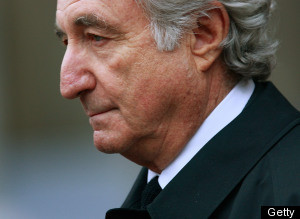
It's a landmark day for victims of Bernard Madoff's Ponzi scheme. A bankruptcy court judge approved the trustee's request to dole out billions of dollars in seized assets to the victims.
Judge Burton Lifland ruled on Thursday that Irving Picard, the court-appointed trustee in the recovery of assets stolen by Madoff, should free up cash to compensate victims.
This applies specifically to the $7.2 billion estate of Jeffry Picower, a philanthropist and Madoff associate who died of a heart attack in 2009. On Dec. 17, 2010, Picard reached a deal with Picower's widow Barbara, who agreed to turn over the money her husband received from the Madoff scheme so it could be returned to victims. This is the largest forfeiture in U.S. history.
"It was totally appropriate and correct and very beneficial to the victims," Picard told CNNMoney.
Picard claimed in court filings that Picower was a key beneficiary of Madoff's scheme. The trustee said Picower had withdrawn $7.8 billion from Madoff's firm since the 1970s, even though he only invested $619 million. Picower "knew or should have known that [he] was profiting from fraud, because of the highly implausible high rates of return" on his accounts, the trustee said.
Barbara Picower has denied that her late husband knew anything about the scheme.
Many victims have received compensation through the Securities Investor Protection Corp., which insured $783 million of the damages to investor. But with the court's ruling, this is the first time that victims will receive money from seized assets.
The trustee has verified nearly $6 billion worth of claims from 2,372 victims. More than 10,000 claims have been denied, in some cases because the victims withdrew more from Madoff than they invested, and in other cases because they invested through feeder funds.
The trustee has sued at least 400 investors, who withdrew more money from Madoff than they invested
Madoff pleaded guilty in March 2009 to orchestrating the most massive Ponzi scheme in history. He used his Manhattan investment firm as a front for the pyramid-style scam.
He stole money from investors while claiming to be investing it in the markets. He would provide the stolen money to his more mature investors, like Picower, while fraudulently claiming that the returns were legitimate.
Madoff is serving a 150-year sentence in a medium security federal prison in Butner, N.C.
Auto bailout's estimated cost to taxpayers: $19 billion
A Congressional oversight panel says that a "starkly improved" outlook for the auto industry has reduced the likely taxpayer loss on the bailout by more than half to about $19 billion.
The previous estimate from the panel was that taxpayers would lose $40 billion of the $81.3 billion given to the automakers and their finance arms from the Troubled Asset Relief Program.
The bailouts funded the automakers' operations through bankruptcy and Treasury ended up with significant equity in the various companies in return for the bailouts.
The report questions Treasury's decision to sell so much of its stake in General Motors (GM) during the automaker's successful initial public offering in November, saying the decision "essentially locked in a loss of billions of dollars and thus greatly reduced the likelihood that taxpayers will ever be repaid in full."
And it also cast doubt on whether Treasury will be made whole on a smaller bailout of the Chrysler Group, and questioned its handling of its holdings in the former finance arms of the two automakers, GMAC/Ally Financial and Chrysler Financial.
Treasury spokesman Mark Paustenbach said that despite the criticisms in the report, the analysis of the bailout was largely positive. The report acknowledged the government's action was necessary, he said, and because of the bailouts, the industry is now on a promising course.
Administration officials said it is too soon to say the final cost to taxpayers until the last shares of stock in GM, Chrysler and Ally Financial are sold.
But the Congressional report also says that there are significant consequences of the bailout which go beyond the loss of tax dollars.
"Treasury's rescue suggested that any sufficiently large American corporation -- even if it is not a bank -- may be considered 'too big to fail,' creating a risk that moral hazard will infect areas of the economy far beyond the financial system," it said.
"Further, the fact that the government helped absorb the consequences of GM's and Chrysler's failures has put more competently managed automotive companies at a disadvantage. For these reasons, the effects of Treasury's intervention will linger long after taxpayers have sold their last share of stock in the automotive industry."
1 million homes repossessed in 2010
Foreclosures were at a record high in 2010, and more than 1 million people lost their homes, even as notices started leveling off during the end year.
In total, there were nearly 2.9 million foreclosure notices filed during the year, according to report released Thursday by RealtyTrac. That was a record high, but just 1.7% above 2009.
It most certainly would have been higher had notices not plunged in November and December as banks halted tens of thousands of foreclosures in the face of the robo-signing scandal.
"Total properties receiving foreclosure filings would have easily exceeded 3 million in 2010 had it not been for the fourth quarter drop in foreclosure activity," said James Saccacio, RealtyTrac's CEO. "Many of the foreclosure proceedings that were stopped in late 2010 -- which we estimate may be as high as a quarter million -- will likely be re-started and add to [foreclosure] numbers in early 2011."
For the fourth consecutive year, Nevada led the nation in the rate of foreclosures with one of every 11 households there receiving at least one filing in 2010. Still, that constituted a 5.3% improvement from a year earlier.
In Arizona, one of every 17 households received a filing in 2010, down 4.5% for the year. Florida's 2010 foreclosures (one in 18 households) dropped 6.1% year-over-year, and California (one in 25) fell 8.5%.
Overall, 2010 was a rough one for the mortgage industry. The big news was the robo-signing scandal, which erupted in the fall amid allegations that banks were foreclosing on homes without having read the documentation.
Then, President Obama's efforts to fend off foreclosures foundered as the year wore on and the potential for ever more massive foreclosures ballooned.
At the beginning of 2010, the bloom had not yet faded from Obama's HAMP (Home Affordable Modification Program ) program, and many analysts were optimistic it would help many people save their homes.
By April, it became apparent that the program was losing the foreclosure fight; there were reports of 10 new defaults for every HAMP modification and the projections for the number of borrowers who would actually receive a HAMP mod had nose-dived to 1 million from 4 million.
Then the next shoe to drop came in June, with a report from Fitch Ratings that showed HAMP modifications re-defaulting at a high clip. The company forecast that three-quarters of all HAMP mods would ultimately fail.
The foreclosure prevention program really started to fade by mid-summer: Fewer than 37,000 loans received HAMP modifications in July, down from more than 50,000 a month earlier. Only 435,000 loans had gotten permanent modifications through the program.
The next few years could be difficult. Some industry analysts, such as Laurie Goodman, head of Amherst Securities mortgage group, say that as many as 11 million mortgage borrowers are in potential danger of default.
However, Rick Sharga, RealtyTrac's spokesman, predicted 4 million to 5 million and scoffed at quantifying the magnitude of the potential disaster, comparing it to "taking inventory of deck chairs on the Titanic."
Roger Federer 'can win 20 Grand Slams', says Annacone

Roger Federer's coach Paul Annacone has predicted that the world number two could extend his record Grand Slam tally to 20 titles.
"If he can stay healthy and happy and eager, I don't know what the end number would be. But is 20 realistic, sure, why not?" Annacone said.
Federer, 29, will bid for his 17th Grand Slam title at the 2011 Australian Open starting on Monday.
Annacone was hired by the Swiss after a quarter-final Wimbledon exit in 2010.
Federer has credited the Californian coach for his recent resurgence, capped by victory over world number one Rafael Nadal to win the season-ending World Tour Finals in November.
"He can win every tournament he plays, he's probably not going to, but he can win every match he plays and there's not a lot of guys you can say that about," Annacone, who works with Federer's Swiss coach Severin Luthi, told the Australian Open website.
Outlining his approach to coaching the world number two, Annacone, who has previously coached American Peter Sampras and Briton Tim Henman, added: "It's about combining the head, heart and talent components of a player, and understanding how they interact, the best way to match up against other players.
"And, ultimately, the best way for them to keep having fun doing it, and the best way to try to get better."
Federer kicked off his season with victory at the Qatar Open when he thrashed Russian former top-10 player Nikolay Davydenko in the final.
The Swiss is in Melbourne preparing for next week's Australian Open and he hopes to organise a charity exhibition match on Sunday to help the victims of the flooding in Queensland, Australia.
Federer organised a similar event last year following the Haiti earthquake, with Nadal and Serena Williams among those who took part.
"The floods here in Australia are devastating!" Federer said on Facebook.
"I am on my way to practise now and am going to speak with Tennis Australia to see if we perhaps can organise something on Sunday to help raise some funds for the people of Queensland who have been affected.
"Stay tuned as it would be great if the sport of tennis can help out right before the Australian Open begins."
Queensland's flooding has caused billions of dollars worth of damage and affected 200,000 people, with the death toll at 12 so far and many others reported missing.
American Andy Roddick pledged $100 for every ace he served at the Brisbane International last week, and doubled the tally to $10,800 after losing the final to Robin Soderling.
Australian Sam Stosur offered the same and the ATP and WTA professional tours expect to donate A$40,000 with their pledge of $100 for every ace over three tournaments, including next week's Australian Open.
England's cricketers and their Australian counterparts also passed collection buckets around the crowd at the Adelaide Oval on Wednesday during their first Twenty20 match, and plan to donate part of their match fees to Queensland Premier's Flood Relief appeal.
It was announced that $24,899 had been raised from the crowd of 32,054.
England bowler Graeme Swann said: "It is important that we do something, those people need as much help as possible. It's a terrible time and each day it seems to get worse and worse."
England batsman Kevin Pietersen had already announced that he would auction off one of the shirts he wore in England's Ashes triumph, as well as a bat and two tickets to a one-day international to raise funds.
Brazil flood and mudslide deaths rise as search goes on
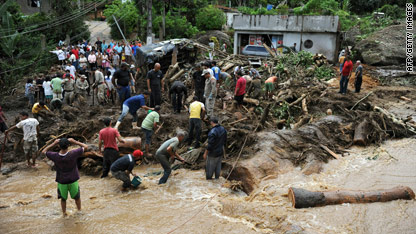
More than 500 people are now known to have died in floods in south-eastern Brazil, the country's worst natural disaster for several decades.
Heavy rain has led to massive mudslides hitting several towns, resulting in thousands being made homeless.
Police say the number of dead is likely to rise further.
The death toll has now surpassed the devastating 1967 mudslides in Caraguatatuba, Sao Paulo state, in which up to 430 people perished.
'Thousands trapped'
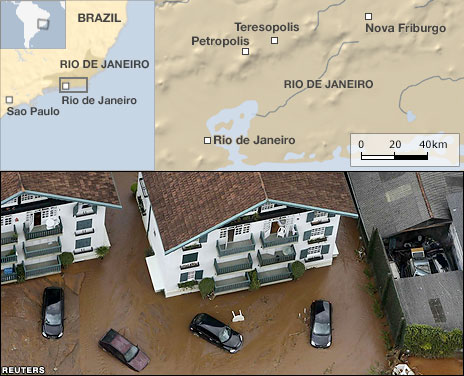
Rescue workers will resume searching for survivors in the mountainous Serrana region, north of Rio de Janeiro, later on Friday.
Many spent Thursday scrabbling with their bare hands through debris.
On her visit to the area, President Dilma Rousseff promised a shipment of seven tonnes of medicines.
In the Campo Grande area of Teresopolis, which was earlier cut off, rescuers found people pulling bodies from the mud.
In the neighbouring town of Petropolis, local resident Nelson Toledo told the BBC that some areas "had been completely devastated" by the floods and mudslides.
He said "thousands" of people remained trapped in their homes.
Morgues in the affected towns were full, with churches and police stations receiving bodies.
Officials in Brazil's civil defence department have warned there could be hundreds more bodies yet to be recovered in Teresopolis alone, the Globo media organisation reported.
One area of Teresopolis, Campo Grande, remains cut off entirely and is yet to be reached by any rescuers. It is feared 150 people may be buried there.
One resident of Teresopolis, Angela Marina de Carvalho Silva, told the Associated Press news agency she feared she might have lost 15 relatives, including five nieces and nephews.
"There are so many disappeared - and so many that will probably never be found," she said.
She said she had taken refuge at a neighbour's house on higher ground and watched the water sweep away cars, tree branches and animals and destroy the homes of friends and family.
"There was nothing we could do. It was hell."
A state of emergency has been declared in the town, after the mayor called the floods "a huge catastrophe, a major disaster".
Sixteen more bodies were found there early on Thursday, but the most dramatic rise was in Nova Friburgo, where 48 more people were reported to have died.
Amid the death and destruction in Nova Friburgo there was one glimmer of hope: a six-month-old baby, reportedly named Nicholas, was found alive after 12 hours trapped in the rubble of a ruined building, reports said.
In Petropolis, Mayor Paul Mustrangi said the waters had ripped through some areas with devastating effect.
"There is nothing left. All the houses were hit," he told Jornal do Brasil.
Tunisia protests: Live bullets fired in central Tunis
Security forces have fired live bullets and tear gas in the centre of the Tunisian capital Tunis, reports say.
At least one person is reported to have been killed and a large area of the city centre has been closed off by police and the military.
It comes after violent scenes in the capital overnight despite a night-time curfew being put in place.
At least 23 people have died since nationwide protests over poverty and corruption began last month.
The BBC's Adam Mynott in Tunis says the unrest has now reached the central streets of the capital, close to shops, banks and the French embassy.
Police have put up road blocks and have fired tear gas to push back crowds gathering to watch the events, our correspondent adds. There have been reports of looting.
Witnesses said at least one person had been shot and another seriously wounded.
It comes after one protester was reportedly shot dead in a western suburb of Tunis, and three others in a southern area of greater Tunis. Rights groups said up to eight people had died.
President Zine al-Abidine Ben Ali has called the unrest a "terrorist act".
But France, the former colonial power in Tunisia, has called on the government to show restraint.
Escalating anger
The protests reached the capital for the first time on Wednesday afternoon, as protesters threw stones and police responded with volleys of tear gas.
An indefinite night-time curfew was put in place but overnight, youths fought battles with security forces and set fire to buildings.
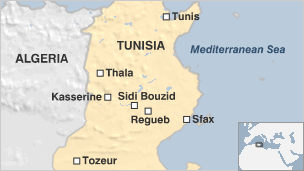
More clashes were reported from at least half a dozen towns across the country, including Sfax, Douz and Thala.
Reuters reported up to 10,000 people were on the streets in Sidi Bouzid.
"It is not just about unemployment any more," one protester said. "It's about freedom of expression, freedom of assembly, all the freedoms."
Switzerland's foreign ministry has confirmed that a woman who had dual Swiss-Tunisian nationality was killed in the north of Tunisia.
Swiss Radio said she was hit in the throat by a stray bullet while watching a protest late on Wednesday in the town of Dar Chaabane.
A foreign ministry statement said the Tunisian ambassador had been summoned, and called on the Tunisian government to "respect dialogue, fundamental liberties and human rights", including freedom of assembly.
French diplomats have also reportedly informed the family of a French-Tunisian academic, Hatem Bettahar, that he was one of two protesters killed by the police on Wednesday in the central town of Douz.
Mr Bettahar, a computer science lecturer in France, had been visiting his mother. A Tunisian teacher has said he has posted on the internet a video showing Mr Bettahar lying in a pool of blood after being shot.
French Prime Minister Francoi Fillon has criticised the "disproportionate use of violence" and called on all sides to show restraint.
Strike call
The International Federation for Human Rights says 66 people have died since mid-December, almost three times the government's official figure of 23.
UN High Commissioner for Human Rights Navi Pillay has blamed the deaths on "excessive measures used, such as snipers" and urged the government to investigate them fully.
Earlier this week, Mr Ben Ali dismissed his interior minister and ordered the release of most of those arrested during the protests. He also promised to look into the allegations of corruption.
But many in Tunis view these assurances as empty words, says our correspondent.
"Tunisia needs global reform as well as the formation of a national unity government more than ever," said the secretary-general of the opposition Progressive Democratic Party (PDP), Maya Jribi.
Unions have also called for a strike in Tunis on Friday as another means to put pressure on the government. Union officials told the BBC that a strike had been observed in the central Kasserine region on Wednesday.
Meanwhile, al-Jazeera TV is reporting that the president has sacked two of his top advisers, Abdelaziz Ben Dhia and Abdelouahab Abdallah. And the AFP news agency quoted opposition officials as saying the Army chief of staff, Gen Rachid Ammar, had been replaced for refusing to order soldiers to put down the protesters.
There are also unconfirmed reports that the president's son-in-law, the billionaire businessman and MP Mohamed Sakher El Materi, has fled the country and taken refuge in the Canadian city of Montreal, where he owns a mansion.
Protesters have directed much of their anger at the great wealth and lavish lifestyle of the president's extended family.
Anti-government demonstrations have been rare in Tunisia, where there are tight controls aimed at preventing dissent.
Mr Ben Ali is only Tunisia's second president since the country gained independence from France in 1956. He came to power in 1987 and was last re-elected to a five-year term in 2009 with 89.62% of the vote.
Berlusconi suffers trial setback as judges amend law
Italian Prime Minister Silvio Berlusconi has suffered a setback after judges amended a law shielding him from prosecution temporarily.
A Constitutional Court meeting in Rome ruled that individual judges should be allowed to decide whether a prime minister could be tried in office.
The 15 judges found that some points of the law passed last year were not consistent with the constitution.
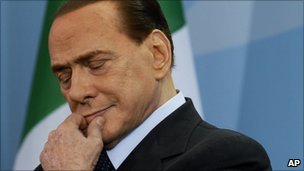
Mr Berlusconi is a defendant in three trials which have been suspended.
He denies wrongdoing and mocked the constitutional hearing earlier.
The court said in a statement that the prime minister could not automatically invoke a "legitimate impediment" claim exempting him and cabinet ministers from attending trials in progress because of their official duties.
Had the court rejected the law completely, Mr Berlusconi's trials on corruption and tax fraud charges would have resumed immediately.
But Giovanni Guzzetta, a professor at Rome's Tor Vergata University, predicted that the trials would eventually restart.
"At each hearing it will have to be decided if the impediment invoked by the prime minister for not appearing is legitimate or not," he told AFP news agency.
The law granting members of the government immunity from prosecution for up to 18 months was passed in March in the face of bitter opposition.
Mr Berlusconi, who owns the Mediaset business empire, faces three trials in Milan:
- He is accused of bribing British lawyer David Mills to give false testimony in 1997 to protect his business interests
- He is accused of inflating the price paid for acquiring television rights via offshore companies under his control and skimming off part of the sum declared to create illegal slush funds
- He is accused of fraud and embezzlement over the acquisition of television rights at inflated prices
The prime minister has argued he is the target of left-wing prosecutors.
Mr Berlusconi told reporters in Berlin on Wednesday that he found the Constitutional Court hearing "laughable".
Arizona shootings: Funeral for victim Christina Green
Christina Taylor Green, the nine-year-old killed in Saturday's shooting in Arizona, is to be buried on Thursday in the first of six such funerals.
Christina, whom President Barack Obama hailed on Wednesday night, was a top student, dancer and athlete.
She had hoped to meet Congresswoman Gabrielle Giffords at a constituency event on Saturday when she was killed and Ms Giffords gravely injured.
Doctors say Ms Giffords is making "encouraging" progress in hospital.
They said they had begun intense physical therapy, and that she was able to lift her legs on command.
Jared Loughner, 22, is jailed pending trial in the attack in the city of Tucson. Six people were killed in the shooting, including Christina Green and a federal judge. More than a dozen were wounded.
At a memorial service on Wednesday night, President Barack Obama honoured the victims of the shootings, urging the US to heal divisions opened by "sharply polarised" political debate.
"Imagine," Mr Obama said at a public ceremony in Tucson, "here was a young girl who was just becoming aware of our democracy; just beginning to understand the obligations of citizenship; just starting to glimpse the fact that someday she too might play a part in shaping her nation's future."
A witness to Saturday's attack said Christina had been smiling broadly as she waited in line to meet Ms Giffords.
Christina, who was born on 11 September, 2001, had just been elected to the student council at Mesa Verde Elementary School, and her father has said her interest in politics was inspired by Mr Obama.
"President Obama and his campaign is where she started getting interested in politics, and at least to have heard him mention her makes me feel better," John Green said. "She began her life on a tragedy, on 9/11, and her life was ended with a tragedy, here in Arizona."
Mr Obama called on the nation to honour her: "I want us to live up to her expectations. I want our democracy to be as good as she imagined it."
Giffords' progress
Meanwhile, Ms Giffords's doctors said on Thursday morning that she had opened her eyes and appeared to be trying to focus her vision, "encouraging" signs she was recovering.
Ms Giffords is moving both legs and both arms, has opened both eyes and is responding to friends and family, doctors said.
"She's making the progress that we could hope for her," Dr Michael Lemole said.
In another development, documents released by Pima Community College, where Mr Loughner attended school in the months before the attack, show a pattern of increasingly bizarre behaviour that troubled school officials and police.
The documents suggest Mr Loughner was prone to nonsensical outbursts and was confronted several times by police.
School officials described Mr Loughner's "dark personality" and some feared for their safety around him.
Source: BBC