
UPDATE ON ADDRESS CONFIRMATION
To date eighty percent (80%) of Streets in Providenciales have been confirmed. The Survey and Mapping Department is working assiduously to complete Grand Turk, which is currently about seventy-five percent (75%) complete. Mr. Demarco Williams of Survey and Mapping Department said, “We are pleased that Street naming and numbering on Providenciales are almost complete. We are working hard to complete this exercise in Grand Turk by the end of August 2012.”
NUMBER YOUR HOUSE
As well as having distinct and clear street names, the ability of emergency services to reach you as quickly as possible will also depend on how easy it is to find your house on the street. Your house number should be as clear and visible as possible. It should be lit or reflective so that it is clearly visible at night.
Tammika Lall of 911 Emergency Communications Centre that issues Official Address confirmations to residents noted that many residents have not displayed their official address number and some are displaying the numbers incorrectly. The Street Addressing Ordinance 2010 stipulates that the numbers should be a minimum of two feet six inches above the ground and the lettering should be a minimum of three inches in height and at least 3/8 of an inch thick. Residents are also reminded that as at 1 November failure to display their official building number carries a fine of up to $5,000.
Further, although 911 in conjunction with the Survey and Mapping Department have issued addresses since 2009 many residents still do not know or in some cases do not remember their official address when there is an emergency, which can delay response times.
The RTCI Police are appealing to residents to purchase their Street signs and have them displayed, as this will greatly assist emergency services to locate your residence or emergency location.
If you do not yet know your address, please fill out the 911 Data Form and you will receive your official address as registered in the 911 system. Once you learn your address, memorize it, and make sure family members know it too.

Protests as Clinton holds meetings in Egypt
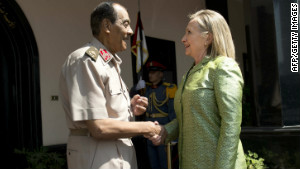 Egyptian protesters threw tomatoes and shoes at U.S. Secretary of State Hillary Clinton's motorcade Sunday and shouted, "Monica, Monica, Monica" as she left the newly reopened U.S. Consulate in Alexandria.
Clinton said she was in the city to answer critics who believe Washington has taken sides in Egyptian politics. There were already vocal protesters at the start of her visit to the consulate, forcing the ceremony to be moved inside.
"I want to be clear that the United States is not in the business, in Egypt, of choosing winners and losers, even if we could, which, of course, we cannot," Clinton said at the ceremony to reopen the consulate, which was closed in 1993 because of budget constraints.
"I have come to Alexandria to reaffirm the strong support of the United States for the Egyptian people and for their democratic future."
The protesters threw the tomatoes, shoes and a water bottle as the staff walked to their vans after the ceremony and riot police had to hold back the crowd. A tomato hit an Egyptian official in the face.
Clinton's van was around the corner from the protesters, and a senior State Department official said her car was not hit.
The chants of "Monica" refer to Monica Lewinsky, the White House intern who had an affair with Clinton's husband, former President Bill Clinton.
Earlier Sunday, Clinton held a closed-door meeting with the head of Egypt's military leadership, Field Marshal Mohamed Hussein Tantawi, whose military council is in a political tug of war with new President Mohamed Morsy.
Egypt's military leaders took control of the government after a popular uprising toppled former President Hosni Mubarak in February 2011, promising to hand over control after elections.
But after this year's elections, the military council issued a decree stripping the presidency of much of its power. And more than two weeks after Morsy took office, the country remains in the throes of domestic political chaos. The president has no Cabinet and the country has no parliament.
Tornadoes hit Kujawy-Pomorze and Wielkopolska in Poland
One person has been killed and at least 10 others injured during a series of freak tornadoes in northern and western Poland.
The extreme winds hits the country's Kujawy-Pomorze and Wielkopolska provinces, destroying 100 homes.
Some 400 hectares of trees have also been damaged in Bory Tucholskie forest, a national park and popular tourist destination.
Electricity power-lines have also been damaged.
The BBC's Adam Easton, in Warsaw, says that those tornadoes are not unknown in Poland, this summer's series of events has been particularly dramatic and weather forecasters have predicted stormy conditions will continue.
According to local media reports, a 60-year-old man who was killed died in the village of Wycinki after being crushed beneath his collapsing house.
Residents have described hearing a terrifying rumble as the tornado approached.
A vast clean-up operation is now under way as people hastily cover up their roofs, fallen trees are removed and power lines are repaired.
Syria in civil war, Red Cross says
The International Committee of the Red Cross (ICRC) says fighting in Syria is so widespread that the conflict is now in effect a civil war.
The change in status means combatants will now be officially subject to the Geneva Conventions, leaving them more exposed to war crimes prosecutions.
The Red Cross had previously regarded only the areas around Idlib, Homs and Hama as war zones.
Meanwhile, the Syrian government is disputing claims it used heavy weapons.
Activists initially described fighting on Thursday in the village of Tremseh near Hama as a massacre of dozens of civilians, but later accounts suggested most of the dead were armed rebels.
The UN accused Syrian forces of using heavy artillery, tanks and helicopters, but Damascus denied those allegations and said just two civilians had been killed.
The accusations, if proved, would mean Damascus had broken an agreement it made with envoy Kofi Annan.
Later on Sunday, video footage emerged purporting to show heavy fighting in southern Damascus.
Activists claimed the fighting was the most intense seen in the capital since the start of anti-government protests in March last year.
They said tanks and mortars were used, and in some areas residents were fleeing.
There has been no independent confirmation of their claims.
The International Committee of the Red Cross, which oversees the Geneva Conventions, said fighting had now spread beyond the three hotspots of Idlib, Homs and Hama.
Spokesman Hicham Hassan said Syria was now regarded as a "non-international armed conflict", which is the technical term for civil war.
"What matters is that international humanitarian law applies wherever hostilities between government forces and opposition groups are taking place across the country," he said.
The BBC's Imogen Foulkes in Geneva says the statement is significant because it is the Red Cross' job to monitor the conduct of the fighting, and to tell warring parties what their obligations are.
Under the Geneva Conventions, indiscriminate attacks on civilians, attacks on medical personnel or the destruction of basic services like water or electricity are forbidden and can be prosecuted as war crimes.
From now on, all those fighting in Syria are officially subject to the laws of war, and could end up at a war crimes tribunal if they disobey them.
Last month, the UN's head of peacekeeping Herve Ladsous also said Syria was in a state of civil war.
And Syrian President Bashar al-Assad has previously said the country is in a state of war.
Some 16,000 people are thought to have been killed since the uprising against Mr Assad's regime began in March 2011.
UN diplomats are attempting to agree a way forward for the organisation's monitoring mission in the country.
The mission's mandate runs out on Friday, and Western nations are trying to get Russia and China to agree to a beefed-up resolution authorising sanctions.
BBC
Hillary Clinton meets Egypt military leader Tantawi
US Secretary of State Hillary Clinton has met the head of Egypt's top military council, Field Marshal Mohamad Hussein Tantawi, on the second day of her visit to the country.
Mrs Clinton discussed the transition of power to newly elected President Mohammed Mursi and stressed the need to protect the rights of all Egyptians, US officials said.
Mrs Clinton met Mr Mursi on Saturday.
Mr Mursi and the military have been in conflict over parliament's dissolution.
The Supreme Council of the Armed Forces (Scaf) shut down the chamber, dominated by Mr Mursi's Islamist allies, before he was formally sworn in last month.
It also stripped the new president, elected in the country's first freely contested leadership vote earlier in June, of many of his powers.
Mr Mursi, of the Muslim Brotherhood's Freedom and Justice Party, tried to reinstate parliament by decree last weekend. The Supreme Constitutional Court has said the dissolution is final.
'Cordial'
As head of the Scaf, Field Marshal Tantawi became Egypt's interim ruler after the fall of President Hosni Mubarak in February last year.
Mrs Clinton held talks for more than an hour on Sunday with Field Marshal Tantawi.
A senior US state department official said: "They discussed the political transition and the [military council's] ongoing dialogue with President Mursi.
"The secretary stressed the importance of protecting the rights of all Egyptians, including women and minorities."
Field Marshal Tantawi brought up Egypt's economic needs, while the pair also discussed US aid plans.
After meeting Field Marshal Tantawi and other army leaders, Mrs Clinton headed to Egypt's second city, Alexandria, a stronghold of the Muslim Brotherhood.
Protesters in the city targeted her motorcade, with shoes, water bottles and tomatoes thrown towards the armoured vehicles.
A senior state department official said that neither Mrs Clinton or her vehicle were struck by any of the objects thrown.
Speaking at the newly re-opened US consulate in Alexandria, Mrs Clinton said: "I want to be clear that the United States is not in the business, in Egypt, of choosing winners and losers, even if we could, which of course we cannot."
She added: "Democracy is not just about reflecting the will of the majority. It is also about protecting the rights of the minority."
Mrs Clinton also held meetings with leading women, the Coptic Christian community and young entrepreneurs.
'Full transition'
On Saturday, Mrs Clinton told Mr Mursi that the situation required "compromise and real politics".
She praised Egypt's military council for its interim leadership, "for representing the Egyptian people in the revolution as compared to what we are seeing in Syria which is the military murdering their own people".
But she also voiced support for a "full transition to civilian rule".
The secretary of state also encouraged President Mursi to live up to promises to protect the rights of women and minorities, and to preserve the peace treaty with Israel.
The hour-long meeting between President Mursi and Mrs Clinton was described by a US official as candid and cordial.
However, on Saturday evening hundreds of demonstrators gathered outside Mrs Clinton's Cairo hotel, chanting anti-Islamist and anti-US slogans in protest at her visit. Some brandished posters depicting the field marshal.
Another protest outside the US embassy was organised by Coptic Christian youth activists, who chanted: "They both can't be trusted, not the Americans, not the Brotherhood."
The BBC's Jon Leyne, in Cairo, says that for all the US fears of an Islamist takeover in recent decades, the governments in Washington and Egypt have now realised they need each other.
Mr Mursi and the Muslim Brotherhood are particularly keen to avoid the sort of international isolation so damaging to other Islamist governments after they have taken office, our correspondent adds.
BBC
Chinese tourists drop big bucks in US
Chinese tourists have developed quite a reputation for dropping big bucks during their US travels. According to the Department of Commerce of the United States, on average, Chinese tourists each spent 37.5 thousand yuan, or approximately 6,000 US Dollars in 2011.
It’s not quite the weekend yet, but stores at the Leesburg Outlets near Washington D.C are already full of buyers Chinese buyers on holiday.
Miss Xiao has lived in the states for 19 years, she told us even more Chinese tourists are here on the weekends.
Miss Xiao, Local Resident, said, "On the weekends, about 20 to 30 percent of the shoppers here are Chinese. And one third of them are tourists from the Chinese mainland."
In order to attract more Chinese tourists, many stores have started printing ads and signs in Chinese, and have hired Chinese speaking salespeople.
Ma Yifang, Tourist, said,"My friends and I bought lots of luxury goods from Gucci, Armani and Coach. They are more expensive in China."
And that’s one of the reasons why Chinese tourists spend a lot here. Plus, there are more brands and styles to choose from.
Statistics show that the number of Chinese tourists in the US is rising steadily, with over 30% increase in six years over the last decade.
Torrential Rains Strand Thousands in Japan
Japanese troops have airlifted supplies to thousands of people who remain cut off by floods and mudslides triggered by days of torrential rains that have killed at least 26 people.
More than 3,000 people are stranded in Fukuoka prefecture, southwestern Japan.
More than 90 millimeters of rain an hour fell in Kyoto prefecture in western Japan, flooding hundreds of homes.
The Japan Meteorological Agency on Sunday said the worst is over but it predicted more heavy rain in some areas through Monday.
‘Ice Age’ Is Top Weekend Film With Sales of $46 Million
 “Ice Age: Continental Drift,” the fourth film in the animated series from News Corp.’s Twentieth Century Fox, opened in first place in U.S. and Canadian theaters with $46 million in sales.
“The Amazing Spider-Man” came in second with $35 million in receipts for Sony Corp., researcher Hollywood.com Box-Office said today in an e-mailed statement.
“Ice Age: Continental Drift” faced little fresh competition as the only new film opening in wide release this weekend. The previous installments of the series, about four prehistoric creatures who embark on adventures, took in more than $2.1 billion in worldwide ticket sales from three previous pictures, according to industry researcher Hollywood.com.
“Hollywood right now is absolutely focusing on franchises, sequels, stories that have proven themselves over time,” said Paul Sweeney, a media and entertainment analyst for Bloomberg Industries. While the weekend’s top film “came in a little below expectations, it’s still a pretty solid number.”
Domestic ticket-sales forecasts for “Ice Age: Continental Drift” ranged from $48.5 million at Box Office Mojo to as much as $56 million, the prediction of Box Office Guru. The second film in the franchise, “Ice Age: The Meltdown,” opened with $68 million in sales and the third film, “Ice Age: Dawn of the Dinosaurs,” brought in $41.7 million in its opening weekend, according to researcher Hollywood.com.
‘Amazing Spider-Man’
The fourth installment follows Manny, Sid, Diego and Scrat on an adventure after their continent is set adrift, caused by Scrat’s pursuit of the acorn he’s been after for each of the previous three films. Ray Romano and Denis Leary star. John Leguizamo and Queen Latifah co-star.
“The Amazing Spider-Man” has now collected $200.9 million in domestic sales in two weekends, according to Hollywood.com. The film revives a franchise that took in $2.55 billion in worldwide ticket sales from three previous pictures, according to researcher Box Office Mojo. The latest picture was made for about $230 million, the researcher said.
This installment features a new cast, with U.K.-raised Andrew Garfield replacing Tobey Maguire in the title role. Garfield portrays the orphaned Peter Parker, nursing a crush on high-school classmate Gwen Stacy while trying to unravel the mystery behind his parents’ disappearance. A visit to a high- tech research laboratory results in a spider bite that endows him with extraordinary powers.
Emma Stone is featured as Gwen. Martin Sheen and Sally Field co-star as Peter’s Uncle Ben and Aunt May.
‘Brave’
“Ted,” the R-rated comedy from Comcast Corp.’s Universal Pictures, came in third with sales of $22.1 million. Mark Wahlberg and Mila Kunis star in the movie about a man whose teddy bear comes to life as a result of a childhood wish. He must choose whether to stay with his girlfriend or keep his friendship with the foul-mouthed toy.
In “Brave,” the fourth-highest grossing film with sales of $10.7 million, a rebellious princess Merida prefers riding horses and archery to the sedentary duties of a princess. Her refusal to hew to a traditional role at the royal court leads to unforeseen consequences that place her family in jeopardy.
“Magic Mike,” featuring Channing Tatum in a film about the seedy world of male strippers, came in fifth, generating $9.03 million in sales for Time Warner Inc.’s Warner Bros.
Weekend revenue for the top 12 films fell 39 percent to $151.9 million from the year-earlier period, Hollywood.com said. Domestic film sales this year have risen 7 percent to $6.05 billion, with attendance up 9 percent.
The amounts below are based on actual ticket sales for July 13 and July 14 and estimates for today.
                       Rev.            Avg./   Pct.   Total
Movie                 (mln)  Theaters  Theater Chg.   (mln)  Wks
===============================================================
1 ICE AGE              $46.0   3,881  $11,853   --    $46.0   1
2 AMAZING SPIDER-MAN    35.0   4,318    8,106   -44   200.9   2
3 TED                   22.1   3,303    6,705   -31   158.9   3
4 BRAVE                 10.7   3,392    3,153   -45   195.6   4
5 MAGIC MIKE             9.03  3,090    2,922   -42    91.9   3
6 SAVAGES                8.74  2,635    3,315   -45    31.5   2
7 TYLER PERRY’S MADEA    5.6   2,004    2,794   -45    55.6   3
8 KATY PERRY: PART OF ME 3.74  2,732    1,367   -48    18.6   2
9 MOONRISE KINGDOM       3.66    924    3,963   -19    32.4   8
10 MADAGASCAR 3          3.5   2,285    1,532   -53   203.7   6
11 TO ROME WITH LOVE     2.54    744    3,413   -18     8.7   4
12 THE AVENGERS          1.3     747    1,723   -41   613.5  11

Top 12 Film Grosses:
Abu Dhabi Bypasses Hormuz Strait in Exporting First Pipeline Oil
Abu Dhabi started exporting its first crude from a pipeline that bypasses the Strait of Hormuz, shipping the fuel to a refinery in Pakistan.
The pipeline, stretching from Abu Dhabi to the neighboring sheikhdom of Fujairah on the Gulf of Oman, was loading the first shipment of 500,000 barrels to the Pakistani plant, Mohamed Bin Dhaen Al-Hamli, oil minister for the United Arab Emirates, said yesterday at a ceremony to inaugurate the network. International Petroleum Investment Co. spent $4.2 billion building the 423- kilometer (263-mile) link, Khadem Al-Qubaisi, managing director of the Abu Dhabi-run fund known as IPIC, said at the ceremony in Fujairah.
Abu Dhabi, the U.A.E.’s capital and holder of more than 90 percent of its oil, built the link as an export route for crude that avoids Hormuz at the mouth of the Persian Gulf. Iran has threatened to block the strait, a chokepoint for tankers carrying a fifth of the world’s traded oil, in retaliation for sanctions targeting the country’s nuclear program. The U.A.E., the fifth-biggest oil producer in OPEC, pumped 2.61 million barrels a day in June, according to data compiled by Bloomberg. Fujairah is one of the U.A.E.’s seven sheikhdoms.
An Iranian lawmaker, Mohammad-Hassan Asferi, said yesterday the pipeline’s limited capacity would keep it from obviating the need of regional suppliers to export most of their oil through the strait. He dismissed the project as “propaganda and political maneuvering guided by the Western countries, especially the United States, which aims to reduce the strategic importance of the Strait of Hormuz,” according to state-run Press TV. Asferi serves on the national security and foreign policy committee of Iran’s parliament.
Iran
Abu Dhabi’s first export cargo from Fujairah is destined for Pak Arab Refinery Ltd., a joint venture between Pakistan’s government and IPIC, Al-Qubaisi said. IPIC owns a 40 percent stake in the plant, which regularly uses about 40,000 barrels a day of Abu Dhabi crude, of the 100,000 barrels it consumes daily, he said.
Abu Dhabi earlier shipped a test cargo from Fujairah to its own refinery at Ruwais, inside the Persian Gulf, said Abdul Munim Al-Kindi, general manager of Abu Dhabi Co. for Onshore Oil Operations. As the main oil producer at the emirate’s onshore fields, the company, known as ADCO, will operate the pipeline and gradually expand its capacity by year-end, he said. The network is designed to load tankers at three offshore buoys, Al- Kindi said.
Fujairah’s Expansion
IPIC’s Al-Qubaisi said his company plans to spend as much as $5 billion to build a refinery in Fujairah with a capacity of about 250,000 barrels a day to produce for local sale and export, further enhancing the port’s importance as a hub for the processing, storage and shipment of fuels. The company is working with another state-owned investment fund, Mubadala Development Co., on a project for a terminal at the port for imports of liquefied natural gas. Fujairah is already among the world’s three biggest refuelling ports for commercial ships, along with Singapore and Rotterdam.
Al-Hamli, the oil minister, said the pipeline gives buyers an alternative location from which to receive crude. It will allow them to fill very large crude carriers, or VLCCs, the largest class of tanker capable of carrying 2 million barrels of oil. Filling such vessels in the Gulf of Oman will reduce shipping traffic in Hormuz, he said.
Shipping Flexibility
“The pipeline is going to be beneficial because our clients will be able to lift bigger cargoes,” he said. “Currently you can only lift 1 million barrels a day from Ruwais. From Fujairah now our clients now can bring in VLCCs and lift more.”
The pipeline can transport 1.5 million barrels a day of Murban crude from Habshan, a collection point for Abu Dhabi’s onshore oil fields, across a desert and mountains to Fujairah. The system is able to pump as much as 1.8 million barrels a day at periodic intervals, officials said at the inauguration. IPIC will likely charge ADCO “a few cents per barrel” for use of the pipeline, Al-Qubaisi said.
The first oil exported from Fujairah is priced the same as Murban crude loaded inside the Gulf, three people with knowledge of the matter said this month. Abu Dhabi may later devise a separate formula including a premium to account for the cost of using the pipeline, said the people, who asked not to be identified because the matter is confidential. Abu Dhabi officials yesterday did not comment on pricing.
China economic growth slows to 7.6% in second quarter
China's economy has grown at its slowest pace in three years as investment slowed and demand fell in key markets such as the US and Europe.
Gross domestic product rose by 7.6% in the second quarter, compared with the same period a year ago. That is down from 8.1% in the previous three months.
In March, Beijing cut its growth target for the whole of 2012 to 7.5%.
China accounts for about a fifth of the world's total economic output and any slowdown may hamper a global recovery.
At the same time, many of Asia's biggest and emerging economies are becoming increasingly reliant on China as a trading partner.
"China has been a big factor for the slowdown in Asia this year," said Tai Hui from Standard Chartered Bank in Singapore.
He added that if China's growth does not pick up in the second half of the year then "that's going to mean a very difficult second half for a lot of the manufacturers in this region".
Spurring growth
However, despite Friday's slower growth figures many analysts tried to allay fears of a so-called hard landing in China's economy and its subsequent impact on the rest of the world.
"If you get a drop in the growth rate of 1 percentage point per annum, that's not a lot in terms of the world gross domestic product," Edmund Phelps, a professor of political economy at Columbia University and a Nobel prize winner, told the BBC.
He added that China had a lot of ammunition to counter the slowdown, some of which it has already started using because of the patchy recovery in the US, and the ongoing debt and economic issues in the eurozone.
China's central bank has cut the amount of money banks must keep in reserve in order to boost lending, and it recently cut the cost of borrowing twice in one month.
Earlier this week, Premier Wen Jiabao said that boosting investment would also be crucial for stabilising growth, fuelling expectation that more state-driven stimulus measures would be on the way.
"Now that China's growth is slowing, there are calls for yet another stimulus," said Edward Chancellor, global Strategist at investment management firm GMO.
Slowdown
But analysts warned that China's growth problems may not be solved by a simple injection of capital and a new round of government spending. Especially as many of today's issues can be traced back to the way the country tried to kick start growth after the global financial crisis in 2008-2009.
At the time the central government began pumping huge amounts of money into the economy, mainly on infrastructure and construction spending.
This led to excess capacity, a surge in property prices and an increase in consumer costs and inflation.
Faced with these problems and amid fears that the economy may be overheating, policy makers decided to implement measures to curb lending and slow inflation.
Those steps, along with a drop in demand for Chinese goods from key markets such as Europe and the US, have caused the most recent cycle of slowing growth.
In 2011, China's economy grew by 9.2%, down from 2010's figure of 10.4% growth.
But while the longer-term trend is of a slowdown, China also released a number of other figures on Friday and they painted a more nuanced and mixed picture of the economy.
According to the official figures, retail sales increased by 13.7% in June, little changed from May's 13.8% figure.
At the same time, electricity output, an indicator that many analysts use to calculate current business and consumer activity, was also flat in June at 393bn kilowatt-hours.
Optimists, however, would have been buoyed by news that new bank loans increased to $144.4bn in June, up from $124.4bn in May.
The BBC's John Sudworth in Shanghai says the data will do nothing to stop the economic squabbling over whether China is heading for a hard or soft landing.
"Rising stock piles of coal paint a vivid picture of just the kind of indicator the bears will use when arguing that 7.6% is proof of the impending economic catastrophe," he says.
"But here's another picture for you. A new DHL delivery hub built on the outskirts of Shanghai shows that there are still plenty of bulls out there too.
"For them 7.6% is probably a turning point and they also have their indicators of choice to support the case."