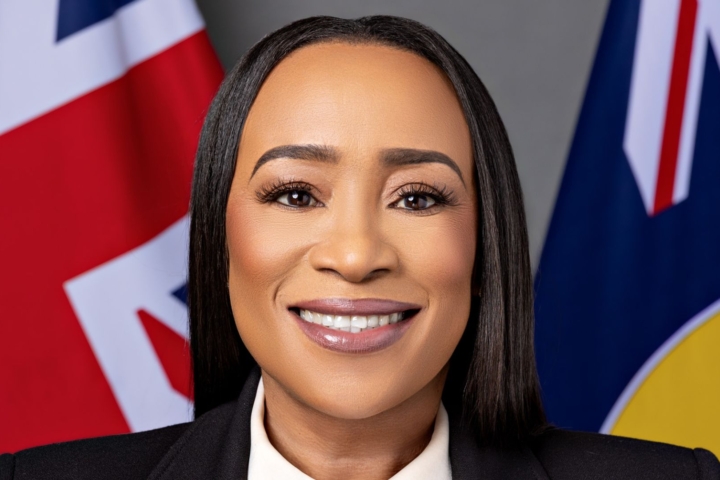
Mr. Speaker, I am proud to stand here today to make my first contribution to this Honorable House as Minister responsible for Education, Youth, Sport and Library Services. I give God the honor and the glory. I am thankful also to the community of the Turks and Caicos Islands for electing me as their all Island representative and thankful to my Government for entrusting me with leadership of the Ministry.
I know the task afforded me is an important one and I am confident that I have the ability, the fortitude, the stamina and the wherewithal for this awesome journey ahead. I am committed to do my best and to always use this medium to keep my people of these islands informed and updated on the progress and initiatives of my portfolio.
Mr. Speaker, my government Change document emphasizes clearly that Education, Youth and Sports Development are key priority areas. Mr. Speaker as that is the case, it is my intention to do my best to ensure that these areas receive the resources they deserve and that opportunities are created for the youth to develop their talent, skills and identity.
Mr. Speaker, during the last week, we here in the Turks and Caicos Islands have experienced several milestones in the area of Sports. Where sports is concerned, the athletes know that they have my Ministry’s full backing to be able to achieve their goals locally and internationally. My Government will be strengthening investment in sports. Sports will be given priority in order to develop individual abilities as well as foster a sporting culture at an early age. We will continue to invest in our young people skills and their future. I must pause here to congratulate:
- Mr. Colby Jennings for securing a bronze medal in the IAAF World under 18 Championships in Nyrobi, Kenya.
- Mrs. Rita Gardiner on achieving the Commonwealth Games Award of Merit.
- The TCI Rising Stars Basketball Club who finished 2nd place in the Puerto Rico Basketball Tournament 2017.
- Team TCI for winning the bronze medal in the girls’ beach soccer in the Commonwealth Youth Games in the Bahamas, and
- The team of athletes and coaches who travelled to the Bahamas for the Commonwealth Youth Games.
The education of our children is fundamental to producing decent, productive, positive and respectful citizens of any nation. Therefore, our education system must be one that ensures our students are equipped with the knowledge and skills they need to be successful in a rapidly changing society. Progress in learning is strengthened when our students, parents, teachers, principals, support staff and broader community all have a clear understanding of what must be done to achieve this chosen future for the Turks and Caicos Islands.
Mr. Speaker, please allow me, at this time, to congratulate all our students who successfully graduated from primary, high and tertiary levels in the Turks and Caicos Islands and internationally. We know how important education is to a nation’s current and future prosperity, development and growth. We owe our children a better life, and a better world and we have the opportunity to contribute to this through a quality, efficient and accountable education system.
Mr. Speaker, my Ministry in collaboration with the Caribbean Examination Council (CXC) will introduced the Caribbean Certificate Secondary Level Competence (CCSLC) to stakeholders when school reopens in September of this year. This program will demonstrate the level of competence attained while at school.
The Caribbean Examinations Council first offered the Caribbean Certificate of Secondary Level Competence in June 2007. The CCSLC curriculum is intended to provide certification for all students who complete secondary school in the participating territories. It was developed to provide the learner with the competencies that will serve as a foundation for more advanced studies, the world of work and life as a citizen of the region. According to the Caribbean Examination Council, CCSLC responds to the changing demands of education, and is designed to certify the knowledge, generic competencies, attitudes and values that all secondary school leavers should have attained.
This program will be integrated into all government secondary schools throughout the Turks and Caicos Islands. The CCSLC programme was designed for students in Forms 1 to 3. The CCSLC will be awarded if the candidate, over a period of up to three years, successfully completes a minimum of five subjects which includes English and Mathematics as compulsory subjects. This programme will also aid in the formation of skills needed to gain employment. These skills include oral and written communication, mathematical literacy, problem solving, critical thinking, informed decision making, handling conflict and social and citizenship skills.
The launch of this new examination should be seen as a milestone in the development of Turks and Caicos Islands’ education system. Its aim is to merge both the technical, general and vocational subjects, as well as develop certain competencies to give school leavers the best opportunity to move into the next stage of their development with qualifications to ensure that they are able to help and take part in the development of the Turks and Caicos Islands.
Mr. Speaker, my Ministry have revised the Scholarship Policy which came into effect this month. Through its scholarship and award schemes, the Ministry of Education continues its commitment to provide financial support for students undertaking tertiary education. The listing for the new awardees of scholarships will be announced Mid-August. The scholarship and award opportunities are being offered to promising students for both local and overseas studies. My Ministry is immensely proud of the new scholarship policy, but we also recognize that this is the continuance of a much larger process to improve the post-secondary opportunities for all Turks and Caicos Islanders.
The Scholarship Policy was modified to allow inclusiveness of different strategies to strengthen aspects of the already established 2011 Policy, making procedures and practices more relevant in today’s scholarship system.
Changes that were implemented to the National Policy 2011 are as follows:
- Enlargement of the approved Institutions list which must now be officially accredited by an established Accrediting Agency in accordance to the accreditation requirements for Higher Education Institutions in each jurisdiction (Caribbean, United Kingdom or United States).
- Establishment of a Full and Partial Scholarship Approved Institution list.
- To distinct between scholarship categories to further define the criteria of awarding amounts for Full, Partial Scholarship, Grants and Distance learning.
- Capping the number of grants received per student and the maximum awarding amounts.
- Establishing clear academic standards to determine eligibility for awarding of local and international scholarships in the various scholarship categories.
- Determine academic standards for awardees to maintain their scholarship awards.
- Regularizing standards for eligibility for scholarships, transfers and deferral of scholarship awards.
- To establish a mechanism to ensure transparency and remove any perception of biasness in the Scholarship Awarding Process.
This modified National Scholarship Policy 2017 document was implemented by the Ministry of Education and the Education Advisory Committee immediately for applicants who have applied for tertiary education scholarships during this year’s scholarship review process.
Mr. Speaker, my Ministry is in partnership with the Ministry of Border Control and Labour to help ensure that students returning to the Turks and Caicos Islands who have successfully completed tertiary level education will be awarded the opportunity of being placed where vacancies exist.
Mr. Speaker, I wish to thank you for this opportunity. God bless.