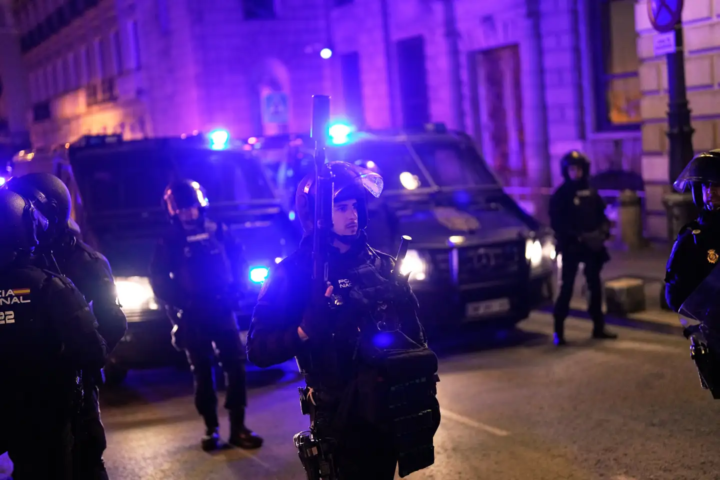
Rioters have clashed with other protesters in Athens where thousands of people are rallying outside parliament to condemn new cuts.
Scores of masked youths attacked a group from a communist-backed trade union with stones and petrol bombs, and police fired tear gas.
The trade unionists had been trying to maintain order during the rally.
A 48-hour general strike is under way in protest at austerity measures aimed at reducing Greece’s crippling debt.
The Socialist-dominated parliament is expected to give final approval to a new austerity bill on Thursday, after giving it preliminary approval in a first vote late on Wednesday by a margin of 154-141 of the 300 deputies.
The bill, which includes tax hikes and pay cuts, is needed to secure EU and IMF bailout loans.
Civil servants, shopkeepers, dock workers, taxi drivers, doctors, lawyers, teachers, construction workers and others were all due to take part in the strike, which began on Wednesday.
Greek television footage showed masked rioters attacking trade unionists before the trade unionists counter-charge, AFP news agency reports.
On Wednesday, at least 40 people were injured in running battles in central Athens.
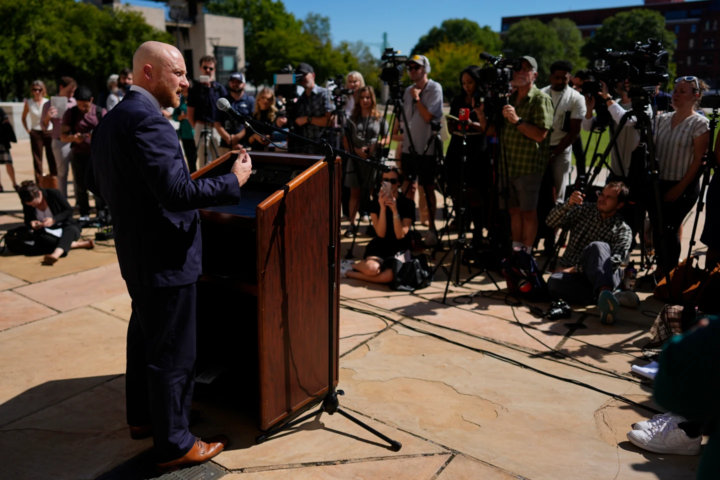
At least 35,000 protesters gathered on Syntagma Square, in front of parliament, on Thursday.
“There is no way that we will stop this battle until this government falls, which is one of our demands,” the president of the hotel union, Nikos Papageorgiou, told Reuters news agency.
Irini Kyriakidou, a 53-year-old seamstress, said: “What I want to tell the government is that we won’t let this pass so easily.
“We will fight so they do not put an end to labour contracts which will put us back a century.”
The bill includes plans for further cuts to pensions and salaries and temporary lay-offs of 30,000 public sector workers.
Some of Prime Minister George Papandreou’s ruling Socialist party deputies have threatened not to vote for some of the bill’s articles.
With Greece unable to borrow long term on international bond markets to finance its debt, the EU and IMF have stepped in with two bailout packages.
Finance Minister Evangelos Venizelos described the choice as between a “difficult situation and a catastrophe”.
“We have to explain to all these indignant people who see their lives changing that what the country is experiencing is not the worst stage of the crisis,” he said.
“It is an anguished and necessary effort to avoid the ultimate, deepest and harshest level of the crisis.”
Greek haircut
There are fears that if the Greek government defaults on its debts, it will set off a chain reaction that could engulf banks and other highly indebted eurozone nations.
But the government is struggling to convince lenders that it is cutting effectively enough. Greece says it needs the next 8bn euros ($11bn; £7bn) of the first bailout agreed to last year or it will soon be unable to pay its bills.
The details of the second rescue plan have yet to be finalised. Banks have agreed to take a 21% loss, or “haircut”, on their loans to Greece but there is growing pressure for them to accept higher losses.
European leaders and global finance chiefs are trying to work out a broader plan to tackle the eurozone’s debt crisis ahead of a weekend summit in Brussels.
French President Nicolas Sarkozy flew to Germany late on Wednesday to meet German Chancellor Angela Merkel and senior officials from the European Central Bank and IMF.
Neither leader gave any details about what had been discussed.
The two have disagreed about how Europe’s bailout fund, the European Financial Stability Facility (EFSF), can be leveraged from its current 440bn euros to a much higher value in order to bail out banks and struggling countries such as Italy and Spain, if needed.
Source-BBC
Related Posts
Trump announces Nidal Hasan execution ‘will not be streamed’
Trump said that Hasan's execution will still take place as scheduled "by firing…