
Quick Facts
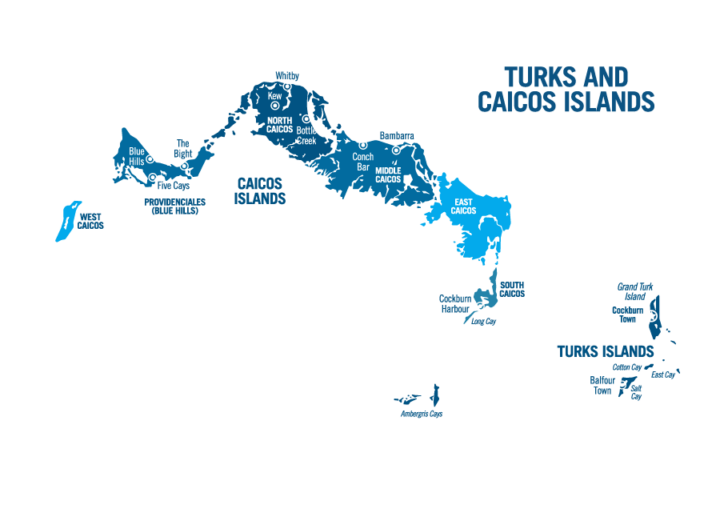
The Turks and Caicos Islands consist of 40 islands and cays, eight of which are inhabited. The islands are located 550 miles southeast of Miami, Florida, just below the Bahamas chain and just to the east of Cuba and the island of Hispaniola (Dominican Republic and Haiti.) Technically, the Turks and Caicos are located in the Atlantic Ocean, not the Caribbean Sea. The islands are home to roughly 30,000 full time residents, and welcome more than 200,000 tourist annually.
Language - English
Currency - The US dollar is the official currency of Turks and Caicos. Most hotels, restaurants and taxi services accept traveler's cheques, which can be cashed at local banks. Most credit cards are accepted and banks offer ATM's as well as cash advances on credit cards. Tipping is normally paid to waiters, taxi drivers, maids and porters at 15%.
Time Zone - Eastern Standard Time and Daylight Savings Time is observed from April to October.
Electricity - 110 volt/60 cycle, suitable for U.S. appliances.
Climate - The average temperature ranges between 85 and 90 degrees (29-32 degrees celsius) from June to October, sometimes reaching the mid 90's (35 degrees celsius), especially in the late summer months. From November to May the average temperature is 80 to 84 degrees (27-29 degrees celsius). Water temperature in the summer is 82 to 84 degrees (28-29 degrees celsius) and in winter about 74 to 78 degrees (23-26 degrees celsius). A constant trade wind keeps the climate at a very comfortable level.
There is an annual rainfall of 21 inches on Grand Turk and South Caicos, but as you go further west the average rainfall could increase to 40 inches. In an average year the Turks and Caicos has 350 days of sunshine. Hurricane season runs from June 1 to November 30th.
People - Turks & Caicos Islanders are mostly descendants of Africans who were brought in to work the salt pans or the cotton plantations. The expatriate population consists of British, Canadians, Americans, French, Bahamians, people from Hispaniola and virtually everywhere in the world.
Economy - The economy of the TCI relies on the tourism industry, real estate development and the exportation of seafood. A wide variety of financial services are available, including company formation, offshore insurance, banking, trusts, limited partnerships and limited life companies. The Financial Services Commission regulates, develops and promotes the industry in major world markets.
Government - The Turks & Caicos Islands are a British Crown Colony. A Governor is appointed by the Queen and presides over an Executive Council formed by an elected local self-government. Government offices are located in Grand Turk, with branches on other Islands as needed. The legal system is based on English Common Law.
Courier Service - Daily delivery service is provided by FedEx, with offices on Provo and Grand Turk. Service is also provided by DHL and UPS.
Cable Television - Satellite television service is provided throughout the islands, with most major American networks available.
Water - As on many Islands, our fresh water is precious, we depend upon rainfall or desalinated water produced by reverse osmosis for the supply. Please be conservative in using water.
Telephone Service - Local and international service is provided by Cable & Wireless and Digicel (wireless only). Telex, facsimile, internet and cellular phone services are provided. You may use your credit card or a debit PhoneCard at public phone booths. Country code is 649. Network is through Cable and Wireless. Pay phones, calling cards, facsimile, Internet, cell phones for rent at various locations.
If you have cell service in the USA please bring your phone with you because if you have International Roaming service with a cellular carrier that has a roaming agreement in the Caribbean then your phone will be able to make and receive calls whilst in the Turks and Caicos. If you do not have roaming then you will be able to make calls using the credit card platform. Postal Service - Post Offices are located on all inhabited islands. All mail is transported by air. There are many different issues and denominations of stamps for enthusiasts to collect. Philatelic Bureaus are located on both Provo and Grand Turk.
Crime - These Islands boast one of the lowest crime rates and highest crime-solved rates in the Caribbean. We cannot, however, let down the guard against opportunist-type theft. Do not leave valuables unattended. Lock doors and windows. Use the hotel safe for storage of valuables. These simple precautions should prevent the loss of cash, jewelry and identification. Confrontation and violent crimes are extremely rare. Any problems should be reported immediately to the Royal Turks and Caicos Police.
Clothing - Shorts are worn in town as well as the beach during the day, it is advisable to also wear sunhats and sunscreen. In the evenings, light sweaters and jackets may be occasionally needed in the winter. Dinner is usually not formal, most restaraunts accept dress shorts while others require pants with a collared shirt for gentlemen and dress slacks or dresses for the ladies.
Public Nudity is illegal throughout the islands.
Customs and Immigration - Duty free goods that may be brought in to the Islands include: 50 cigars, 200 cigarettes, 1.136 liters of spirits or wine and perfume for personal use. There are no restrictions for travellers on the import of cameras, film or sports equipment, except spear guns and Hawaiian slings. To bring in firearms of any type (including spear guns and Hawaiian slings), you must have written approval from the Commissioner of Police. Controlled drugs and pornography are illegal.
Effective January 8, 2007 all US Citizens traveling by air to the Turks & Caicos Islands will be required by the US Government to have a valid US passport. Cruise ship passengers have until June 1, 2009 to meet the requirement. Visitors from other countries do require passports, but no visas are necessary except from countries of the former Eastern Bloc. They are advised to contact the nearest British Consulate Office.
All visitors must hold a round trip ticket.
Visitors are allowed to stay for 30 days; this is renewable one time only.
For luggage restriction, individual airlines should be consulted.
Pets - There are some restrictions on bringing domestic pets into the Turks and Caicos Islands. All pets should be up-to-date with vaccinations and pet owners should ensure that they have completed the standard documents required for their pet's international travel.
Health Care - There is a small hospital on Grand Turk, and a number of private general practitioners on Providenciales as well as an emergency care facility. All of the other islands have commuinty clinics.
Other health services available include: emergency room, dental, chiropractic, physiotherapy, optometry, pharmacy, X-ray, ultrasound, recompression chamber and air ambulance service.

About the Islands
Long before Christopher Columbus first set foot on the capital island of Grand Turk during his discovery voyage of the new world in 1492, the islands of the Turks & Caicos were inhabited by Taino and Lucayan Indians. These original settlers left a rich heritage of seafaring, salt raking and farming, which still lingers on today. Words such as canoe, Caribbean and caicos are derived from the Arawak language. Even the name of the country comes from these earliest inhabitants. Turks is a reference to the indigenous Turk's head cactus and Caicos is from the Lucayan term “caya hico†meaning string of islands. Another peculiarity that has been passed down through the generations is a love of shellfish, particularly conch which is actually available in abundance to this day, thanks to the work of the Caicos Conch farm, the only commercial conch farm in the world.
For almost 700 years, the Taino and Lucayan Indians were the sole residents of the islands, settling mainly in Middle Caicos and Grand Turk. They lived peacefully and were skilled in farming, fishing and gardening. They cultivated almost 50 types of plants, some of which can still be found on undeveloped sections of the islands. Shortly after Columbus arrived in 1492, the Lucayan civilization disappeared and the islands remained sparsely populated for about 30 years. During this time, the salt making industry was born. Bermudians came to Turks & Caicos to rake the salt and take it back to Bermuda. Salt was a precious commodity back then as it was used not only for flavoring food but for preserving it as well. The shallow waters surrounding the islands were ideal for salt raking but treacherous for nautical navigation and more than 1000 ships were wrecked during the journey to and from.
In 1706, the French and the Spanish briefly captured the Turks & Caicos Islands from the Bermudians. Four years later the British reclaimed the islands for Bermuda but in subsequent years the place became primarily a haven for pirates and British Loyalists fleeing the American Revolution. Ultimately, Britain retained the island country by the end of the century as part of the Treaty of Versailles. In 1766, after being controlled by the Spanish, French and British, Turks & Caicos became part of the Bahamas colony and was placed under the Bahamian government. Attempts to integrate the two distinct communities failed and in 1874 after the Great Bahamas Hurricane devastated much of the chain of islands, the Turks & Caicos Islands became dependencies to the British Crown Colony of Jamaica. Jamaica won independence from Britian in 1962 and so Turks & Caicos then became a British Crown colony on its own and still is one today. It was not until the early 1980's when Club Med Turkoise Resort opened that Providenciales and Turks & Caicos in general - started to become a viable tourist destination. Since then, increasingly more development has taken shape, and the small, salt raking island country of Turks & Caicos has grown into what is quickly becoming recognized as one of the world's premier beach destinations.
Though the days when the Lucayans fished and sailed the turquoise waters of Turks & Caicos have given way to live-aboard dive boat operators, commercial fishing and off-shore financial services, their gentle temperament and love of nature can still be felt today, after almost 1200 years. Turks & Caicos is quickly becoming a leading international investment center for the offshore investor. The islands are a zero tax jurisdiction and therefore have no taxes on income, capitol gains, corporate profits, inheritance or estates. Today, Turks & Caicos stands on the threshold of an exciting future boasting the fastest growing economy in the Caribbean coupled with strictly controlled development to protect the islands heritage as a pristine sanctuary for both local residents and tourists to enjoy for the next thousand years.
Important Dates (courtesy of the TCI Museum)
AD 750 - the first inhabitants (Tiano and Lucyan Indians) arrive on the shores of the Turks & Caicos Islands;
1492 - Christopher Columbus lands at Guanahani Beach, Grand Turk;
1512 - Ponce de Leon passes by the Turks Islands on his way to Bimini;
1668 - Salt making industry begins;
1706 - Turks & Caicos is captured from the Bermudians by the French and the Spanish;
1710 - The British recaptured the islands on behalf of Bermuda;
1783 - French seize Grand Turk during its wars with Great Britain;
1790 - The Crown granted land to the British loyalists on Providenciales, Middle Caicos, North Caicos and Parrot Cay.
1792 - Grand Turk becomes the official Port of Entry to the Turks & Caicos, a customs office is established;
1799 - Britain places Turks & Caicos in the hands of the Bahamas;
1813 - A large hurricane forced many of the Loyalists to leave the islands; some moved to Grand Turk
1821 - Hundreds of slaves fled from the islands and escaped to freedom in Haiti;
1834 - All British Colony slaves are granted freedom;
1842 - Bambarra on Middle Caicos was settled by survivors of a Spanish slave shipwreck called the "Gambia";
1845 - First newspaper published, "Turks Island Gazette & Commercial Reporter";
1873 - Queen Victoria grants a royal charter; TCI becomes an independent colony;
1874 - "The Great Bahamas Hurricane" devastated the Turks & Caicos Islands and the entire Bahamian chain - the islands are annexed to Jamaica for medical and technical assistance and grants;
1852 - Grand Turk lighthouse erected;
1857 - "Waterloo", built in 1815, was acquired for the Governors residence;
1898 - First telegraph cable, Bermuda to Grand Turk to Jamaica; First fire engine;
1948 - First commercial flight to Turks & Caicos;
1959 - Hurricane Donna devastates all agriculture on Turks & Caicos;
1962 - John Glenn splashed down off the coast of Grand Turk after his space flight;
1968 - Airport opens on Providenciales;
1991 - Turks and Caicos National Museum opens on Grand Turk
2008 - Hurricane Ike was an intense and destructive tropical hurricane in September that swept through portions of the Turks & Caicos
Ripsaw Music
(Story & Photos by David Bowen, Turks & Caicos Islands)
THAT SWEET SOUND
I can still recall the day I was reintroduced to the sweet, unique sound of ripsaw music. It was exactly two weeks to the day since I had moved back to Grand Turk after being away for close to 20 years. There was some kind of party going on in the Over Back settlement and I happened to be driving on Lighthouse Road on my way back home. As I made the turn on Duncombe's Alley, I saw a group of guys sitting on a wall banging on a drum, scraping a saw, hitting on a few bottles and singing at the top of their lungs the old folk song, "Uncle Lou."
"Did you see Uncle Lou
When he fall in the well Oh,
Oh Uncle Lou when he fall in the well.
He fell so deep,
til he went straight to hell
Oh, Oh Uncle Lou
when he fall in the well."
Being a musician myself, I was drawn to the music and immediately struck by how powerful the sounds of these simple instruments were. I sat and listened for close to two hours and even ended up tapping out a rhythm on an old beer bottle with a nail, but it was the saw player that really held my interest. The simple, but ingenious way he got high and low sounds by bending the saw to extreme angles while "ripping" out a rhythm with an old knife across the teeth of the saw was fascinating. Every once in a while, I was able to hear the wobbled over tones produced by the hitting, bending and scraping that really made the music come alive.
I left those guys playing on that wall and I sang all the way home, very much moved by the experience of hearing my native music once again. I even got out the old saw from the shed in my grandmother's back yard and quickly discovered that "ripsaw" was as much fun to play as it was to listen to.
What is Ripsaw Music?
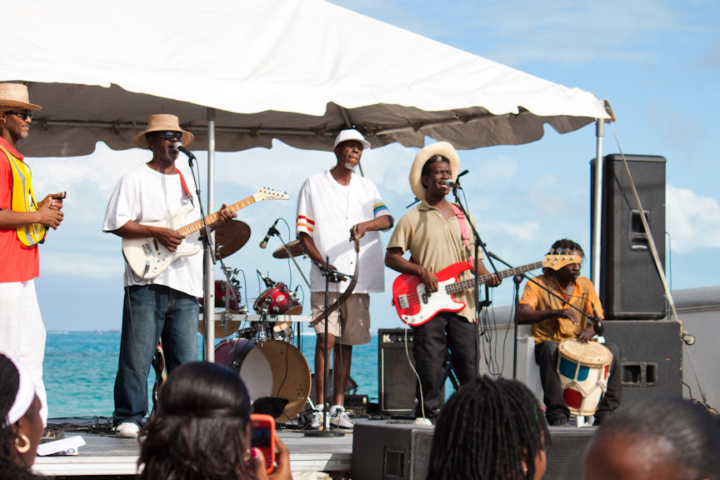
Ripsaw music is the national music of the Turks & Caicos Islands. Accompanied by instruments such as the accordion, concertina, goat and cow skin drums, triangle, shakers (maracas), box guitar and conga drums, the common carpenter saw is used as the featured instrument, producing a rhythmic foundation for the rest of band.
The term "ripsaw" comes from the local name for the handsaw. The term also refers to the "ripping" sound produced by the action of passing a metal object called the "scraper" (usually an old knife) along the side of the saw's teeth. The resulting sound is similar to that of paper being torn or ripped. There are several theories as to why the carpenter saw was used as an instrument and like all indigenous folk music, our ripsaw is the product of the passion of a people looking for a way to produce sound and music with available materials.
According to one theory, the natives of the Turks & Caicos were exposed to the music of the Dominican Republic and Haiti through trade. Both of these countries have a vibrant cultural heritage where music plays a major role. Their use of instruments such as the accordion, Guido, grater and round goat or cow skin drums, called conga or tambou, influenced the music and musicians of the Turks & Caicos. Due to a lack of natural resources and materials in the Islands to reproduce the instruments, our ancestors found ways to make square and round drums which were heated over a fire to tighten and tune the skin and they duplicated the ripping and scraping sound of the Guido by using the jagged edges of the saw.
Another theory states that the slaves of the Loyalists who fled the United States and settled in the Caicos Islands brought saw playing here. These slaves reproduced on the saw the sound of their native African instrument, the Shekere (pronounced Shaker-ray) and made simple hand drums to duplicate the sound of the Djembe (pronounced Jem-bay).
Ripsaw and Rake & Scrape
There is much debate as to the origin of the use of the saw, but it is safe to say that our style of Ripsaw music originated and developed in the Caicos Islands--Middle and North Caicos in particular. According to local musician and cultural historian Lovey Forbes, it is in these Islands where we find the roots of our native cultural explosion. To this day, most the best drummers and ripsaw players come from Middle and North Caicos.
The Bahamas has also claimed ownership to ripsaw but Junkanoo is considered their national music. Their version of Ripsaw is called Rake & Scrape, a term which describes the action and method of playing the saw by the musician. (He "rakes" and "scrapes.") As our countries share a common history and cultural heritage, it is difficult to dispute claims by either side. However this much is clear, Ripsaw music is played on every inhabited island of the Turks & Caicos and is nationally celebrated as a Turks & Caicos cultural art form.
Cat Island is the only Bahamian Family Island that celebrates "Rake & Scrape" on a grand scale. The whole island is involved in the annual Cat Island Rake and Scrape music festival during the Bahamian Labor Day holiday in June. The Turks & Caicos have strong ties to Cat Island, where many of our people settled during the lean years here at home. Eris Moncur, president of the Cat Island Rake & Scrape Festival Committee and local historian, himself is a descendent of the Stubbs family of the Turks & Caicos. In the Cat Island festival, only the saw, concertina and conga drum are used as the main instruments for the contest.
Cultural Exodus
The movement of a people from one country to another is bound to affect the culture and cultural development of the host country. During the 1920s, 1930s and 1940s, on invitation from the Bahamian government who was looking for laborers and contract workers to augment their work force, there was a mass exodus from the Turks & Caicos Islands to the Bahamas. Since things were tough in those days, many Islanders left looking for a better life in Inagua, Cat Island, Nassau and Pine Ridge in Grand Bahama.
As the Bahamian economy grew, many choose to remain and settle in the Bahamas and sent for their families to join them. Naturally they took with them all aspects of their cultural heritage, such as ripsaw music, folk songs, stories and ring games. Over time, this has woven itself into the cultural fabric and folklore of the Bahamas.
Bahamian music and culture was highly influenced by Turks & Caicos natives and their music. It was amazing to discover that so many "Bahamian" musical stars are actually native Turks & Caicos Islanders and many others are first generation descendants of Turks Island workers. For many years it was difficult to be a Turks Islander in the Bahamas. Many of our people held their tongues and claimed Bahamian roots to avoid ridicule, prosecution and deportation.
Bahamians are often surprised to discover that many of their local artists and musicians are indeed Turks Islanders. The #1 gospel group in the Bahamas, The Cooling Waters, are all Turks Islanders. Singing stars and musicians like Marvin Handfield, Count Bernardino, Perry Delancy, Leo Jones, Sly Roker and Bradley Dean, just to name a few, are all native Turks & Caicos Islanders who helped shape the Bahamian music scene.
In recent years, with the return of many Belongers and their descendants from the Bahamas due to the economic boom we are now experiencing in the Turks & Caicos, there are bound to be significant cultural changes in music, dance and entertainment as these "T.I.--Bahamians" are in effect reintroducing a hybrid of Turks & Caicos culture in the form of Bahamian-style calypso and Junkanoo. Bahamian Junkanoo is now influencing our local festivals. Junkanoo parades were known as "Massin" or "Jump Up" in the early years and the groups were mainly made up of ripsaw musicians. Now, cowbells, whistles and a brass section have replaced the saw, accordion, shakers, conch shells and glass bottles.
The two biggest and most popular Junkanoo groups are the We Funk Junkanoo Group led by Kitchener Penn and The Predators led by Wesley "Tanka" Williams. Both were involved with the top groups in Nassau and Freeport and when they returned home to the TCI brought with them the cowbells, horns and big bass drums of the exciting, colorful Bahamian-style Junkanoo that has now added a new dimension to Turks & Caicos Junkanoo.
Playing the Ripsaw
Playing the saw is not as easy as might appear to the casual observer. One must have an incredible sense of rhythm, strong hands and stamina. The saw is held handle side up by the support hand with the teeth facing away from the body. The narrow tapered end is braced on the outside or inside of the player's thigh. Many players choose to cover this part of the saw to avoid their clothes or skin from being cut by the blade.
The working hand holds the scraper, usually an old kitchen knife but screwdrivers, long nails and bits of strong wire have been used. The thigh acts as a brace for the saw and the support hand bends and adjusts the tone as the working hand scrapes the scraper over the teeth in time to the music.
Many first time players make the mistake of using the whole arm of the working side and tend to tire easily. According to Desmond "Dez" Misick, a local drummer and saw player, the trick is to use only the wrist to cut down on fatigue. This will enable a player to play a full show, which usually lasts between two to three hours.
When playing in a band, it's also important to choose the right type of saw. Lovey Forbes suggests an 11 point saw with its fine teeth. The lower the points, the coarser the teeth and deeper the "Rip;" it is also a more difficult saw to play. The higher the points, the finer the teeth and the "Rip" is smoother and easier to maintain.
If saw playing is not your calling, there are many other instruments that can accompany a band. In a typical ripsaw band of yesteryear, the main instruments were the saw, the goatskin drum and the accordion or concertina. Over the years, the name "concertina" has been used to describe the accordion but they are two different instruments. They both use air to produce the sound and are similar to bellows in their construction, but their shape, size and keys are very different. The concertina is a lightweight, six-sided instrument with a keyboard a little larger then the size of a man's hand. There are between 10 to 30 keys or knobs on each side, laid out in rows of five. Both the melody and chords are played with both hands. The accordion is much larger and heavier. It needs to be strapped on the player for support. The melody is played with the right hand on a piano-like keyboard and the bass and chords use knobs on the left.
Additional instruments such as the box guitar, harmonica, triangle, shakers, glass bottle, tin canister, conch horn, homemade tinhorns and the simple comb and paper we call "mouth organ" were all played. According to Mr. Samuel Simmons of Salt Cay, James "Jaimsee" Bassett played trumpet and jazz horn in their Salt Cay ripsaw band. Nowadays, the electric guitar and keyboard have replaced the accordion and concertina as the lead instruments and the bass guitar and drum set make up the rhythm section, but through all these changes, the saw has maintained its place as the binding glue and rhythmic support for the band.
It is interesting to note that H.E. Sadler, on page 278 of his book, Turks Islands Landfall, refers to a local "steel band," but does not list the steel pan among the instruments, all of which are those played in ripsaw music, so he was obviously referring to a "ripsaw band." It is only in the last few years that the steel pan has become a part of the local music scene. It began with Allison Williams and the wonderful Provo Primary Steel Band and really made an impact with the Clement Howell High School Steel Band, under the skillful direction of music teacher Kenton Wyatt. The H.J. Robinson High School joined the trend by forming a steel band in 2001 under the direction of Mrs. Lyons, a music teacher from Trinidad.
The Saw and the Wider World
Beyond the boundaries of the Bahamian and Turks & Caicos archipelago, the saw was used to some degree in local folk music in the U.S., Europe and the Eastern Caribbean. I've discovered saw playing in the Caribbean island of Antigua, the "hillbilly" community of the Southern U.S.A. and, much to my surprise, Quebec, Canada.
One day, when discussing local culture and ripsaw music with Marielle and Serge Tuyssuzian, who run the Turks Head Brewery, I was quite surprised to learn that saw playing existed in Canada. The French-Canadians have a style of ripsaw music called Equoine (pronounced Aqwin). Accompanied by the violin and spoons, the saw functions as a rhythmic support for the other instruments.
In Europe, the saw was used but it was the smooth edge that was played. Instead of a scraper, a bow like those used to play the violin was used. These saws could actually play melodies and were used mainly as a solo instrument. I plan to follow up my research on the use of the saw in music throughout the world in hopes of putting on a truly international saw festival right here in the Turks & Caicos Islands.
The Future of Ripsaw in the Turks & Caicos
Like most of our cultural heritage, ripsaw is now being rediscovered and appreciated by the local and expatriate population. I have big plans and dreams to expose ripsaw music to a wider audience and encourage the youth of the country to learn and develop ripsaw and take it to the next level.
Mr. Lovey Forbes has already begun a new style of ripsaw called "Combina" music. The concept came about in 1981 and the term "Combina" comes from the word combination with the "tion" removed, giving it that cultural T.I. feel and dialect. Mr. Forbes has taken the basic rhythm and sound of the saw and incorporated it into different styles of music such as reggae, pop, blues, country, gospel and calypso.
Combina music came about through a conscious effort on the part of Mr. Forbes to fuse the musical taste of our truly international population. Lovey also started a Ripsaw Jamboree to showcase the saw and its players. His son Correy held a Jamboree in North Caicos in 1995 with the hope of enticing saw players to form new bands. Bernard Been held a Junior Festival in Grand Turk in 1999 with groups from Middle Caicos, South Caicos and Grand Turk in hope of enticing the youth to take up saw playing and refocus on local cultural music as a balance for their fascination with American hip hop and rap music.
These men and these events were on the right track to promoting and exposing the ripsaw to the younger generation. Though it is important to have freedom of choice, I truly feel that our youth should be exposed from an early age to the positive aspects of their indigenous culture. This will instill pride and appreciation for their country and culture and they will be able to better manage their passion, fascination and understanding of the music and lifestyles of other cultures.
The summer of 2003 will see a spectacular performance of ripsaw music during the First Annual Turks & Caicos Ripsaw Festival. There will be bands from each island participating in this two-day event. A ripsaw competition will be held for the younger bands with cash prizes and trophies going to the best saw player, the best drummer, the best original song and, of course, the best overall band.
This festival will be a long overdue celebration of Turks & Caicos culture and ripsaw music. Liam McGuire, who held the post of Minister of Tourism from 1976-1980, realized the importance of ripsaw as a vehicle for tourism by having a band greet visitors at the airport and play for special guests at the Admiral Arms Hotel in South Caicos. I hope to revive the passion of this native music and to once again have ripsaw bands play at the airports and hotels throughout the Turks & Caicos.
I encourage you to contact me in care of the Turks & Caicos Tourist Board with names and information on other ripsaw musicians, so that my list will continue to grow and these special persons become an integral part of our cultural consciousness.