
Timbaland, Missy Elliot to Release Solo CDs in June
Longtime friends and collaborators Timbaland and Missy Elliot are both planning to release solo albums in June.
The artists – who last worked together on the 2011 track ‘Take Ur Clothes Off’ – want to drop their forthcoming records, Timbaland’s “Shock Value III” and Missy’s “Block Party,” at the same time so they don’t move “too ahead” of each other.
“Right now, we’re just preparing to get both our videos, our first singles, shot kinda at the same time,” Timbaland told MTV News. “We want to do it as a movement and spontaneously. I just don’t want to move too ahead of her, and she doesn’t want to move too ahead of me.”
Missy has recently been working as a songwriter and producer for Keyshia Cole, Monica and Jazmine Sullivan, but she hasn’t released a full-length album since 2005′s “The Cookbook.”
She will be featured on Timbaland’s star-studded album along with Justin Timberlake, Bruno Mars and Chris Brown.

HELP CHTA EDUCATION FOUNDATION RAISE $1.5 MILLION FOR CARIBBEAN YOUTH FOR TRAVEL SHOW
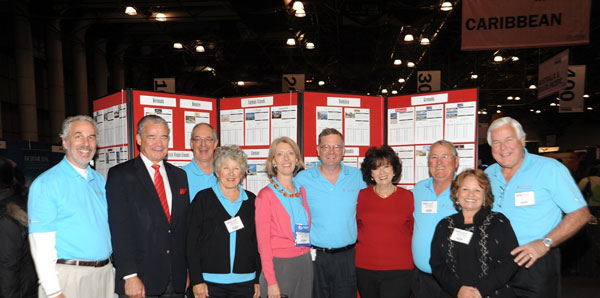 Having raised $1,396,150 in scholarship funds for Caribbean youth seeking to continue their education since its inception, the non-profit Caribbean Hotel & Tourism Association (CHTA) Education Foundation has put out a plea to hoteliers, airlines and other stakeholders in the region to support the initiative by donating stays for the highly visible Caribbean Auction at The New York Times Travel Show. There is only one week remaining to sign up, so please send in the donation form by Feb. 15 or contact the foundation for more info.
The Education Foundation's single largest annual fundraising activity, the Caribbean Auction attracts thousands of affluent eyeballs as New York City's most avid travelers research and bid on the Caribbean resort and tourism-related prizes available at the silent charity auction. With the support of hoteliers, airlines and tourism partners, the Education Foundation plans to increase its total contribution to the education of Caribbean nationals beyond $1.5 million.
"Supporting our human resources by participating in the Caribbean Auction ensures the future sustainability of our tourism and helps to raise living standards across the region in the long run," said Tom Pas, chairman of the Education Foundation.
"But with more than 18,000 consumers and retail agents attending The New York Times Travel Show annually, its also an impactful promotional vehicle," added Pas, noting that many tech-saavy New Yorkers research hotel websites and TripAdvisor reviews on their smart phones before bidding. "This results in brand recognition and may lead to bookings when determined travelers are outbid."
The Education Foundation expanded last year's fundraising efforts by including additional auctions items beyond Caribbean hotel and resort stays. The move resulted in a frenzy of interest from consumers who were able to bid on air tickets and attractions, as well as an air-inclusive London vacation contributed by Virgin Holidays.
"This year we're accepting donations from a wide variety of partners in order to raise as much as we can to support our beneficiaries," said Pas. Nothing is too small or insignificant. Regardless of your business model, you can become a hero to a deserving young professional."
Learn more about the foundation's mission, projects and accomplishments at www.chtaeducationfoundation.com.
Top marine officer to oversee Caribbean
United States President Barack Obama has nominated a top Marine Corps officer to lead the US military operations in Latin America and the Caribbean.
Lieutenant General John F. Kelly, who currently serves as senior military advisor to Secretary of Defense Leon Panetta, will head the Miami-based Southern Command.
Kelly will succeed Air Force General Douglas Fraser when confirmed by the US Senate.
The Pentagon said he has served multiple deployments in Iraq and also worked as a Defence Department representative on Capitol Hill.
Former T&T PM heads to US for treatment
Former Trinidad and Tobago Prime Minister Patrick Manning has been flown to the United States, to seek further medical treatment amid concerns by his family about the care he was receiving in the twin-island republic.
Two weeks ago, Manning suffered a mild stroke that left him partially paralysed.
His sister, medical doctor, Petrolina Manning Alleyne, said the results of important blood tests done by the former prime minister at a public hospital, had been late and could have contributed to the stroke.
Dr. Manning-Alleyne said her brother, who had been taking the medication, warfarin, to prevent blood clots, is also questioning the source of the medication.
Manning, 66, is expected to remain at the Walter Reed Memorial Hospital in the US for at least four weeks.
Over the weekend, the Speaker of Parliament, Wade Mark, said a request on Manning's behalf for 90 days leave was granted on the grounds of illness.
Prime Minister Kamla Persad-Bissessar had confirmed that TT$600,000 was approved by the Cabinet to allow Manning to travel to Washington for treatment.
Manning is unable speak clearly or move on his own.
Defence claims ex-CFO, not Stanford behind alleged scheme
Lawyers for Texas tycoon, Allen Stanford, have claimed that it was his former chief financial officer and not their client who was the mastermind behind an alleged seven-billion-dollar Ponzi scheme.
Stanford is on trial for allegedly defrauding tens of thousands of investors at his Antigua-based Stanford International Bank through bogus certificates of deposit.
Stanford’s defence team told federal jurors yesterday that letters, emails and other documents showed that former CFO James M. Davis was the scheme’s mastermind.
The lawyers say Davis, who worked for Stanford for 21 years, was the sole person who created documents that inflated the value of the bank’s holdings to $6.3 billion when, in reality, it was about to collapse.
But Davis said Stanford instructed him to falsify the figures.
Stanford faces 14 counts, including mail and wire fraud, in the criminal case.
He faces up to 20 years in prison if convicted.
DPSU threatens to stage protest action
Public Servants on the island have given the government an ultimatum to retract statements which were made by Productivity Consultant Parry Bellot that they are unproductive-or face protest action.
The Dominica Public Service Union (DPSU) called a meeting on Tuesday with its general membership at their Valley Road office, to address concerns that they say have been affecting their livelihoods.
Chief among their gripes were statements by Bellot that 80% of them are unproductive.
General Secretary of the Dominica Public Service Union Thomas Letang says government has seven days to respond failing which the membership will take action.
“In seven days we expect a response. We will be calling on public officers to stand in solidarity with each other. We want you to encourage those who are not here to show up. We want to tell you that we will be embarking on protest action to make our position clear. We want an apology,” he added.
The PSU also wants the government to make a decision regarding pending salary increases.
“Government said the exercise will require at least nine months for completion, a period that will well take us into the next triennium 2012/2015. The union believes it would be in the best interest of all parties to confirm negotiations for the current triennium and to defer consideration of the results of the classifications,” he said.
General Audit Chamber of Sint Maarten achieves membership in CAROSAI.
Chamber, Mr. Roland Tuitt, of the approval of its membership request.
The Caribbean Organization of Supreme Audit Institutions is a regional organization wherein the Supreme Audit Institutions (SAI's) of over 20 (island) nations are represented, among which Aruba, Antigua, the U.S.V.I., Bahamas, Bermuda, Grenada, St. Lucia, Jamaica, Guyana, Suriname and Trinidad.
CAROSAI's objectives are to increase the exchange of knowledge and experiences among member Supreme Audit Institutions (SAI's) as well as expand training and continuing education possibilities among these institutions. Additionally, CAROSAI seeks to increase the importance of internal audit function in the public sector as well as render technical assistance and support to the member institutions. The Secretariat of the Caribbean Organization of Supreme Audit Chambers is situated in Castries, St. Lucia W.I.
As the General Audit Chamber of Sint Maarten was recently established (10-10-10), participation in international organizations is crucial to the continued institutional development.
Approval of the membership to CAROSAI occurred during the meeting of its membership that was held on February 1 & 2 in Antigua. In the notification to the General Audit Chamber, CAROSAI's General Secretary ,
Ms. Averil James-Bonnette, indicated that the organization believes that "the Supreme Audit Institution of Sint Maarten will play a vital role in enabling CAROSAI to achieve its objectives".
Board and management of the General Audit Chamber are proud to be able to join the regional institution and in so doing both represent Country Sint Maarten as well as contribute to CAROSAI's objectives.
Fabio Capello quits as England manager after meeting with FA
 Fabio Capello has resigned as England manager, the Football Association has confirmed.
Capello quit after a meeting with FA chairman David Bernstein and general secretary Alex Horne at Wembley.
An FA statement read: "The Football Association can confirm that Fabio Capello has today resigned as England manager."
On Monday, the Italian, 65, publicly challenged the FA's decision to strip John Terry of the captaincy.
The FA's statement continued: "The discussions focused on the FA Board's decision to remove the England team captaincy from John Terry, and Fabio Capello's response through an Italian broadcast interview.
"In a meeting for over an hour, Fabio's resignation was accepted and he will leave the post of England manager with immediate effect."
Bernstein said: "I would like to stress that during [the] meeting and throughout his time as England manager, Fabio has conducted himself in an extremely professional manner.
"We have accepted Fabio's resignation, agreeing this is the right decision. We would like to thank Fabio for his work with the England team and wish him every success in the future."
A media conference with Bernstein and the Club England management team will take place at Wembley Stadium on Thursday at 1200 GMT.
The FA will not be making any further comment until the media conference.
Wednesday's meeting was the first time Capello had met the FA since their decision to remove the armband from Terry pending the outcome of his court case in July.
Terry, 31, denies a charge of allegedly racially abusing QPR's Anton Ferdinand.
On Sunday, Capello told Italy's state broadcaster RAI he did not believe someone should be punished by sporting authorities before a court had reached a verdict.
"I thought it was right that Terry should keep the captain's armband," said Capello, whose first game in charge was on 6 February 2008, against Switzerland.
"I have spoken to the [FA] chairman and I have said that in my opinion one cannot be punished until it is official and the court - a non-sport court, a civil court - had made a decision to decide if John Terry has done what he is accused of."
FA head of elite development Gareth Southgate suggested Under-21 head coach Stuart Pearce will be in charge for England's friendly against the Netherlands at Wembley on 29 February.
"Stuart Pearce is in the building and with the under-21s," said the former England defender.
"But you have to think for the summer - can you get the person you want for the longer term? Because the leading candidates are with clubs at the minute.
"Harry Redknapp is one of leading candidates but Tottenham will have something to say about that and Daniel Levy is not going to want Harry to leave without a fight, so there's an awful lot to work out in the next few weeks."
Former England captain Alan Shearer said: "England should be managed by an Englishman and I would go along with Harry Redknapp as the outstanding candidate. He's a genius at motivating players."
"Let's move on and get someone who wants to manage England in a major tournament. Managers come and go and you have to be professional as a player.
"They'll want to put on the white shirt and go out there and play regardless of who's in charge."
Another possible candidate to succeed Capello is West Brom manager Roy Hodgson, who was tipped to replace the Italian after the 2010 World Cup.
However, before the FA made its decision, the vastly experienced Hodgson plumped for an ill-fated spell with Liverpool before moving on to the Hawthorns.
Zambia 1-0 Ghana
Emmanuel Mayuka came off the bench to score a late goal as Zambia shocked Ghana to earn a place in the Africa Cup of Nations final.
The substitute collected a pass and steered a shot into the bottom corner 12 minutes from the end after Asamoah Gyan missed a first-half penalty.
Gyan's effort was saved when Davies Nkausu fouled Kwadwo Asamoah.
Derek Boateng was sent off late on for Ghana before Prince Tagoe had a goal-bound shot blocked.
Despite the Black Stars' dominance and the penalty miss, Zambia's Chris Katongo had another great opportunity in the first half but fired off-target.
The Chipolopolo have never won the competition but the two-times runners-up have now reached the final of the competition for the first time since 1994.
While for Ghana, who reached the 2010 final and have not won the Cup of Nations for 30 years, it was another crippling blow in similar circumstances to their World Cup exit in 2010.
Back then, the Black Stars fell to a penalty-shoot out defeat in the quarter-final against Uruguay, where Gyan again missed from the spot in normal time.
This time it was Kennedy Mweene who saved, as the striker shot low to the keeper's left after Asamoah was caught by Nkausu following Samuel Inkoom's cross.
Ghana, who were without the injured Emmanuel Agyemang Badu dominated possession in the first period with brothers Andre and Jordan Ayew showing some neat link-up play as they strove to get in behind the Zambian defence.
But Herve Renard's team stood firm, and after Nathan Sinkala tested goalkeeper Adam Kwarasey, they could have taken the lead on the break.
Rainford Kalaba cleverly received the ball and slipped in Katongo, but he shot wide from 12 yards with only Kwarasey to beat.
Jordan Ayew missed a sitter when his brother found him before the break and shot from range early in the second half, yet for all their persistence and further efforts by Gyan, Ghana could not pierce the Zambian defence.
With the game in a lull it was a surprise, then, that Gyan was replaced with 15 minutes left, especially as Zambia struck with the second half's only major chance.
And when it finally came it was a goal worthy of winning the match.
Half-time substitute Mayuka was fed by Isaac Chansa, before he held off a Ghanaian challenge and on the half turn fired into the bottom corner and in-off the post.
The Ghana riposte was put off course when Derek Boateng received his second yellow card to reduce the 1982 champions to 10 men.
And although Tagoe was denied in the closing stages, the four-times champions were made to rue another missed opportunity to claim silverware.
Bolt to open season at Camperdown Classic
World 100 and 200-metre record holder Usain Bolt will open his 2012 season at the Camperdown Classic this Saturday at the National Stadium.
Bolt listed the meet on his website as his first for the 2012 season although not mentioning which event he will take part in.
It is expected that Bolt will compete in the men’s 400 metres where he will square off with Botswana sprint star Isaac Makwala.
Bolt last competed at the Camperdown Classics in 2010.
World 100-metre champion Yohan Blake will also open his season at the meet.
Over the past three years, Bolt and other members of the Racers Track Club, which also include Jermaine Gonzales, Olympic 400 metres finalist, Rosemarie Whyte, Olympic 100 metres finalist, Daniel Bailey, and Schillonie Calvert have opened their season at the Camperdown Classics.