Maradona threatens to leave Al Wasl
Diego Maradona warned the owners at Al Wasl on Tuesday that he may not return to coach the team next season if it doesn't buy the kind of players that would allow him to compete for the league title.
The Argentine football great complained at a press conference that the United Arab Emirates club didn't bring in enough quality players during the recent January transfer window. It signed two foreign players, Mohammad-Reza Khalatbari of Iran and Juan Ignacio Mercier of Argentina, but Maradona said he had wanted to sign several others as well, without providing names.
"It was a restrictive budget and did not allow us to sign players we had in mind," Maradona said through a club translator.
"I would like everyone to know, especially the fans, that next season I will not accept a small budget. We need a big budget that will allow us to sign players that will give us a boost. ... If this will not happen, I will not be able to do my job. I will not be able to continue."
Maradona's criticism is the latest sign that he is growing tired of his lucrative coaching job in the conservative Gulf nation.
Since arriving on a two-year contract in May, Maradona has taken aim at referees he called biased, questioned the professionalism of some players in the league, and was fined by the league for verbally abusing a rival coach.
Along with criticising management Tuesday, he opened the news conference by accusing security staff of allowing people to watch a closed practice earlier in the day. He said he "couldn't do his job" if his instructions weren't followed, and called for those responsible to be fired.
Maradona's frustration is partly linked to the team's disappointing perform-ances thus far.
The arrival of the 1986 World Cup-winning Argentine was expected to elevate the club back to the top. Instead, they sit in fifth place, nine points behind league leaders Al Ain. The club has also has been knocked out of several cup competitions and Maradona has already conceded the club has little chance of picking up any silverware this season.
Maradona coached Argentina to the 2008 World Cup quarter-finals in South Africa. He was fired after the World Cup and was linked to several clubs before accepting the Al Wasl offer.
The sports club is chaired by Sheik Ahmed bin Rashid Al Maktoum, a brother of the Dubai ruler. Al Wasl is considered one of the top clubs in Dubai but hasn't won anything since 2007.

Raid at TTFF office
The Trinidad and Tobago Football Federation (TTFF) had some of its physical assets levied upon by some members of the national football team that participated in the 2006 FIFA World Cup finals in Germany.
Accompanied by a Court Marshall and police officers, the players entered the TTFF’s Dundonald Street, Port of Spain office at around 10 am today, and proceeded to remove computers and office furniture.
This action came as a result of the TTFF’s failure to comply with an October 2011 High Court ruling by Justice Devindra Rampersad, which ordered the local football body to pay the sum of TT$4.2 million to thirteen members of the Soca Warriors squad.
TEN
Greece bailout: Coalition fails to agree cuts
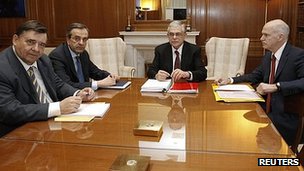 Greek PM Lucas Papademos has failed to secure the support of his coalition for a raft of new austerity measures, after more than seven hours of talks.
He had met officials from three parties to try to secure a deal leading to a fresh bailout package.
The main stumbling block in the crunch talks was proposed pension cuts, reports said.
Mr Papademos was said to be going directly to discuss the problem with EU and IMF officials.
They are representing the so-called "troika" of bailout creditors - the European Union, the European Central Bank and the International Monetary Fund - who had earlier agreed the draft proposals with the prime minister.
They are thought to include a 20% minimum wage reduction, pension cuts and the sacking of 15,000 public sector workers - and have prompted further mass protests.
Officials from Pasok, New Democracy and the far-right Laos party only received the 50-page text on Wednesday morning, reports said, after Mr Papademos agreed the deal with the troika on Tuesday night.
Pressure
According to Laos leader George Karatzaferis, the bulk of Wednesday's meeting was spent discussing the issue of supplementary pensions, which had reportedly been in line for a 15% cut.
Mr Papademos's office said Mr Karatzaferis had expressed "serious reservations" during the meeting.
As he left, Mr Karatzaferis told reporters: "I made my positions clear from the beginning... I wanted to support Mr Samaras (New Democracy leader) on that issue (pensions)."
Antonis Samaras said he had felt obliged to bargain hard.
"We want to ease the people's suffering,'' he said.
Eurozone finance ministers are to discuss the bailout on Thursday and observers say there is huge pressure for the Greek political leaders to agree a deal prior to that meeting.
But the BBC's Mark Lowen, in Athens, says the package of cuts and reforms would go down very badly with an austerity weary Greek nation.
According to unconfirmed reports in the Greek media, the measures were aimed at trimming 3.2bn euros (£2.7bn; $4.2bn):
- Minimum wage to be cut by 22% from 751 euros per month to 600 euros.
- Supplementary pensions to be reduced by 15% but basic pensions also likely to be cut
- 15,000 public sector jobs to go by end of 2012
- But holiday bonuses, known as 13th and 14th month salaries, expected to be saved
On Tuesday night, a spokesman for the International Institute of Finance (IIF) which is negotiating on behalf of the private creditors said the talks had been constructive and its three officials were returning to Paris for further consultations.
As part of Greece's new 130bn euro ($170bn; £110bn) bailout deal - Greece's second international bailout - Mr Papademos and Finance Minister Evangelos Venizelos have also been engaged in a separate strand of negotiations with private creditors over a write-off of up to 70% of the value of the money owed by the Greek government.
BBC
European central banks to blast cash into economy
With Europe sliding toward recession, the region’s two main central banks are preparing to redouble their emergency measures aimed at softening the downturn and blunting the effects of the government debt crisis.
Analysts expect the U.K.’s central bank, the Bank of England, to announce Thursday that it will inject another 50 billion pounds ($79 billion) of new money into an economy that shrank at the end of last year.
Meeting the same day at its headquarters in Frankfurt, Germany, the European Central Bank is expected to trumpet the advantages of its second unlimited offering of cheap, three-year loans to be allotted to banks on Feb. 29.
Neither central bank is expected to change interest rates from their current record lows — the Bank of England at 0.5 percent and the ECB at 1.0 percent. Rather, attention will focus on their outlooks and their attempts to push more money into the banking systems and the economy.
A first blast of cheap ECB credit — euro489 billion ($641.23 billion)— was taken up by 523 banks on Dec. 23. The step has been credited with calming some of the market panic from the debt crisis hitting the 17 countries that use the euro, and stocks and government bonds have risen since then. Analysts think the takeup could equal or exceed the first one, since the ECB has loosened collateral requirements.
Despite a remarkable easing in tensions on financial markets this year — particularly evident in the big drop in the borrowing rates of weak countries like Italy and Spain — the 17-country eurozone and the U.K. face worrying signs from the wider economy.
The eurozone economy is widely expected to have contracted in the fourth quarter, while the U.K. shrank 0.2 percent in the last three months of the year. Many analysts predict both regions will fall into a technical recession — defined as two consecutive quarters of negative growth — by the end of March.
Both remain exposed to any sudden shock from the crisis in Europe over too much government debt — financial volatility quickly causes credit to seize up, stifling economic activity.
A messy default by Greece — currently in drawn-out talks with other eurozone governments, the ECB and the International Monetary Fund about a second bailout — would threaten the integrity of the eurozone, shaking British and world markets as well.
Recent economic indicators for Britain and the eurozone have suggested things may pick up a bit in the months ahead, but big risks remain.
Credit availability, crucial to help businesses expand and create jobs, appears to be dropping in the eurozone. An ECB survey of banks indicated that the number tightening lending requirements surged at the end of last year, to a net 35 percent from 16 percent.
Andrew Goodwin, senior economic advisor to the Ernst & Young ITEM Club, says Britain still needs a further shot of stimulus thanks to the commotion across the Channel.
“Short-term prospects remain on a knife-edge given the ongoing policy paralysis in the eurozone. If the crisis deepens, it would most likely reverse all of the pickup seen in the last couple of months,” he said.
Analysts think the Bank of England will create new money to buy securities — mostly British government bonds — from private investors such as insurance companies and pension funds, on top of 275 billion pounds ($437 billion) it has already purchased.
The hope is that the purchases, known as quantitative easing or QE, will increase the amount of cash flowing through the financial system, which will in turn help lower interest rates and borrowing costs for businesses and raise asset prices. Quantitative easing can be inflationary, but analysts say the bank has room to act as inflation is widely forecast to fall from 4.2 percent toward the official 2 percent target over the next two years.
Vicky Redwood, chief U.K. economist at Capital Economics, said inflation “is expected to fall some way short of target.”
“Accordingly, we think the big picture will be that further QE is still needed,” Redwood added.
The U.S. Federal Reserve, which has already done two rounds of quantitative easing, has raised the possibility of doing another round as well.
For its part, the ECB may remain in a holding pattern on interest rates for some time, barring a sudden financial disaster in Greece. The country’s political leaders need to agree to tough austerity terms this week if Athens is to get more bailout loans in time to pay debts coming due March 20 and avoid default.
ECB president Mario Draghi is likely to face questions over whether the central bank will help find more money for the Greek bailout, now believed to be euro15 billion short of Greece’s needs.
Eurozone officials have suggested that the bank find a way to donate potential profits it may make on euro55 billion ($72 billion) in Greek bonds it bought for around euro40 billion on the secondary market. It could do that by selling the bonds to the eurozone bailout fund for what it paid for them, and the fund could then write them down.
Some analysts say the ECB isn’t in principle opposed to such a move, but is holding back to not appear to be taking instructions from governments — it is forbidden by the EU treaty to do that. Draghi turned aside questions about the issue at the bank’s January meeting but will be pressed for a clearer statement this week.
YAHOO News
Apple seeks change to 'essential' patent licence rules
Apple has asked for more clarity over how patents deemed crucial to industry standards should be handled.
The firm wrote a letter to the European Telecommunications Standards Institute (ETSI) in November, which has now been reported by the Wall Street Journal.
The iPhone maker called for "more consistent and transparent" application of rules designed to ensure that such intellectual properties were licensed.
Both Samsung and Motorola Mobility have sued Apple over "essential" patents.
The document has since been published in full on the Foss Patents blog.
It centres on what are termed Frand principles - an agreement to license technologies critical to a recognised standard, such as 3G networks or MP3 files, under fair, reasonable and non-discriminatory terms.
Companies that sign up to the rules agree that they cannot discriminate who gets to use their invention so long as they are paid a fee, which cannot be excessive.
Three-step plan
Apple notes that it committed itself to the agreement in 2007 - although it has launched numerous lawsuits concerning its rivals' alleged infringements of its non-Frand innovations.
The company's request lists three specific points:
- Parties should only be able to claim an "appropriate royalty rate", both at the start and end of negotiations.
- There should be a "common royalty base" - in other words, the patent's value should be determined as a percentage of the cost of the relevant components rather than the device as a whole.
- Patent owners should commit to a "no injunction" policy under which they do not seek to block the sale or shipments of rivals' equipment on the basis of a Frand-patent dispute.
"Apple is committed to this framework, provided that other parties reciprocate," said Bruce Watrous, the firm's chief intellectual property counsel.
Foss Patents' author, consultant Florian Mueller, links the letter to 9 To 5 Mac's revelation last September that Samsung had sought 2.4% of Apple's sales prices for each of a series of 3G-related Frand-type patents that it contested last year. The case was rejected by a Dutch court.
The European Commission has subsequently notified Samsung that it is investigating whether the firm had used its rights to "distort competition in European mobile device markets".
Blame game
Mr Mueller also notes that Motorola Mobility sought 2.25% of Apple 3G-enabled iPhone and iPad sale prices when Apple sought to license the Razr phonemaker' s GPRS-related Frand-innovations.
Apple had to briefly remove several of its devices from its German online store last week because of the dispute with Motorola.
However, one patent lawyer suggested that Apple was not blameless in the spate of recent lawsuits.
"Steve Jobs effectively declared war on Samsung and Android - so the litigation has been emotionally charged," said Ilya Kazi from the UK's Chartered Institute of Patent Attorneys.
"It is fair to say that most manufacturers are in favour of Frand-type agreements - at least when they are on the receiving end of a lawsuit.
"The issue is whether this letter has a great deal of legal significance. Frand is a great principle but there is also the underlying principle of letting patent holders enforce their rights."
Nokia to carry out 4,000 job cuts
Finnish mobile phone maker Nokia announced the details of 4,000 job losses on Wednesday at plants in Hungary, Mexico and Finland.
The company said the plants would remain open and refocus on customising phones whilst the actual assembly would move to South Korea and China.
The cuts are planned to be complete by the end of the year.
Nokia said the move is aimed at placing its production closer to its component suppliers who are also based in Asia.
The cuts come two weeks after the Finnish firm posted a 1.08bn euro ($1.4bn; £905m) loss for the three months to the end of December 2011.
Nokia reported that its net sales fell 21% on a year earlier to 10bn euros and net sales of its mobile phones were down by a quarter.
Burning platform
Nokia, formerly the world's largest maker of mobile phones, announced a tie-up with Microsoft last year in the face of fierce competition from a new generation of smartphones including Apple's iPhone and Samsung's Galaxy.
At the time Nokia chief executive Stephen Elop likened Nokia's situation to standing on a "burning platform".
The company announced a series of job cuts in a statement in September 2011 and mentioned planned cuts to its European facilities at the time.
With the latest job losses, the firm has made 14,000 cuts since 2010.
Cuba and Dominican Republic strengthen commercial bonds
New business opportunities to boost a greater commercial flow between Cuba and the Dominican Republic were analyzed on Monday in Havana by a group of entrepreneurs from the two nations.
Attending the meeting, organized by the Cuban Chamber of Commerce, were representatives of several Dominican Republic enterprises, headed by Eddy Martinez, general secretary and executive director of the Center for Exports and Foreign Investment.
Martinez told the press about his interest in significantly consolidating bonds in the fields of trade, cooperation and investment, “because in addition to fraternity, there’s still economic potential that has not been exploited between the two countries.”
He explained that this type of meeting represents new opportunities of development for Cuban and Dominican Republic enterprises, in order to generate more riches and jobs. He added that, at present, the commercial flow between the two parties is around $60 million a year, a figure still insufficient, when compared to what is obtained from their trade with the rest of the world.
That’s the reason why it is hoped, he said, that during the meeting between the two countries’ delegations, projects and joint work agreements, particularly in sectors like energy, food, health, mining, manufacture and services, are established — a priority for their economies.
Caribbean News Now
UN's Ban says Arab League mission to Syria may resume
 UN chief Ban Ki-moon says the Arab League plans to revive its mission to Syria, and has sought help from the UN.
Mr Ban said the "disastrous" failure to agree a UN resolution on Syria had encouraged Damascus "to step up its war on its own people".
The international community is struggling to find a way forward in the crisis after Russia and China blocked the resolution last week.
Syrian forces are continuing to attack opposition strongholds in the country.
Hundreds of people have died in the central city of Homs after days of heavy bombardment.
Speaking at the UN, Mr Ban said: "I fear that the appalling brutality we are witnessing in Homs, with heavy weapons firing into civilian neighbourhoods, is a grim harbinger of worse to come."
He said Arab League chief Nabil el-Arabi had told him he intended to revive a monitoring mission in Syria, which collapsed last month amid escalating violence.
Mr Ban said Mr Arabi had asked for UN help with the project and proposed a joint UN-Arab League observer mission, including a joint special envoy.
"In the coming days we will further consult with the council before fleshing out details,'' Mr Ban said.
"We stand ready to assist in any way that will contribute toward improvement on the ground.''
Lost opportunity
Earlier, the US rejected Russian calls for talks between the Syrian government and the opposition.
White House spokesman Jay Carney said President Bashar al-Assad had missed the "opportunity" for dialogue.
"From the (earliest) days of this situation in Syria, there was an opportunity for the Assad regime to engage in dialogue with the opposition," White House spokesman Jay Carney said.
"Rather than take that opportunity, Assad brutally cracked down on his own people. We don't think that that opportunity is available any more.
"It is clear that Assad has chosen a path and that choice has resulted in the deaths of many Syrians, including innocent children."
Russian Foreign Minister Sergei Lavrov, who visited Damascus on Tuesday, had said that President Assad was ready to talk with "all political forces" to end the violence.
But his comments were dismissed by opposition leaders and violence across Syria has continued unabated.
Mr Carney said the US planned to meet soon with its international partners to discuss ways to stop the violence in Syria and provide humanitarian aid.
In a day of intense diplomatic activity, Turkish Foreign Minister Ahmet Davutoglu said on Wednesday that if the UN Security Council couldn't protect Syrian civilians, then like-minded countries should find ways to do so.
He is due in Washington for talks with Secretary of State Hillary Clinton early next week.
Russian President Dmitry Medvedev, in a phone conversation with French President Nicolas Sarkozy on Wednesday, urged the West "to avoid hasty unilateral steps" in Syria, Russian news agency Interfax reported.
Meanwhile, the UK-based Syrian Observatory for Human Rights said more than 50 people were killed in Wednesday's shelling of Homs.
Witnesses in the Baba Amr neighbourhood reported intense shelling by tanks, mortars, artillery and heavy machine guns.
"The situation is dire. We are short of food, water and medical aid. Doctors have collapsed after treating the wounded without rest for five days," said activist Omar Shaker in Homs.
"We want Lavrov to come and spend a night in Homs to see what we have been passing through."
The Observatory also reported at least another eight civilians killed around the country on Wednesday.
Syria restricts access to foreign media and casualty figures cannot be independently verified.
The UN resolution backed an Arab League peace plan that would have seen President Assad hand power to a deputy to oversee a transition.
Russia, a strong ally of Syria, said that amounted to regime change.
The Syrian government blames the violence on foreign-backed groups and insists the Homs offensive will continue until "order" is restored in the city.
Wade Faces Protests on Campaign Trail
Senegalese President Abdoulaye Wade took his controversial campaign for another term on the road Wednesday, holding a rally in a town where opposition support is strong.
The president's convoy faced rock-throwing protesters as it drove the 70 kilometers from the capital to Thies. At the rally site, thousands of supporters wearing Mr. Wade's Democratic Party blue came to cheer him on. But the crowd was much smaller than those he once attracted as a longtime opposition leader.
The 85-year-old Mr. Wade has faced violent opposition to his bid for a third term, despite a two-term limit. Last month, a court agreed that the limit did not apply to him because it came into effect after he was first elected in 2000.
On Tuesday, the president summoned the U.S. ambassador to Senegal after local media published an interview in which he criticized President Wade's bid for a third term.
Ambassador Lewis Lukens told local journalists that President Wade has compromised the elections and threatened the security of the country by insisting on running for a third term in the February 26 presidential election.
The U.S. State Department also has urged Mr. Wade to allow power to pass “to the next generation,” prompting complaints of foreign intervention by Mr. Wade's government.
Thirteen candidates are competing against Mr. Wade, including his former allies, Macky Sall and Idrissa Seck. A run-off will be held if no one wins more than half of the total vote.
UN Condemns Tuareg Violence; New Town Under Rebel Control
Tuareg rebels in northern Mali have seized a strategic border town, and the United Nations has urged an end to the fighting.
Rebel fighters said Wednesday they seized the town of Tinzawaten, and government forces confirmed they made a “strategic” retreat. The government troops withdrew across the border into Algeria.
United Nations Secretary-General Ban Ki-moon said he is “deeply concerned” about the civilian casualties and large numbers of people displaced from the fighting. In a statement Wednesday, Mr. Ban called on the rebels to immediately end all attacks and to use talks with the government to resolve their grievances.
Tuareg rebels launched this new rebellion on January 17, clashing with government troops in several northern towns. The United Nations refugee agency says at least 22,000 people have fled the unrest in northern Mali.
Hundreds of ethnic Tuaregs recently returned to northern Mali from Libya, where they fought alongside troops loyal to ousted leader Moammar Gadhafi.
The government has been holding talks in recent months in an effort to defuse rising tensions in the north.
Tuareg rebels say they are seeking independence from the southern-based government, which they say has ignored Mali's impoverished northern desert region.
Tuareg nomads are present throughout the Sahel region of Africa. Both Mali and Niger have battled Tuareg uprisings in the last decade.