
US house prices fall in October despite low rates
US home prices have fallen further in October despite record low mortgage interest rates, according to new data.
The Standard & Poor's Case-Shiller index of 10 major metropolitan areas fell 1.1% from a month earlier and its 20-city index fell 1.2%.
Atlanta was one of the worst performing cities, down 5% month-on-month.
Last week, government-sponsored mortgage agency Freddie Mac said average 30-year mortgage rates had fallen to a record low of 3.91%.
Chicago, Cleveland, and Minneapolis all posted monthly declines of 1% or more.
For the year, average home prices across the US were down 3.4% in the three months to October compared to the same period in 2010.
Americans have been reluctant to enter the housing market in the face of high unemployment and weak job growth.
But the house price index is see as a lagging indicator of the market, as it is published with a two month dealy, and is based on an average of the preceding three months.
In contrast, separate data released before Christmas suggest that there may have been an improvement in the US housing market in more recent months.
Home sales volumes rose in November, as did confidence among builders, who have been restarting building projects.
This other data rallied investors, who believed a recovery in the housing market was on the way.
"In light of the more positive housing numbers we've seen in the last week or so, this [Case-Shiller data] might be a bit of a disappointment," said Omer Esiner, chief market strategist at Commonwealth Foreign Exchange in Washington.

Brazil to be world's fifth-largest economy in less than 4 years
Brazil will overtake France to become the world's fifth-largest economy in less than four years, the country's Finance Minister Guido Mantega said Tuesday.
"The International Monetary Fund says Brazil will be the world's fifth-largest economy by 2015, but I think that it will happen earlier," he said.
He made the forecast after the Center for Economics and Business Research (CEBR) said Monday that Brazil will overtake Britain as the world's sixth-largest economy in 2011.
Brazil registered a 7.5-percent gross domestic product (GDP) growth last year and was the world's seventh-largest economy, after the United States, China, Japan, Germany, France and Britain.
Mantega said Brazil's GDP is growing twice as fast as those of European countries, and thus it is natural that it will manage to overtake Britain, France, and maybe even Germany in the near future.
Mantega predicted that the Brazilian economy would grow 3 to 3.5 percent this year, and may even see growth of 4 to 5 percent in 2012.
Brazil is on the right path, he said, highlighting the country's recent accomplishments, such as its high job generation and stable inflation rate.
"We will grow more in 2012 than in 2011, the exchange rate will be better and credit will be cheaper," Mantega said.
However, Mantega warned that Brazil's living standards are still below those of developed countries, and it would take years for it to reach the per capita income levels registered in developed nations.
North Korea begins two-day Kim Jong-il memorial
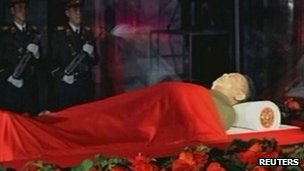 North Korea is to begin two days of funeral services for its late leader Kim Jong-il, with hundreds of thousands expected to attend in Pyongyang.
Few details are known and there will be no foreign delegations but a procession is expected on Wednesday, echoing that for Kim's father, Kim Il-sung, in 1994.
As then, the funeral is expected to be used to cement the succession of new leader Kim Jong-un.
Kim Jong-il died of a heart attack on 17 December, aged 69, state media said.
He has been lying in state since then.
'Memorial service'
If the funeral does mirror 1994, there will be much pomp and military might, with tens of thousands of weeping North Koreans.
Kim Jong-il was not in the funeral motorcade for his father's death and observers will be watching to see how prominent a role Kim Jong-un - who is Mr Kim's third son - plays.
Kim Jong-un's name is first in the list of members of the "national funeral committee" published by the main North Korean news agency, and the funeral committee did take part in Kim Il-sung's funeral.
Kim Jong-il's two other sons are not members of the committee and have not been seen during the mourning period.
South Korean media have suggested a start time of about 01:00 GMT, with a 24-gun military salute followed by a march of troops through the centre of the capital.
There will probably be a large photograph of the late leader, smiling, on prominent display.
Citizens will line the streets, with many of the women in traditional black dresses.
There have been many images of distraught citizens released by state media since the death. Early on Wednesday it broadcast more footage of weeping mourners paying their respects to Kim Jong-il.
Thursday is expected to feature a three-minute silence at noon local time, followed by trains and ships sounding horns.
The national memorial service will then begin.
State media have portrayed Kim Jong-un as leader since his father's death. He is thought to be in his late 20s and has very little political experience.
Kim Jong-il was in the process of formalising him as his successor when he died but the transition was not complete, leaving regional neighbours fearful of a power struggle in the nuclear-armed pariah state.
The Rodong Sinmun newspaper has described Kim Jong-un as the head of the Workers' Party Central Committee, meaning that he now controls one of the country's highest decision-making bodies.
The newspaper earlier gave him the title of "supreme commander" of the armed forces.
Analysts say he will be surrounded by a group of experienced military insiders and relatives, as the Pyongyang elite attempts to hold on to power.
Iran Threatens to Block Gulf Oil if Sanctions Applied
Iran has threatened to block the flow of oil through the Strait of Hormuz if Western governments attempt to impose sanctions on its petroleum exports in their dispute over its nuclear ambitions.
The official Iranian news agency IRNA quoted Vice President Mohammad Reza Rahimi as saying that if Iranian oil is banned “then not a drop of oil will pass through the Strait of Hormuz.”
Rahimi was quoted as saying Iran does not want hostilities but that Westerners are not willing to give up “their plots.”
The blunt warning came as Iran's naval forces continued a 10-day exercise in the Strait and nearby waters that began Saturday.
In Washington, U.S. State Department spokesman Mark Toner dismissed the threat as “bluster.” He called the comments “another attempt to distract attention from [Iran's] continued noncompliance with international nuclear obligations.”
Iran contends its uranium enrichment program is for civilian purposes, but a United Nations report issued last month said Tehran appears to be secretly working on designing an atomic weapon and missile delivery system.
European Union ministers have said that a decision on further economic sanctions – including the question of whether to boycott Iranian oil – would be made in the coming weeks. The vast majority of Iran's foreign revenue comes from oil exports.
More than one-third of the world's tanker-borne oil supply passes through the Strait of Hormuz.
Powerful quake hits Russia's Siberia, no casualties reported
An earthquake measuring 6.6-magnitude on the Richter scale jolted Russia's southeastern Siberian republic of Tuva on Tuesday, said local emergency center.
The Siberian regional center of the Russian Emergency Situations Ministry said information available showed there was no damage or casualties in the quake-hit region.
"Everything is all right. Our dispatchers work round the clock and they did not receive any calls on any destruction," a spokesman for the regional center was quoted by RIA Novosti news agency as saying.
The spokesman also said local residents were warned about the possibility of aftershocks and were advised to leave their homes.
The geophysical service of the Russian Academy of Sciences said the quake, with its epicenter registered at a depth of 10 kilometers some 120 km to the east of Kyzyl, capital city of the Tuva republic, occurred at 19: 21 Moscow time (1521 GMT).
The Kremlin press service said Russian Emergency Situations Minister Sergei Shoigu had reported to President Dmitry Medvedev about the quake and the situation in the region.
"Rescue teams were working at the scene and relief work was continuing," the Kremlin said, adding that all necessary assistance has been provided to people.
Earlier, the U.S. Geological Survey said the quake hit the region with its epicenter at a depth of 6.90 km.
China wins women's chess champion worlds
China beat India 2.5-1.5 in the last round of the 2011 World Women Chess Team Championship (WWTC) on Tuesday to win the title in Mardin province of southeastern Turkey.
Russia finished second and Georgia third.
For Chian-India match, three games ended in draws and Zhao Xue defeated Tania Sachdev on the third board.
"India wanted to make quick match draw with us, but our players hoped to fight. Zhao Xue eagered a win particularly and she made it," said China coach Yu Shaoteng.
Zhao Xue said:" I lost a game yesterday and I really want to win today."
In other matchups, Russia made a quick draw with Armenia to secure medals, Vietnam also drew with Ukraine, Greece beat South Africa and Georgia ousted Turkey.
Following are the final standings:
1. China - 16 points
2. Russia - 13 points
3. Georgia - 12 points
4-5. India, Ukraine - 11 points
6-7. Armenia, Vietnam - 9 points
8. Greece - 5 points
9. Turkey - 4 points
10. South Africa - 0 point.
Mass Protests in Homs as Monitors Arrive
Syrian security forces fired tear gas to disperse tens of thousands of protesters who rallied in Homs Tuesday, as Arab League observers visited the city to monitor government pledges to withdraw troops, release political prisoners and halt violence.
The London-based Syrian Observatory for Human Rights said about 70,000 anti-government protesters chanting calls to execute President Bashar al-Assad marched toward the city center when security forces confronted them.
The Observatory confirmed amateur video showing troops also fired live ammunition on demonstrators in Homs. It said six people were killed in the city Tuesday, among 15 protest-related deaths nationwide.
A contingent from the 12 Arab League observers visiting Homs met with the regional governor and then with opposition representatives inside the city. The delegation's head told Reuters that the first day of talks was “very good” and that “all sides were responsive.”
Sporadic fighting continued Tuesday in the hard-hit Homs district of Baba Amr, an opposition stronghold. Activists said some tanks were seen leaving the area, while others were hidden in government zones from where they could be quickly redeployed when monitors leave.
Video posted on YouTube appears to show several men pleading with observers to venture farther into Baba Amr, and to announce that they had been prevented from seeing key areas because of government sniper fire.
Rights groups have questioned whether monitors can work independently and if the relatively small number of observers will render the mission ineffective. Initially 500 monitors were to have entered Syria, but now only 150 are likely to be allowed into the country.
Fifty observers and 10 other Arab League officials arrived in the capital, Damascus, on Monday. The Arab League says the monitors also will visit several other Syrian cities, including Idlib, Hama and Daraa.
The French foreign ministry says the observers have arrived at a time when Syria's unrest has “never been as tragic” as it is now in Homs. The city has become the center of the nine-month uprising against Mr. Assad.
Activists said security forces killed at least 34 people in Homs on Monday before monitors arrived. The state-run SANA news agency reported “armed terrorists” blew up a gas pipeline in Homs on Tuesday. It also said “terrorists” clashed with authorities near the Turkish border.
The United Nations estimates 5,000 people have been killed since March in violence linked to Syria's unrest. Syria says armed terrorists are driving the revolt. It accuses them of killing 2,000 security personnel since March.
Syrian authorities agreed to the Arab League observers under international pressure and threats of Arab sanctions. The plan requires Syrian authorities to give the monitors freedom of movement everywhere except sensitive military sites.
Mission: Impossible' (the fourth one) tops 'Sherlock Holmes' (the second one) at the weekend box office
Mission: Merrily Accomplished for Tom Cruise. The fourth installment in the actor’s Mission: Impossible spy-fi franchise — this time directed by Oscar winner Brad Bird making his live-action debut — finished in first place at the box office this weekend (Friday-Sunday), beating last weekend’s top flick, Sherlock Holmes: Game of Shadows. Mission: Impossible — Ghost Protocol scared up $26.5 million on 3,448 screens and has grossed nearly $59 million since its release on Dec. 16. Game of Shadows brought in $17.8 million on 3,703 screens, down 55.1% from last weekend. The sequel has tallied $76.5 million since opening two weeks ago.
In a close battle for third, Alvin and the Chipmunks: Chipwrecked ($13.3 million; $50.3 million overall) edged the opening weekend frame of The Girl with the Dragon Tattoo ($13.0 million; $21.4 million cumulative).
The Adventures of Tintin grossed $9.1 million ($17.1 cumulative) for fifth place, followed by We Bought a Zoo, which brought in $7.8 million in its first three days in theaters.
11 missing after fatal capsizing in India
At least 13 people died and 11 were reported missing after a boat capsized Sunday in a southern India lake, authorities said.
Three people survived the accident on Pulicat Lake, about 36 miles north of Chennai, according to affiliate CNN-IBN.
V. Vanitha, senior superintendent of police in Thiruvallur district, said the private boat was on a pleasure trip.
Local fishermen were assisting divers and crews in the rescue and search mission, officials said.
The lake is in Tamil Nadu state, near the Bay of Bengal.
Libya to Integrate Former Rebels in Military
Senior Libyan officials have announced a program to disarm and integrate into the country's armed forces and civil institutions thousands of former rebels who helped topple Moammar Gadhafi.
Planning Minister Issa al-Tuijer said Sunday the ex-rebels – many who still are organized in disparate militia groups – will be assigned to the military as well as police and other civilian posts.
The registration period will begin after January 1 and last about one month.
Defense Minister Osama Juwaili said the plan's main focus is to fill positions such as border guards, where former fighters would police the country's porous frontier. He said key installations, including oilfields and refineries now held by rival militias, also would receive guards.
Some ex-rebels would take up high-ranking positions in the military. Talks are under way with a number of countries to train rebels inside and outside Libya for military posts.
Interior Minister Fawzi Abdelali said his understaffed ministry is among those expecting large numbers of recruits. He recently estimated that 25,000 former rebels would join the interior ministry and another 25,000 would join the defense ministry.
Although rebels met a deadline imposed by the ruling National Transitional Council to withdraw this week from the capital, Tripoli, militias led by rival commanders still guard key installations and checkpoints across the city.
The lack of a fully functioning army and police force has allowed militias to fight turf wars after the uprising that ended Gadhafi's 42-year rule in August.
VOA