
Egyptian Activists, Security Forces Clash for 3rd Day in Cairo
Egyptian anti-government activists and security forces have engaged in a third day of street battles in Cairo. Protesters are demanding that the country's military rulers hand power to a civilian administration.
The anti-government activists threw rocks at security forces Sunday on a road leading from Tahrir Square to the seat of government. Egyptian soldiers set up concrete barriers on the road as riot police confronted the protesters. Egyptian security personnel in civilian clothes threw stones at the protesters from rooftops.
Egyptian state television said rocks and gasoline bombs thrown by rioters injured 24 police. There were no other reports of casualties.
On Sunday, the United Nations and the United States expressed concern about the violence in Egypt.
U.N. Secretary General Ban Ki-moon's office said he was “highly alarmed by the excessive use of force employed by the security forces against the protesters.”
U.S. Secretary of State Hillary Clinton said on Sunday she was deeply concerned about continuing violence in Egypt.
Authorities say 10 protesters were killed and at least 500 other people were hurt in the first two days of rioting. Military officials say 164 people have been detained.
The anti-government activists protesting in Cairo want the military council to step down immediately. They accuse the council of manipulating the transition process to retain permanent powers. But other Egyptians want a stop to months of street protests to allow the voting to proceed.
Egypt's main Islamist group, the Muslim Brotherhood, said Sunday its party secured the biggest share of party-list votes in the second stage of the parliamentary election last week. It said unofficial results from the nine Egyptian provinces that voted on December 14 and 15 show the Freedom and Justice party won about 40 percent of the party-list ballots.
The Brotherhood's party and the ultra-conservative Islamist Al-Nur party dominated the first stage of the election in Cairo, Alexandria and seven other provinces earlier this month.
An Egyptian military council is overseeing the three-month phased parliamentary election, and has promised to hand power to an elected president by July
In another development Sunday, Egyptian authorities say saboteurs blew up part of a pipeline carrying natural gas to Israel and Jordan, the 10th such attack this year. The latest blast happened near the town of El-Arish on the northern coast of the Sinai Peninsula. No fire was reported because the pipeline was disabled following a previous attack last month. No group has claimed responsibility for the series of pipeline blasts.
.

More Protests in Russia Over Alleged Election Fraud
Thousands marched again Sunday in Moscow and St. Petersburg against alleged fraud in this month's Russian parliamentary elections.
The Communist party organized the Moscow protests while several different parties were behind the St. Petersburg march. But Sunday's protests were much smaller than those held across Russia last week.
Both the opposition and outside observers say there were widespread irregularities and outright fraud in the December 4 election, won by Prime Minister Vladimir Putin's ruling United Russia party.
Despite unprecedented public outrage against United Russia, Prime Minister Putin is widely expected to win the March 4 presidential election and swap jobs with current president Dimitry Medvedev.
Mr. Putin was elected president in 2000 and 2004, but Russia's constitution made him ineligible to seek a third consecutive term in 2008.
Last month, Mr. Putin formally accepted his party's nomination to run again for the presidency. The job swap deal has angered many in Russia, who say it would strengthen authoritarian rule and clear the way for Mr. Putin to become Russia's longest-serving leader since Soviet dictator Josef Stalin.
Political turmoil flares in Iraq as U.S. pulls out
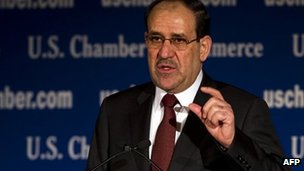 Iraqi Prime Minister Nuri al-Maliki is asking lawmakers to withdraw confidence from his deputy after Saleh al-Mutlaq made controversial comments this week over American forces withdrawing from Iraq, state media reported late Saturday.
In a recent interview with CNN, al-Mutlaq accused al-Maliki of amassing dictatorial power.
"There will be a day whereby the Americans will realize that they were deceived by al-Maliki ... and they will regret that," said al-Mutlaq, a leader within Iraqiya movement.
Al-Maliki's request followed word that Iraqiya, a powerful political bloc, won't participate in the country's parliament -- a move that would threaten Iraq's fragile power-sharing arrangement.
The Iraqiya bloc, a largely secular and cross-sectarian group headed by former Prime Minister Ayad Allawi, made the move on Friday night. The bloc is one of the largest and most powerful political groups in Iraq and boasts among its members the speaker of the parliament. The bloc had been in a power-sharing deal with al-Maliki's State of Law Alliance, backed mostly by Shiites.
Iraqiya accuses al-Maliki of trying to consolidate his own power rather than share it.
His rivals say, for example, that he still controls the country's security ministries and all decisions go through him. They also say that the hundreds of people seized by the government in October for backing terrorism and supporting the banned Baath Party are Iraqiya supporters.
Iraqiya spokesman Haider al-Mulla said the bloc has always warned about the deal's risks and says the State of Law Alliance has been violating the law.
"Iraqiya has always expressed its rejection to the policy of exclusion and marginalization, lack of power sharing, politicization of the judiciary, the lack of balance within the government institutions," al-Mulla said.
Al-Maliki won a second term as prime minister in 2010 after a months-long dispute among the leading parties in the country's parliamentary elections. The largely secular Iraqiya movement won two more seats than al-Maliki's party, but a merger of the premier's Shiite Muslim slate with a smaller Shiite bloc put him first in line to form a government.
There had been fears of renewed bloodshed between Iraq's majority Shiite and minority Sunni populations and that prompted U.S. officials to work out a power-sharing agreement, bringing the Iraqiya movement into the government.
Al-Mutlaq told CNN that Washington is leaving Iraq "with a dictator" who has ignored a power-sharing agreement, kept control of the country's security forces and rounded up hundreds of people in recent weeks.
He said he was "shocked" to hear U.S. President Barack Obama greet al-Maliki at the White House on Monday as "the elected leader of a sovereign, self-reliant and democratic Iraq."
"America left Iraq with almost no infrastructure. The political process is going in a very wrong direction, going toward a dictatorship," he said. "People are not going to accept that, and most likely they are going to ask for the division of the country. And this is going to be a disaster. Dividing the country isn't going to be smooth, because dividing the country is going to be a war before that and a war after that."
Neighboring Iran, predominantly Shiite and led by a Shiite regime, views al-Maliki as its man in Baghdad and has dictated the shape of the current government, al-Mutlaq said. But he said al-Maliki is playing games with both Washington and Tehran.
The last U.S. troops are scheduled to be out of Iraq by the end of December, nearly nine years after the 2003 invasion that topped Saddam Hussein. More than 4,000 Americans and an estimated 115,000 Iraqis died in the invasion and the years of insurgency and sectarian warfare that followed.
A Sunni who was originally barred from running because of allegations that he supported Hussein's Baath Party, al-Mutlaq said he has no authority within the government.
He said al-Maliki has flouted the power-sharing deal's provisions by refusing to name permanent ministers to lead the defense and interior ministries, which concentrates control over the military and police in the prime minister's hands.
He said U.S. officials, who brokered the power-sharing deal, either "don't know anything in Iraq and they don't know what is happening in Iraq, or because they don't want to admit the reality in Iraq, the failure in Iraq, the failure of this political process that they set in Iraq."
Along with Shiites and Sunnis, Kurds are a major player in Iraqi politics.
Mahmoud Othman, a Kurdish member of parliament, said lawmakers discussed the Iraqiya move on Saturday and said it reflects "a level of mistrust between the blocs, the government, Iraqiya and others.
"The problem is that Maliki isn't sharing any security decisions with Iraqiya, he doesn't trust them and this is a big problem," he said. "Power-sharing was never power-sharing. We are in a government of conflict. Power-sharing was never successful.
"The Kurds don't want to take sides, we want them (Iraqiya and State of Law Alliance) to get together to solve their problems."
He is worried that the problem could morph into fighting between Sunnis and Shiites or violence against the government.
"This isn't just political," he said. "It's sectarian."
CNN
Barry Bonds’ House Arrest Sentence Delayed Pending Appeal
 Barry Bonds will remain free while he appeals his conviction for giving misleading testimony before a grand jury, reports ESPN.
Bonds was sentenced in federal court Friday to 30 days of house arrest, two years of probation and 250 hours of community service — then the judge delayed the sentence pending an appeal likely to take a year or more.
U.S. District Judge Susan Illston also put on hold a $4,000 fine against Bonds for his obstruction of justice conviction arising from a grand jury appearance eight years ago.
Prosecutors wanted the home run king to spend 15 months in prison. Assistant U.S. Attorney Matthew Parrella argued that home confinement wasn’t punishment enough, “for a man with a 15,000 square foot house with all the advantages.” Bonds lives on an estate in Beverly Hills.
Well-wishers hugged the 47-year-old Bonds in the hallway outside the courtroom after the hearing was over. He declined to speak in court.
A jury convicted Bonds in April of purposely answering questions about steroids with rambling non sequiturs in an attempt to mislead a grand jury investigating sports doping in December 2003. Bonds’ trial jury failed to reach a verdict on three other charges accusing Bonds of lying when he denied taking performance-enhancing drugs and when he denied receiving injections from someone other than his doctor.
Prosecutors in September dropped those deadlocked charges, giving up on another trial.
Bonds, Major League Baseball’s career leader with 762 home runs, now has 14 days to file his intention to appeal his conviction.
Bonds was one of two former baseball superstars to stand trial in doping-related cases this year. The trial of pitcher Roger Clemens was halted after just two days in July because prosecutors used inadmissible evidence. U.S. District Judge Reggie Walton has set a new trial for April 17.
Accused NFL Drug Dealer Sam Hurd Taps Former Death Row Attorney David Kenner
Accused Chicago Bears drug dealer Sam Hurd has hired high-powered defense attorney David Kenner to represent him in his federal drug dealing case.
The former wide receiver was arrested on Wednesday (December 14), after he met with an undercover agent in a Chicago restaurant and attempted to purchase multiple kilos of cocaine.
Federal prosecutors began investigating Hurd in July, when an informant tipped them off, claiming that Hurd was running a drug dealing network.
According to prosecutors, Sam Hurd admitted to an undercover agent that his drug dealing network was selling about 4 kilos of cocaine per week.
He was at the restaurant meeting with a confidential informant, to set up a deal, because he could not keep up with the demand.
The NFL star was attempting to purchase 5 to 10 kilograms of cocaine per week at a cost of $25,000 per kilo, along with 1,000 pounds of marijuana to distribute, per week. He also left the meeting with a package he believed contained a kilo of cocaine.
Sam Hurd’s attorney David Kenner is already well-known in Hip-Hop circles.
Kenner represented incarcerated drug baron Michael “Harry-O” Harris, who was allegedly an early investor in Death Row Records.
According to the documentary “Welcome to Death Row,” Kenner helped Harry-O form Godfather Entertainment, which was supposed to be the parent company for Death Row Records, which was co-owned by Marion “Suge” Knight and Dr. Dre.
Harry-O’s alleged ownership of Death Row Records set off a bitter battle for the label, which resulted in Suge Knight bankrupting the legendary imprint.
The company was eventually sold to Canadian based company Wide Awake Entertainment for $18 million in January of 2008.
David Kenner, along with Johnnie Cochran, was among the lawyers who represented Snoop Dogg in his 1996 murder trial, which ended in an acquittal for the rapper.
David Kenner is hopeful that he can successfully defend Sam Hurd against the federal drug dealing charges.
“Sam intends to fight these charges, and we intend to defend him fully,” David Kenner told the Associated Press. “We have complete confidence in him…they start off looking terrible, and then we end up with not guiltys.”
Sam Hurd’s coach Lovie Smith and other members of the Chicago Bears were shocked at his arrest.
Earlier in the summer, Hurd had signed a $5.15 million deal with The Bears.
He also earned a $1.35 million signing bonus and took home a base pay of $685,000.
But things could get worse for the disgraced NFL star, as reports are surfacing that he was providing drugs to other NFL players.
According to CBS Radio’s 670 The Score, federal prosecutors have a double-digit list of NFL players that are connected to the drug dealing network, in some manner.
Hurd is charged multiple offenses, including conspiracy to possess with the intent to distribute more than 500 grams of cocaine, or half a kilogram.
He faces up to 40 years in prison and a $2 million fine if convicted.
Sam Hurd is currently free on $100,000 bail.
Deion Sanders Announces Divorce from Wife Pilar
Back in September we reported that football Hall of Famer, Deion Sanders, took to Twitter to deny that he and wife Pilar were getting divorced after 11 years of marriage.
The supposed reason for the divorce was that he didn’t want Pilar to become a reality TV star as crazy as it sounds. Here’s how he responded at the time:
“Ladies and gentlemen I never address Ignorance but I must at this point. I’ve never filed 4 divorce and hadn’t made a statement to Any media,” he tweeted.
Hmm, OK. Fast forward to today and this statement to TMZ from Mr. Sanders:
“Pilar and I have decided to end our marriage and move on to the next phase of our individual lives with mutual respect. We are friends and our top priority has and will continue to be the well-being of our children.”
He adds, “We arrived at this decision prayerfully and carefully in order to be able to pursue what is in both of our best personal interests.”
They have three children together and were married in 1999.
Mike Tyson Floats Idea of ‘Over 40’ Boxing Tournament
Mike Tyson has an idea.
Speaking to Fightnews.com during the WBC convention in Vegas this week, “Iron” Mike says he’s come up with a way to make some money by having past-their-prime heavyweights aged 40 and over battle it out in an elimination tournament.
Think Evander Holyfield, Oliver McCall, Cedric Boswell, Jameel McCline, Larry Donald, Andrew Golota and Riddick Bowe facing off for your entertainment.
“Fighters over 40 cannot compete with the best,” Tyson stated. “They can look good against okay opposition, but not the upper echelon of the heavyweight division. Maybe an over-40 tournament would be a good idea. Just make them fight only eight rounds so they will be full of energy. I’m sure people would buy this. The fights would be entertaining. Everybody over 40 is very welcome except Vitali Klitschko – he is too good.”
Tyson said he himself would not be tempted to fight in such a tournament.
“It’s not for me anymore. I would be afraid to fight,” he said.
Tyson mentioning the word “afraid” in the same sentence as “fight” doesn’t even sound right. Just four months ago, he was promoting his pigeon reality show “Taking on Tyson” and revealing the secret to his domination in the ring.
Digicel goes after LIME’s fixed line customers in Barbados
 MOBILE phone provider Digicel says market penetration for cellphones in Barbados is nearly maxed out and it is now going after LIME’s substantial fixed line customers.
Barry O’Brien, Digicel Barbados’ managing director said at the company’s launch of its 4G network, that cellphone penetration was around 110 per cent, while the highest figures achieved in some European countries was about 118 to 120 per cent.
“Barbados has a population of 280,000 and it has a 110 per cent market penetration . . . so the market is not going to grow hugely. What we at Digicel are offering is more products and more services to the market to grow that revenue for us,” he explained.
“The other way we are going to grow is to take customers from our competitors because the population is obviously not growing. The number of homes that people are going to buy is not going to grow substantially,” O’Brien explained.
“The way forward is to grow from being a mobile company – which is where we primarily make our revenue – into a full [information communications technology] company,” he added.
In this connection, he cited Digicel’s recent acquisition of Netxar Technologies, a local ICT company.
O’Brien said Digicel was now eager to bring more competition to the fixed line market.
“Government has been very positive about offering a licence for the landline and has been very supportive. So we are just going through due process and I am very confident we will get it when we need to get it,” O’Brien noted.
The telecom boss said it was much too early to talk about pricing for its planned service, but said it would definitely come in under the current rates.
“As we did with mobile, we hope that it would bring down pricing overall for customers. We are all about bringing value and we certainly would not be offering a service that was more expensive than what exists. It will be about giving value and better service and getting customers to switch over to us like we did in mobile,” O’Brien added.
Jamaica Observer
LIAT seeks to allay concerns among regional travelers
Despite a breakdown in mediation talks with pilots, LIAT management is promising to maintain scheduled flights.
The assurance was given to allay concerns among regional travelers during the Christmas season – one of the busiest periods for the airline.
The company said in a statement that “efforts are continuing to respond to the various labour and other issues which have caused our customers to be concerned about further disruptions to our schedule.”
Mediation talks chaired by Labour Minister Dr Errol Cort broke down on Monday.
Pilots are demanding the immediate reinstatement of their colleague, Captain Michael Blackburn – the union chairman – while management insists he brought the company into disrepute by comments he made on a local radio station.
Blackburn’s December 5 dismissal resulted in three days of industrial action that was shelved in the wake of the minister’s intervention.
Chairman of the group of LIAT unions, Grenada’s Senator Chester Humphrey has warned that “the failure of LIAT’s management to reinstate Captain Michael Blackburn…will lead to further disruption to the airline’s service.”
LIAT said in a statement that it remains in “frank and respectful” dialogue with the Leeward Islands Airline Pilots Association on areas of concern.
“Discussions are also on-going with various unions aimed at addressing a number of the other concerns which have arisen between the company and its employees,” LIAT added.
Nation News
Political parties meet in Guyana
At the invitation of President Donald Ramotar, the leaders of A Partnership for National Unity (APNU) and the Alliance for Change (AFC) met with the president on Thursday.
Ramotar was accompanied by Prime Minister Samuel Hinds, Head of the Presidential Secretariat, Dr Roger Luncheon and Presidential Adviser Gail Teixeira. The APNU delegation comprised David Granger, Dr Rupert Roopnaraine and Joseph Harmon. The AFC delegation comprised Raphael Trotman, Khemraj Ramjattan, Clayton Hall and Gerhard Ramsaroop.
During the discussions several issues were raised and the following was agreed as the way forward:
i) The three parties would by Monday, December 19, 2011 exchange lists of issues for discussion and prioritization at the next meeting scheduled for Wednesday, December 21, 2011;
ii) The three parties will name two persons each as their plenipotentiaries who will meet after the meeting of December 21, 2011 to work on identified and agreed on priority issues;
iii) The National Assembly will not be convened in the month of December;
iv) The Minister of Finance will meet with the two identified finance persons of the APNU and AFC in the near future to consult on the preparation of the Budget 2012.
Caribbean News Now