
‘Dudus’ sentencing now Jan 17
The sentencing of Christopher ‘Dudus’ Coke, the former Tivoli Gardens strongman, has been postponed until January 17, officials close to the case told the Observer.
Coke’s sentencing had originally been scheduled for this Thursday, following a plea bargain which was reached between his attorneys and prosecutors in August.
He faces more than 20 years in prison under the agreement, and while no reason has been given by the Attorney’s office for the Southern District of New York, which is handling the case, there is heightened speculation within the Jamaican community here that the postponement is linked to the possibility of more indictments arising from the case for which Coke was convicted.
Coke has been incarcerated for more than a year after waiving extradition rights on drugs and gunrunning charges. He pleaded guilty to conspiracy charges during an August 31 court appearance after prosecutors presented his legal team with compelling evidence in the case.
The evidence included the planned testimony of several persons from Tivoli Gardens who are incarcerated here on various charges.
Since reaching the plea agreement, Coke has written to Judge Robert P Patterson seeking leniency in his sentence.
Jamaican Observer

Dominican Republic nationals arrested in major drug haul
Five nationals of the Dominican Republic have been nabbed with around US$6.3 million dollar in drugs near Puerto Rico.
The US Customs and Border Protection (CBP) said the Dominicans were arrested after the vessel on which they were transporting the 661.37 (300 kilos) pounds of cocaine was intercepted about 50 miles north of the coast of Aguadilla Saturday afternoon.
The CBP said the twin-engine fiberglass vessel was spotted by one of its Maritime Surveillance Aircraft heading on a southeasterly course at approximately 10 knots.
“Two CBP marine interceptors, with Puerto Rico Police FURA agents on board, were launched to intercept the vessel along with a CBP medium lift helicopter that provided coverage for the marine units during the intercept,” it said in a statement.
“Upon obtaining visual contact with the suspect vessel, persons on board started throwing large bales overboard, forcing one marine unit to stop pursuit to recover the packages in the water.”
The vessel yielded to the CBP marine unit shortly after it attempted to elude the authorities.
Some 254 bricks of cocaine were found in the eight bales of contraband recovered from the water, while two bales were found onboard the vessel, the statement added.
Immigration and Customs Enforcement (ICE) Homeland Security Investigations said they have assumed custody of the narcotics and the five individuals while investigations continue.
Caribbean 360 News
St Kitts lawmakers debate OECS Economic Union treaty legislation
Lawmakers will tomorrow begin debating legislation that would give effect to the Revised Treaty of Basseterre, which establishes the OECS Economic Union.
This comes almost 18 months after the treaty was signed by OECS states and ratified in January this year.
The economic union allows for the free movement of people among the member states, and incorporates other arrangements, including a common market, monetary policy, maritime jurisdiction and maritime boundaries and civil aviation.
“The goal is to increase competitiveness and total output, among the countries involved so as to improve the welfare and quality of life of the people,” stated the Explanatory Notes accompanying the 57-page draft bill that goes before the National Assembly.
“Our service providers can now sell their services throughout the OECS without being burdened with having to acquire a work permit. It should be noted that the Economic Union will give us access to a market of over 500,000 potential customers. Nationals of St. Kitts and Nevis should therefore see these member states as part of our domestic market and benefit from the opportunities that exist there. In the long run this can only help to increase competition among the businesses throughout the OECS thus leading them to provide improved services for all OECS nationals.”
The document pointed out that Eastern Caribbean countries are a prime example of what can be achieved when member states of an organization such as the OECS merge to form a single entity with the express purpose of regional cooperation.
It noted that OECS leaders have come to the realization that the sub-grouping can only become a meaningful player on the international scene by deepening and strengthening the economic integration process.
“The process of functional cooperation through economic integration will help to reduce our vulnerabilities and increase our resilience to external impacts. The Revised Treaty addresses the new circumstances confronting the Member States, especially as they relate to the weaknesses in implementing sub-region wide policies by instituting legislative and executive procedures,” it explained.
Lawmakers are also expected to approve legislation that exempts OECS nationals from requiring a temporary permit to drive in the federation once they are holders of a valid driver’s license issued by a member state.
Antigua and Barbuda, Dominica, Grenada, Montserrat, St. Kitts and Nevis, St. Lucia and St. Vincent and the Grenadines are full members of the OECS, while Anguilla and the British Virgin Islands are associate members.
Caribbean 360 News
Germany's Schaeuble welcomes eurozone downgrade threat
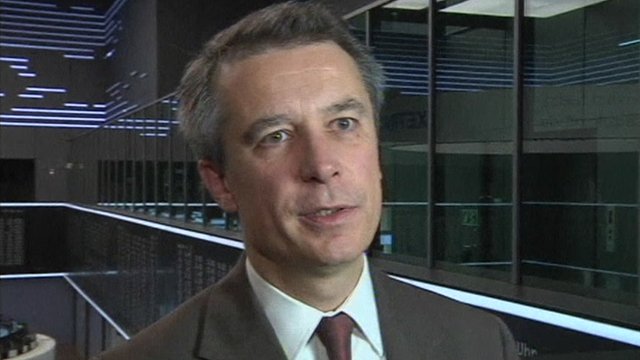 German Finance Minister Wolfgang Schaeuble has said Standard & Poor's (S&P) threat to downgrade eurozone countries is the "best possible incentive" ahead of Friday's summit.
S&P put almost all eurozone countries on "credit watch" on Monday.
It means that six countries with top AAA ratings have a 50% chance of seeing their credit ratings downgraded.
European markets were lower on Tuesday morning, with the Dax in Frankfurt down 0.6% and the Cac 40 in Paris down 0.1%.
The borrowing costs of Spain and Italy rose slightly, but yields on Italian 10-year bonds remained below 7%, the rate which is considered to be unaffordable.
"S&P's analysis is backward-looking, identifying the structural weaknesses in the currency union that have been conspicuous to investors for months and which the eurozone's leaders are trying to solve," said BBC business editor Robert Peston.
Mr Schaeuble said that the eurozone summit on Friday must now act to regain the confidence of investors.
"The solution to the crisis must be... verifiable, credible and confidence-building," he said.
"The truth is markets worldwide don't trust the eurozone at all right now."
Earlier, Norbert Barthle, an aide to German Chancellor Angela Merkel, said the warning could help Mrs Merkel and French President Nicolas Sarkozy to push through their plans for greater budget discipline.
The announcement from Standard & Poor's came after talks in Paris between the two leaders.
They said that all 17 eurozone states should should face greater checks on their budgets and sanctions if they run up deficits, and that a new treaty should be completed by March to ensure such a crisis never happens again.
'Systemic stresses'
S&P announced on Monday that it had placed its "long-term sovereign ratings" on 15 eurozone nations on credit watch "with negative implications".
The ratings agency said the decision was prompted "by our belief that systemic stresses in the eurozone have risen in recent weeks to the extent that they now put downward pressure on the credit standing of the eurozone as a whole".
As well as Germany and France, Austria, the Netherlands, Finland and Luxembourg also currently have a top AAA rating.
S&P's announcement means that there is a one in two chance that those countries will see their credit rating fall within 90 days.
Analysts also say S&P's move reflects uncertainty about what would happen were a larger eurozone country - such as Italy - to default in future.
The only two countries not put on credit watch on Monday were Cyprus, which is already under review, and Greece, whose rating has already been severely downgraded.
Gasoline: The new big U.S. export
The United States is awash in gasoline. So much so, in fact, that the country is exporting a record amount of it.
The country exported 430,000 more barrels of gasoline a day than it imported in September, according to the U.S. Energy Information Administration. That is about twice the amount at the start of the year, and experts and industry insiders say the trend is here to stay.
The United States began exporting gas in late 2008. For decades prior, starting in 1960, the country used all the gas it produced here plus had to import gas from places in Europe.
But demand for gas has dropped nearly 10% in recent years. It went from a peak of 9.6 million barrels a day in 2007 to 8.8 million barrels today, according to the EIA.
The drop was caused partially by the recession but also by the advent of more fuel efficient vehicles, higher prices and the greater use of ethanol as an ingredient in gasoline. Demand for other products made from crude oil like diesel and jet fuel has also declined, although not as much.
To be sure, the United States is still importing plenty of oil to make that gasoline -- and is still dependent on foreign countries for well over half the crude it uses. (Read: OPEC: We want clean energy.)
But now the country's massive refining infrastructure is producing more gasoline, diesel and jet fuel than the United States needs, freeing it up to be exported to places like Brazil, Mexico and Chile where demand is still strong.
The Wall Street Journal, which reported on the export trend last week, said the United States is on track this year to be a net exporter of refined products for the first time in 62 years.
"We've got plenty of excess refining capacity," said Jonathan Cogan, a spokesman for EIA. "It's a reminder that this is a global oil market, and it's reflected by the movements of products to where they will get the highest prices."
Mark Williams, global head of refining, trading and marketing for Royal Dutch Shell (RDSA), said exporting diesel and other refined products from the United States used to happen fairly irregularly but is now becoming much more common.
"It's growing as a new business," he said, although he cautioned that the United States would probably not become a huge exporter of fuel.
Still, the ability to export oil is good news for Shell and other oil companies like Exxon Mobil (XOM, Fortune 500), BP (BP) and Chevron (CVX, Fortune 500). They can use their extensive and modern refineries in the United States to make gasoline for the rest of the world.
But it may be bewildering for American drivers, who could experience record high gas prices next year even though U.S. demand could hit the lowest level in a decade, said Tom Kloza, chief oil analyst at the Oil Price Information Service.
"I can understand it, from a truck driver's perspective," said Kloza. "You're paying $4 or $4.50 a gallon to run your rig, yet we're exporting the crap out of this fuel. I'd be outraged too."
Still, he cautioned against restrictions on exports of diesel or gasoline, a move he expects politicians to at least talk about in 2012.
Apple in EU e-book market probe
Apple and five publishers are to be investigated over anti-competitive practice in the e-book market, says the European Union's anti-trust watchdog.
As well as the tech giant, the inquiry centres on Hachette Livre, Penguin, Harper Collins, Simon & Schuster and Verlagsgruppe Georg von Holzbrinck.
The Commission said it would focus on alleged illegal agreements restricting competition in the EU.
The UK's Office of Fair Trading has already carried out a similar inquiry.
The character and terms of agreements that the companies made with agencies are to be examined for breaches of EU rules on cartels, the Commission said.
The Office of Fair Trading has now finished its own investigation, but continues to work closely with the Commission, which is extending the scope of the inquiry across the whole of Europe.
The Commission carried out "unannounced inspections" on the companies in March 2011 as part of its investigations at premises in several European countries.
Apple's iBook store, which supplies e-books to the company's iPad tablet computer and the iPhone, is likely to come under scrutiny.
The EU announced an investigation into Google for potential anti-competitive behaviour in November.
Chinese bank mulls further financing for Ethiopian development projects
Ethiopian Prime Minister Meles Zenawi on Monday met a senior official of the Export-Import (Exim) Bank of China on ways of further enhancing the bank's financial assistance to development projects in Ethiopia.
During a meeting here with Exim Vice President Zhu Hongjie, Zenawi said he is very grateful for China's assistance, as he understands that every penny China, also a developing country, lends to Ethiopia is out of generosity of the Chinese people.
Zhu told reporters that he had a fruitful discussion with Zenawi.
Zhu said Ethiopia and China have maintained very good relations for the past years in terms of politics, economics and culture.
Zhu was leading a high-level Chinese delegation for a working visit in Ethiopia. The delegation is expected to meet with senior Ethiopian officials and other pertinent bodies and visit development projects financed by the bank here in the country.
Europe goes back to the drawing board
European leaders will meet this week for yet another summit to discuss ways to save the euro, and this time they are talking about rewriting European Union treaties.
The key players -- Germany, France and the European Central Bank -- all broached the subject last week, saying closer political and economic ties are needed to ensure the future of a unified Europe.
Early Monday, French President Nicolas Sarkozy and German Chancellor Angela Merkel met to hammer out the details of a new fiscal pact.
Among other things, the pact would change existing laws to make it easier for EU regulators to challenge budget policies of member nations.
The overarching idea is to begin building a fiscal union that will correct flaws within the EU, which has a common currency and shared monetary policy, but no mechanism to ensure that all members are financially sound.
"We are beginning to create the fiscal union," Merkel told lawmakers Friday. But she stressed that the European debt crisis will not be resolved overnight, saying the process "will take years."
In what is seen as a concession by Sarkozy, the pact includes automatic sanctions for member states that violate an existing rule to keep budget deficits under 3% of gross domestic product.
On Thursday and Friday, government leaders from all 27 EU nations will meet in Brussels for what is expected to be the final meeting of the European Council in a year that has seen more than its fair share of such summits.
Merkel and Sarkozy both said last week that a fiscal pact should be written into the EU treaty so that budget rules can be properly enforced through broader oversight and automatic penalties for nations that fail to comply.
"Europe needs to be rethought," Sarkozy said. "It must be redesigned."
In a sign of what's at stake for the United States, Treasury Secretary Tim Geithner will spend most of this week in Europe to meet with top officials, including Sarkozy and the newly appointed Italian Prime Minister Mario Monti.
President Obama has called the crisis a serious threat to the U.S. economy, noting that Europe is one of America's biggest trading partners.
While both Merkel and Sarkozy agree on the need to form a fiscal union, they appear to be at odds over what that could mean.
Last Friday, Merkel again ruled out the creation of eurobonds, which could drive up borrowing costs for creditworthy nations such as Germany. The European Commission has proposed issuing so-called stability bonds as part of a plan to pool government debt across Europe.
Merkel also stressed that the ECB should remain independent, underscoring the deep opposition in Germany to the central bank risking inflation by printing money to prop up troubled governments.
Sarkozy also said the ECB should remain independent, but he sounded much less draconian than his German counterpart.
CNN
Iraqi leader under Saddam Hussein to be executed
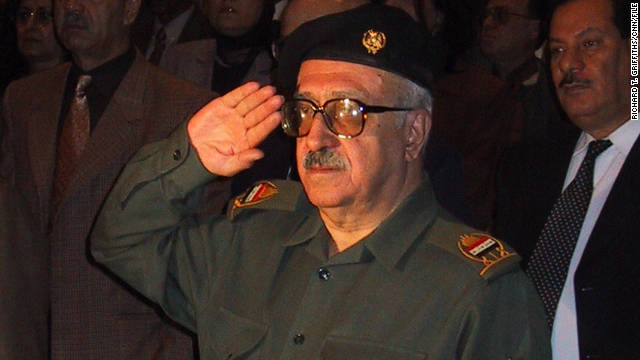 Tariq Aziz, who served as Iraq's top diplomat under Saddam Hussein, will be executed next year, after U.S. forces have pulled out of the country, an adviser to Iraq's prime minister told CNN on Monday.
"It will definitely take place, and it will take place after the Americans leave Iraq," said the adviser, Saad Yousif al-Muttalibi, about Aziz, who served as foreign minister.
A lawyer for Aziz said he was surprised. "I did not expect the government would be that stupid, by doing this they will drag this country to the edge of the abyss," said Badi Arif in a telephone interview.
"What about the national reconciliation that this government has been calling for? The government's position will be even weaker if they carry out the execution after the American troops leave the country and this will lead to more conflict among Iraqi factions."
A new law is under consideration that would require death sentences be ratified by the president within 15 days of their being handed down, al-Muttalibi said.
Al-Muttalibbi added that all of Iraqi society, including members of the three main sectarian groups -- Sunnis, Shiites and Kurds -- favor the law.
Aziz was captured by U.S. forces in April 2003, shortly after the U.S.-led invasion that toppled Hussein. He appeared frail when he testified in Hussein's 2006 trial on war crimes charges, for which the ousted dictator was hanged later that year.
Aziz was sentenced to death in October 2010 by the Iraqi High Tribunal for his role in eliminating religious parties during Hussein's regime.
His family was shocked by the verdict, his daughter told CNN at the time.
"My father served his country for more than 22 years. He delivered himself to the U.S. Army (after the fall of Hussein) because he wasn't afraid. He didn't do anything wrong. He served his country," Aziz's daughter, Zainab Aziz, said. "He has been wronged."
Arif said last year that there was a political motive behind the death sentence.
"Mr. Aziz used to always tell me, 'They'll find a way to kill me, and there is no way for me to escape this,'" Arif told CNN. "But from a legal perspective, this sentence is wrong; this is illegal and this is unexpected."
Aziz served as deputy prime minister from 1981 to 2003, also holding the post of foreign minister for part of that time.
After the verdict was announced, Amnesty International urged Iraq not to carry out the sentences, even as it acknowledged the brutality of Hussein's regime.
"Saddam Hussein's rule was synonymous with executions, torture and other gross human rights violations, and it is right that those who committed crimes are brought to justice," said Malcolm Smart, Amnesty International's director for the Middle East and North Africa in 2010.
"However, it is vital that the death penalty, which is the ultimate denial of human rights, should never be used, whatever the gravity of the crime," he said in a written statement.
The Vatican also opposed the death sentence, spokesman Federico Lombardi told CNN.
"This is not the most adequate way to promote reconciliation and reconstruction of justice and peace in a country that has suffered so much," he said.
CNN
Russia election protests: Troops sent to Moscow
Thousands of police and interior ministry troops are being deployed in Moscow, after protesters accused the authorities of electoral fraud.
Lorries filled with troops were reported driving into central Moscow.
Interior ministry spokesman Col Vasily Panchenkov said they wanted "to ensure the security of the citizens".
At least 300 protesters were arrested overnight in Moscow, after parliamentary elections said to have been marred by flagrant violations.
Several thousand people had taken to the streets in one of the biggest opposition gatherings in the centre of the capital in years.
Alexei Navalny, a leading campaigner against corruption and fierce critic of Prime Minister Vladimir Putin, was among those detained.
A counter-demonstration by Putin supporters was held beside Red Square on Tuesday.
Observers from the Organisation for Security and Co-operation in Europe (OSCE) reported that Sunday's election had been slanted in favour of Mr Putin's party, United Russia.
United Russia won the election with just under 50% of the vote, a sharp drop in its support.
Correspondents say the result reflects Mr Putin's declining popularity ahead of his bid for the Russian presidency in March.