
Pakistan's PM address to rebuild ties with US
Pakistan wants to rebuild ties with the United States, despite conflict with the US over deadly NATO airstrikes on its troops along the Afghan border.
In an interview with the media, Pakistan's Prime Minister, Yousuf Raza Gilani underlined his nation's stance, saying he did not regret skipping the Bonn meeting. But he stressed that Pakistan is committed to the reconciliation process in Afghanistan.
Yousuf Raza Gilani said, "Pakistan is committed, Pakistan has a resolve, Pakistan has ability, and Pakistan had been doing a lot for the reconciliation and Pakistan has suffered a lot because of foreign terrorism and extremism. Not only in the form of casualties of 30 thousand innocent people, but 5 thousand brave soldiers, law-enforcement agencies, and also in the form of economy. How can anybody doubt our intentions that after making so much sacrifices that we will not be committed to the reconciliation process in Afghanistan? We are committed and despite that we are not attending but we are committed, but we want to have our relationships with clear defined parameters in future."

Suicide Bombing Kills 48 at Shi’ite Shrine in Kabul
Afghan officials say at least 48 people, including women and children, have been killed in a suicide bomb attack on a Shi'ite shrine in central Kabul.
Officials say the suicide bomber detonated his explosives near the Abul Fazel shrine as pilgrims gathered Tuesday to celebrate the Shi'ite festival of Ashura. More than 100 people were also wounded in the blast.
Meanwhile, officials say a second explosion targeted a shrine in the northern city of Mazar-e-Sharif, killing four people. It is not clear whether Shi'ites were also the target of the second attack.
No one has immediately claimed responsibility for either attack.
The 10-day Ashura festival, which reaches its peak on Tuesday, is the most significant holiday for Shi'ite Muslims. It marks the martyrdom of Imam Hussein, the grandson of the Prophet Muhammad.
Afghan President Hamid Karzai immediately condemned the attack, saying it was the first time a terrorist attack has taken place on “such an important religious day in Afghanistan.”
Eyewitnesses say they expect the number of casualties to rise.
Attacks between Afghanistan's Sunni citizens and minority Shi'ite population have been rare in recent years. Attacks between the two groups are more frequent in neighboring Pakistan.
Officials also said three people were wounded Tuesday when a bomb hidden in a motorcycle exploded in the southern city of Kandahar. The attack did not take place near any building of worship.
The attacks come a day after world leaders gathered in the German city of Bonn to discuss Afghanistan's future as international combat troops prepare to leave the country.
President Karzai told the conference that after the withdrawal of NATO troops from his country in 2014, Afghanistan will still need international help for at least another decade.
Pakistan, considered vital to any prospect of stability in Afghanistan, boycotted the one-day meeting in response to a cross-border attack by NATO late last month that killed 24 Pakistani soldiers.
Tsunami that struck Japan in March resulted from merging waves
The devastating wall of water that struck Japan in March was the result of at least two waves that combined to create a more powerful tsunami, U.S. scientists said Monday.
Ocean ridges and mountain ranges below the surface of the water channeled the waves created by the 9.0 magnitude earthquake off the coast of Japan, bringing them together far out at sea to form a "merging tsunami," according to researchers from NASA and Ohio State University.
The earthquake and tsunami together killed 15,840 people, according to the most recent death toll, and set off a nuclear crisis at the Fukushima Daiichi plant.
Satellite data have enabled the researchers to come up with an account of the formation of the tsunami and its destructive force.
"Nobody had definitively observed a merging tsunami until now," Y. Tony Song, a research scientist at NASA's Jet Propulsion Laboratory in Pasadena, Calif., said in a statement.
The results of the research could help predict the risks from tsunamis in the future.
"We can use what we learned to make better forecasts of tsunami danger in specific coastal regions anywhere in the world," said Professor C.K. Shum of Ohio State University.
China 'ill-prepared' for unrest, says security chief
China's security chief has warned that the government needs better methods to deal with social unrest due to a slowing economy.
Zhou Yongkang, a member of the politburo, asked provincial officials for improved "social management".
China has seen an increase in labour unrest in recent weeks.
The comments are a sign that the Chinese government is worried that another slowdown could spark public anger.
"It is an urgent task for us to think how to establish a social management system with Chinese characteristics to suit our socialist market economy," Mr Zhou said in comments published Saturday.
"Especially when facing negative effects of the market economy."
He called for innovative approaches to a large set of policies which could include anything from increased policing to better internet control or better unemployment insurance.
There have been multiple signs of a slowdown in recent months in China.
The economy grew by 9.1% between June and September compared to a year earlier, the slowest rate of expansion in two years.
Last week, manufacturing was showed to have contracted sharply and the government cut the amount of money banks must keep in reserve to spur more lending, reversing recent policy.
There has also been a spike in labour unrest in recent weeks.
Employees of a Singaporean electronics firm Hi-P International in Shanghai went on strike last week over mass job losses.
Thousands of workers in Shenzhen and Dongguan, two of China's top export centres in the south of the country, went on strike last month protesting cuts in overtime.
Irish economy remains fragile, warns Taoiseach Enda Kenny
The Irish Republic's economy remains fragile and is likely to take years to recover, Taoiseach Enda Kenny has warned ahead of an austerity budget.
He said the "four-year path to recovery" would be difficult for many, including home owners, the jobless, and people trying to fund an education.
Mr Kenny also warned the country was spending 16bn euros more than it was taking in from taxes.
The televised address to the nation was the first of its kind in 30 years.
"Let me say this to you, you are not responsible for this crisis," said Mr Kenny.
"My government is determined that now, the necessary decision and challenges are made to ensure that this is never allowed to happen again."
Dole payments
He added: "I know this is an exceptional event. But we live in exceptional times. And we face an exceptional challenge."
Public spending in the Irish Republic will be cut by 2.2bn euros (£1.9bn) a year and taxes raised by 1.5bn euros, Mr Kenny said. He said income tax would be untouched but indirect taxes would be raised.
The proposals, which are due to be outlined in more detail in the Irish parliament later, are expected to include a rise in vehicle tax, cuts in some welfare entitlements and an increase in VAT to 23%.
The budget is also expected to include cuts to child benefit of up to 10 euros a month, dole payment cuts of around eight euros a week and a 50 euros annual fee on medical cards.
The Irish Republic is trying to save 3.8bn euros in a new round of cost-cutting measures following last year's international bailout.
Mr Kenny, who came to power in February, said the Irish economy remained fragile but job creation would be at the centre of the recovery.
He said steps to recover from the Irish economic crisis had been taken since last year but the crisis remained.
"This budget will be tough. It has to be tough," Mr Kenny warned.
"Right now the state is spending 16 billion a year more than it is taking in," he said.
"This problem will not be fixed unless we take action to bridge this gap. This can only be done by us, ourselves, working together."
Mr Kenny added: "I do not for a moment want to make it sound simplistic or painless. It is not. We are on a four-year path to recovery.
"This, our first Budget, is a necessary step, but it will include cuts to many worthwhile projects."
Italian taxes
His address was the first of its kind since Charles J Haughey made a similar appeal in 1980 when he claimed the Republic of Ireland was living beyond its means.
The second part of the budget will be announced on Tuesday - on the 89th anniversary of the signing of the Irish Treaty and the creation of the Free State.
The proposals come as Italy's new government adopted a package of emergency austerity measures aimed at fending off bankruptcy and saving the euro from collapse.
Taxes on the assets of the wealthy will go up, as will pension ages, and there will be a major drive to tackle tax evasion.
Italian Prime Minister Mario Monti said the measures were necessary to "save Italy", and announced he would give up his own salary as part of the effort.
The plans must still be approved by the Italian parliament.
Game designer Zynga plans $9bn stock market flotation
Game designer Zynga, which makes the highly successful FarmVille game for Facebook, has announced plans for a stock market flotation.
Reports suggest the firm could raise as much as $925m (£589m) from the listing.
The firm plans to sell 100 million shares, or 14.3% of the company, at $8.50 to $10 per share according to a regulatory filing made on Friday.
The IPO would value Zynga at as much as $9.04bn - one of the biggest US games companies by stock market value.
It would place the firm alongside industry giants Electronic Arts and Activision Blizzard.
The valuation is actually 30% less than Zynga's regulatory filing two weeks ago suggested its value would be - $14.05bn - meaning that the games maker cut its price to cope with volatile stock markets.
Unlike its competitors, Zynga does not charge for its games but makes money from selling add-ons such as virtual weapons, vehicles or buildings which can be used within the games.
Zynga earns over 90% of its revenue through Facebook according to its own figures.
In October the firm set up an initiative called Project Z which is designed to remove the firm's dependency on the social networking site.
Zynga has been in talks with Goldman Sachs and Morgan Stanley since June to manage the listing process on the US tech exchange, NASDAQ.
The firm has already reduced its expectations for the IPO after recent listings of other internet firms performed less well than planned.
Shares in the Social networking site LinkedIn fell below their May offer price after a 180 day lock-up period.
Discount voucher website Groupon listed on the Nasdaq exchange at the beginning of November and its shares are now trading below its initial offer price.
On Friday, the Office of Fair Trading (OFT) launched an investigation into Groupon after the firm broke UK advertising regulations 48 times in 11 months.
Fewer new jobs and more competition in City, firm says
The number of qualified staff for each vacancy in the City of London is at the highest for two years, according to a financial services recruitment firm.
There are 5 qualified candidates for each job, compared to 1.7 at the start of the year, Astbury Marsden said.
In November, the firm said there were 2,670 new vacancies in the City - fewer than the previous month.
Banks have been cutting jobs as the weak UK economy and eurozone debt crisis takes it toll.
The Royal Bank of Scotland, for example, has cut 27,500 jobs since the beginning of the financial crisis.
Lloyds Banking Group has also cut 27,500 jobs since 2009 and in June said that it would cut 15,000 more.
Astbury Marsden said there was a high number of investment bank staff in the capital's financial area searching for new roles, and a decrease in the number of new jobs.
"It means they are being pitted against more intense competition then they may have faced for years," said Mark Cameron, chief operating officer at Astbury Marsden.
"However, this is the silver lining for those few institutions or departments looking to hire; they should be able to pick a higher calibre of candidate from a wider pool."
It said the number of qualified staff for each City vacancy is at its highest level since December 2008 - the height of the financial crisis.
Banking and financial services such as insurance account for nearly 20% of London's total income, and around 10% for Great Britain, according to the City of London Corporation.
It said that there were about 349,200 people employed in the sector in 2008.
Sarkozy and Merkel kick off week of euro crisis talks
French President Nicolas Sarkozy and German Chancellor Angela Merkel are to meet to agree on joint proposals aimed at resolving the eurozone debt crisis.
They will take their ideas to an EU summit on Friday that is being seen as crucial for the single currency.
Germany favours strict EU central control while France wishes to preserve more national sovereignty.
Meanwhile, two badly-hit Eurozone countries, Italy and Ireland, are preparing tighter austerity measures.
In Italy, Prime Minister Mario Monti is due to seek approval for his government's plans in parliament.
Taxes on the assets of the wealthy will go up, as will pension ages. There will be a major drive to tackle tax evasion.
And Irish Prime Minister Enda Kenny has said the population must prepare for a tough budget this week.
Public spending will be cut by 2.2bn euros (£1.9bn) a year and taxes raised by 1.5bn euros, with VAT increasing to 23%.
Treaty talk
Monday's Franco-German meeting in Paris kicks off a week of meetings involving European leaders, the European Central Bank (ECB) and US Treasury Secretary Timothy Geithner, culminating in Brussels on Friday with an EU summit.
With financial markets putting pressure on some of the eurozone's largest - and most highly indebted - nations, President Sarkozy said the stakes were high.
"What will remain of Europe if the euro disappears?" he asked. "Nothing."
 France and Germany must play a key role to ensure "a zone of stability", he said last week.
"We must confront those who doubt the stability of the euro and speculate on its break-up with total solidarity."
Mrs Merkel has promised "concrete steps towards a fiscal union" - in effect close integration of the tax-and-spend polices of individual eurozone countries, with Brussels imposing penalties on members that break the rules.
"We need budget discipline and an effective crisis management mechanism," she said. "So we need to change the treaties or create new treaties."
Mr Sarkozy faces an election early next year and is under pressure not to cede sovereignty to unelected officials in Brussels.
Mrs Merkel and Mr Sarkozy have been working so closely in recent weeks that commentators have taken to calling the two Merkozy.
Treaty change could take many months, but the hope is that a strong, unified expression of intent on Friday could reassure markets enough to lower borrowing costs for Italy, Spain and other countries with high debt and spluttering economies.
If governments can not pay their debts - if they default - the resulting shock could bring down the banks that lend to them and create another global economic crash.
US Treasury Secretary Timothy Geithner's presence in Europe this week for several meetings with leaders is a measure of US concern that Europe's woes could spread beyond the continent.
On Thursday the ECB holds its monthly policy meeting. It has come under pressure to do more to ease Europe's debt crisis but has ruled out the idea of "eurobonds" backed by all eurozone members.
Germany is against the notion as is the ECB itself because such a move could lessen pressure on governments to control their spending.
However, ECB head Mario Draghi has hinted that the bank could take more aggressive action to help governments.
The ECB has been buying modest amounts of government bonds on the secondary market but could step that up, which would stabilise or lower borrowing costs.
Tiger Woods ends two-year title drought
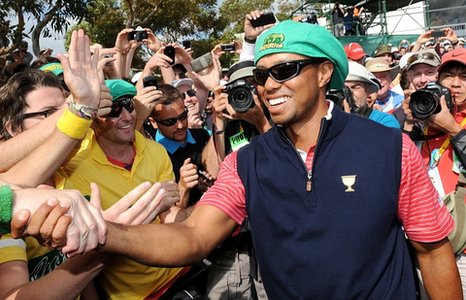 Tiger Woods won his first event for two years at the Chevron World Challenge, finishing birdie-birdie to see off rival Zach Johnson on the 18th hole.
Woods was one behind overnight leader Johnson going down the 17th but sunk a 15-foot birdie putt to draw level.
Johnson missed his birdie attempt on 18 before Woods drained a six-footer to clinch his first title since the Australian Masters in November 2009.
Paul Casey closed with a 69, like Woods, to finish third on five under.
"It feels great," said a jubilant Woods after his spectacular finish ended a run of 26 tournaments without a victory.
"It was a lot of fun coming down the stretch. Zach put a lot of pressure on me. He turned the tide [with birdie on 16], next thing I am one down playing the last couple of holes. Then I made two good putts."
Fourteen-time major winner Woods's three-under-par 69 at Sherwood Country Club meant he secured the 95th tournament win of his career and his first in the United States since the BMW Championship in September 2009.
Woods' world ranking plummeted from number one to 52nd while he struggled with fitness and form and his private life imploded.
And asked to describe his feelings after ending his lengthy title drought, the 35-year-old replied: "It feels awesome, whatever that is."
Johnson, seeking his first victory since last year's Colonial Invitational, was left to curse his form on the greens after closing with a 71.
The World Challenge event was founded by Woods and his charitable foundation in 1999 as a fundraiser.
Woods, who has now won it five times, lost in a play-off last year to Northern Ireland's Graeme McDowell.
Italy cabinet meets to discuss austerity measures
Prime Minister Mario Monti has speeded up plans to approve a number of austerity measures to bolster Italy's economy and head off the crisis threatening to engulf the eurozone.
At a cabinet meeting, called 24 hours ahead of schedule, he was expected to unveil new austerity measures.
They are thought to include savings, tax increases and pension reform set to force more Italians to work longer.
They come at a time of grave concern about the state of Italy's finances.
Italy has recently been compelled to pay the kind of very high rates of interest that eventually forced Greece to call for an international bailout.
Mr Monti wants to show the outside world he is determined to put this country back on a sound financial footing, and he clearly hopes this will ease the intense pressure on Italy in the money markets, says the BBC's Alan Johnston in Rome.
On Monday, German Chancellor Angela is due to meet French President Nicolas Sarkozy in Paris to outline joint proposals on closer ties between eurozone economies which they announced last week.
Eurozone leaders have warned the bloc is entering a decisive phase in its bid to resolve the debt crisis. They are due to meet on Thursday and Friday in Brussels to try to agree a broader rescue plan for the bloc.
Mr Monti, a former EU commissioner, said there would be no room for error at the summit and that financial markets would punish inaction.
"The choice is between adopting tough austerity measures and starting the euro rescue, or Italy not being able to stand on its feet, and we risk the collapse of the euro," said Emma Marcegaglia, head of Italian employers' lobby Confindustria.