
Justin Bieber Alleged Baby Mother Mariah Surfaced
Teen pop idol Justin Bieber just got slapped with a paternity suit from a 20-year-old woman known as Mariah Yeater.
According to reports by Star Magazine, Yeater claims that Bieber is the father of her now three-month-old baby.
The magazine release exclusive photos of Justin and Mariah’s alleged baby, Tristyn Anthony Markhouse Yeater, who was born on July 6.
He is pictured with his mother, 20-year-old Mariah Yeater, in the magazine, who filed a paternity lawsuit against the 17-year-old Biebs on October 31.
Mariah Yeater told Radaronline the scoop on how they met and what happened.
Immediately, it was obvious that we were mutually attracted to one another, and we began to kiss. Shortly thereafter, Justin Bieber suggested that I go with him to a private place where we could be alone.
I agreed to go with him and on the walk to a private area, he told me he wanted to make love to me and this was going to be his first time.”
We went inside and immediately his personality changed drastically. He began touching me and repeatedly said he wanted to ‘#### the %^&* out of me.’ At the time I asked him to put a condom on for protection, but he insisted that he did not want to.
Yeater said the whole escapade “was brief, lasting only approximately 30 seconds.”

Elephant Man Robbed Of Travel Documents Among Other Things
Alliance member Elephant Man is pleading to thieves to return his travel documents after the deejay was robbed earlier this week.
According to the deejay, his Toyota Corolla was broken into on Monday night while he was at an event.
“Mi passport, mi documents, mi just get a copy of the brand new video for Survivor and a today it did fi come pon RE TV. The studio stuff, mi hard drive, laptop, mi need the whole a dem back. It’s a Gucci bag and a black travel pack,” Elephant Man said. “Mi nah diss nobody, mi nah do nobody nutten, mi just need back mi bag dem. Dem fi stop walk and bruck people car. Mi just want back mi bag and mi documents.”
Elephant Man said he is booked for upcoming shows in Africa, Haiti and Europe starting this weekend. He is appealing for his documents to be return as soon as possible.
“Mi fi go pon tour weekend and mi need back mi stuff dem. I am going Europe and Africa for three weeks and then I am going to Haiti. I already take the promoters’ money so I need back mi stuff. If dem can just drop it off at any Alliance corner, throw it over the fence, whatever. Nobody inna Jamaica nuh fava mi, so you can’t travel on my stuff,” Ele said.
Region must work together to achieve low fuel costs says PM Skerrit
Prime Minister Roosevelt Skerrit says geothermal energy can significantly lower fuel costs in the region but countries must work together to effectively deliver it.
He told the David Thompson Memorial Lecture last week, that a secure, affordable and sustainable supply of energy was critical for the economic survival and prosperity of the countries in the region.
Skerrit said geothermal development held the potential to significantly change the fortunes of citizens in Dominica, Nevis and those in the sub-region of the Organization of Eastern Caribbean States (OECS).
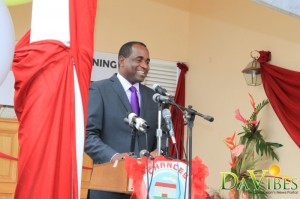 According to him, it had the potential to provide a stable, cleaner and lower-cost electricity supply option.
Skerrit said further that Dominica sees the development of its geothermal resource as having the potential of changing its energy status from being one of a net importer of energy to being a net exporter of energy.
“But this must be developed in conjunction with several other countries to create the critical market size for that energy. Our geothermal energy development must be seen as a regional enterprise. It is not about Dominica only, but how we can work together to deliver this very important resource to the people of the Caribbean region,” Skerrit told the lecture.
“Advancement towards an improved energy situation for many CARICOM countries will depend on increased functional cooperation, while at the same time benefiting the regional integration process. Unless the high cost of energy is addressed, many of the noble economic objectives will not be realized,” he said.
According to him, some cleaner alternative energy sources such as geothermal and natural gas will not realize their full potential to provide lower-cost fuel supplies unless there is a significant cooperation among other member states.
“Natural gas had the same potential and that similar cooperation was needed if the proposed natural gas pipeline from Trinidad was to provide a lower-cost fuel option to Eastern Caribbean states,” he said.
Source-Dominica Vibes News
Bahamas credit rating downgraded again
International credit ratings agency Standard & Poor’s on Monday downgraded The Bahamas’ sovereign credit rating for the second time in two years.
The Bahamas’ downgrade from a long-term credit rating of BBB+ to BBB came after S&P recently revised the way it evaluates sovereign ratings, placing heavier weight on “economic diversity” and “growth prospects”.
S&P said the country’s dependence on tourism, particularly from the United States, was a major factor in the downgrade.
“Tourism accounts for more than 50 percent of GDP (gross domestic product) and employs more than 50 percent of labour force and one geographic market (US tourists account for more than 80 percent of the total),” S&P said in a report.
The Bahamas’ short-term credit rating was also downgraded from A-2 to A-3 on Monday.
The Ministry of Finance responded to the ratings downgrade by claiming that the move “seemed likely” following the agency’s change in evaluation methods.
“This notwithstanding, the government of The Bahamas remains focused on stimulating economic growth through inward direct foreign investment, increasing support for small and medium size business development, improving the domestic environment for doing business and strengthening the productivity of The Bahamas’ workforce,” said the ministry in a statement.
The government said it also remains focused on strategies to reverse the growth rate of the country’s debt-to-GDP ratio and return it to more sustainable levels.
“We will continue to focus on these in order to create optimum opportunities for the citizens of The Bahamas to be employed, to increase their income generating capacity and pursue their business interests,” the ministry said.
The Bahamas’ credit rating now sits just two notches away from the non-investment grade level — where the ability of a country to pay back its debt becomes speculative.
The country’s credit rating was downgraded from A- to BBB+ in December 2009.
Another international credit ratings agency, Moody’s, downgraded the country’s economic outlook from stable to negative in August.
Source-Nassau Guardian
Jamaica reports increased remittance inflows
The Bank of Jamaica (BOJ), in its latest report on remittances, said that during the month of August, total remittance inflows were US$174.6 million, an improvement of US$17.8 million or 11.4 percent over the corresponding period last year.
Net remittances for the month, after accounting for outflows, were US$148.9 million, which represented an improvement of US$15.0 million or 11.2 percent relative to the corresponding period of 2010.
The BOJ attributed the growth in net remittances largely “to typical seasonal increase in demand for funds to finance back-to-school purchases prior to the start of the new school year.” There were increases of US$14.6 million and US$3.2 million, respectively, for the “Remittance Companies” and “Other Remittances” sub-categories.
Meanwhile, for the first eight months of 2011, net remittances were US$1.1 billion, which represented an increase of US$78.7 million or 7.3 percent relative to the corresponding period of 2010.
For the period, the BOJ reported that total remittance inflows were over US$1.3 billion, representing an increase of US$87.9 million or 7.1 percent. The increase in total remittance inflows emanated from improvements in inflows to both the Remittance Companies, and the Other Remittances sub-categories.
Remittance Companies recorded an increase of US$73.6 million or 7.0 percent, while Other Remittances had an increase of US$14.3 million or 7.6 percent compared to the corresponding period in 2010. For the eight-month period, increases in outflows of US$9.2 million, partially offset the positive growth in net remittances.
The report stated that although marginally better than the corresponding period in 2010, the inflows of US$1.3 million were still below the pre-crisis (global financial meltdown of 2008) trend. It noted that a continued improvement in remittance inflows in “ensuing months is juxtaposed on the improving macroeconomic conditions in source economies.”
For the first five months of the 2011/12 fiscal year, net remittances were US$738.2 million, which represented an increase of US$58.6 million or 8.6 percent relative to the corresponding period of the previous fiscal year. This resulted from an increase in gross inflows though partially offset by increases in remittance outflows.
For that period, total remittance inflows were US$852.8 million, representing an increase of US$60.6 million or 7.6 percent over the corresponding period of the preceding fiscal year.
The growth in total remittance inflows emanated from increases of US$51.7 million or 7.7 percent by Remittance Companies and US$8.9 million or 7.3 percent by Other Remittances.
Remittances represent a significant source of national income. According to the Inter American Development Bank’s Multilateral Investment Fund (IDB-MIF) in Latin America and the Caribbean, remittances play an important role in the economy of the region, totaling over US$66.5 billion in 2007, with about 75 percent originating in the United States.
The IDB-MIF research revealed that total remittances represent more than the sum of foreign direct investment and official development aid combined. In seven Latin American and Caribbean countries, remittances account for more than 10 percent of GDP and exceed the dollar flows of the largest export product in almost every country in the region.
The IDB-MIF has been the leading agency on regional remittance research.
Source-JIS
TRINIDAD'S PM WRONG
Prime Minister Kamla Persad-Bissessar got her facts wrong when she named Prof Kenneth Julien as the former chairman of Petrotrin.
Julien issued a release yesterday noting that Persad-Bissessar named him as the former chairman of Petrotrin, against whom legal action will be taken to recover monies for the unfruitful gas-to-liquids (GTL) projects which cost this country billions.
He said his record of achievement can withstand the Government's "witch-hunt".
Julien pointed to Persad-Bissessar's statement in her budget contribution on October 14, "Mr Speaker, pre-action protocol letters, on behalf of Petrotrin, have been authorised for commencement of legal proceedings against several members of the Prof Kenneth Julien board for negligence, breach of statutory duty."
This statement by the Prime Minister, Julien said yesterday,"was categoric. It described me to be a member of the board of Petrotrin. This is totally false and it is untruthful".
In his 40 years of public service, Julien said he never served either as chairman or a board member of Petrotrin, nor did he have any involve ment in GTL.
He said his professional record is well documented locally, regionally and internationally as professor of engineering, founding president of the University of Trinidad and Tobago (UTT) and his leadership role in the energy sector—including the Point Lisas development (gas-intensive industries).
"This record of achievement can stand the scrutiny of the current witch-hunt, which also has a negative effect of inhibiting talented and willing individuals from participating in the development of the country," said Julien.
"Trinidad and Tobago is now faced with some serious challenges in the future growth of the natural gas sector ,which has been the driving force of the economy," he added.
Julien pointed out that these challenges include the fact that this country, with less than .25 per cent of the world's gas reserves, is fast losing its leading position in the gas export market, with Qatar having four times the energy production of Trinidad and Tobgo and the United States, our prime market for liquefied natural gas (LNG), shortly to become an exporter of LNG.
He further noted that countries both in West and East Africa are finding gas reserves substantially greater than this country's and aggressively pursuing investments in the gas sector.
"T&T will, in a relatively short period of time, lose its leadership in this area. This difficult challenge can only be faced successfully if the country draws upon the expertise and experience of the young professionals of the energy sector," said Julien.
Contacted yesterday for a response to Julien's statement, Attorney General Anand Ramlogan said he cannot comment on whether the Prime Minister may have made an error as he did not have the official Parliament Hansard before him.
"I haven't seen the Hansard, so I can't comment on that; what I can say is that he (Julien) is being sued as the former head of eTecK (Evolving Tecknologies and Enterprise Development Company Ltd)."
"Ken Julien is the former chairman of eTecK, and he is a defendant in a matter that is presently before the courts. That matter is now sub judice and Prof Julien will have his day in court," said Ramlogan.
He disclosed that former attorney general John Jeremie was Julien's attorney in the matter.
Source-TEN (Trinidad Express Network)
St. Maarten Police Force Accepted as Member of Interpol.
Chief Commissioner of Police Peter de Witte who is currently off island attending the 80th Session of Interpol in Hanoi, Vietnam announced that the St. Maarten Police Force is now a member of the Interpol.
"We can proudly announce that on Monday after the presentation of Mr. de Witte at the General Assembly, which was a very important moment at this conference, the country of Sint Maarten was unanimously accepted as an independent member of Interpol, by the other 188 country-members, making Sint Maarten the 189th member."
De Witte said the acceptance to Interpol is a great achievement for country Sint Maarten in its relentless battle against crime. An Interpol Office on Sint Maarten definitely means international communication with all other country-members regarding many criminal issues, such as identifying of escaped convicts and suspects, the expertise in large scale investigations, carrying out international search warrants and the access to the database of the other country-members, concerning issues such as stolen motor vehicles and false documents.
Becoming a member of Interpol gives Sint Maarten an edge in being able to intercept criminals before entering this country, creating a safer environment for the community and tourists who visit our island.
As they say: "Security begins at our borders," De Witte said.
Bishoo spins Windies to victory over Bangladesh
 Devendra Bishoo exploited favourable conditions to finish with career-best figures and bowl West Indies to a 229-run victory in the second Test against Bangladesh yesterday. The West Indies leg-spinner grabbed five wickets for 90 runs from 25 overs, as Bangladesh were dismissed for 278 in their second innings on the final day at the Sher-e-Bangla Stadium. Bishoo ended with match figures of eight for 152, the best by a West Indies spinner in an overseas or neutral Test since his compatriot Lance Gibbs collected nine for 143 against India 36 years ago in Mumbai.
Kemar Roach formalised the fourth victory for West Indies eight Tests against the Bangladeshis, when he bowled Rubel Hossain for seven about half-hour after lunch. The result meant that West Indies won the two-match series 1-0, after the badly weather-affected first Test ended in a draw last Tuesday at the Chowdhury Stadium in Chittagong. This followed a 2-1 series triumph in the One-Day International series and a narrow defeat in the sole Twenty20 International. It was the first Test series victory for West Indies on foreign soil since they prevailed over Zimbabwe by the same margin eight years ago.
Prior to the match, West Indies were expected to be tormented by the Bangladeshi spinners on a turning pitch, particularly on the last day, but the home team found themselves confronting that prospect instead. Bishoo gave West Indies early success, when Bangladesh continued from their overnight total of 164 for three, chasing a highly improbable target of 508. He had Tamim Iqbal caught at slip for the top score of 83, when the left-hander charged down the pitch and tried to a flighted delivery outside the off-stump through cover. Tamim struck eight fours and one six from 158 balls in just over three hours of batting.
West Indies ran into a roadblock, when Shakib Al Hasan joined his captain Mushfiqur Rahim and they spent close to the next hour batting with enterprise, putting on 88 for the fifth wicket. A short ball from Bishoo was cut through backward point from Shakib for his first boundary and Mushfiqur joined in the fun with a pull for four when the leg-spinner dropped short again in his following. Bishoo continued to feel the brunt of the assault, but Mushfiqur drove a pitched-up delivery from Fidel Edwards through cover for his seventh boundary to bring up his 50 from 81 balls.
The West Indies leg-spinner conceded two successive fours to Shakib in his 18th over, when the left-hander dangerously drove him over the top of mid-off for his third four and followed up with a square cut for another boundary. Another short ball from Edwards was rocketed through square leg for four to carry Shakib to his 50 from 65 balls. West Indies captain Darren Sammy persisted with Bishoo, but soon took matters into his own hands.
He provided the breakthrough, when he had Shakib caught at fly slip for 55 from a leading edge, looking to play into the leg-side. The left-handed Bangladesh all-rounder struck seven fours from 70 balls. After this, West Indies faced token resistance from the remainder of the Bangladesh batting with the turning point coming when Bishoo bowled Mushfiqur for 69, as the home team reached 263 for six at lunch. The wicketkeeper/batsman smoked nine fours from 109 balls in close to 2 hours at the crease. Bishoo struck twice in the first over after the interval, trapping Nasir Hossain lbw for three and having Suhrawadi Shuvo caught at slip for a one-ball duck before he also removed Naeem Islam lbw for three to accelerate the slide.
West Indies leave Dhaka on Thursday for India, where they play three Tests, five One-Day Internationals and a Twenty20 International against Mahendra Singh Dhoni’s side. (CMC)
SCOREBOARD
Bangladesh vs West Indies – 5th
WEST INDIES 1st Innings 355
(K. Edwards 121; Shakib Al Hasan 5-63)
BANGLADESH 1st Innings 231
(Shakib Al Hasan 73; F. Edwards 5-63)
WEST INDIES 2nd Innings 383 for five dec.
(D.M. Bravo 195; Suhrawadi Shuvo 3-73)
BANGLADESH 2nd Innings (target: 508)
(overnight 164 for three)
Tamim Iqbal c Sammy b Bishoo 83
Imrul Kayes c K. Edwards b F. Edwards 9
Shahriar Nafees c and b Sammy 18
Raqibul Hasan c Sammy b Samuels 17
Mushfiqur Rahim b Bishoo 69
Shakib Al Hasan c Chanderpaul b Sammy 55
Naeem Islam lbw b Bishoo 3
Nasir Hossain lbw b Bishoo 3
Suhrawadi Shuvo c Sammy b Bishoo 0
Shadadat Hossain not out 1
Rubel Hossain b Roach 7
Extras (b6, lb1, nb6) 13
TOTAL (all out, 80.2 overs) 278
Wkts at: 1-26, 2-73, 3-124, 4-168, 5-256, 6-260, 7-264, 8-264, 9-271
Bowling: Edwards 14-0-56-1 (nb3); Roach 13.2-2-49-1 (nb3) Sammy 13-4-19-2; Bishoo 25-6-90-5; Samuels 15-2-57-1
Result: West Indies won by 229 runs
Series: West Indies won two-match series 1-0
Man-of-the match: K.Edwards (West Indies)
Man-of-the-Series: Shakib Al Hasan (Bangladesh)
Umpires: K. Dharmasena, N. Llong
TV umpire: Nadir Shah
Matchreferee: A. Pycroft
Reserve umpire: Enamul Haque
Rory McIlroy says decision to leave Chandler was 'very difficult'
Rory McIlroy says his shock split from manager Andrew "Chubby" Chandler was "a very difficult decision to make".
McIlroy, who won his first major at the US Open in June, announced last month that he was leaving Chandler's International Sports Management (ISM) for Dublin-based Horizon.
"Chubby has been there for me since day one," the 22-year-old told BBC Sport.
"It was very difficult for me - I was very close to him and remain very close to him."
The Northern Irishman, who won the Shanghai Masters on Sunday and is competing in the WGC-HSBC Champions in the same city this week, said he had thought long and hard before making the decision.
"It was a purely business decision and nothing personal at all," he said.
"It's a decision that I didn't take lightly. I had a lot of chats with my mum and dad.
"You know sometimes to go forward in your career you just need to make decisions and I just thought it was a decision I needed to make.
"For four years, Chubby was the best guy and ISM were fantastic for me, but sometimes to progress you need to have a fresh view on things.
"It's about me trying to play my best golf and that's all there is to it. With a new environment around me, it might enable me to play even better."
On Tuesday, McIlroy bumped into his former manager on the range at the Sheshan Golf Club and there appeared to be no hard feelings between the two men.
"We've both already moved on," said Chandler. "We shared a laugh and a couple of jokes, had a chat and were fine, just like I knew we would be. I wish Rory nothing but the best."
Meanwhile, ISM client Lee Westwood was quick to praise Chandler's stewardship when asked to comment on McIlroy's departure.
"The service that they have given me has been very good," the English world number two told BBC Sport.
"I think it is important you have somebody that you can get on with as a manager."
Westwood tweeted that McIlroy's was a "bizarre decision" when his stable-mate announced he was leaving ISM on 21 October.
But he added: "I was pretty surprised, but not completely shocked. He [McIlroy] has always kind of done his own thing."
In his first tournament under new manager Conor Ridge, world number three McIlroy triumphed for the first time since his US Open victory when he won the Shanghai Masters.
Now McIlroy is aiming for back-to-back wins in the Chinese city - and with a first prize of nearly £750,000 up for grabs, he could make significant inroads into the £1.13m advantage of the absent Luke Donald in the Race to Dubai.
McIlroy said: "He [Donald] has obviously got a huge lead and if I could just get it somewhat close going into the last event in Dubai I would be happy. I know I will need to play well this week."
World number one Donald is at home in the United States awaiting the imminent arrival of his second child.
Tiger Woods, winless in 2011, failed to qualify for the 78-man event because the field is largely drawn from champions from tours around the world.
Four-time major winner Phil Mickelson is also absent because he does not want to play three weeks in a row and with the Presidents Cup in Australia looming, he has already committed to play in Singapore next week.
Andy Murray pulls out of Swiss Indoors because of injury
British number one Andy Murray has pulled out of the Swiss Indoors in Basel because of a right gluteal muscle strain.
The 24-year-old, who is on a 15-match winning streak, withdrew shortly before his first-round match against Dutchman Robin Haase was due to start.
"I was struggling to walk," said Murray, the world number three.
Roger Federer made progress to the quarter-finals with a 6-1 4-6 6-3 win over Finland's Jarkko Nieminen.
Murray, who won three titles in Asia last month, had requested a wildcard to play in an event featuring world number one Novak Djokovic and defending champion Federer.
"I trained twice on Monday and felt fine after that. It was a bit better on Tuesday morning and I went to a pool for some exercises and had a light hit. But this morning [Wednesday] I knew it was still not good enough.
"I don't know how I did it or what it came from. I've never had anything like this before."
Murray said he will travel to Paris on Thursday and take four or five days off with anti-inflammatory treatment in the hope of being fit for the Paris Masters, the final event of the regular ATP season, which starts on Monday.
Murray was replaced in the draw by Swiss Marco Chiudinelli, who subsequently lost the match against Haase 6-2 7-6.
Murray had chosen to play in Basle over Valencia, where he was champion two years ago, and was also set to play in the doubles with his brother Jamie.
The Scot was confident of adding to the titles he recently won in Bangkok, Tokyo and Shanghai, which enabled him to climb above Federer in the rankings.
Murray, who also won the Cincinnati Masters title in August, has only suffered one defeat in his last 26 matches - that came against Rafael Nadal in the semi-finals of the US Open last month.
Murray is gearing up for the ATP World Tour finals at the O2 Arena in London from 20-27 November.