
Elections prep finally underway
 DEFINITIVE preparations are finally underway to get the TCI ready for elections slated for next fall.
From drafting new corruption-busting laws to defining 10 constituencies in place of the present 15, the wheels are now in motion to facilitate the critical return to self-rule.
For many islanders, it spells an imminent end to a ceaseless waiting game for Britain to release its grip on the stricken territory.
Consultations between UK delegates and TCI business, political and community leaders on a new Elections Ordinance began this week.
The aim is to stifle capacity for vote-rigging and malfeasance said to have plagued previous ballots.
A four-strong team – from London’s Westminster Forum for Democracy (WFD) – has been tasked with identifying strengths and weaknesses in the current electoral system.
With input from local leaders, they will then help establish proper codes of conduct during campaigns.
This week the Governor’s office outlined four separate processes to be achieved before a voting date can be set.
In addition to the new ordinance defining standards expected from politicians, outdated procedures in the current Elections Ordinance will be brought in line with internationally recognised practices.
A new Boundary Commission will be put in place to prescribe the 10 constituencies and the Electoral Register will be updated too, following the completion of next year’s census.
Philip Rushbrook, director of the Governor’s office, said elections could take place within 30 days of the new constitution coming into force.
But he warned meticulous preparations were needed first, which are unlikely to be completed before next September.
“The census scheduled for February 2012 has a direct bearing on when the new election boundaries and Electoral Register of voters can be prepared,” he said.
“Both of these activities will benefit from access to the most up to date information on population distribution and it is now known the initial census data will be available in April 2012.”
Mr Rushbrook said setting up the Boundary Commission and finalising the list of eligible voters should take no more than a few weeks thereafter. The Commission will consist of three members appointed by the Governor.
The revised Electoral Register will also help oust past problems of some islanders voting in two separate districts.
Mr Rushbrook said clearer definitions of voting districts for each person – particularly where someone has family ties on one island but lives and works on another – would discontinue that practice.
A small group of government and Governor’s office officials, plus Attorney General chambers staff, has been enlisted to kickstart the work ahead.
Additional members from the community will be added to help out as things progress.
Consultations on the changes ahead will be sought from the public via town hall meetings and other methods similar to those used to revise the constitution.
This week’s trip by the WFD team will be followed by a further visit in November featuring confidential and public meetings with various individuals and groups.
WFD is an independent body, funded by the UK’s Foreign and Commonwealth Office (FCO), which strives for sustainable political change in emerging democracies.
The four delegates who jetted into the TCI this week included Shadow FCO Minister John Spellar, and Paul Speller, head of the Liberal Democrats’ international office and a former Deputy Governor of Gibraltar. They were joined by George Edward Cockram and David Thirlby.
The team’s work in the TCI is being fully funded by the UK.
-TC WEEKLY NEWS

PNP pledges independence referendum
TRAMPLING of democracy, refusal to stage imminent elections, imposition of taxes without consent and the erosion of human rights under the new constitution.
Just some of the claims levelled at London by the PNP which this week announced an active bid for independence from Britain.
The party has pledged to hold a prompt referendum on the issue if successful in next year’s elections, after members backed proposals at a meeting on Monday.
Leader Clayton Greene vowed in a statement that the “march to freedom” had begun.
“The question can no longer be whether there will be or whether there should be independence. The question must now be when.”
He said the PNP believed it was the destiny of all people worldwide to obtain independent status – and the responsibility of every government to make it happen.
“Our party is therefore committed to doing all that it can, whether in or out of government, to prepare the people of the Turks and Caicos Islands politically, socially and economically for that eventuality.”
Mr Greene said every party policy would strive to ensure “greater social, economic and political opportunities” for islanders.
The PNP has long called for liberty from UK shackles, but the resolution passed at its National General Council meeting represents a significant stride forward on the road to autonomy.
The party claims the TCI was abandoned by Britain for many years following the collapse of the once lucrative salt industry.
Members say native people achieved major prosperity for the islands without help from the mother country.
Among a list of 12 ‘failures’ by the UK, are the seizure of governance without permission, the suspension of the TCI’s “most basic laws”, the axing of the automatic right to a jury trial, wreckage of the economy, and the installation of a “mock” legislature.
Controversial civil service reforms, which have seen widespread job losses and wage cuts, invoked PNP wrath too.
The resolution also accuses Britain of failing in its duties – as outlined by the United Nations – to prepare the country for self-determination.
“At every stage of these oppressions, the people of the Turks and Caicos Islands have petitioned for redress in the most humble terms, and our repeated petitions have only been answered by repeated injury,” it goes on to state.
It continues that the current relationship is not in the islands’ “best interest”.
“The time has come that we as a people chart our own future towards progress and prosperity.”
The resolution ends by pledging to embark on a public education programme aimed at extolling the virtues of an independent nation.
And to secure “as soon as practicable” a referendum to gauge the views of the populace.
-TC WEEKLY NEWS
Darren Bravo bangs 195 as Windies go for win
 West Indies’ bid for victory in the second Test against Bangladesh hit a snag yesterday, after Darren Bravo set things up, narrowly missing a double-hundred. Bravo was dismissed for 195 and fellow left-hander Shivnarine Chanderpaul was unbeaten on 59, allowing West Indies to declare on 383 for five in their second innings about an hour before tea on the third day at the Sher-e-Bangla Stadium, setting Bangladesh a highly improbable, if not impossible victory target of 508. Bravo finished his near 7 hour innings with 12 fours and five sixes from 297 balls. He added 143 for the fifth wicket either side of lunch with Chanderpaul, whose knock included six fours from 79 balls, after night-watchman Kemar Roach fell in the first hour.
The visitors however, ran into Tamim Iqbal in a rampant mood. The left-handed opener was unbeaten on 82 and his captain Mushfiqur Rahim was not out on 33, carrying the home team to 164 for three at the close. West Indies first innings bowling hero Fidel Edwards grabbed an early scalp, when Imrul Kayes was caught at slip for nine in the third over. Wickets, however, did not come thick and fast for West Indies like in the Bangladesh first innings, as Tamim anchored the batting, sharing defiant stands either side of tea with Shahriar Nafees, Raqibul Hasan, and Mushfiqur before stumps were drawn. Roach felt the weight of Tamim’s bat in his fifth over, when the left-hander inside-edged a drive to deep fine leg for four off the second ball, tucked a short ball into the same place two balls later for another boundary, and finished it off with an upper cut past gully for another four.
West Indies captain Darren Sammy made a breakthrough, when he held a return catch to dismiss Shahriar for 18 to leave Bangladesh 73 for two on the stroke of tea. After the break, the Windies ran into more resistance, when Raqibul joined Tamim and they put on 51 for the third wicket. A half-volley from Bishoo was greeted with a crisp extra cover drive for four in the first full over after the break, and the Bangladeshi opener moved on to reach his 50 from 58 balls with a single to mid-wicket off Sammy. West Indies seemed powerless at times to stop Tamim, as he lofted Marlon Samuels to long-off for four, and roughed up Bishoo, when he twice hit him straight for a four and a six off the last two deliveries of the next over. Samuels scalped Raqibul for 17 with a catch to slip, leaving Bangladesh 124 for three before Mushfiqur arrived to bat through the remainder of the day with Tamim, adding 40 unbroken for the fourth wicket before the close.
Earlier, Bravo continued merrily from where he left off the previous day and seemed almost unstoppable. His dismissal, caught behind, gave Suhrawadi Shuvo the last of his three wickets for 73 runs from 26.3 overs and prompted the declaration. After Roach charged down the pitch and was caught at long-off for 12 skying a well-flighted delivery from Suhrawadi, Chanderpaul joined Bravo and they continued batting West Indies into an impregnable position. Bravo reached 150 in the last over before lunch, when he crunched Suhrawadi through mid-wicket for his 10th four. After the interval, he got into stride with a six off Nasir Hossain over long-off before he gave Shakib Al Hasan a difficult chance running back at mid-on off Shahadat Hossain on 158. Batting with the declaration clearly in mind, Chanderpaul too, started to show greater enterprise, reaching his 50 from 70 balls in style with a pull through square leg off Shahadat for his fifth boundary. Five overs later, Bravo’s fun came to a screeching halt, when he tried to swipe Suhrawadi for another six to reach the 200-run mark, top-edged and gave a catch to Mushfiqur. The two-Test series is level 0-0, after the badly weather affected first Test ended in a draw at the Chowdhury Stadium in Chittagong. (CMC)
SCOREBOARD BANGLADESH VS WI
WEST INDIES 1st Innings 355
(K. Edwards 121; Shakib Al Hasan 5-63)
BANGLADESH 1st Innings 231
(Shakib Al Hasan 73; F. Edwards 5-63)
WEST INDIES 2nd Innings
K. Brathwaite run out (Naeem Islam) 0
K. Powell c Nasir Hossain b Shakib Al Hasan 12
K. Edwards b Suhrawadi Shuvo 86
D.M. Bravo c wkpr Mushfiqur Rahim
b Suhrawadi Shuvo 195
K. Roach c Naeem Islam b Suhrawadi Shuvo 12
S. Chanderpaul not out 59
Extras (b6, lb4, w5, nb4) 19
TOTAL (5 wkts decl’d, 111.3 overs) 383
Fall of wickets: 1-0, 2-33, 3-184, 4-240, 5-383
Bowling: Rubel Hossain 12-2-36-0 (nb2, w5); Nasir Hossain 25-5-78-0; Shakib Al Hasan 21-1-79-1; Naeem Islam 12-2-38-0; Suhrawadi Shuvo 26.3-3-73-3; Shahadat Hossain 11-0-57-0 (nb2); Raqibul Hasan 4-0-12-0
BANGLADESH 2nd Innings
Tamim Iqbal not out 82
Imrul Kayes c K. Edwards b F. Edwards 9
Shahriar Nafees c and b Sammy 18
Raqibul Hasan c Sammy b Samuels 17
Mushfiqur Rahim not out 33
Extras (b2, lb1, nb2) 5
TOTAL (3 wkts, 47 overs) 164
Fall of wickets: 1-26, 2-73, 3-124
Bowling: Edwards 9-0-38-1 (nb2); Roach 8-2-36-0; Sammy 7-2-11-1; Bishoo 11-3-35-0; Samuels 12-2-41-1
Position: Bangladesh need 344 more runs to win with seven second innings wickets standing.
Conrad Murray decides not to give evidence
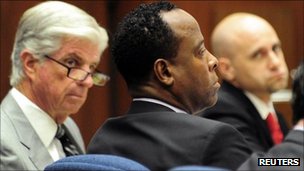 Dr Conrad Murray has told a judge he will not testify in his own defence in the trial over Michael Jackson's death.
He denies involuntary manslaughter but could face a prison term and the loss of his medical licence if convicted.
Dr Murray told trial Judge Michael Pastor he had made his decision "freely and explicitly", reports said.
The decision comes after the defence called its last witness, propofol expert Dr Paul White. Closing statements will begin on Thursday.
"My decision is I will not testify in this matter," Dr Murray said after being asked if he understood the choice to testify or not was his alone.
Throughout the 22-day trial, both the prosecution and defence have called their own medical experts to take the stand.
On Tuesday, the prosecution called their own propofol expert, Dr Steven Shafer, as a rebuttal witness to counter arguments put forth by Dr White.
Duelling experts
During earlier testimony, Dr Shafer said the suggestion that Jackson could have drugged himself was "crazy".
The defence called former patients of Dr Murray as character witnesses, and tried to introduce doubt into the testimony of the prosecution's witnesses.
Defence lawyers have argued that Jackson, dealing with insomnia, drugged himself with an additional dose of propofol after Dr Murray left his bedroom.
They dropped their original contention that Jackson drank the propofol but maintained that he had intravenously administered the fatal dose himself.
Paramedics were called to Jackson's California home on 25 June 2009 after he stopped breathing. He was pronounced dead two hours later at the UCLA medical centre.
The prosecution alleges Jackson died from an overdose of the anaesthetic drug propofol and that Dr Murray was negligent by giving him the drug outside of a hospital setting.
BBC
Second Expendables stuntman in 'stable condition'
A stuntman seriously injured on the set of Expendables 2 is now in a stable condition, after a colleague died as a result of the same accident.
Nuo Sun, who was hurt while filming a stunt sequence in Lake Ognyanova, Bulgaria last week, has been taken to Germany for further treatment.
Fellow stuntman, Kun Lieu, was killed in the incident.
"Our deepest condolences go to the family of Kun Lieu," film company Nu Image told the Hollywood Reporter.
"His passing is tragic," the statement continued.
The accident happened during filming of an explosion on an inflatable boat on the Ognyanovo dam, 15 miles outside the capital Sofia.
It said that Nuo Sun's condition had "stabilised" and he was now receiving "top medical care from the best specialists" in Munich.
Nu Image denied reports in the Bulgarian press that the stunt doubles for stars Sylvester Stallone and Jet Li had been involved in the accident.
Nuo Sun and Kun Lieu were working in the second stunt unit.
"At the time of the accident, neither Li's or Stallone's stuntmen were on or near the second unit set, nor were any of the film's main actors, director Simon West or any of the main unit crew," Nu Image told the Hollywood Reporter.
"Only second unit filming has been temporarily suspended and will resume shortly. The filmmakers continue to work with authorities investigating this accident. Main unit production has not been interrupted and continues as scheduled."
The Expendables 2 features a star-studded action hero cast that, alongside Stallone and Jet Li, includes Arnold Schwarzenegger, Bruce Willis, Dolph Lundgren, Chuck Norris and Jean-Claude Van Damme.
Rihanna cancels gig in Malmo, Sweden, because of flu
Rihanna has been forced to pulled out of a concert in Sweden after receiving treatment for flu.
The 23-year-old singer apologised to fans and posted a picture on Twitter of her arm connected to an IV drip.
Organisers for the gig at the Malmo Arena said they hoped to reschedule the show, and fans who missed out would be offered refunds.
Rihanna's European tour is set to resume tonight (1 November) at the Ericsson Globe in Stockholm.
The singer has already completed a handful of UK dates on her Loud tour and is set to return to play gigs in London, Birmingham, Sheffield, Manchester, Nottingham, Glasgow and Newcastle later this year.
Rihanna is to release her sixth album Talk That Talk later this month.
China artist Ai Weiwei served with $2m tax demand
Chinese authorities have served Ai Weiwei with an official demand telling him to pay 15m yuan ($2.3m; £1.4m) within 15 days, the artist has said.
He said he had rejected the notice, and was not sure whether he would pay.
The artist, one of China's most famous people, was held for almost three months earlier this year before being accused of "economic crimes".
His supporters say the accusations are part of a plot to silence Mr Ai, who is an outspoken critic of the government.
Mr Ai said he would pay the money if it was proved to be a tax issue.
But he said he had not been able to review his company's account books because they had been taken by the authorities.
And he said he had not seen any evidence showing that the firm had evaded tax.
"I am only a designer of the company. I never signed any of the company's contracts, nor did I ever read any of the company's finance reports, so I have no idea," he told the BBC.
Mr Ai was picked up by police in April as authorities rounded-up activists, following calls on websites for a Middle Eastern-style Jasmine revolution in China.
The state news agency Xinhua said in June that Mr Ai had been released "because of his good attitude in confessing" to tax evasion and because he had agreed to pay back the money he owed.
But on Tuesday he said: "It was not true that I admitted to tax evasion charges. I was never formally arrested and never charged."
"If they really want to prove that I am a bad guy, why don't they behave themselves to make the process more transparent?" he later added.
Since his incarceration, he has won numerous art awards, and was recently named the world's most powerful artist in a poll carried out by an art magazine.
His case has also become a cause celebre for rights activists and critics of China's Communist Party.
Singer Beryl Davis dies aged 87
British singer Beryl Davis, who sang with Frank Sinatra and Benny Goodman, has died in Los Angeles aged 87.
Family spokesman Greg Purdy told the Los Angeles Times newspaper that she passed away on Friday from complications of Alzheimer's disease.
Born in Plymouth, she began performing with her father, band leader Harry Davis, at the age of three.
A popular singer during World War II, she later became a star in the US, after singing on Bob Hope's radio show.
Inspired by American singers, particularly Ella Fitzgerald, she toured around Europe before the war broke out, playing with Stephane Grappelli, big band leader Ted Heath and pianist George Shearing.
Her career blossomed throughout the war, thanks in part to a contract with the BBC, who broadcast up to 10 performances a week to the Armed Forces or the World Service.
She was spotted by Glenn Miller and sang with his Army Air Force Band towards the end of the war. After his death, she decided to travel to America because, she said, "I wanted to meet Nat King Cole, Frank Sinatra, Helen Forrest".
At least one of those wishes was granted when she appeared alongside Sinatra on the radio show Your Hit Parade.
Davis continued to sing into old age, her signature tune being the ballad I'll Be Seeing You, which had been popular with troops serving overseas during the war.
She was married once, to Hollywood radio and TV star Peter Potter in 1948, but they eventually divorced.
Her partner of 35 years, Buck Stapleton, died in 2003. She is survived by three children a sister and two grandchildren.
Pakistan cricketers guilty of betting scam
Pakistan cricketers Salman Butt and Mohammad Asif have been found guilty of their part in a "spot-fixing" scam after a trial at Southwark Crown Court.
Former captain Butt, 27, and fast bowler Asif, 28, were both found guilty of conspiracy to cheat and conspiracy to accept corrupt payments.
They plotted to deliberately bowl no-balls during a Lord's Test match against England last summer.
Another bowler, Mohammad Amir, admitted the charges prior to the trial.
The guilty pleas by the bowler, who was 18 when the scam took place, could not be reported before.
The jury was not told of these pleas.
BBC sport news correspondent James Pearce says all three are facing the prospect of jail terms.
Conspiracy to accept corrupt payments carries a maximum prison term of seven years.
Our correspondent also says the case "raises serious questions about the integrity of Test cricket".
A statement was read out by Amir's lawyer at the start of the trial, before any evidence had been heard.
He said: "Mohammad Amir accepts full responsibility for deliberately bowling two no-balls and, in due course, you will hear how this vulnerable 18-year-old boy was subjected to extreme pressure from those on whom he should have been able to rely.
"He recognises the damage his actions have caused Pakistan cricket."
Spot-betting involves gamblers staking money on the minutiae of sporting encounters such as the exact timing of the first throw-in during a football match or, as in this case, when a no-ball will be bowled.
After deliberating for nearly 17 hours, the jury unanimously convicted Butt and Asif of conspiracy to cheat.
Our correspondent said Butt's wife, Gul Hassan, had given birth to a baby boy one hour before he was found guilty.
The BBC's Aleem Maqbool, in Lahore, said the story was leading the national news in Pakistan and the four-week trial had been closely followed in the country.
The judge, Mr Justice Cooke, extended bail for Butt and Asif until sentencing later this week.
'Rampant corruption'
They were charged after a tabloid newspaper alleged they took bribes to bowl deliberate no-balls.
The court heard the players, along with fast bowler Amir, conspired with UK-based sports agent Mazhar Majeed, 36, to fix parts of the Lord's Test last August.
Three intentional no-balls were delivered during the match between Pakistan and England from 26 to 29 August last year.
Prosecutors said Butt and Asif had been motivated by greed to "contaminate" a match watched by millions of people and "betray" their team, the Pakistan Cricket Board and the sport itself.
Aftab Jafferjee QC, for the prosecution, said the case "revealed a depressing tale of rampant corruption at the heart of international cricket".
Following the verdicts, Haroon Lorgat - chief executive of the International Cricket Council, the sport's governing body - issued a statement.
In it, he said: "We hope that this verdict is seen as a further warning to any individual who might, for whatever reason, be tempted to engage in corrupt activity within our sport."
He added that the ICC had a zero-tolerance attitude towards corruption and would use everything within its power to ensure that any suggestion of corrupt activity within cricket was "comprehensively investigated and, where appropriate, robustly prosecuted".
Sally Walsh, of the Crown Prosecution Service (CPS), said the players had "brought shame on the cricket world" through their actions and "jeopardised the faith and admiration of cricket fans the world over".
She said their actions "went against everything expected of someone in their position and they failed to take into account their fans of all ages and nationalities when deciding to abandon the values of sportsmanship so unconditionally".
The senior lawyer added: "The jury has decided, after hearing all of the evidence, that what happened at the crease that day was criminal in the true sense of the word."
DCS Matt Horne, of the Metropolitan Police, said what had happened was "cheating, pure and simple".
"I think we all look forward to sport being played in its truest spirit as we go forward with these types of issues," he added.
DCS Horne also acknowledged the investigative journalism that led to the trial.
Mazher Mahmood, the former News of the World journalist who uncovered the betting scam, said: "It is a sad day for cricket but a good day for investigative journalism."
He said he hoped cricketing authorities would take the opportunity to tackle illegal gambling in the sport and do everything in their power to regain the cricket fans.
Meanwhile, former Pakistan cricket captain Asif Iqbal told BBC 5Live it was a "sad day for cricket" and said the case would send out a "huge message".
Angus Fraser, a former England fast bowler, said it could be a "watershed" for the game.
"It shows young cricketers that there is a consequence to their behaviour. In the past players have been banned and then they have come back," he told BBC 5Live.
"The International Cricket Council has got to support the players, see these signs and help them out of predicaments, but also see (that) if players do commit these offences they are punished severely."
NBA-No future labor meetings on tap; Hunter pledges unity among players
Four days after the latest impasse in talks between NBA owners and players and one day into what would have been the league's regular-season schedule, two sources involved in the negotiations said there are no new meetings scheduled.
The two sides, according to one of the sources, spoke separately with federal mediator George Cohen about a possible reunion meeting this week, but the session will not take place. Cohen, to review, was the point man for three straight days of marathon negotiating sessions in mid-October that did not lead to resolution.
Yet while the overarching questions continue to surround the split of basketball-related income -- the players want 52.5 percent while the owners last offered a 50-50 split -- and system issues (discussed in detail here), the absence of two-way communication this week led to an increase in dramatics.
Miami Heat owner Micky Arison was fined $500,000 on Monday for his comments on Twitter that revealed a break in the ownership ranks. Then, union president Derek Fisher wrote a letter to players refuting a recent FoxSports.com column that claimed he was secretly negotiating with David Stern and pushing players to accept the 50-50 deal, in part, to curry favor with the commissioner for the future benefit of his post-playing career.
And on Tuesday, a Yahoo! report claiming union executive director Billy Hunter was behind the anti-Fisher column and detailing a divide in the union ranks surfaced. One union source, however, insisted that the perceived chaos within wasn't as bad as it might seem.
"There's been disagreement about how to negotiate or what moves to make, but there's no fatal disagreement here," the source said of the Hunter-Fisher dynamic.
SI