
Floods Devastate SE Asia
Thailand authorities are battling to protect the capital, Bangkok, from the flood waters that devastated central provinces, while officials in neighboring Burma said Sunday floods there killed at least 100 people.
Bangkok Governor Sukhumbhand Paribatra said the city's flood defenses are prepared, but face a new wave of waters now bearing down from the northern provinces of Pathumthani and Ayutthaya.
The floods are part of a major inundation across Southeast Asia that have claimed more than 700 lives and forced millions from their homes.
Thailand's death toll has reached 356, including some 50 children. More than 110,000 people are displaced, and the economic damage continues to mount. Economists estimate the cost of the floods at $6 billion. In Cambodia, close to 250 people were killed so far, while at least 100 people died in Burma and more than 55 in Vietnam.
A growing number of countries are pledging aid to the flood-ravaged region.

Three European aid workers kidnapped in Algeria
Three European aid workers have been kidnapped from a refugee camp in western Algeria.
Two Spanish workers and an Italian were seized overnight from the Rabuni camp near Tindouf, their foreign ministries confirmed.
The camp houses Sahrawi refugees from Western Sahara.
The Polisario movement, which is seeking independence for Western Sahara and runs the camp, blamed local al-Qaeda militants for the kidnappings.
In a statement, the Algeria-based group said the armed attackers had arrived at the camp in four-wheel drive vehicles and left in the direction of neighbouring Mali "from where they came".
Western Sahara was annexed by Morocco in 1975 and the Polisario Front has campaigned for its independence since then.
Al-Qaeda in the Islamic Maghreb (AQIM) sprang from an Algerian Muslim extremist movement, and has become a problem for many countries across north Africa.
It targets Western interests, but has so far not been known to target camps for Western Sahara refugees.
Dozens die as strong quake rocks eastern Turkey
A strong quake has shattered buildings near the eastern Turkish city of Van, killing at least 70 people and trapping an unknown number under rubble.
Casualties are reported to be particularly high in the town of Ercis, close to the Iranian border, where around 30 buildings fell.
Reports spoke of thousands of residents running screaming in the streets.
Fears rose of a death toll in the hundreds as rescuers worked into the night to find survivors.
Some were seen digging through rubble with shovels or their bare hands.
Turkey is particularly vulnerable to earthquakes because it sits on major geological fault lines.
Two earthquakes in 1999 with a magnitude of more than 7 killed almost 20,000 people in densely populated parts of the north-west of the country.
'One thousand buildings'
The earthquake struck at 13:41 (10:41 GMT) at a depth of 20km (12.4 miles), with its epicentre 16km north-east of Van, the US Geological Survey said.
It was followed by a series of powerful aftershocks, also centred north of Van, including two of magnitude 5.6.
Of the 70 confirmed deaths, 50 occurred in Ercis alone, Huseyin Celik, deputy leader of the ruling Justice and Development Party (AKP), told Turkish TV channel NTV.
Up to 80 buildings, including a dormitory, collapsed in the town about 60km north of Van, while 10 fell in Van itself.
Town mayor Zulfikar Arapoglu appealed for help. "We need urgent aid, we need medics," he said.
Ambulances, soldiers and rescue teams rushed to the town, a Reuters photographer reported from Ercis.
Survivors complained of a lack of heavy machinery to remove chunks of cement floors that had pancaked on to each other, the Associated Press reports.
Serious damage and casualties were also reported in the district of Celebibag, near Ercis.
"There are many people under the rubble," said the local mayor, Veysel Keser.
"People are in agony, we can hear their screams for help. We need urgent help."
The head of Turkey's seismology institute said hundreds of people could have been killed.
"We estimate around 1,000 buildings are damaged and our estimate is for hundreds of lives lost - it could be 500 or 1,000," said Mustafa Erdik, general manager of the Kandilli Observatory.
Night search
As evening fell, residents of Van and Ercis lit camp fires, preparing to spend the night outdoors.
Rescuers could be seen working by torchlight, using their hands and shovels.
Temperatures were expected to drop to near freezing overnight. The quake cut electricity and telephone lines and the authorities in some areas have cut gas to avoid the risk of fire.
The BBC's David O'Byrne, in Istanbul, said more search and rescue teams were being sent from other parts of the country.
Hakki Erskoy, from the Turkish Red Crescent, said aid teams from the north and east of Turkey were being sent to the earthquake-hit area.
He said camps were being set up to shelter people and blankets, food and water were being sent along with mobile kitchens.
Military aircraft were being deployed to help with the rescue and relief efforts, Mr Erskoy told BBC World News.
However, Turkey has rejected all offers of foreign assistance, a foreign ministry official, who spoke on condition of anonymity, told Reuters.
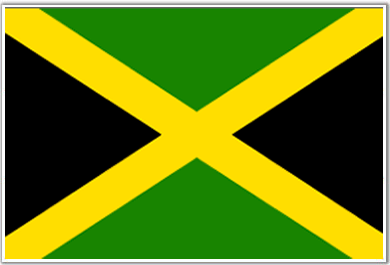
Jamaican parliament calls for removal of Cuban embargo
Jamaica’s House of Representatives has approved a motion in support of the removal of the economic, commercial and financial embargo against Cuba by the United Sates.
The motion also advocates dialogue between both governments, as Jamaica prepares to put forward its position on the matter on October 25, at the United Nations General Assembly, when it is anticipated that Cuba will submit for the consideration of the General Assembly, a draft Resolution entitled ‘Necessity of Ending the Economic, Financial and Commercial Blockade Imposed by the United States of America Against Cuba’.
This will be the 20th consecutive time that Cuba will be presenting this resolution at the assembly.
Minister of Foreign Affairs and Foreign Trade, and Deputy Prime Minister, Dr Kenneth Baugh, noted that last year 187 member states voted in favour of the resolution, which he said is “irrefutable proof that the battle for the lifting of the blockade has the recognition and support of the vast majority of the international community.”
Baugh was speaking on the private member’s motion, which was brought to the House by Member of Parliament for Western St Andrew, Anthony Hylton, at Tuesday’s sitting.
The minister pointed out that the 49-year-old blockade has been further intensified, despite repeated and almost unanimous demand by the international community, particularly the UN General Assembly, for its elimination.
He said despite measures taken by US president, Barack Obama, on travel and remittances by Cuban immigrants, this did not change the complex framework of laws, regulations and provisions of the blockade policy.
Therefore, he noted that Cuba continues to be unable to freely export or import goods and services to, and from the US, or use US dollars in its international financial transactions.
Baugh said that the blockade continues to be “an absurd, illegal and morally unsustainable policy that has not succeeded and is not likely to succeed in fulfilling the purpose of breaking the political will of the people to preserve its sovereignty, independence and right to self determination,” and serves only as one of the main hindrances to Cuba’s economic and social development.
Hylton’s resolution emphasised that “the blockade is a violation of international law, and is contrary to the purposes and principles of the UN Charter and to the norms governing international trade and freedom of navigation, as well as constituting a transgression on the right to peace, development, and security of a sovereign state.”
“It continues to be an act of unilateral aggression and a permanent threat against stability of a member country of the UN,” it adds.
In attendance at the House was the Cuban Ambassador to Jamaica, Yuri Gala Lopez.
Source-Caribbean News Now
Gulfstream expands service to Freeport, Grand Bahama
Gulfstream International Airlines plans to expand service to Freeport, Grand Bahama (FPO), with the launch of a new daily flight from West Palm Beach, FL (PBI). The new service begins November 8, 2011.
With the expanded service, Gulfstream now offers six daily weekday flights to Grand Bahama – five from Fort Lauderdale and one from West Palm Beach. Weekend service will expand to seven flights – six from Fort Lauderdale and one from West Palm Beach.
“Gulfstream continues to offer service to more destinations in The Bahamas than any other US carrier,” said Darrell Richardson, CEO of Gulfstream. “This new daily flight provides an attractive option for tourists, especially now, as we get closer to the winter season people begin to plan warm-weather getaways.”
Grand Bahama combines the excitement of Nassau with the laid-back charm of the Out Islands, to offer a unique Bahamian escape all its own. From large, sprawling resorts, lively attractions and casinos, to secluded beaches, incredible boating, fishing, scuba diving, snorkeling and more, Grand Bahama has everything that leisure travelers love about The Bahamas all in one spot.
Palm Beach County Airports Director Bruce Pelly stated: “We are pleased to be able to offer our Palm Beach County residents and the surrounding communities the opportunity to now fly direct from Palm Beach International Airport to Freeport daily on Gulfstream, and we look forward to future opportunities to partner with Gulfstream.”
New Gulfstream flights between West Palm Beach and Grand Bahama are on sale now for departures beginning November 8, 2011.
Source-Caribbean News Now
Nearly 470,000 cholera cases reported in Haiti over the past year
Almost 470,000 cases of cholera, including 6,595 deaths, have been reported in Haiti since an epidemic of the disease erupted in the Caribbean country one year ago, the United Nations World Health Organization (WHO) reported on Friday.
Some 250,000 of the cholera patients had been hospitalized over the past year, the agency’s spokesperson, Tarek Jasarevic, told reporters in Geneva, adding that the disease could infect 75,000 another by the end of the year if the current trend continues, bringing the cumulative total number of cases to about half a million.
After a decline in weekly cholera incidents in August, the number of cases rose in September, with South and Nippes departments seeing significant increases, along with Nord, Centre, and the capital Port-au-Prince. There are currently 37 cholera treatment centres in Haiti, 269 cholera treatment units and 766 oral rehydration posts.
Jasarevic said that with heavy rainfall forecast this month in the departments of south, south-east, north and other parts of the country, conditions favourable to the spread of cholera and other diseases water-borne diseases are expected to arise.
According to Jasarevic, a number of WHO’s partners had withdrawn or were scaling down their operations in Haiti due to a lack of funding. The agency has urged the humanitarian community and donors to remain vigilant as long term and coordinated cholera response may be necessary.
Source-Caribbean News Now
Saudi Arabia Crown Prince Sultan dies
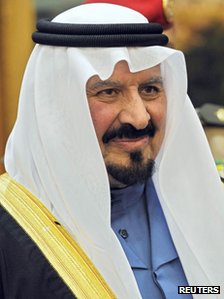 Saudi Crown Prince Sultan bin Abdulaziz al Saud has died, Saudi TV says.
The crown prince was King Abdullah's half-brother and first in line to the Saudi throne. He was also minister of defence and aviation.
He was in his eighties and was diagnosed with colon cancer in 2004. He is thought to have died at a New York hospital.
Prince Sultan had been on a visit to the US for medical tests, and he had an operation in New York in July.
The royal court confirmed the death in a statement carried by SPA, the state news agency:
"With deep sorrow and sadness the Custodian of the Two Holy Mosques King Abdullah bin Abdulaziz mourns the death of his brother and his Crown Prince Sultan... who died at dawn this morning Saturday outside the kingdom following an illness."
US Secretary of State Hillary Clinton paid tribute to the crown prince, saying Washington's ties with Saudi Arabia were "strong and enduring".
"The Crown Prince was a strong leader and a good friend to the United States over many years, as well as a tireless champion for his country," Mrs Clinton said during a visit to Tajikistan.
'Moderniser'
Crown Prince Sultan was a member of the most powerful family group in Saudi Arabia, the Sudairi Seven, and one of the sons of the country's founder, King Abdulaziz, known as Ibn Saud.
The Sudairi Seven are the sons of Ibn Saud's most influential wife, Hassa bint Ahmad al-Sudairi.
The oldest of the seven was King Fahd, who died in 2005 - to be succeeded by a half-brother, the current King Abdullah.
Prince Sultan's first appointment was as governor of Riyadh and he became minister of defence and aviation in 1963.
He oversaw extraordinary expenditure on modernising the armed forces - with multi-billion dollar deals making Saudi Arabia one of the world's biggest arms spenders.
Prince Sultan was also involved in the setting up and development of the national airline, Saudia.
He was one of the strongest supporters of forging close ties with the US, which faced its biggest challenge after 9/11.
His son, Prince Bandar, was instrumental in this as the kingdom's Washington ambassador for more than 20 years.
But BBC Middle East analyst Sebastian Usher says that, with the current generation of Saudi leaders now in their seventies or eighties, there is no clear idea yet of who will take over among Ibn Saud's legion of grandsons when they have died out.
Next in line
Prince Sultan's most likely successor as the next in line to the Saudi throne is Prince Nayef, 78, also a full brother of King Abdullah and one of the Sudairi Seven.
He has been the interior minister, in charge of the security forces, since 1975. In contrast to King Abdullah, who is seen as a cautious reformer, Prince Nayef is believed to be closer to conservative Wahhabi clerics.
Earlier this year, as part of a package of reforms to see off unrest spreading from other Arab countries, the king announced an extra 60,000 posts to be created within the security forces.
In 2009, after Prince Sultan fell ill, King Abdullah named Nayef as his second deputy prime minister, traditionally the post of the second in line to the throne.
However, the king - who is 87- has also established a succession council, made up of his brothers and nephews.
It is expected to meet for the first time to determine who will be named as the next in line to the Saudi throne.
Source-BBC
Muammar Gaddafi's body to undergo post-mortem
A post-mortem examination on the body of Libya's ex-leader Col Muammar Gaddafi is expected to be carried out on Saturday in the city of Misrata.
His burial has been delayed, with officials divided about what to do with the body.
The UN and Col Gaddafi's family have called for a full investigation into the circumstances of his death.
Video footage showed Col Gaddafi alive after his capture in Sirte on Thursday, and then dead a short time later.
The US has called on Libya's new authorities to give a full account of Col Gaddafi's death in an "open and transparent manner".
Libya's National Transitional Council (NTC) is expected to formally announce the liberation of the country during the weekend.
Election date
Hundreds of Libyans have been queuing to get a glimpse of the body of Col Gaddafi in a meat storage room in Misrata.
The BBC's Gabriel Gatehouse in the city says some - mostly women - craned their necks to see the body of his son Mutassim, who was also killed on Thursday.
Officials, including acting Prime Minister Mahmoud Jibril, have also been to see the corpses.
Oil Minister Ali Tarhouni told Reuters Col Gaddafi's body would not be released for immediate burial.
"I told them to keep it in the freezer for a few days... to make sure that everybody knows he is dead," he said.
It is unclear whether the ex-leader will be buried in Misrata, in his hometown of Sirte, where he and his son were captured, or elsewhere.
Officials from the NTC have said they will conduct a secret burial. There is some speculation that they might even try to bury him at sea, as happened with al-Qaeda leader Osama Bin Laden, to prevent any grave being turned into a shrine.
'Major concerns'
Meanwhile, questions are mounting as to exactly what happened in Col Gaddafi's last moments following his capture.
Mr Jibril said Col Gaddafi had been shot in the head in an exchange of fire between Gaddafi loyalists and NTC fighters in Sirte.
Video footage suggests he was dragged through the streets.
Misrata's chief forensic doctor, Othman al-Zintani, told al-Arabiya TV that full autopsies would be carried out on the bodies of Col Gaddafi and his son.
The post-mortems are scheduled to take place on Saturday and are expected to take several hours.
In Washington, state department spokesman Mark Toner said the NTC "has already been working to determine the precise cause and circumstances of Gaddafi's death, and we obviously urge them to do so in an open and transparent manner as we move forward".
But Russia's Foreign Minister Sergei Lavrov said the "way his death happened poses an entire number of questions".
Mr Lavrov called for a full investigation, echoing a similar call by UN Human Rights Commissioner Navi Pillay.
Her spokesman Rupert Colville told the BBC that the killing could have been illegal.
"There are two videos out there, one showing him alive and one showing him dead and there are four or five different versions of what happened in between those two cell phone videos. That obviously raises very, very major concerns," he said.
However, correspondents say few Libyans are worried about the manner of their former dictator's humiliating end. Celebrations continued late into the night across Libya.
Col Gaddafi, who came to power in a coup in 1969, was toppled in August. He was making his last stand in Sirte alongside two of his sons, Mutassim and Saif al-Islam, according to reports.
There are conflicting reports as to the whereabouts of Saif al-Islam, and Col Gaddafi's security chief - who are both at large.
Clashes Erupt in Yemen's Capital
Fierce clashes erupted on two fronts in the Yemeni capital, Sana'a, on Saturday, a day after the U.N. Security Council passed a resolution condemning the government's crackdown on dissent.
Witnesses say security forces have raided neighborhoods that are home to family members of an opposition tribal leader, Sheik Sadeq al-Ahmar. They say plumes of smoke have been seen rising from several areas.
In another part of Sana'a, government forces have clashed with loyalists of Ali Mohsen al-Ahmar, a Yemeni general who joined the opposition.
Friday's Security Council measure was the body's first resolution on Yemen since widespread protests against President Ali Abdullah Saleh began earlier this year.
It calls Yemen's use of force against protestors excessive and says "those responsible for violence, human rights violations and abuses should be held accountable."
The resolution also reaffirms support for a Gulf Cooperation Council (GCC) initiative that calls for Saleh to transfer power to a deputy in exchange for immunity from prosecution.
Saleh has agreed to the plan several times, but each time, he has backed away without signing the deal.
For the past ten months, opposition activists have been demanding an end to Saleh's 33-year autocratic rule. Dozens of people have died in protest-related unrest over the past few days.
Yemen has also been plagued by violence linked to al-Qaida militants.
Some information for this report was provided by AP, AFP and Reuters.
Iraqi PM: U.S. Withdrawal Triggered by Immunity Issue
Iraqi Prime Minister Nouri al-Maliki says the U.S. decision to withdraw troops from Iraq by the end of the year came after the Iraqi government refused to guarantee legal immunity for U.S. service members in Iraq.
Mr. Maliki spoke to reporters Saturday, a day after U.S. President Barack Obama announced the withdrawal. The United States had asked for immunity for a small group of U.S. troops to remain in Iraq to help with training and counter influence of neighboring Iran.
About 39,000 U.S. troops remain in Iraq, down from a high of about 165,000 in 2008.
Also Saturday, U.S. Secretary of State Hillary Clinton vowed that the withdrawal of troops will not end the U.S. commitment to Iraq.
Clinton said the pullout marks a new phase of Washington's relations with Baghdad. She said the U.S. would go on to have a “robust” and “continuing” presence in the region.
Clinton commented from Tajikistan, a stop on her tour of Central Asia.
Mr. Obama said Friday that U.S. troops in Iraq would “definitely be home for the holidays.” He said he and Mr. Maliki were in agreement on that decision.
U.S. Defense Secretary Leon Panetta said later Friday that the United States will negotiate with the Iraqi government after the end of 2011 about a possible American role to train Iraqi forces.
About 150 U.S. troops will stay in Iraq after the end of the year, where some will be part of the U.S. embassy's security force — which is common at U.S. diplomatic posts worldwide.
Before Friday's announcement, the possibility had remained that U.S. troops would extend their presence in the nation beyond the December 31 deadline set in 2008.
The war, begun in March 2003, is one of the longest military conflicts in U.S. history. More than 4,400 U.S. troops have died in the conflict.