
Alison: No personal apology
BARBADIAN soca queen Alison Hinds is yet to receive an apology from the Miami Carnival organizers, who have blamed time constraints for her not being allowed to perform last Sunday.
Following intense criticism from disappointed patrons on various social media and from Hinds herself, who on Twitter and Facebook blasted the organizing committee for “disorganization”, the committee apologized in an official statement yesterday.
“Our headline act Alison Hinds was unable to perform due to contractual obligations to the stadium and the financial repercussions that would follow the extension of the event scheduled. We were [therefore] unable to permit a time extension,” the statement, prepared by committee chairman Mario Zamora and public relations manager Yvette Harris, said.
They added that the inclement weather had presented delays and other challenges, causing the show to go beyond its scheduled time.
The statement added: “We want to apologize for not being able to deliver the complete entertainment line-up that our patrons were looking forward to and expected on Carnival Sunday . . . .
“We take full responsibility for the logistic and presentation quality of all the cultural elements of the carnival. Since the onset of these disappointments, we have communicated with all parties to express our sincere apologies.”
But, Hinds, who spoke to the MIDWEEK NATION yesterday, said she was still awaiting an apology and explanation.
“I haven’t had any kind of communication with the organizers since I left Miami (Monday). “They have not reached out to me,” she said. “I want a personal and public apology because this wasn’t good enough, especially since I did all I was asked to do, including every piece of media. I was punctual – everything, so I’m not at fault at all.”
Hinds, who had promoted the event on NBC and via social media, said she was supposed to headline the show at Sun Life Stadium Miami Gardens Sunday but encountered “total chaos” in the coordination of the show and poor backstage arrangements.
“There was a total lack of control. Backstage there was one tent in the corner with no light, no drinks or anything,” she said.
She said the best part of the carnival was the exposure through interviews with the Miami Herald, along with two appearances on NBC. “I was very excited, and the fans were excited,” she added.
“The Miami Broward One Carnival needs to do better,” Hinds said.

Golding hints Holness will become PM ‘in a matter of days’
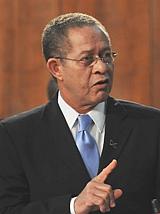
BRUCE Golding yesterday signalled that he would be stepping down as head of the Government earlier than his original November timeline, confirming information from highly placed sources close to the administration that Andrew Holness will go into the ruling Jamaica Labour Party’s (JLP’s) annual conference next month as prime minister and announce a snap general election.
Golding’s hint at the development came during an address at the official launch of Compete Caribbean at the Wyndham Hotel in New Kingston.
Said Golding: “The person who is expected to succeed me in a matter of days has provided very strong leadership in transforming our education process, but that is not something that can be done in any short time span.”
Journalists covering the assignment were unable to question Golding about his statement as he left shortly after completing his address. However, it gave legitimacy to speculation in political circles that Golding wanted to ensure that Holness had enough time to call the election for early December.
Under Jamaican law, there should be a minimum of 16 and a maximum of 23 days between nomination day and election day. In addition, there must be five days, excluding Sundays and public holidays, between the announcement of the election and nomination day.
If, therefore, Holness chooses to announce the election at the public session of the JLP conference on November 20, the country could be asked to vote as early as December 15.
Since Universal Adult Suffrage in 1944, Jamaicans have gone to the polls in general elections five times in December. According to data on the Electoral Office of Jamaica website, the 1944, 1949, 1976, 1983 and 1997 elections were all held in December.
Last month, Golding stunned the country when he announced his intention not to seek reelection as JLP leader at the party conference in November and to step down as chief executive as soon as a new JLP leader was elected.
Since then, Holness, the 39-year-old education minister, has received overwhelming support from the JLP’s parliamentary group and party delegates in general, to replace Golding and has given the JLP a bounce in public support. He remains the only candidate duly nominated.
Holness’s elevation to the country’s top job will make him the youngest ever occupant of the post, and JLP insiders have said that the party intends to take advantage of the popularity he is now enjoying.
This week, at the Observer Monday Exchange, Holness said his life has been transformed into a whirlwind of activities since it became clear that he was the front-runner for the top job.
Before appearing at the Monday Exchange shortly after 9:00 am, he had an early morning meeting with Golding. After leaving the Observer, he attended another meeting with the prime minister and representatives of the International Monetary Fund before going to the weekly Cabinet meeting at Jamaica House.
“I’ve been attending, on average, seven to eight meetings a day,” said Holness, who has also been attending party rallies and fulfilling his portfolio responsibilities at official functions.
Source: jamaicaobserver
TNT Dookeran: No easy way out by raising taxes
GOVERNMENT did not take the "easy way out" of raising taxes and cutting social spending with the 2011/ 2012 national budget, according to Finance Minister Winston Dookeran.
He said it was quite a challenge to keep increased revenue without adding a taxation burden.
The country was overburdened and not able to turn the corner of growth, he said, but added that there were many unexplored areas of existing taxation that could be explored.
Dookeran was the feature speaker yesterday at the Chamber of Industry and Commerce's annual post-budget panel discussion at the Chamber's offices in Westmoorings.
He noted the fiscal deficit had continued for another year, and coming out of a period of negative growth, Government had to go further into deficit financing.
"The issue of deficit financing, in my view, is not so much the size of the deficit, but the use to which it is put," he said.
He explained the deficit was not to finance recurrent expenditure but to facilitate new investment.
"You have to spend your way out of deficit," he later told the media.
He also took the opportunity to clarify how the increase in minimum National Insurance pensions, from $2,000 to $3,000, would be funded, a move questioned by Opposition Leader Dr Keith Rowley. Dookeran said there would be an increase to the contributions from those in the $8,300 to $10,000 band— middle-income earners —to fund this.
Senior economist and manager at Republic Bank Dr Ronald Ramkissoon said over the last three years, there has been a decline and contraction of the economy, which was a "serious matter", and he had been looking forward in the budget for measures to build growth momentum.
He said the budget had identified a number of measures with the potential of generating positive growth "to turn the economy around".
He noted the issues that needed to be addressed "frontally" were implementation, accountability and transparency. He encouraged the minister to get the capital and energy sector projects "off the ground" so there can be positive growth.
Ramkissoon noted one challenge was the paucity of data on local investment and said the Central Statistical Office needed to address this, so the minister can speak from a "position of knowledge". Dookeran said that unlike academics, he had to come to conclusions with "imperfect data".
The Finance Minister also stressed that the performance of the budget was not solely his responsibility, predicting that on Friday, in Parliament, he would be "attacked" for forecasting a two per cent economic growth when there was, instead, a 1.4 per cent contraction.
He said he could only set the platform and it was up to everyone, including the Opposition, to "make it happen".
Source:TEN
BlackBerry outage hits Jamaica
Sporadic outages of BlackBerry messaging and email service spread to Jamaica, the U.S and Canada on Wednesday, as problems stretched into the third day for Europe, Asia, Latin America and Africa.
In Jamaica, telecommunications company Digicel issued a statement apoligising for the outage.
"Digicel is aware that some of its customers have been experiencing difficulties with their BlackBerry Service since 11:00pm on Tuesday, October 11th," the statement said.
"RIM has confirmed that this is an issue that is currently impacting approximately 15 per cent of BlackBerry users across the Caribbean, plus Canada and Latin America. Our technical team is therefore working with RIM to get an update and to have this issue resolved as soon as possible," the statement continued.
Research In Motion Ltd., the Canadian company that makes the phones, said users in the Americas "may be experiencing intermittent service delays this morning," and said it's working to fix the problem.
Bell Canada spokesman Mark Langton said some BlackBerry users at all Canadian carriers were affected.
Overseas, the problems started Monday, leaving many BlackBerry owners exasperated. On Tuesday, RIM said a crucial link in its infrastructure had failed, and a backup didn't work either. It said it was now working to get through a backlog of traffic.
The service outage, the longest in many years, added to RIM's woes. The company is struggling with slowing sales and a tablet that's been a dud. Its shares are approaching a five-year low.
In the United Arab Emirates, the two biggest phone companies said they would compensate their BlackBerry users for the mishap by giving them at least three days of free service. Matthew Willsher, chief marketing officer for Etisalat, the country's biggest telecom, said it was acting in response to the "exceptional and unprecedented circumstances."
Unlike other cellphone makers, RIM handles email and messaging traffic to and from its phones. That allows it to provide services that other phones don't have, lets it optimize data service and provide top-class security. But when it encounters a problem, a large share of the 70 million BlackBerry subscribers worldwide can be affected all at once. BlackBerry outages tend to occur several times a year, but they usually last for less than a day.
One of the BlackBerry's big attractions is the BlackBerry Messenger, or BBM, which works like text messaging but doesn't incur extra fees. That service was affected by the outage, and to make matters worse for RIM, Apple Inc. is releasing software Wednesday for its iPhones that works like BBM. Competition from Apple is one of the chief causes of RIM's diminishing fortunes.
RIM shares fell 42 cents, or 1.7 percent, to $23.99 in morning trading in New York as major indexes rose.
Prominent Jamaican politician indicted by US Grand Jury, Extradition request soon?
The Caricom News Network understands that a prominent Jamaican politician has been indicted by the United States authorities, possibly in connection with the ongoing criminal matter involving reputed drug lord Christopher ‘Dudus’ Coke, who is awaiting sentencing in a United States court. Florida based attorney-at-law, Professor David Rowe, told host of the Evening Edition's Lambert Brown on 93FM yesterday, that he has been reliably informed that an indictment has already been handed down and efforts are now been made by US officials to make the necessary arrangements to extradite the person involved.
According to Professor Rowe, this "bomb-shell" is expected to hit the Jamaican political landscape within the next ten days and is expected to have a devastating effect on the affected political party. He said news of the indictment has already been leaked to sections of the US media as well as highly placed political operatives in the United States. A report in today's edition of the Jamaica Observer news paper, seemed to comfirm Professor Rowe's shocking revelations to Lambert Brown by indicating that " extradition requests from the American Government for five Jamaicans, among them three prominent faces, are expected to be delivered to local authorities today." Quoting a a highly placed US Government official who spoke on condition of anonymity, "two of the wanted men are politicians, one is a veteran entertainer, while the others both conduct regular business at Kingston’s Port Bustamante."
The Observer report said "the extradition requests are related to the ongoing criminal matter involving reputed drug lord Christopher ‘Dudus’ Coke, who is awaiting sentencing in a United States court, following his admission of guilt in relation to racketeering in the US and conspiracy to commit assault in aid of racketeering."
According to the US Government official, the politicians named in the extradition warrants are believed to have assisted Coke in the importation of various items from the United States, some of which may not have been brought in legally.
The Observer was told that US authorities got critical information on certain persons in Jamaica from Coke, although his legal team has maintained consistently that the former fugitive did not squeal.
Source: CNN
$200,000 bail for Sport manager on rape charge
A project manager at the Sport Company of T&T (Sportt) was yesterday placed on $200,000 bail when he appeared in court accused of rape. Travis Watson, 32, a certified engineer of Malabar, Arima, was not called upon to plead when he appeared before Magistrate Maureen Baboolal-Gafoor in the Port-of-Spain Seventh Court. The incident was alleged to have happened on September 12 in a car that was parked at the Queen’s Park Savannah, Port-of-Spain, during the woman’s lunch hour
Watson, who is originally from Guyana, was ordered by Baboolal-Gafoor to surrender his passport and to report to the Malabar Police Post everyday until the matter was completed. Watson was also ordered to refrain from contacting the alleged victim in the matter. Several employees of the Sportt were seen sitting in the public gallery of the court to lend support to their colleague.
Watson was arrested by Cpl Sean Ammon, of the Belmont Police Station, last Friday while at work at Sportt’s office, Henry Street, Port-of-Spain. He was represented by attorney Quako Wilson, while police prosecutor, acting inspector Ricky Lochan, represented the State. The matter was adjourned to October 21.
Source: TNT Guardian
AMERICANS IN SEARCH OF RYDER CUP REVENGE
 TCI-BASED North American golfers will be practicing extra hard over the next couple of weeks.
Provo Golf Club plays host to its biggest and most popular event of the year on Saturday and Sunday October 29 and 30 – the Hugh G O’Neill and Co/Caribbean Snow Removal Ryder Cup.
It will be the 19th staging of the competition with the North American’s trailing 12-6 to their International counterparts.
But despite having lifted the trophy just half a dozen times, director of golf, Dave Douglas, is predicting a close contest.
He explained: “This is the big one when it comes to club members – the one they all want to win. The professional Ryder Cup between America and Europe is packed full of tension and excitement and our version is no different.
“The TCI is a multi cultural place with residents from all over the world. Our membership reflects that too and it’s why this competition proves so popular.
“The International team ran out good winners last year to extend their overall lead and I know that hurt the North Americans. They will be going all out for revenge this year and it should be a fantastic two days golf.”
He added: “One thing is certain – I wouldn’t want to bet either way on the outcome of this one.”
Both sides will include 20 male and six female players of various abilities and handicaps, with the North Americans captained by Mike Adamo and assistant, Fraser Dods, and the International team skippered by Chris Bruno and his assistant, Will Shoreman.
The competition will be decided by the exciting matchplay format with golf fans urged to come and support their side.
“Spectators are very welcome”, added Douglas. “It’s free to watch and we have a great restaurant serving food and refreshments. A big crowd will give the players a huge boost and it will certainly be an entertaining two days.
“The singles take place on the Sunday and they can be dramatic affairs and the buzz around the 18th green is fantastic.
“Anyone who has watched the professional Ryder Cup will know what I mean and I can guarantee the TCI version is just as tense and as meaningful as the real thing.”
The action gets underway on both days at around 8am with the pairs best ball matches on the Saturday and the singles on the Sunday.
NFL fines Giants S Kenny Phillips $20,000 for hit
The NFL has fined New York Giants safety Kenny Phillips(notes) $20,000 for a hit on Seattle Seahawks tight end Zach Miller.
Phillips was flagged for a hit on a defenseless Miller in the first quarter of the Seahawks’ 36-25 win over the Giants on Sunday.
It marked the second time this season that Phillips has been fined by the league for a hit. He was accessed with a $10,000 fine on the opening weekend of the season for unnecessarily striking Redskins tight end Fred Davis(notes) in the head and neck area. No penalty was called on that play.
Phillips hung up both letters from the league in his locker on Wednesday with the fine totals circled. He wrote ‘HELP!’ at the bottom of the first letter and ‘PLEASE HELP’ at the bottom the most recent one.
(AP)
FIFA begins CFU bribery cases
T&T Football Federation general secretary, Richard Groden faces a possible ban from FIFA on Friday as the latest wave of its election bribery cases began yesterday. The case began with 15 Caribbean Football Union officials explaining their part in an alleged plot involving former presidential candidate Mohamed bin Hammam. FIFA said its ethics committee will hear the defendants over three days, and was expected to deliver verdicts on Friday. The 15 officials from 11 Caribbean countries are accused of accepting $40,000 cash payments in T&T during Bin Hammam’s later-abandoned challenge to FIFA president Sepp Blatter.
They were charged after FIFA appointed former FBI director Louis Freeh to continue leading an investigation that began in May. FIFA’s gravest scandal in 107 years has removed two of its most influential powerbrokers—Asian football president Bin Hammam and FIFA vice president Jack Warner—from office after a combined 43 years sitting on world soccer’s ruling executive committee. Bin Hammam, who denies bribery, is appealing his lifetime ban at the Court of Arbitration for Sport, and FIFA dropped charges against T&T Minister of Works Warner after he resigned his soccer positions in June.
The defendants now facing bans include FIFA committee members Yves Jean-Bart of Haiti and Groden, a close ally of Warner. Jean-Bart sits on the associations panel that monitors FIFA’s 208 national members and Groden helps allocate tens of millions of dollars of development funding as a member of the Goal Bureau which Bin Hammam chaired for 12 years. The Haitian official is among five national association presidents answering charges this week, including one of soccer’s most senior women officials: Franka Pickering of the British Virgin Islands. Former international referee Mark Bob Forde of Barbados has also been charged and faces a ban from soccer duty.
Along with Bin Hammam in July, FIFA’s ethics panel suspended two Caribbean Football Union members of staff after ruling that they distributed $40,000 cash payments in brown envelopes at the Hyatt Regency Hotel in T&T. Caribbean Football Union vice-president Colin Klass, a longtime Warner ally, received a 26-month FIFA ban after a separate hearing last month. The Guyana federation president lost his seat on FIFA’s futsal and beach soccer committee. Qatari candidate Bin Hammam withdrew his election bid three days before the FIFA poll in June. Blatter was left unopposed to receive a fourth four-year presidential term, and was endorsed by 186 FIFA members, including most Caribbean islands. Blatter is scheduled on October 21 to provide details of his promised anti-corruption project to clean up world soccer and its damaged image.
Source:AP
Windies sink despite Samuels half-ton
A Marlon Samuels half-century was not enough to save West Indies from defeat, as Bangladesh captain Mushfiqur Rahim produced a superb unbeaten 41 to fire his side to a three-wicket win with a ball to spare in the one-off Twenty20 International yesterday.
The right-handed Samuels' 58 formed the foundation of the West Indies' 132 for eight after they were sent in at the Shere Bangla National Stadium.
However, Mushfiqur produced a fine innings, hammering a six off the penultimate ball of the match to help Bangladesh draw first blood in the series that comprises three one-day internationals and two Tests.
West Indies got off to a slow start when openers Lendl Simmons (23) and Adrian Barath (15) added a lazy 25 from 26 balls.
The innings gained momentum through a 36-run, second-wicket stand off 30 balls between Simmons and Samuels, but once they were parted, the innings lost its way badly.
Samuels, who hit a hundred in a T20 tour match last Sunday, counted two fours and four sixes off 42 balls.
In reply, Bangladesh lost key wickets along the way to slump to 93 for six in the 16th over before Mushfiqur and Nasir Hossain (18) posted a crucial 31 off 24 balls for the seventh wicket.
When Nasir was caught behind off the third ball of the final over, Bangladesh still required five for victory but Mushfiqur promptly dispatched the fifth delivery over midwicket to end the match emphatically.
Samuels, whose four overs of spin cost a miserly 14 runs and yielded two wickets, then bowled the dangerous Shakib Al Hasan for a first-ball duck off the very next ball to leave Bangladesh reeling at 49 for three in the eighth over.
Earlier, the Windies lost Barath trying to accelerate the scoring, caught at mid-on by Tamim Iqbal off left-arm spinner Shakib Al Hasan.
Samuels got off the mark in style with a six over backward square off pacer Rubel Hossain and followed up two balls later by hammering the same bowler over point for another six.
Simmons slapped left-arm spinner Abdur Razzak for a six over long on but played back to the next ball and was lbw at 61 for two at the end of the ninth, and André Russell (5) - promoted to number four - and Darren Bravo (7) failed to make any impression, as the Windies slumped to 105 for four in the 16th over.
Source:CMC