
Andy Murray through in Shanghai as Dmitry Tursonov pulls out
Andy Murray was handed a walkover at the Shanghai Masters when Russian opponent Dmitry Tursunov pulled out with a wrist injury.
Murray is seeded second for the tournament and will now face Stanislas Wawrinka in the third round.
Tursunov beat Thomas Bellucci 6-7 6-4 7-5 in the second round but was not fit to face Murray, who is yet to play in the tournament after a first-round bye.
Rafael Nadal beat Guillermo Garcia-Lopez 6-3 6-2 to reach the third round.
Jo-Wilfried Tsonga was beaten by Japan's Kei Nishikori 7-6 4-6 4-6 but third seed David Ferrer eased through with a 7-5 7-6 win over Milos Raonic.
Murray's side of the draw has opened up with the losses of Tsonga and fifth-seeded Mardy Fish, who fell to Australian Bernard Tomic on Tuesday.
The highest-ranked seed remaining in his half of the draw is Gilles Simon of France who is seeded eighth.
Murray's match against Wawrinka will take place not before 0830 BST on Thursday.
Source:BBC

Blackberry problems spread to the TCI, US & World
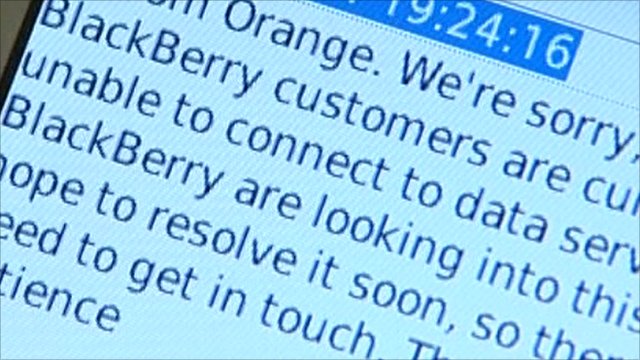 Problems with the Blackberry smartphone system appear have to spread to the United States.
Users began to report loss of services on Wednesday, with many turning to Twitter to complain about their lack of email.
The latest development follows two days of sporadic blackouts across Europe, the Middle East and Africa.
Blackberry's owner, RIM, blamed the latest outages on a backlog of emails to Europe from Asia and the Americas.
"It is a backlog issue," RIM software vice president David Yach told a press conference in Ottawa, Canada.
"Clearly we have a backlog in Europe... as you can imagine, with the global reach of Blackberry and people using it to contact others around the world, there's a lot of messages to Europe from Asia and the Americas.
"Over time that backlog has built up and affected our other systems."
As news of the failure in the US spread, one user tweeted: "What is the status here in the USA? I am in New York and there seems to be no email service."
Another, who lives in Texas, wrote: "My #blackberry is not working! I can dial out that's it. What's up?".
'Data backlog'
Blackberry had earlier declared services to be "operating normally", only to be contradicted by frustrated users.
Many called on the phone firm to "sort out" the problems and get the network running again.
RIM acknowledged that it was still experiencing problems and apologised for the inconvenience.
"The messaging and browsing delays... in Europe, the Middle East, Africa, India, Brazil, Chile and Argentina were caused by a core switch failure within RIM's infrastructure," a company statement said.
"Although the system is designed to failover to a back-up switch, the failover did not function as previously tested.
"As a result, a large backlog of data was generated and we are now working to clear that backlog and restore normal service as quickly as possible."
The blackouts have left millions of users without email, web browsing and Blackberry Messaging (BBM) services.
The cause is believed to be due to server problems at RIM's UK data centre in Slough.
Blackberry users around the world began reporting problems with their handsets mid-morning on 10 October and at 14:42 BST, Blackberry UK sent out a tweet which said: "Some users in EMEA are experiencing issues."
The "issues" left many Blackberry owners only able to text and make calls.
'Harsh criticism'
Many corporate customers said they had not lost service, suggesting that the problem was with Blackberry's BIS consumer systems, rather than its BES enterprise systems.
"Blackberry runs two infrastructures," explained Simon Butler, a Microsoft Exchange consultant at Sembee.
"The understanding I have is that the BIS service has crashed.
"The business side runs on a different set of servers, although enterprise Blackberrys can still use messenger and the consumer services, so they are also affected," said Mr Butler.
Such a major failure will still come as unwelcome news to Blackberry's owner RIM, which has been losing market share to smartphone rivals - in particular Apple's iPhone.
Many corporate clients have switched to the device after Apple made a concerted effort to improve its support for secure business email systems.
Malik Saadi, principal analyst at Informa Telecoms & Media, said RIM would have to resolve the problem quickly.
"The current situation with the Blackberry outages couldn't come at a worse time for RIM, following some harsh criticism in recent months," he said.
Such crashes may lead RIM and others to "re-evaluate their reliance on centralised servers and instead look to investing in more corporately controlled servers", he added.
But he thinks customers will stick with the firm despite current frustrations.
"It will take more than just a couple of collapses to persuade loyal consumers of Blackberry services to look for alternatives," he said.
Many of those complaining about the crash said on Twitter that they could not live without access to BBM.
Source:BBC
Barroso outlines plan to resolve eurozone debt crisis
The president of the European Commission, Jose Manuel Barroso, has set out a plan designed to bring an end to the eurozone debt crisis.
In a speech, Mr Barroso said banks must set aside more assets to help guard against future losses.
Banks supported by the eurozone bailout fund - the European Financial Stability Facility - should be stopped from paying dividends or bonuses, he said.
The commission called it a "comprehensive response" to the crisis.
It outlined five areas of action "designed to break the vicious circle between doubts over the sustainability of sovereign debt, the stability of the banking system and the European Union's growth prospects".
Mr Barroso said the plan "charts Europe's way out of the economic crisis".
"Reactive and piecemeal responses to different aspects of the crisis are no longer sufficient," he said.
The plan calls for five policy actions:
- Decisive action on Greece so that "all doubt is removed" about the country's economic sustainability. This includes freeing up the latest tranche of bailout funds
- Implementing measures agreed in July, which include increasing the size of the EFSF to 440bn euros ($607bn; £385bn) and accelerating the launch of its permanent successor, the European Stability Mechanism
- Co-ordinated action on strengthening Europe's banks. Banks should set aside more assets to cover losses through private funding or national governments if necessary. If this is still not adequate, they can tap into the EFSF, but if they do they will not be allowed to pay dividends of bonuses
- Speeding up policies to enhance growth and stability, such as free trade agreements
- Building greater integration for economic governance across the eurozone.
Late on Tuesday, Slovakia voted against increasing the powers of the EFSF - the only one of the 17 members of the eurozone to do so.
However, internal political wrangling was behind the no vote, and observers expect a fresh vote before the end of this week.
In addition to expanding the EFSF's powers, the measures agreed in July by eurozone leaders also included private lenders taking a 21% hit on loans to the Greek government.
However, investors now believe both these measures are inadequate. They are calling for the bailout fund to be increased towards 2 trillion euros, and believe private investors will be forced to take a much bigger hit than the 21% suggested.
The leaders also agreed in July to a second bailout package for Greece worth 109bn euros.
The commission, along with the International Monetary Fund and the European Central Bank, has been in Athens deciding whether to release the latest tranche of funds from the first bailout agreed in 2010.
On Tuesday, the three bodies agreed measures that Greece needs to take to bring down its debt levels and said they were likely to release the 8bn euros that country needs to pay its bills.
Leaders have been heavily criticised, particularly by investors, for not taking decisive action to end the crisis.
However, there is feeling now that such action will be forthcoming, analysts say, with all eyes on a summit of EU leaders on 23 October and a G20 meeting in Cannes at the beginning of November.
Federal Reserve split over 'Operation Twist' stimulus
Three members of the Federal Reserve's Open Market Committee (FOMC) voted against the Fed's latest stimulus measures at its meeting last month, minutes have revealed.
After the meeting, the Fed announced a $400bn (£254bn) bond programme designed to keep interest rates low.
But three members argued for no additional stimulus.
Two other unnamed members said the fragile state of the economy could justify stronger action.
They went along with the Fed's so-called Operation Twist programme as it did not rule out further action at a later date.
Under the programme, the Fed said it would sell about $400bn of short-term bonds and buy longer-term debt. Buying bonds pushes the price up and lowers the interest rate, or yield.
The Fed hopes the move will help to keep long-term interest rates low, thereby boosting mortgage lending and loans to businesses.
Unlike quantitative easing, the policy does not inject any new money into the economy.
'Downside risks'
"Most members agreed that the revisions to the economic outlook warranted some additional monetary policy accommodation to support a stronger recovery," the minutes said.
"Two members said that current conditions and the outlook could justify stronger policy action... Three members concluded that additional accommodation was not appropriate at this time."
The three members voting against the action were Richard Fisher, Narayana Kocherlakota and Charles Plosser.
There are 10 members of the FOMC.
The Fed also gave a somewhat gloomy outlook for the US economy.
"Members generally continued to expect some pickup in the pace of the economic recovery over coming quarters but anticipated that the unemployment rate would decline only gradually and agreed that there were significant downside risks to the economic outlook," the notes said.
Source:BBC
Australia parliament passes divisive carbon tax
Australia's lower house of parliament has narrowly passed a bill for a controversial carbon tax.
The legislation would force about 500 of the biggest polluters to pay for each tonne of carbon dioxide they emit.
The tax is central to the government's strategy to combat climate change, but the opposition says it will cause job losses and raise the cost of living.
Australia is the world's largest coal exporter and one of the biggest per capita greenhouse gas emitters.
"Today is a significant day for Australians and the Australians of the future who want to see a better environment," Prime Minister Julia Gillard said before the vote.
After her Clean Energy Bill 2011 was passed with 74 votes for and 72 against, she hugged colleagues and waved to supporters in the public galleries.
Along with a companion bill for A$300m ($298m; £191m) in assistance for the Australian steel industry, it is expected to pass the Senate with the help of the Greens next month.
Protests
The victory is an important one for the prime minister, whose popularity with voters in opinion polls has been declining against the opposition.
The bill has polarised Australian opinion. Thousands of people have protested against it, accusing Ms Gillard of lying before last year's election.
Two previous failed attempts to pass similar bills were partly responsible for the fall of her predecessor as prime minister and Labor Party leader, Kevin Rudd.
Ms Gillard made a pledge during last year's federal election not to introduce a carbon tax.
The proposed tax was drawn up after Ms Gillard failed to win an overall majority in parliament at the polls and had to rely on the support of the Greens.
Australia's 500 heaviest polluters will pay A$23 for each tonne of carbon emissions.
The government says nine out of 10 households will be compensated through tax cuts or welfare increases for any increased costs, but the opposition says 60% will be worse off.
The tax will be introduced on 1 July next year, and will then evolve into an emissions trading scheme three years later.
The conservative opposition leader, Tony Abbott, has promised to ditch the tax if he wins office.
US Senate passes bill to pressure China on yuan
The US Senate has voted through a bill that aims to aims to put pressure on China to increase the value of its currency, the yuan.
Some lawmakers argue that the Chinese yuan has been kept artificially undervalued, giving the country an unfair advantage and hitting US jobs.
The legislation passed the Democrat-led Senate 63-35, putting it through to the House of Representatives.
However, the bill is unlikely to be passed by the House.
Trade war
House Republican leaders agree with many business groups that action against China could result in a trade war.
The Obama administration has indicated it would prefer diplomacy.
China's foreign ministry said that the bill "obstructs China-US economic relations and trade".
China built up a $273bn trade surplus with the US last year. Critics say this is a result of China keeping its currency at an artificially low level, which makes China's exports to the US cheaper and imports from the US more expensive.
US lawmakers said the vote was a signal that it was time to confront China over its trade policies.
"There are always people who don't want to stand up to China and I think they are, frankly, undercutting our ability to stop the haemorrhaging in our manufacturing jobs," said Democrat Ohio Senator Sherrod Brown.
The bill is designed to put pressure on countries the US says are keeping their currencies deliberately undervalued.
If passed into law, it would allow Washington to impose so-called "countervailing duty" tariffs on imports that it sees as unfairly state-subsidised.
Most analysts say the Chinese yuan is undervalued against the US dollar by 25%-30%, with some US lawmakers putting the difference up to 40%.
There has been some appreciation of the yuan in the past year, but not enough to appease critics.
Damaging relations?
Recent comments in the Chinese media have shown fierce opposition to the bill, saying the trade imbalance between the two countries is a result of US economic policies and not the exchange rate.
China calls on the US to discard protectionism, stop politicising economic issues and take concrete action to create an enabling environment for the development of bilateral economic relations and trade," said Ma Zhaoxu, a spokesperson for the foreign ministry, in a statement on Wednesday.
The Chinese foreign ministry also urged the Obama administration not to support the bill.
Many in the US are also worried that action against China would damage US-China relations.
House Speaker John Boehner has said it would be "dangerous" for Congress to get involved with a foreign country's exchange rate.
This sentiment puts the fate of the bill in question.
Secretary of State Hillary Clinton said to Reuters news agency: "I don't know whether this bill in the form that it's passing the Senate will ever end up as a piece of legislation coming from the Congress.
"But it does reflect a great deal of frustration on the part of the American people."
Source:BBC
Underpants bomber' Abdulmutallab pleads guilty
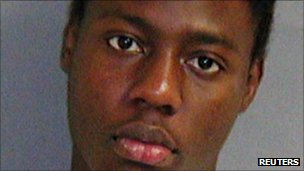 A Nigerian accused of trying to bomb a US-bound flight on Christmas Day 2009 has told his trial in Detroit that he is pleading guilty to all charges.
Umar Farouk Abdulmutallab, 24, told a judge he was admitting all eight counts against him, including terrorism and attempted murder.
Abdulmutallab was badly burned when a bomb sewn into his underwear failed to detonate fully, prosecutors say.
Almost 300 people were on the flight from Amsterdam to Detroit.
Abdulmutallab will be sentenced on 12 January 2012 but the BBC's Jonny Dymond, in Washington, says this is now a formality - Abdulmutallab will spend the rest of his life in prison.
US Federal Judge Nancy Edmunds verified that Abdulmutallab understood his right to silence before asking him if he wished to make a plea.
"Do I understand correctly that you wish to waive that right [in order] to plead guilty to all the charges in the indictment?" she asked.
"Yes," the defendant replied.
He told the court the bomb was a "blessed weapon to save the lives of innocent Muslims".
"The US should be warned that if they continue to kill and support those who kill innocent Muslims, then the US should await a great calamity... or God will strike them directly," he said.
Abdulmutallab was representing himself, with a standby lawyer appointed by the court to assist with his defence.
He sacked his original legal team, also appointed by the court, in September 2010.
"We wanted to continue the trial, but we respect his decision," said standby lawyer Anthony Chambers outside the court on Wednesday.
US Attorney General Eric Holder welcomed the guilty plea, saying it showed the courts were "one of the most effective tools we have to fight terrorism".
In a statement, he said: "Our priority in this case was to ensure that we arrested a man who tried to do us harm, that we collected actionable intelligence from him and that we prosecuted him in a way that was consistent with the rule of law.
"We will continue to be aggressive in our fight against terrorism and those who target us, and we will let results, not rhetoric, guide our actions."
Al-Qaeda in the Arabian Peninsula (AQAP), which is based in Yemen, said it was behind the attack on 25 December 2009.
US investigators have said Abdulmutallab told them he was working for AQAP and had received the bomb from them, as well as training.
US and Yemeni officials have linked Abdulmutallab to radical cleric Anwar al-Awlaki, whom he is said to have met while in Yemen before the attack.
Awlaki was killed last month by a US drone strike in Yemen.
Abdulmutallab flew from Nigeria to Amsterdam, where he boarded Northwest Airlines Flight 253 to Detroit, which was carrying 279 passengers and 11 crew.
He was already on a US watch list, but not a no-fly list.
Passengers had to put out the fire after the bomb failed to detonate fully, the court heard on Monday.
Abdulmutallab's father, Alhaji Umaru Mutallab, an influential banker who is well connected in Nigerian politics, said he had approached the US embassy officials and Nigerian authorities in 2009 to warn them about his son.
Abdulmutallab was denied a request to ban statements he made while being treated for burns at a hospital, as well as other material, from appearing at trial.
During the first day of his trial, on Monday, prosecutor Jonathan Tukel showed the court a picture of the remains of the burnt underwear which contained the explosive device.
Federal Bureau of Investigation (FBI) analysts found the high explosive pentaerythritol (PETN) inside the device. Officials say he planned to detonate it using a syringe filled with chemicals.
The bomb was not detected when Abdulmutallab passed through airport security in Lagos and Amsterdam.
The court was also shown a video of Abdulmutallab explaining his suicide mission.
US Treasury imposes sanctions on Iran's Mahan Air
The US has imposed sanctions on an Iranian airline it says flew members of an elite force linked to an alleged plot to kill the Saudi envoy to the US.
The US Treasury says Mahan Air ferried operatives from Iran's Quds Force and Hezbollah across the Middle East.
Under the sanctions, the airline's US assets will be frozen and US firms barred from doing business with it.
Secretary of State Hillary Clinton meanwhile said the alleged plot was a "dangerous escalation" by Iran.
The sanctions were unveiled a day after the authorities announced they had foiled a conspiracy to assassinate the Saudi ambassador to Washington, Adel Al-Jubeir, on US soil using explosives.
'Secretly ferrying operatives'
The US government accused members of the Iranian government - and the Quds Force, an elite unit of the Revolutionary Guard Corps - of involvement.
"It's clear that senior levels of Quds force were engaged in the plotting," White House press secretary Jay Carney told reporters.
On Tuesday, the US also imposed sanctions against five people it linked to the alleged assassination plot, including two men charged over the investigation.
The pair were named as Manssor Arbabsiar, a 56-year-old naturalised US citizen with dual Iranian and US passports, and Gholam Shakuri, who is based in Iran.
Mr Shakuri and three others named in Tuesday's sanctions were described as members of the Quds Force.
Mr Arbabsiar - accused of wiring $100,000 (£63,000) to a US bank account to finance the alleged $1.5m conspiracy - was charged in a New York City court on Tuesday.
US officials have said that the accused approached a US informant posing as a member of a Mexican drug cartel to carry out the assassination.
Source:BBC
Viktor Bout arms dealing trial begins in New York
A former Soviet military officer has appeared before a New York court to face charges of selling arms to anti-American rebels.
The prosecution says Viktor Bout, dubbed a "Merchant of Death", wanted to sell "staggering quantities" of weapons and explosives for millions of dollars.
His defence insists that Mr Bout wanted only to sell two transport planes for $5m (£3.2m).
Mr Bout was arrested in 2008 in a hotel in Bangkok, Thailand.
He is being tried for conspiracy to kill US citizens and conspiracy to provide help to a terrorist organisation.
If convicted, he could face up to 25 years behind bars.
Arms sale
In the opening statements of the trial the prosecution alleged Mr Bout had promised to deliver 100 surface-to-air missiles, 20,000 high-powered rifles and 10 million rounds of ammunition to rebels in Colombia in 2008.
"This man, Viktor Bout, agreed to provide all of it to a foreign terrorist organisation he believes was going to kill Americans," Assistant Attorney Brendan McGuire told the jury.
The court was told that Mr Bout had been caught in a sting operation by the US Drug Enforcement Administration.
Two US government informants were posing as weapons buyers for the Revolutionary Armed Forces of Colombia, known as Farc, which Washington has classified as a terrorist organisation and says is involved with the cocaine trade.
Prosecutors told the jury of key meetings in Bangkok in which Viktor Bout was told the weapons would be used to kill US pilots working with Colombian officials.
According to prosecutors Mr Bout replied: "We have the same enemy."
But the defendant's lawyer countered, saying: "Viktor never walked into that meeting saying, 'Hey I want to kill Americans'.'"
The court will also hear hours of recorded conversations which purport to show Mr Bout talking about the weapons' sale.
His defence lawyer, Albert Dayan, argued that his client had only agreed with DEA operatives to secure the sale of two transport jets, for a total cost of $5m.
He told the jury Mr Bout had subsequently lost his transport business and was working in real estate when he became the target of the US government sting.
"Viktor was baiting them along with the promise of arms, hoping just to sell his planes," Mr Dayan said.
The charges relate only to the alleged arms sale in Thailand, but US officials say Viktor Bout sold weapons to dictators and guerrilla forces in Africa, South America and the Middle East.
Before the opening of the trial the jury was asked not to reveal their involvement with the case via social media.
A day earlier, the trial judge also asked the jury to sign a pledge not to undertake any research about the trial on the internet.
Republican hopefuls in TV debate
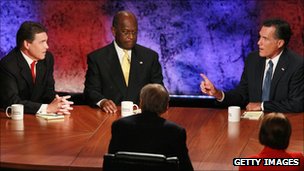 Republican presidential candidates discussed the economy during a televised debate in the state of New Hampshire.
Former Massachusetts Governor Mitt Romney defended Wall Street bailouts and attacked Mr Obama's healthcare law.
Many candidates focused their attacks on Mr Romney, who is a frontrunner in the race.
He received a high-profile endorsement from New Jersey Governor Chris Christie hours before the debate.
Mr Christie was flanked by Mr Romney in New Hampshire as he praised his experience as a businessman and elected leader.
Cain attacked
Correspondents say the donors who had been poised to help fund a Christie White House campaign will now funnel their money to Mr Romney.
Tuesday's debate was seen as a big test for Texas Governor Rick Perry, after criticism of his performance in previous debates and on the campaign trail.
Mr Perry argued the government should open up further domestic energy production.
He said the US must "pull back those regulations that are strangling American entrepreneurship".
Former pizza company executive Herman Cain repeatedly called for replacing the US tax code with a 9% national sales tax and a 9% levy on personal and corporate income.
Candidates at the roundtable criticised Mr Cain's signature "9-9-9" plan.
"I thought it was the price of a pizza when I first heard it," joked Jon Huntsman, the former governor of Utah.
Former Speaker of the House Newt Gingrich spent his evening attacking Obama administration officials and members of Congress, who he said had botched the response to the 2008 financial crisis.
He blamed Federal Reserve Chairman Ben Bernanke for the recession and called for him to be fired.
While Mr Romney joined his rivals in attacking Mr Obama's healthcare law, he sounded a different note on the response to the financial crisis.
Mr Romney said the 2008 bailout of Wall Street banks had been essential to preserving the nation's currency and financial system from collapse.
"Action had to be taken," said Mr Romney. "Was it perfect? No."
The nation was on a precipice, Mr Romney said, "and we could have had a complete meltdown".
Perry's poll woe
The former Massachusetts governor was widely judged to have beaten Mr Perry in the last Republican television debate, in Orlando, Florida.
Mr Perry became the frontrunner in the Republican field after declaring his candidacy in August, but his lead has proved fragile.
A poll released on Monday gave Mr Romney 38% of support among Republicans in New Hampshire, one of the first states to vote for the party's White House nominee.
Businessman Herman Cain was second on 20%, while Mr Perry trailed in sixth place with only 4%, according to the survey by Harvard and St Anselm's College.
Mr Perry has been attacked by conservative Republicans over his 2007 order mandating vaccinations for Texas schoolgirls against a sexually transmitted infection that causes cervical cancer.
He has also come under fire for backing in-state tuition for the children of immigrants who entered Texas illegally.
Source:BBC