
Plane from New York crashes at Guyana airport
A plane has crashed and broken in two on landing at Guyana's main airport in the capital, Georgetown, causing injuries but no deaths.
The Caribbean Airlines Boeing 737-800 flight BW-523 from New York had 163 people aboard.
The plane apparently overshot the runway at Cheddi Jagan International Airport during wet weather.
"It's an absolute miracle that took place today," said Caribbean Airlines chairman George Nicholas.
A few passengers sustained bruises, with one suffering a broken leg.
The plane halted near a 200-ft (61-m) ravine that could have resulted in dozens of deaths, Guyana's President Bharrat Jagdeo said.
"We are very, very grateful that more people were not injured," Mr Jagdeo added, quoted by AP news agency.
There were 157 passengers and six crew aboard the plane when the accident occurred at 0132 local time, according to a statement from Caribbean Airlines.
The plane had made a stop in Trinidad en route from New York.
Rescuers struggled in the dark to free passengers from the wreckage.
A woman quoted by Guyana's Kaieteur News service described hearing a loud sound when it landed in Guyana, and said everyone began screaming.
"It was terror," she said. "I was praying to Jesus."
Her husband opened the emergency door and passengers began escaping, she added.
Another passenger, 42-year-old Adis Cambridge, said: "I realised that everything was on top of me, people and bags. I was the second to last person to get off that plane in the dark.
"I hit my head on the roof. It was so scary."
She and other passengers described jumping first onto the wing and then down onto a track below to escape.
Geeta Ramsingh, 41, of Philadelphia, quoted by AP, said passengers applauded as the plane landed, but applause quickly "turned to screams".
"The plane sped up as if attempting to take off again. It is then that I smelled gas in the cabin and people started to shout and holler," she said.
"I am in pain, but very thankful to be alive."
Ms Ramsingh said a taxi driver reached the crash site before rescuers and asked for $20 to drive her back to the terminal.
"I had to pay, but in times of emergencies, you don't charge people for a ride," she said.
Kristopher Kimlin, who was not on the crashed plane but was trying to fly out of the airport, told BBC News there was "chaos" after the crash.
"The airport is simply not set up to deal with this kind of situation - they were overwhelmed," he said.
"There were queues of people around the entire terminal building and out of the door. There were maybe 1,000 people.
Caribbean Airlines, which is majority-owned by Trinidad and Tobago with Jamaica holding a minority stake, does not have a history of serious safety problems.

Panama police seize more than half a tonne of heroin
Police in Panama have seized more than half a tonne of heroin - one of the biggest ever drug hauls in the country's history, officials say.
Officers found hundreds of plastic packages of the drug in a car in the remote Caribbean coastal town of Jobea.
The packages were ready to be shipped to other countries, the country's anti-drugs prosecutor said.
Gangs are increasingly using Central America to traffick drugs from South America to the US and Europe.
Announcing the heroin seizure on Monday, Javier Caraballo, Panama's anti-drugs prosecutor, said the consignment was put at 639kg.
Three people were arrested in the operation, which took place in the province of Colon at the weekend.
Mr Caraballo said another police operation near the capital, Panama City, had netted an estimated 468kg of cocaine.
So far this year, Panamanian officials have seized 22 tonnes of drugs originating in South America and destined for the US and Europe, Panamanian newspaper La Prensa reports.
The UN's latest World Drug Report says that in 2009, drugs seizures in Panama were the third largest in Latin America and the Caribbean, put at 53 tonnes.
Gun & Ammunition Also Seized From SailBoat
The Bermuda Police confirmed today [Aug.2] that in addition to seizing a “substantial amount” of drugs from a sailboat yesterday, they also found a firearm and ammunition on the boat.
Police said that the Latvian man they arrested had diverted to Bermuda after experiencing mechanical problems with his boat while traveling to Europe, and investigations suggest the shipment of illegal drugs was not destined for Bermuda. The 24-year-old man is expected in court in due course.
Police and Customs officers descended on McCallan’s Wharf in St. George’s at approximately 2pm yesterday, searching the sailboat and removing numerous bags it.
Today a police spokesperson said, “The Bermuda Police Service in conjunction with HM Customs can confirm that a 24 year old Latvian man is in police custody after a significant amount of illegal drugs, a firearm and ammunition was seized from his sailboat.”
“The 24 year old man diverted to Bermuda after experiencing mechanical problems with his boat while traveling to Europe. Investigations conducted thus far suggest that this shipment of illegal drugs was not destined for Bermuda, however this seizure is another good example of cooperation between overseas law enforcement agencies as well as local agencies.”
“A court appearance for the 24 year old man is expected in due course.”
Norway attacks: Breivik makes 'unrealistic' demands
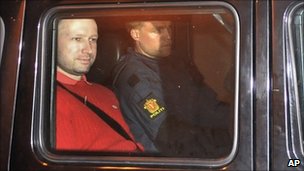 The man who has confessed to killing 77 people in Norway has made a list of "unrealistic" demands, his lawyer says.
Anders Behring Breivik wanted the government to resign and Japanese specialists to assess his mental health, Geir Lippestad told reporters.
The far-right extremist admits killing eight people with a bomb in Oslo and shooting dead 69 on Utoeya island.
Meanwhile, the leader of the right-wing Progress Party has warned that Norway still faces a serious Islamist threat.
"All the debates that we had prior to 22 July will come back. All the challenges that Norway was facing and the challenges that the world was facing are still there. Al-Qaeda is still there," Siv Jensen told the AFP news agency.
"The new thing is that we have been in a horrible way reminded of the fact that terrorism can come in many different forms, with different rhetoric behind it, with different crazy ideas behind it."
Ms Jensen also said in another interview that the anti-Muslim views of Mr Breivik, who was a member of the Progress Party between 1999 and 2006, were "perversely unique" and that it was not aware of his plans.
"It was impossible for us to foresee at the time. He obviously changed in recent years without anyone knowing," she told the Associated Press.
Mr Breivik blames the governing Labour Party for increased immigration in Norway. Its youth wing was on Utoeya for a summer camp when the attack took place, while the bomb was set-off near government buildings.
'Impossible'
Mr Lippestad said Mr Breivik's list of demands was "far from the real world" and "completely impossible to fulfil" and showed "he doesn't know how society works".
"His demands here includes the complete overthrowing of both the Norwegian and European societies," he told the Associated Press. "But it shows that he doesn't understand the situation he's in."
The 32-year-old had linked his demands to his willingness to share information about other alleged terrorist cells, Mr Lippestad said.
Norwegian police have previously cast doubt on Mr Breivik's claims that he was part of a broader network but said they would investigate them.
A court has appointed two psychiatrists to try to examine Mr Breivik's actions, with a mandate to report back by 1 November.
Mr Lippestad said Mr Breivik had asked that he also be examined by Japanese mental health specialists as he believes "the Japanese understand the idea and values of honour" and would understand him better than Europeans.
The lawyer has previously said his client is probably insane.
Mr Lippestad added that a second list from his client requested items like cigarettes and civilian clothes.
Terrorism charges
Mr Breivik has been charged under the criminal law for acts of terrorism. The charges include the destabilisation of vital functions of society, including government, and causing serious fear in the population.
At a court appearance on 25 July, Mr Breivik admitted carrying out the attacks but did not plead guilty to the charges. He was remanded in custody for eight weeks, with the first four to be in solitary confinement.
The attacks on 22 July traumatised Norway, one of the most politically stable and tolerant countries in Europe.
The government plans to set up an independent "July 22 Commission" to examine the attacks, including investigating whether police reacted too slowly to the shootings at Utoeya.
Spain PM postpones holiday as debt fears hit record
Spain's Prime Minister Jose Luis Zapatero has been forced to postpone his holiday as investors continue to flee his country's debt.
Mr Zapatero had been due to leave for south-west Spain.
But on Tuesday, the yield on Spanish bonds reached 4.04 percentage points more than German debt - a record since the euro was introduced in 1999.
The so-called premium to hold Italy's debt also hit a record.
"The prime minister has postponed the start of his holidays," Mr Zapatero's spokesperson said. "He is keeping an eye on the international economic situation."
The latest spike in yields comes at a bad time for the Spanish government, which plans to raise as much as 3.5bn euros ($5bn, £3.1bn) in a bond auction on Thursday.
On Tuesday, the euro reached a record low against the Swiss franc. The currency is usually considered a so-called safe haven in times of turmoil.
Higher costs
Despite another bailout for Greece last month, the eurozone is struggling to contain fears that more countries will not be able to repay their enormous debts.
The Irish Republic and Portugal have both been bailed out, and Greece has been rescued twice.
And as the bond yields rise, Italy and Spain have seen their borrowing costs rise sharply in recent weeks.
Italy's 10-year bonds rose above 6% on Tuesday - a rate considered unsustainable.
The premium over the equivalent German debt also reached a record spread of 3.74 percentage points.
Italy has the largest sovereign debt of any European country.
As a percentage of output, Italy's debt is second only to Greece in the eurozone - whose huge debts have led to two bailouts.
Representatives from the Italian central bank and stock regulator Consob were set to hold discussions on "the sovereign debt market situation and implications for the banks and the economy".
As their countries' bond yields rise, it becomes more expensive for governments to sell more debt, which leads to a vicious circle as the old debt comes due for repayment.
On Tuesday, Germany - the biggest economy in Europe - saw its bond yield drop below the inflation rate for first time since reunification.
This suggests that investors are now so scared, they are willing to sacrifice a return on their investment to hold the least risky bonds in Europe.
US to avoid default as Senate backs debt ceiling rise
The US Senate has passed a deal struck between Republicans, Democrats and President Barack Obama to increase the US debt ceiling and avert a default.
The bill passed the Senate by 74 votes to 26. Mr Obama is due to speak shortly and then sign the deal into law.
The bill raises the debt limit by up to $2.4tn (£1.5tn) from $14.3tn, and makes savings of at least $2.1tn in 10 years.
The deal was struck after months of fierce negotiations between the White House and lawmakers of both parties.
The vote came roughly 12 hours before Washington was due to run out of time. Without a deal to raise the debt ceiling the US would be unable to meet all its bills, according to the US treasury department.
Before the vote, Senate Republican leader Mitch McConnell praised the direction of the legislation, saying Congress had "engaged in an important debate" in recent weeks.
"The push-and-pull people saw in Washington this week was not gridlock, it was the will of the people working itself out," Mr McConnell said.
"Together, we have a new way of doing business in Washington," he added.
Senate Majority Leader Harry Reid spoke after Mr McConnell, saying that though debt deal was not perfect, the US needed to avert the financial disaster that would have been caused by a default.
The legislation passed in the House of Representatives by a clear majority on Monday evening.
Triggers in place
The deal, hammered out over the weekend after weeks of feverish speculation, raises the debt limit by up to $2.4tn (£1.5tn) from $14.3tn, and makes savings of at least $2.1tn in 10 years.
In a key point for President Obama, the bill would raise the debt ceiling into 2013 - meaning he would not face another congressional showdown on spending in the middle of his re-election campaign next year.
The compromise deal deeply angered both right-wing Republicans and left-wing Democrats.
Liberals have been unhappy that the plan relies on spending cuts only and does not include tax rises, although Mr Obama could still let Bush-era tax cuts for the top brackets expire in January 2013.
House Republicans were displeased that the bill did not include more savings.
Announcing the deal on Sunday evening, President Obama said that, though it was not the one he would have preferred, it was a "serious down-payment" on the US deficit.
The deal would enact more than $900bn in cuts over the next 10 years.
It would also establish a 12-member House-Senate committee charged with producing up to $1.5tn of additional deficit cuts over a decade.
Economists have said that failure to pass the debt deal would have shaken markets around the globe.
Fall in US consumer spending fuels economic worries
US consumers cut their spending in June for the first time in almost two years, according to new data.
They also saw their incomes grow at the smallest pace for nine months, fuelling further concerns about economic growth.
The US Department of Commerce said spending fell 0.2% in June, while incomes rose 0.1%.
Paul Dales, of Capital Economics, said it was a further sign that any economic rebound "will be more modest than previously looked likely".
Figures released last week showed that the US economy grew at a modest annual rate of 1.3% in the second quarter of the year.
Higher energy prices and unemployment have squeezed household budgets.
The economy added just 18,000 net jobs in June, the smallest rise in nine months. Meanwhile, unemployment in June rose to 9.2%, the highest rate so far this year.
Barclays profits fall by a third
Barclays has reported pre-tax profits of £2.6bn for the first six months of the year, down 33% from last year.
The bank also said it aimed to cut at least 1,400 more jobs in 2011, having cut 1,400 posts already this year.
The fall in half-year profits was partly caused by a £1bn provision for settling claims of mis-selling of payment protection insurance (PPI).
However the bank reported a big drop in bad debts and said it was on course to meet targets for UK business lending.
Share rise
Charges for bad debts fell 41% on last year to £1.8bn as the bank managed its exposure to troubled eurozone economies such as Spain and Portugal.
Most of Barclays' profits come from its investment banking division, Barclays Capital, which includes parts of the former US bank Lehman Brothers.
Adjusted profits at this division fell 9% to £2.3bn due to lower returns from investments in bonds and commodities.
The euro debt crisis reduced fixed income trading across the industry. With developed economies also growing slowly the results were better than forecast.
"BarCap had a relatively strong quarter compared to its peer group," said Mike Trippitt from Oriel Securities.
Underlying profits - which exclude the one-off £1bn charge for PPI - across Barclays as a whole were up 24% from a year ago to £3.7bn.
Barclays shares were up 4.5% at lunchtime on Tuesday.
Job losses
The bank said it was looking to cut costs to boost profits in future.
Chief executive Bob Diamond said 1,400 jobs had been cut during the first six months of the year across its operations.
"You should assume this trend will continue and increase somewhat," he said.
Barclays currently employs more than 147,000 staff around the world.
On Monday, rival HSBC announced it would cut 25,000 jobs by 2013 as part of its own efforts to cut costs. It had already announced 5,000 job cuts.
Lending targets
Despite the reduced profits, Mr Diamond said he was pleased with the results in what he called a "lacklustre" economic environment.
He said the bank was fulfilling its deal with the government to lend to UK businesses.
"We are meeting our Project Merlin commitments and have extended £20bn of new lending to businesses in the first half," he said.
That included £7bn of lending to small- and medium-sized firms.
IMF details risks to UK economic growth
The International Monetary Fund says there are still "significant" risks to inflation, growth and unemployment in the UK.
In its latest assessment of the UK, the IMF said growth would be 1.5% this year - less than the government expects.
It backed the current austerity measures as "appropriate" to the present economic conditions.
However, it warned the government may need to react to new economic problems such as falling house prices.
The Office of Budget Responsibility had forecast 1.7% growth for 2011.
In its most likely "central scenario", the international financial regulator and lender predicted inflation would fall from 5% in 2011 to 2% by the end of 2012, while growth would accelerate to 2.5%.
Contagion fear
But the IMF warned that there was "substantial" uncertainty about this scenario.
The impact of spending cuts, higher prices for commodities such as oil, economic "turmoil" in the eurozone and falling house prices could throw the economy off course.
The report warned that the ratio of house prices compared with average earnings was still 30% above its historical average - meaning prices could fall, so limiting consumer spending.
It also estimated that the UK banking system had $178bn (£111bn) worth of loans to the three most troubled eurozone economies, Greece, the Irish Republic and Portugal - 25% of the total capital held by UK banks in the first quarter of 2011.
Continuing uncertainty about the ability of these countries to pay their debts therefore poses significant risks to the UK financial system.
If these risks materialised and growth stalled, "significant loosening of macroeconomic policies" would be required, it said.
This could include tax cuts to boost spending.
The IMF also suggested the Bank of England might need to return to quantitative easing - the process of increasing the amount of credit available in the economy.
However, should growth be better than expected, the IMF suggested that the Bank of England may have to increase interest rates to control inflation.
'Hold the course'
"We know we're in for a choppy time. What I think is important is that we stick to our course. That we continue to reduce the deficit," said the Conservative Financial Secretary to the Treasury, Mark Hoban.
He said government policy to encourage manufacturing while cutting the deficit had been endorsed by the IMF.
The opposition Labour party, however, blamed government spending cuts for the slowdown in growth.
"The government have missed every target they've set on relation to growth so far, they've missed their growth targets completely," said Labour shadow treasury minister David Hanson.
The report supported measures to limit the risk of collapse in the UK's banking and financial system, but said risks remained.
It also called for improvements in financial reporting, where it said the UK remained less advanced than other developed economies.
Ambassador: US Not Against Mugabe’s Party
The U.S. ambassador to Zimbabwe says the United States is not against the party of President Robert Mugabe, which it has accused of human rights abuses.
In a speech on U.S.-Zimbabwean relations, Ambassador Charles Ray said “the U.S. does not favor one party over another in Zimbabwe.”
He said the U.S. is “not anti-ZANU-PF,” and recognizes the party's achievements for the good of Zimbabwe's people.
But Mr. Ray said the U.S. believes other parties, including the former opposition Movement for Democratic Change, have critical roles to play in Zimbabwe's future.
He also said the United States wants to see non-violent and credible elections in Zimbabwe where the people's will is honored.
In its most recent human rights report, the U.S. State Department said ZANU-PF supporters use beatings, intimidation, and arbitrary arrests to abuse and harass political opponents and obstruct their activities.
It also said the party has repeatedly violated the Global Political Agreement, the basis of the current unity government.
ZANU-PF and the MDC formed the unity government after the disputed 2008 elections, which observers said were seriously marred by violence, most of it committed by ZANU-PF supporters.
Ambassador Ray made the remarks in Harare last Thursday. His speech was posted this week to the website of the U.S. embassy in Zimbabwe.