
Ameriie is Now Married
R&B/pop singer Ameriie got hitched to her longtime boyfriend, former Columbia Records executive Lenny Nicholson on Saturday. They announced their engagement last year
And just where did the couple tie the knot, you ask? That would be Anguilla in the British West Indies, reports People.
“This is such an exciting time for me. This is my first marriage and I am over the moon,” Ameriie — who added the extra i in her name last year — told the magazine. “I look forward to a loving and enduring marriage. This day couldn’t come any sooner for me.”
People says the bride, 30, wore a dramatic Monique Lhullier gown with a cathedral train, along with baby blue Yves Saint Laurent Tribute sandals, while the groom was decked out in a Hugo Boss tuxedo.
Specifically, the wedding and reception were held at the Viceroy Anguilla which is also where the couple will spend their honeymoon relaxing at the resort’s 5,000 sq. ft. Romance Villa and its accompanying private beach.
Ameriie’s fifth studio album, “Cymatika Vol. 1,” is slated for a Spring 2012 release.

Snoop Dogg to be Honored with BMI Icon Award at 2011 BMI Urban Awards
Snoop Dogg will be saluted as a BMI Icon at the BMI Urban Awards, slated for Friday, August 26 at the Pantages Theatre in Hollywood. BMI President & CEO Del Bryant will share hosting duties with Catherine Brewton, Vice President, Writer/Publisher Relations, Atlanta, as the entertainment community gathers to celebrate the most-performed urban songs, songwriters and producers of the previous year.
The evening will include an all-star musical tribute to Snoop Dogg, as well as the presentation of the Urban Songwriter, Song, Producer and Publisher of the Year crystals.
BMI Icons are selected because of their “unique and indelible influence on generations of music makers.” As a BMI Icon, Snoop Dogg will join ranks that include George Clinton, The Jacksons, James Brown, Isaac Hayes, Little Richard, Chuck Berry, The Bee Gees, Willie Nelson and Carlos Santana, to name a few.
As Snoop Dogg approaches his 20th year in the entertainment industry, he remains a visionary mc with sharp instinct and velvet delivery. Since his culture-shaking 1992 debut, Doggystyle, his sound has engrossed listeners—those who recognize their own lives in his songs, and others simply drawn to Snoop Dogg’s authenticity. He is a fiercely imaginative songwriter, capable of cutting rhymes and wry wordplay.
Twelve BMI Awards spanning urban and pop point to his prominent role in hip-hop’s seduction of the mainstream. Songs including “Next Episode,” “Gin and Juice,” “Drop It Like It’s Hot,” “Beautiful,” “Sexual Eruption,” “Nuthin’ But a “G” Thang,” and so many more created the soundtrack of a generation. He has been honored by the American Music Awards, Source Awards, BET Awards, MTV Video Music Awards, and many others, and has also garnered innumerable Grammy nominations. He has also appeared in countless films and TV series, including Training Day, Old School, Starsky & Hutch, Brüno, Futurama, Weeds, and more, which, when coupled with his music, ensure that Snoop Dogg will be forever ingrained in pop culture’s collective consciousness.
Jimmy Henchman Denied Bail: Found With Fake IDs
Jimmy “Henchman” Rosemond has been caught and is now pleading not guilty in response to a drug trafficking charge.
The always-in-trouble music executive had been on the run for a month. He was finally apprehended in New York City on Tuesday and won’t be released.
The manager and CEO of Czar Entertainment is being accused of leading a coast-to-coast drug organization, which transported cocaine and other drugs between L.A. and New York.
His lawyer Jeffrey Lichtman is claiming the case has no merit.
“This indictment was built on the backs of witnesses that have been threatened and bribed by federal prosecutors. And I plan to expose all of it. If the government wants a fight, they’re going to get a fight,” he told the Wall Street Journal.
But Rosemond isn’t making things better. When he was arrested, authorities found him in possession of a “fugitive kit” consisting of five blackberries, two fake driver licenses and an iPad. The judge denied him bail.
Prosecutors stated at the arraignment Tuesday that Rosemond purchased a plane ticket to the Bahamas and was in the middle of obtaining a fake passport. He was scheduled to leave June 24.
In addition to his drug troubles, the CEO is also being blamed for hiring a “hitman” to assassinate or scare (the motive is unknown) Tupac in 1994.
Cee Lo Green Leaves Rihanna’s ‘LOUD’ Tour
According to Billboard, Cee Lo Green says he’s leaving the tour due to his commitments as a judge on the NBC reality TV show “The Voice,” as well as working on a new album and writing a book.
“He always puts 100 percent into his work and with the requirements and time commitment to ‘The Voice,’ on top of heading back into the recording studio and an upcoming book,” a statement from Green’s publicist said. “He feels that he wouldn’t give his fans the show that they deserve.”
Coincidentally, Green’s performance on the show was called into question by a Minnesota based critic which cased him to respond with what was thought of as a homophobic response via Twitter. After the resulting firestorm, Green apologized to Andrea Swensson.
Reportedly rappers J. Cole and B.o.B. will continue on the tour with Rihanna.
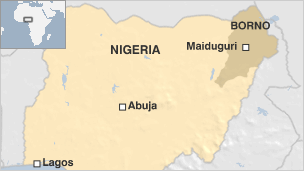
Deadly bombing in north Nigeria
A bomb attack in the north-eastern Nigerian town of Maiduguri has killed at least 25 people and wounded dozens, officials say.
They say they believe the attack, which occurred in a beer garden, was carried out by the Islamic sect Boko Haram.
The group believes Muslims should withdraw from Western society.
It has claimed a number of bombings in north-eastern Nigeria, as well as an attack on police headquarters in the capital Abuja earlier this month.
Two men on motorcycles attacked a packed beer garden late on Sunday, officials said.
"The attackers believed to be Boko Haram members threw bombs and fired indiscriminate gun shots on a packed tavern at Dala Kabompi neighbourhood, killing at least 25 people and seriously injuring around 30 others," a police officer told the AFP news agency.
Eyewitnesses Emmanuel Okon told AFP: "I just heard a loud bang followed by sporadic shootings and plumes of black smoke filled the area with people screaming and running in all directions."
Boko Haram has recently carried out a wave of attacks targeting police, mainly in the north-eastern state of Borno.
Earlier this month, the group said it was behind the bombing of the national police headquarters in the capital, Abuja.
The group's trademark has been the use of gunmen on motorbikes.
Its leader Mohammed Yusuf and several hundred of his supporters were killed by security forces in Maiduguri in 2009 after the group attacked police stations.
Trial of 4 Top Khmer Rouge Leaders Opens in Cambodia
Cambodia's U.N.-backed war crimes tribunal has opened the trial of the top four surviving leaders of the brutal Khmer Rouge regime, accused of genocide and other atrocities in the late 1970s.
The defendants are Khieu Samphan, 79, the nominal head of state; Nuon Chea, 84, described as the Khmer Rouge's ideologue; Ieng Sary, 85, the foreign minister; and his wife, Ieng Thirith, 79, who was minister of social affairs. All have denied the charges against them.
The day's proceedings were devoted to procedural issues, with the presentation of evidence and testimony not expected to begin for several weeks. The trial is expected to last for years, raising concerns about whether the elderly defendants all will live to see it end.
In its only previous case, the court last year convicted Kaing Guek Eav, who ran the main prison and torture house of the Khmer Rouge. He was given a term of 35 years, which was reduced to 19 years.
As many as 2 million people are believed to have been executed or died from disease and overwork under the Khmer Rouge regime.
US Official: China’s Military Expansion Raises Concerns in Asia- Pacific
A top U.S. official for East Asian and Pacific affairs says the U.S. government has conveyed to China that its military expansion is raising concerns in the region.
U.S. Assistant Secretary of State Kurt Campbell spoke to reporters in Honolulu, after a meeting with Chinese Vice Foreign Minister Cui Tiankai.
The two officials held their first round of consultations on the Asia-Pacific region in a closed-door meeting Saturday.
Campbell described the discussions as “open, frank and constructive” and said their goal was to obtain a better understanding of each other's intentions, policies, and actions toward the region.
Campbell said the United States reiterated that it welcomes a strong, prosperous, and successful China that plays a greater role in regional and world affairs. However, he also said greater transparency and more dialogue by China about its growing military capabilities would help ease regional concerns.
Campbell said the bilateral talks also included North Korea's nuclear weapons program, maritime security in the South China Sea and Burma.
The two sides say that Saturday's consultations were an outcome of the third round of the China-U.S.. strategic and economic dialogue held in May and that they reflect a consensus reached by U.S. President Barack Obama and his Chinese counterpart Hu Jintao to build a positive, cooperative and comprehensive relationship
Campbell said that upcoming multilateral sessions should highlight areas where the United States and China — but other countries, as well — are able to very clearly articulate areas of cooperation on issues such as disaster preparedness.
On North Korea, he reiterated that the United States is looking for concrete progress in Pyongyang's relations with South Korea. He said the U.S. has urged China again to press North Korea to deal responsibly and appropriately with South Korea, and to refrain from any further provocations.
On South China Sea tensions, he said the United States told China that it wants an end to regional tensions and dialogue among all the key players.
China last week warned the United States to stay out of the regional dispute over the South China Sea waters which are also claimed by the Philippines, Vietnam and Taiwan.
Palestinians to Seek UN Recognition in September
The Palestinian Authority says it will go to the United Nations in September and ask for recognition of an independent state in the West Bank, Gaza Strip and East Jerusalem, a move opposed by both Israel and the United States.
The official Palestinian news agency said Sunday that leaders in Ramallah confirmed they will seek recognition based on pre-1967 borders, membership in the United Nations and acknowledgment of the right to self-determination in accordance with the U.N. charter.
Israel has denounced the Palestinian U.N. initiative, charging it would shatter efforts to reach a negotiated settlement to the Mideast conflict. The U.S., Germany and Italy have also expressed reservations.
Many Palestinians, however, claim the move would strengthen efforts to renew negotiations with Israel based on the Arab Peace Initiative, the Mideast Quartet decisions as well as U.S. President Barack Obama's Mideast vision which he recently outlined.
About 100 nations have already recognized a Palestinian state in one form or another and a formal vote for recognition at the U.N. General Assembly would be a diplomatic victory. But only the U.N. Security Council has the legal power to add nations to the world body.
Bank of England calls for audit of eurozone crisis risk
 The Bank of England's new financial policy committee (FPC) has called for an audit of UK banks' exposure to the eurozone debt crisis.
The Bank's governor Sir Mervyn King said the debt problems of Greece and other countries posed "the most serious and immediate risk" to UK banks.
The FPC also called for banks to divert their profits towards building up their reserves against future losses.
Prime Minister David Cameron welcomed the committee's suggestions.
"Every bank needs to make absolutely clear what its exposure is," he said following a European Council summit in Brussels.
"We need to make sure all our banks are being strengthened in terms of their capital reserves and what they can withstand."
UK lenders need to build up their capital buffers as part of the Basel III international agreement, which was designed to ensure that all banks worldwide are better able to withstand another financial crisis.
Sir Mervyn said that by paying out less of their profits to shareholders and employees, the banks could rebuild their capital without having to cut back on lending.
In the conclusions of its first meeting, the committee asked the soon-to-be-replaced Financial Services Authority (FSA) to ensure that the banks it supervises comply with the recommendation.
Tangled web
Regarding the eurozone, the Bank governor said that while UK banks may not have lent very much directly to Greece and other troubled economies, they were still at risk of financial contagion.
"The direct exposures of UK banks to Greece are really remarkably small," he said in response to a question at the press conference.
But he said that British banks may be exposed to other lenders who may get into trouble if they were to suffer big losses on their loans to distressed eurozone countries.
The FPC said that all banks, big and small, should be permanently required to report more thoroughly their exposures to different countries.
"There is always uncertainty about the scale of exposures, which counter-parties out there are the ones which are heavily exposed," he explained.
He said this can lead to a crisis of confidence in the banks, because lenders cannot untangle the web of risk exposures involved.
'Gift'
Sir Mervyn also queried whether the emergency loans being arranged for Greece would do much to save it from default.
"Simply the belief that we just lend a bit more will never be [an] answer [to a question] which is essentially one of solvency," he said.
He said that a country such as Greece, that had more debts than it was able to repay, had two options.
"One is to receive gifts or transfers from other countries," he said - something that goes well beyond the loans being discussed with European counterparts.
The Bank governor did not specify whether a default by Greece on its debts might also constitute such a "gift", provided by Greece's existing lenders.
The second option was improving competitiveness to enables the "current account deficit to be turned into a surplus".
Many economists have said that the most obvious way for Greece to do this is by leaving the euro and allowing its currency to devalue.
Opaque
Among the committee's other recommendations was that the FSA carry out a more extensive review of whether the banks have set aside enough money to cover possible losses on their lending and how much debt relief they are granting customers.
The FPC also raised a warning flag over "exchange-traded funds" or ETFs.
Sir Mervyn said that many of these funds - which are traded on the stock exchange and offer investors the return on an index or portfolio of investments - were opaque.
Speaking at the same press conference, Hector Sants, who runs the FSA, questioned whether "synthetic ETFs" - which use financial derivatives to make their investments - were appropriate for ordinary individual investors.
Conrad Black ordered back to prison
A US judge has resentenced former media tycoon Conrad Black to 42 months in prison for fraud and obstruction. He is likely to serve just 13 months because of time already served.
The Canadian-born British peer was convicted in 2007 of defrauding shareholders in media holding company Hollinger of $6.1m (£3.8m).
He was freed in 2010 after the US Supreme Court court found an anti-corruption law unconstitutional.
The court let two other charges stand.
In Chicago on Friday, US District Court Judge Amy St Eve ruled that when Black was released in July, more than two years into a six-and-a-half year term, he had not yet served enough time in prison to remain at liberty.
'Greed and lies'
But she rejected prosecutors' request to sentence him to the same term once again. Imposing that sentence again would have left Black with about four-and-a-half more years to serve.
"He fails to acknowledge his central role in destroying Hollinger International through greed and lies, instead blaming the government and others for what he describes as an unjust persecution," prosecutors said recently.
Black, 66, once controlled a media empire that included the Daily Telegraph in the UK, the Chicago Sun-Times and other newspapers in the US and Canada.
But in 2007, he and three other Hollinger International executives were convicted of defrauding shareholders of $6.1m.
Prosecutors said Black defrauded investors by paying himself a tax-free bonus from the sale of newspaper assets without the approval of the company's board.
Black's convictions rested partly on the idea that he had deprived Hollinger of his honest services as a corporate officer.
In June 2010, the US Supreme Court found that "honest services" law unconstitutionally vague, ruling the law could apply only to cases where bribes and kickbacks had changed hands.