Joe, Beenie Man, Sky bring fitting close to CFW
As R&B singer Joe strutted down the runway like a model, so too did he easily stroll into the hearts of the women at the National Indoor Sports Centre.
The singer appeared on the runway after 11 p.m. on Sunday night as the featured artiste at Pulse's Caribbean fashionweek. Joe, headlining International Night at the event looked debonair in a suit and had the women in the audience screaming, as they ran to get a closer look at the singer. He started with Baby Where You At and continued strumming at heart strings with If I Was Your Man before going into Late Last Night. As he walked from one end of the runway to the next, the ladies followed, walking on the sidelines.
As he sang hits such as More and More and I Wanna Know persons sang along word-for-word, nearly drowning out his vocals.
Female fans closest to the stage were the luckiest, as he drew one and two into an embrace or slow dance. For his last number, he went on the mini stage, whipped out his guitar and played. In closing he commented, "Jamaica is one of my favourite places in the world. I love the culture, you guys are beautiful."
Prior to Joe, entertainment was provided by the likes of Cen'C Love and model-turned-actress-turned-artiste Nicole 'Sky' Grey.
Grey premiered her debut single and video for Lollipop. After the video was played she followed with a short performance.
King of the dancehall, Beenie Man, made his appearance as part of the Everblazing collection. The 'doctor' modelled an item from the Everblazing line before reappearing for a brief performance.
Although the stage was smaller than what Beenie Man is used to, the artiste easily showcased why he is a master performer.
Getting the crowd off their feet and waving their hands, Beenie performed his Rum and Redbull, new single Inna Di Go-go Club and older hits.
Fashion for the night was sexy and young with designs from the likes of Rebel Unit, Minka, Heights International, Earl 'Biggy' Turner, United Kingdom designer Gavin Douglas, Attitude, which had an eye-catching selection, and Italian collection, Everblazing.
White House: US 'can act in Libya without Congress'
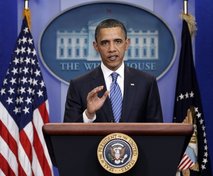
President Barack Obama does not need congressional approval for the US to continue its role in the Nato-led Libya mission, the White House has said.
In a 32-page document, the White House said the president already had legal authority to order forces into Libya.
A Vietnam War-era law states Congress must authorise participation in hostilities longer than 60 days.
Members of Congress have accused Mr Obama of violating that law since 20 May, when the 60-day deadline ended.
'Limited nature'
In the report delivered to Congress on Wednesday, the White House argues that US forces involved in the Nato campaign are merely playing a supporting role.
That role, the White House says, does not match the definition of "hostilities" as described under a 1973 law that constrains the US president's ability to wage military conflict.
"The president is of the view that the current US military operations in Libya are consistent with the War Powers Resolution and do not under that law require further congressional authorization," the White House wrote.
"US military operations are distinct from the kind of 'hostilities' contemplated by the resolution's 60-day termination provision," it added.
The US role in Libya involves helping Nato aircraft with refuelling operations and assisting with intelligence-gathering, the White House says.
The Obama administration insists that the US is not engaged in sustained fighting or "active exchanges of fire with hostile forces" that put US troops at risk.
Under the US constitution, the power to declare war lies with Congress.
If the president orders the US military into a conflict without an explicit declaration of war, the War Powers Resolution requires him to seek authorisation from Congress within 60 days or to end US involvement in the conflict.
The law allows the president to extend the period before going to congress for another 30 days.
'Illegal policies'
Sunday marks 90 days since the US joined the Nato-led no-fly zone mission over Libya.
This week the Republican speaker of the House of Representatives, John Boehner, said "it would appear" that on that day the Obama administration would be in violation of the War Powers Resolution.
Mr Boehner said that the administration would be in breach of the resolution unless the White House "asks for and receives authorisation from Congress or withdraws all US troops and resources from the mission".
The White House rebuttal came as a bipartisan group of US lawmakers sued Mr Obama in federal court for taking military action in Libya without authorisation from Congress.
The lawsuit alleges that the president had violated the US constitution in bypassing Congress.
The lawsuit, which also targets Defence Secretary Robert Gates, challenges the policy "that any president can take the US to war unilaterally", Democratic Congressman Dennis Kucinich of Ohio said.
"We have asked the courts to move to protect the American people from the results of these illegal policies," he added.
Militants Attack Southern Yemeni Town
Several hundred al-Qaida linked militants in Yemen have raided government buildings in the southern town Houta and briefly seized key areas of the provincial capital.
The armed group, Ansar al-Sharia, or Supporters of Sharia , launched the attack before dawn Wednesday. Witnesses and medics say two security personnel were killed and at least three wounded in the fighting.
After several hours, the militants withdrew to new positions in farmlands just outside the city's southern outskirts.
The attack raises concerns of increased violence from Islamist groups throughout Yemen's restive south in the wake of ongoing anti-government protests and the absence of President Ali Abdullah Saleh. Militants seized two other southern cities in May, including Zinjibar, the capital of Abyan province. Continued fighting there has forced hundreds of civilians to flee to the port city of Aden.
President Saleh is recuperating in Saudi Arabia from injuries sustained in a bomb attack on his presidential compound earlier this month. Yemen's state-run news agency says the president told Saudi government officials by telephone Wednesday that his health was improving.
Anti-government protests continue daily throughout the country. Demonstrators have demanded that Mr. Saleh step down and are calling for a transitional council that excludes members of the current government.
On Tuesday, hundreds of thousands of Yemenis rallied in major cities. In the capital, Sana'a, a huge crowd swelled outside the home of Yemen's acting leader, Vice President Abd al-Rab Mansur Hadi – a day after Yemen's political opposition held talks with him on a possible transition plan.
Hackers Claim CIA Website Breach
A group of hackers say they breached the Central Intelligence Agency's website after it crashed Wednesday evening.
The group, known as Lulz Security, claimed credit in a Twitter message that said “Tango down – cia.gov.”
The CIA's public website experienced problems throughout the evening on Wednesday.
Lulz Security only made claims that it attacked the CIA's website and there was no evidence on Wednesday that sensitive data in the agency's internal computer network had been compromised.
A CIA spokeswoman said the agency was looking into the report.
Lulz Security has claimed responsibility for recent attacks on the websites of the U.S. Senate, Sony Corporation, Nintendo, and the Public Broadcasting System television network.
The group is believed to be compromised of members who live across the globe. It has suggested it is trying to highlight cyber security weaknesses.
DRC National Elections to be One Round
Lawmakers in the Democratic Republic of Congo passed a new electoral law Wednesday as they prepare for presidential and parliamentary elections later this year.
The new law, a revision of the 2006 electoral code, calls for the votes to be held in a single round. President Joseph Kabila says it is a cost-saving measure for a vast country whose crumbling infrastructure makes even delivering ballots a difficult task.
But opposition parties have criticized the change, which was first approved as a constitutional amendment earlier this year. More than 100 lawmakers boycotted the vote in January.
The move is seen to benefit Mr. Kabila in his expected run for a second term. He will likely face a number of candidates from opposition parties, splitting the opposition vote.
Meanwhile, voter registration is set to finish by the end of the month, but opposition parties are saying they need more time. Party officials say delays and logistical problems have meant thousands of people have not yet been able to register. One official says some registration centers have yet to enroll even one voter.
Seven opposition parties are calling for a 30-day extension, saying an incomplete voter list could undermine the credibility of the polls. The independent electoral commission says it is looking into the issue.
Extending voter registration could lead the elections, scheduled for November 28, to be pushed back as well.
These are just the second national polls since the civil war ended in 2003.
The DRC is a vast country of some 60 million people, fractured by years of war, unrest, and ethnic strife.
Analysts say that under a one-round election system, a presidential candidate could win with as little as 20 percent of the vote.
President Kabila was elected in 2006, defeating opponent Jean-Pierre Bemba in a runoff.
Haitian-Bahamian tension could lead to violence, said US diplomatic cable
The Americans are of the view that the unaddressed issue of Haitian integration in The Bahamas could eventually lead to ethnic violence in this country, according to a diplomatic cable from the United States Embassy in Nassau.
The detailed, nearly 3,500-word cable from June 2009, obtained by The Nassau Guardian from WikiLeaks, is an extensive analysis by the embassy of the tense Haitian situation in The Bahamas.
“The existence of a large, dissatisfied and poorly-integrated ethnic minority is a potential risk to social and political stability in The Bahamas,” said the embassy.
There are a wide range of estimates as to how many Haitians reside in The Bahamas. The numbers range from 30,000 to 70,000 in a country of 350,000 people.
Many Haitians live in shantytowns and the majority of these shantytowns are in New Providence. However, two of the largest are in Abaco (The Mud and Pigeon Pea).
Successive governments, for the most part, have maintained the country’s traditional policy position regarding Haitians, pushing repatriation of the undocumented and the regularization of those eligible for legal status.
This policy has not solved the problem. There are no official numbers, but many Haitian children born to parents illegally in The Bahamas are ‘stateless’. They consider themselves Bahamians, but have no legal status in this country, having not taken up the Haitian status of their parents.
The Americans consider further engagement of the Haitian community as a possible means of preventing conflict between the communities.
“The GCOB (Government of the Commonwealth of The Bahamas) would be well-served to encourage integration, as some commentators recognize, both to diffuse existing animosities and (to) avoid future manifestations of discontent,” said the cable.
“In the short term, given the economic and social pressures, GCOB anti-immigration policy is unlikely to change. As a result, well-entrenched Haitian communities are barely tolerated and the risk of ethnic flare-ups rises in proportion to economic hardship and stricter immigration enforcement. The possibility of overt inter-ethnic violence persists.”
No sustained inter-ethnic violence between Bahamians and Haitians has emerged, though Bahamians regularly express frustration, and sometimes hostility, via talk radio about the Haitian situation.
The Americans suggested that in a down economy, with increasing numbers of Haitians coming to the country and increased anti-Haitian sentiment, Haitian-Bahamian conflict could at some point emerge in various parts of The Bahamas.
“Inner-city Nassau neighborhoods are most at risk, but the potential for conflict also exists in suburbs where new subdivisions encroach on existing migrant settlements,” said the cable.
“Conflict is also possible in outlying islands, which are proportionately greater affected by demographic changes or economic deterioration, and the competition for scarce land and jobs is fiercer.”
The Haitian vote
In recent years, the Free National Movement (FNM) has publicly been ‘softer’ in its public tone towards Haitians than the Progressive Liberal Party (PLP), which has held more to the traditional policy of repatriation.
At a rally in March at Clifford Park, Prime Minister Hubert Ingraham began by reaching out to the Haitian community, acknowledging the return of the former leader of the country.
“Firstly, I want to give a shout out to my Haitian brothers and sisters and say how pleased I am that President Aristide has been allowed to return back to Haiti,” Ingraham said.
Though a casual remark, Ingraham’s reference to Haitians in The Bahamas as his “brothers and sisters” was a significant demonstration of solidarity by a Bahamian politician and leader.
The extent of anti-Haitian sentiment in The Bahamas was evident after the January 2010 earthquake in Haiti. Ingraham suspended repatriations and released Haitians being detained at the Carmichael Road Detention Centre.
Talk radio across the country was overwhelmed by those expressing anger with Ingraham’s decision.
Thus far Haitians have not organized a political lobby to agitate for their interests in The Bahamas. There are no openly Haitian representatives in Parliament.
With the large number of Haitians in the country, however, the Americans realize that they would have significant power if they came together.
“A well-organized community might already have the power to swing a close election and wield increased influence as a result. Haitians in The Bahamas, however, do not appear as yet to have the will or organizational wherewithal to risk an open challenge to the status quo,” said the cable.
“Instead, most prefer to seek integration in place while others move on to the US.”
With the large number of Haitians in the country, despite the current reluctance by them to openly enter front-line politics, sustained and open Haitian representation in Parliament going forward is inevitable.
The flow of people and discrimination
Cables on China have revealed the American concerns regarding The Bahamas being used as a transit point to smuggle Chinese to the United States.
Many of the Haitians that come to The Bahamas are smuggled into the country by Bahamians. The Americans described these smugglers as experienced.
“Migrants from poorer Caribbean countries are smuggled to or through The Bahamas, destined for the US, by well-established, island-hopping networks. Many are run by Bahamian smugglers based in Freeport, Grand Bahama or Bimini, two of the closest points to Florida shores,” said the cable.
These migrants risk their lives to come to The Bahamas, as the Americans noted. Haitians have relayed stories revealing that they have been told by smugglers to jump overboard from vessels into the sea and to swim to shore when they approach Bahamian islands. Some who could not swim drowned after paying $2,000 to $3,000 to escape the poorest country in the western hemisphere.
“Such tragic incidents highlight the desperation of the migrants and indicate that the illicit Haitian migration flow to and through The Bahamas is unlikely to stop,” said the cable.
After suffering through this ordeal, many Haitian migrants are faced with discrimination once they settle in The Bahamas.
“Bahamians strongly resent the social cost, cultural impact, and crime linked – in popular stereotypes certainly – to Haitian immigration. These sentiments are confirmed in contacts with government officials, political activists, especially the youth, and NGO leaders who interact with both communities,” the Americans observed in the cable.
“Haitians are thought to impose disproportionate demands on inadequate social services, primarily health and education, due to the higher birth rate in the Haitian community.”
These issues, the Americans observed, have the potential to explode someday in The Bahamas if constructive policies are not introduced to further integration.
Opening Statement from PNP Leader Clayton Greene to Minister Bellingham
RTC News today received the presentation from Clayton Greene as he made his presentation to Minister Henry Bellingham.
Greetings,
Let me begin by saying good morning to you all and by thanking you Minister Bellingham for agreeing to see this delegation. We continue to be hopeful that this meeting would result in a constitution that the people of the Turks and Caicos Islands, whom I together with Mr. Parnell have the pleasure of representing, can feel protects them while at the same time provides for them the best opportunity to realize their hopes dreams and aspirations.
Ministers, ladies and gentle, the United Kingdom Government and the people of the TCI have been locked in a battle that is fueled by a deep seated mistrust on both sides.
This mistrust has led to what we believe to be the deliberate alienation of able Turks and Caicos Islanders from the process of governance so much so that we have begun to question whether it is that Britain believes every Turks and Caicos Islander to be a crock that is incapable of forming a Government.
On the other had the people of the Turks and Caicos Islands are increasingly resentful of an Interim Administration whose actions not only lack transparency but are clouded in secrecy and are essentially non-participatory. We recognize that these characteristics are the antithesis of the democracy they claim to promote.
We are concerned that despite our protestations we see no intervention of the British Government or the FCO.
What we have to do now is to rebuild this trust that has broken down. It requires that the United Kingdom Government agrees to meet the people of the Turks and Caicos Islands half way and accept that they bear some of the responsibility for the present circumstances.
Foreign Secretary Hague in his March 11 Ministerial Statement speaking for the British Government said and I quote “we are determined that the situation we have found in the Turks and Caicos Islands is not repeated, there or elsewhere [and] to make sure that the ‘right controls are put in place to ensure good governance..”
The Foreign Secretary must accept that the “situation”, whatever we determine it to be, was not one that the British Government “found”. Whatever the situation, it was allowed to grow and thrive under the watchful eye of a Governor who held ultimate responsibility for Good Governance. As early as October 2003 Minister Bill Rammell, in a memorandum to the Foreign Affairs Committee of the House of Commons, recognized that the UK Government had what he termed an “over- riding responsibility for good governance in the territories...” Minister Rammell went on to suggest that in some of the smaller territories there was a lack of institutional capacity and experience to cope well with the increasing demands on Government and further that the lack of developed civil society, strong legislature, and vibrant media in some Territories meant that many of the usual checks on the Executive can be weaker than normal.
Since 2003 the British Government has done nothing to improve institutional capacity or to provide the experience that they recognized was necessary if Government was to meet the demands of an increasingly complex society.
Whitehall did nothing to develop civil society or to strengthen the legislature or to improve the media. What the British Government did was leave us on our own to fend for ourselves.
The United Kingdom Government having abdicated its responsibility cannot now cure that wrong by undertaking unilaterally to create the institutions that will help to secure Good Governance and create a more perfect Democracy and then simply invite an elected Government to work within it. We must be a part of this process and our constitution must reflect us. The institutions in this Country were created over centuries by those who came to recognize the need for checks and balances on the powers of the Executive. That continues for this Country to be a work in progress. Out of your political experiences you have over time put the institutions in place that would secure the protection of your people and the promotion of their desires.
The Constitution of the United States was put in place by men some of whom were Englishmen, who wanted to create for themselves a more perfect Union; who were seeking to resist some of the same oppressions at the hands of the British that we in the TCI complain of today and who wanted to improve upon the system of governance that obtained in imperial Britain. In America they had begun to realize, although not fully, that all men were created equal and endowed by the creator with certain inalienable rights.
The tenets of good governance and fiscal responsibility cannot be handed down but must be molded by the people of the Territory in which it operates. Minister Bellingham, the answer is elections now so that the people of the TCI can begin to build with you as equal partners a system that will serve the ideals of democracy, that will serve the principles of good governance, that will serve the people of the Turks and Caicos islands and that the people and Governments of the Turks and Caicos will serve. If we cannot have that then the relationship is not worth having.
I wish against this backdrop to be clear as to the positions that I will hold and defend over the next two days. I will defend the right of the people not to have their voting system interfered with save by referendum. As an addendum to this presentation you will find enumerated just some of the reasons why I reject the voting system that is proposed.
I will make the case for the Deputy Governor be a belonger without provisos I will reject the draft constitution to the extent that it purports to increase the powers of the Governor. That is retrogressive. The concerns that the British Administration have are not cured by increasing the powers of the Governor. We are required to learn from our mistakes. The people of the Turks and Caicos Islands have learned valuable lessons. The question is has the foreign and commonwealth office learned anything?
I do not and cannot support the notion that there need be some reference to belongership in the Constitution.
On these fundamental issues I am at one with the people of the Turks and Caicos Islands not least because these issues are so fundamental to the practice of our democracy that they ought not be tampered with save and except there is an expressed and clear will of the people that that should happen.
Failing our agreement today there ought to be on these issues a referendum
Mr. Minister I am called upon at this moment in our history to guard, protect and promote the hopes dreams and aspirations of the people of the Turks and Caicos Islands. My duty to my people is no less sacred than the identical duty that you have to the people of your Island home – that is to preserve the things that they hold dear and the things that they feel to be in their best interest. You carry out that duty today amid the increasing pressures of a large and sometimes seemingly imposing continent.
When you come to consider our requests and reflect upon our positions over the next two days we ask that you remember that small is relative and that our political system like your thrives when there exists organized and properly regulated political parties.
It now leaves me finally to thank you Mr. Minister and the members from the Foreign and Commonwealth Office my fellow Turks and Caicos Islanders who form part of this delegation and particularly my friend and counterpart Mr. Parnell for your kind attention. I wish for us all a productive two days.
Opening Statement
Meeting with Minister Bellingham
June 15th 2011
ARGUMENTS AGAINST THE IMPOSITION OF THE VOTING
SYSTEM PROPOSED IN THE DRAFT CONSTITUTION
The system proposes that 9 of the 15 members be elected on a compensation proportional basis on a national constituency while the remaining 6 members be elected from vastly unequal island constituencies. This is a hugely undemocratic prescription.
This type of proportional representation finds expression most closely in Germany and in New Zealand.
New Zealand has had it since 1996 and later this year they propose to hold a referendum on whether it will continue.
The chief features and disadvantages of the proposed system are as follows:
1. It is fundamentally undemocratic and in a small electorate as we are would give rise to rich corruption opportunities since the Party Lists
and the ranking of individuals on that list will be governed by party managers.
2. The system although touted to be proportional in fact gives small unrepresentative, or special interest, parties hugely disproportional
power in the House of Assembly. A small and unrepresentative party or indeed a group of non-aligned individuals could conceivably become
something of a permanent feature in Government irrespective of which of the major parties secured the main voting allegiance. Under this
system these small unrepresentative parties can have significant and undemocratic blocking or veto power making it very hard for the major
party to achieve anything in government with even one of these smaller parties holding the balance of power. While this may happen under the
first pars the post it is a virtual certainty under proportional representation.
3. Proportional representation ushers in with virtual certainty circumstances in the House of Assembly where legislative action is blocked and where negotiations between the parties (again an opportunity for corruption) is necessary for anything to be achieved; the programme of no one party therefore determines the legislative outcome. It is not what the people may have voted for but what emerges from “behind closed doors” in inter-party negotiations with again a small party or parties exercising, almost always, vastly disproportionate influence, that matters.
4. It is hard to change the Government as the Lists naturally include the same individuals that enjoy the support of the Party Executive and the
order of the names reflect the descending level of that support. This system frustrates or at least thwarts the will of the people.
5. The system is very complicated. Few understand it in any place where it has been adopted. Voting systems should be simple.
6. It is very hard to change any proportional system once it is adopted. This is so because the Party Executive and persons that have found their
names onto the Party List quickly gain a vested interest in its continuance as there seats are virtually secured. Also empirical evidence suggest that an inertia sets in among the people who quickly become alienated from the political system as they see that elections in the main change nothing, and that real reform is next to impossible. It is a locked system.
7. The system results in pallid politics where there are few big changes and where the government doesn’t often change, and where reform is very
difficult and where young and promising people get put off as far as entry into public live is concerned; they see it as pointless trying, as the
system is locked and undemocratic, and in a small polity likely to be corrupt as well.
8. The British people have recently shown, in their overwhelming rejection of an Alternative Voting system, that they prefer direct selection, by the
people, of their Members of Parliament. Why should we have any worse?
9. The voting by Island constituencies also produces massively unequal constituencies with the result that the majority of the people on
Providenciales would be without effective representation.
Michael Misick breaks Silence
PRESS STATEMENT BY MICHAEL MISICK
After losing the leadership contest within my own Progressive National Party (PNP) last year, I had decided to remain quiet and support the new leader Clayton Greene and allow him to tackle the issues at hand.
However, in the face of the complete destruction of my beloved country at the hands of the British government, Dictator Gordon Wetherell and the Turks and Caicos Islanders who sit on the two puppet bodies, the so-called Consultative Forum and the Advisory Council, I can no longer remain quiet.
First, let me put things in perspective for those who would blame me and my administration for the mess that the country is now in.
When the PNP took over the reins of government, the national budget was $90Million and the GDP was about $200 million. When we left office some six years later, the national budget was in excess of $250 million and GDP was over $700 million. It is an undeniable fact that we attracted and presided over unprecedented growth economically, politically and socially.
Using the income from the growth, we invested heavily in infrastructure like the causeway and road works in North, Middle and South Caicos . We invested in building a port in North Caicos , the National Stadium, the Downtown ball park in Providenciales. We also invested in road works and other public infrastructure in Grand Turk and Salt Cay.
We invested tens of millions of dollars modernizing our education system, extending and upgrading schools and providing scholarships and opportunities for higher learning for an unprecedented number of young people all throughout the Turks and Caicos Islands . We invested in the health of the nation by making sure anyone that needed medical attention, received it, whether abroad or at home. We built two state-of-the-art hospitals.
We built institutions like TCI New Media, the Airports and Civil Aviation Authority and the National Health Insurance Board.
Not only did we balance our budget six years in a row, we had a surplus budget six years in a row.
We increased the pay for civil servants and the police by nearly 50 percent.
We hired additional civil servants and government workers in all of the Islands to ensure delivery of government services to all.
We were never late with, or missed, payments to government workers.
People who had done business with the government were paid, and paid on time.
We attracted billions of dollars in foreign investments. Construction was booming and everyone was working.
Belongers were being empowered through land grants and other business opportunities.
These are only but a few reminders of where we came from before the UK ’s unnecessary invasion of our country.
Now, almost three years later, unemployment is almost at 30 percent, there is no investment taking place, crime is at a all-time high, Civil Servants are being laid off left, right and centre, there is a climate of fear, freedom of speech is being suppressed and journalists are being intimidated for speaking out.
In all of this, the British and its Dictatorship government still will not take responsibility for their actions that have killed the buzz that the PNP created and killed our economy. They are still blaming past governments, when the truth is that they have being in power for three unsuccessful, destructive and chaotic years.
Just like US President Barack Obama has to now take responsibility for the wars in Afghanistan , and Iraq and the failing US economy, the British has to take responsibility for the depression that they have caused in the Turks and Caicos Islands .
This Interim Administration that is being led by Gordon Wetherell and includes the Advisory Council and the Consultative Forum, is the worst government that the Turks and Caicos Islands has ever seen. This Interim Government has been such a spectacular failure, that even those who called for them to come to the Turks and Caicos Islands, are now angry and disappointed with them, crying out for them to leave and are prepared to expel them from this beautiful by nature country.
It was never this bad; not even under the PDM. Even the PDM was a better government than this interim administration.
To add insult to injury, after borrowing $260 million that our children will have to pay back, they have mismanaged that money so much that the first time in the history of our islands, Provo Power Company (PPC) was forced to turn off almost all of government offices electricity because of lack of payment.
It’s a crying shame!! That would have never happened under my watch as leader of the PNP, neither would it have happened under the PDM.
Ultimately this is our country. No English man can run our country better than us. No English can care for our people the young and the old like we do. Their interest is in getting a career promotion at our expense.
This brings me to the finally matter that I would like to address that is constitutional changes.
My people of the Turks and Caicos Islands , let’s stop pussy-footing around while the rest of the world is passing us by. Our future does not lie with Britain . Let us stop wasting time and warming up harmony.
Let's seek our independence NOW!!
For those who long to go back to the 2006 Constitution, I say to you as the person who led the team that negotiated it, that the 2006 constitution was good for that time. It’s almost six years later, and so we need a more advance constitution than that.
The British has made a mockery of this process. First by suspending the Constitution, secondly by appointing an incompetent person to carry out an exercise that should have been done by a panel of distinguished persons from within our country; and now lastly by inviting people other than those parties that truly represent the population to a fruitless talk in London .
We should demand the same respect as the British people. Just like the British people, only a few short months ago, had a referendum on whether to change their voting system, we the people of the Turks and Caicos Islands should have a referendum first on whether we want to remain a British colony, and secondly, on any proposed Constitution.
Only through a referendum can the true will of the people be established.
Finally, I say to my countrymen, there has been too much in-fighting. While we fight among ourselves the gains that were made by both political parties are being lost.
The British administration is systematically transferring the wealth of our country into the hands of a few British elite.
It’s time for us to stand up and fight back because we have everything to lose.
Let's conquer our fears. Let's us embrace the democratic winds that are blowing around the world. Let's say and show to the world that the British are hypocrites. They cannot speak with a moral voice on democracy in Libya or Syria when they have taken away our right to choose a government with no date or deadline for elections.
When here in the Turks and Caicos Islands, the very thing America when to war for their independence over, Taxation Without Representation, is happening 300 years later again, but now to us.
We must call on president Obama the leader of the free world to use his influence with the British to intervene on our behalf.
President Obama made a great speech at the British parliament about freedom and democracy for Egypt , Yemen , Syria and Libya but what about us in the Turks and Caicos Islands which is only 500 miles off America ’s door step. What about us?
May God bless us and may He bless our beloved home land!!
That was a release sent to RTC News by Former Premier of the TCI, Micheal Misick.
RFA WAVE RULER VISITS GRAND TURK 16 - 20 JUNE 2011
Royal Fleet Auxiliary (RFA) WAVE RULER is scheduled to make a Regional Engagement Visit to Grand Turk, from the 16th to 20th June 2011. This will be the third time the ship has visited the Turks and Caicos Islands, for regional engagement with the first visit in July 2008 to Providenciales.
RFA WAVE RULER has previously been stationed in the Far East, Persian Gulf and in the South Atlantic, supporting the Falkland Islands, as well as working in territorial waters around the UK.
A significant part of the Royal Navy’s presence is, patrolling the North Atlantic and Caribbean. RFA WAVE RULER’s primary role is to provide support to the UK Overseas territories and strengthen the UK Government’s commitment in the region. This role includes providing regional support in the event of natural disasters such as hurricanes.
A prime example is in September 2008 when RFA WAVE RULER assisted Grand Turk when hurricane Ike caused major damage through the island. Teams were deployed on various tasks, which included restoring power to the islands reverse osmosis plant; providing temporary roofing and restoring power to the health clinic as well as distributing bottled water and food.
With an extensive range of disaster relief stores, WAVE RULER is capable of providing food, water and shelter where required. Additionally the ship and her crew can provide medical and humanitarian aid, search and request facilities utilising the Lynx helicopter onboard, together with technical assistance utilising their training, skills, knowledge and experience.
Whilst at sea working in support of local defence and police forces, from a host of Caribbean nations together with the United States Coast Guard, RFA WAVE RULER conducts maritime patrols.
During the visit to Grand Turk WAVE RULER will be conducting Humanitarian Aid and Disaster Relief visits to enhance awareness of facilities available on Grand Turk, and assist RFA WAVE RULER in preparing to provide future humanitarian aid assistance should the island require it.
The Captain said: “We are delighted to be in Grand Turk. WAVE RULER is in the Region to support UK Overseas Territories, provide regional support in the event of natural disasters and contribute to law enforcement. The Ship’s Company are looking forward to the visit and the opportunity to experience Grand Turk”.
Opening statement to Constitutional talks by Leader of the PEOPLES DEMOCRATIC MOVEMENT BY Mr. Douglas Parnel
Opening statement to Constitutional talks by Leader of the PEOPLES DEMOCRATIC MOVEMENT BY Mr. Douglas Parnell 15TH June 15, 2011
Good morning Ministers. Thank you for bringing direct talks to this process; it is something that we have consistently called for.
The Peoples Democratic Movement stands for political and constitutional advancement of the people of the Turks and Caicos Islands. We believe in a system that is democratic and accountable. We therefore cannot support any measure that will cause regression of the Turks and Caicos people and our rights. We submit that the aims of improving integrity in public life, more efficient arrangements for government, and an improved justice system, achieving a parliament representative of the people, bettering public financial management and promoting an inclusive community are not at odds with constitutional advancement, however this draft does not accomplish this for our people.
In the spring of 2009 the three main political parties in the United Kingdom decided through consensus to intervene and partially suspend our constitution because there was deemed to be a high probability of systemic corruption in the Government of the Turks and Caicos Islands. Most persons felt that the real purpose of the suspension of the constitution was to provide an opportunity for the British Government to fight corruption and bring to justice those who were accused of criminality in Government without local interference.
However, it was our system of Government and way of life that has also been put on trial and the measures to correct a system deemed inappropriate by HMG are being imposed against the will of the people. Out of a sense of love, compassion and duty to our people we have made efforts to at home and here in London to alter this approach but have been met with resistance on the part of the FCO officials, and the Interim Government in favor of forging ahead with an agenda to correct a “system” that has not been proven to be the problem but to the contrary in the case o f the Public Accounts Committee of 2007-2009 helped to uncover the wrongs of the old Government.
Simply put, it wasn’t our 2006 constitution or its organs that failed but those elected by the people and the decision makers at FCO that failed to act appropriately on behalf of the people. In fact, in a paper entitled Governance in the UK Overseas Territories: The Case of the Turks and Caicos Islands this point about UK Government neglect is well argued stating, “But the UK government can be blamed for not doing enough to pre-empt the collapse in governance in the TCI in the first place. There had been strong indications for several years that there were deep rooted problems in the TCI. Numerous studies were undertaken that highlighted issues of concern……After the last report the Governor of the TCI expressed serious concerns about what was happening and even suggested a Commission of Inquiry into Crown Land deals should be established (TCI Commission of Inquiry 2009: 94-95). However, despite these reports only limited action was seemingly taken by the UK authorities. The FCO was certainly aware of some of the problems in the TCI.”
Since our focus in these talks is the restoration of our constitution to aid a swift return to a democratically elected Government and Legislature it is important to note that there are very flawed and dangerous arguments that underpin the proposed changes which have been put forward by some of our own quietly ambitious Turks and Caicos Islanders, who have used our political misfortunes of having elected incompetent and venal Governments over the years as an opportunity to push a political agenda of obtaining power but in the guise of improving society. The false arguments we hope to address are: That our political parties are insular and control a monopoly on the Government and elections process, That there are individuals who have a contribution to make to the advancement of the Government and deserving people are being denied because they cannot climb the ranks of these political institutions, That our community is not open enough to allow residents a right to participate in the direction of the country, That transactional politics have corroded a system of free and fair elections, That Some islands and people in the Turks and Caicos Islands are unrepresented in the Parliament and deserve special status at any cost and That the political parties must be regulated because they cannot be trusted to put measures in place to police themselves. And finally, that we(the political parties) have no greater mandate than those appointed by the British Government.
During these discussions we intend to disprove these arguments and prove that through our history, though not perfect, our people have sought to advance constitutional measures to protect the rights of individuals, improve the checks and balances in the administration of Government, and most importantly promote the Institution of Integrity in Public Life, and that the proposed draft constitution is an overreaction to correct an anomaly in our history. We also intend to prove that the underlying assumptions bringing about the draft constitution are flawed. Effectively, our plea is for the UK Government to reconsider its approach and enact a constitution that gives the people of the Turks and Caicos Islands greater autonomy over our destiny, the Government the right and power to govern while giving the Opposition and the people of the country the opportunity to check the Government. We will address this situation through outlining our views on critical provisions of the draft including: a)Belongership, b) House of Assembly including its size (including committees), its functions and limitations and how it is made up (voting system).c) Powers of the Governor vs. 2006 constitution.
d) Public Finance and the Watchdog Institutions. e) Proposed constitutional Silence on trial by Jury.
f) Constitutional amendments that would give greater authority and responsibility to the electorate, the Legislature and the Executive including referendum provisions and delegation of certain reserve powers.
Most observers to these talks including the international community, the UK Parliament, the TCI people, Caricom and our brothers and sisters in the other Overseas Territories are watching carefully to see if you continue to listen or whether they amount to a rubber stamping of a rejected proposal.