
Risto Benji remembered
 Another entertainer has died at the hands of gunmen, leaving the music fraternity in mourning.
One of the top deejays in the 1980s, Risto Benji, real name Michael Benjamin, was shot and killed on Monday night.
According to a release from the Constabulary Communication Network (CCN), 36-year-old Benjamin, of Unity Drive, Kingston 11, was shot and killed by unknown assailants last night along Vietnam Lane, Church Pen, St Catherine.
Reports from the Old Harbour police are that about 10 p.m., Benjamin was at home when he was pounced upon by a man armed with a gun who opened fire hitting him. Benjamin was taken to the Spanish Town Hospital where he was pronounced dead.
Johnny Wonder of 21st Hapilos is extremely saddened by his death. "Me and Benji go back to late '80s, early '90s at King Jammy's. We remained friends from those times. Benji lived a hard life and now he is in a better place for sure. God bless him. All of us at 21st-Hapilos send condolences to the Benjamin family and his children," he told THE STAR.
Veteran and famed producer King Jammy's said he knew Risto Benji from his childhood days and he will be greatly missed.
"Long time mi know him. From him a likkle bwoy him a tour with us go England and dem place deh. Mi miss him but we neva do any work for a long time. Mi try fi get him back inna di studio but him keep wide," said King Jammy's who produced many of Risto Benji's songs including Gimme De Money.
Sizzla's engineer Breadback said he was probably one of the last producers Risto Benji did any work with.
"Last week him voice a tune fi mi and maybe a him last tune dat. Is a tune weh him a lash out 'gainst politics. My duty now is fi put it out 'cause inna di last part ya him did a try fi do some work," Breadback told THE STAR.
Despite what others may have to say, he said he does not have anything bad to say about Risto Benji.
"Mi neva have no bad time wid him fi tell yuh di truth. Once yuh time come yuh caan go round dat. Mi just hope dem give him a good send-off. To me is a good bredda and him neva do mi no harm. Mi sorry fi hear but a just life. The Lord giveth and the Lord taketh away," he said.
Risto Benji, who rose to prominence in the late '80s on the King Jammy's label, was known for popular songs such as Peenie Pawnie.
In recent years, the deejay had found himself facing the court on robbery and larceny charges.
Up to the time of his death he was facing the Spanish Town Resident Magistrate's Court in a case of robbery with aggravation.
He was also facing the Corporate Area Resident Magistrate's Court on larceny of a motorcycle.
He was also beaten by an angry mob in New Kingston after attempting to steal a bike.
This latest death follows the murders of young deejay Copper Cat earlier this year and Voicemail's Oniel Edwards last year.
-JA STAR

Report: Nicki Minaj Drops Diddy as her Manager

Word has it that Nicki Minaj has given the deuces to her manager Sean “Diddy” Combs…this time for real.
The last time reports surfaced that Minaj had severed ties with Combs, it turned out to be false.
But XXL Magazine in a report today claims the rapper has parted ways with the mogul in order to sign with the company backing her label-mate Drake.
Minaj, who is signed to Lil Wayne’s Young Money Entertainment label, joined fellow rapper Rick Ross on Diddy’s management roster last May.
But according to XXLMag.com, Minaj is now putting her career in the hands of Gee Roberson and Kyambo Joshua, who run production company Hip-Hop Since 1978.
The firm manages her mentor Lil Wayne, Drake, Kanye West and Young Jeezy.
Jill Scott Flaunts Slimmed Down Figure on Ebony Cover

Jill Scott is “in a good place” after losing more than 50 lbs., she tells Ebony Magazine.
The Grammy winner and mother to 2-year-old Jett shows off her new slimmer figure on the magazine’s June cover.
Ebony contributor Dream Hampton sits down with Scott, who opens up about the knock-down, drag-out battle with her former fiancé, her move from Hidden Beach Records and her new mission to stay fit.
In her interview, she says has been working with a trainer who knows how to keep her workouts exciting. “Anything that makes me feel like I’m not working out,” Scott, 39, says. “We go outside and throw footballs, go for walks.”
Alaina, Reinhart fumble 'Idol' performances
The lights likely aren't out for Scotty McCreery on "American Idol."
The 17-year-old crooner of Garner, N.C., flawlessly performed three tunes on the Fox talent contest Wednesday, beginning with his personal selection of Lonestar's "Amazed," following it up with mentor Jimmy Iovine's pick of Thompson Square's "Are You Gonna Kiss Me or Not" and then sealing it with the judges' choice of Kenny Rogers' "She Believes in Me."
It was a different story for Lauren Alaina, the 16-year-old songbird from Rossville, Ga., and Haley Reinhart, the 20-year-old vocalist from Wheeling, Ill. Alaina missed a key change on The Band Perry's "If I Die Young," while Reinhart slipped on the stairs during Led Zeppelin's "What Is and What Should Never Be."
One of the singers will be dismissed Thursday.
AP
UN Security Council urges Haiti's new government to ensure stability and rule of law
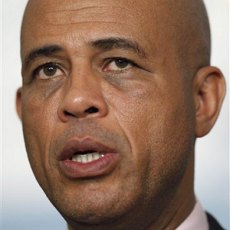 The United Nations Security Council on Wednesday urged Haiti’s new government to focus on the critical tasks of rebuilding the country and ensuring stability and rule of law in the Caribbean nation as it congratulated the country’s people for conducting elections peacefully.
In a press statement, the Council encouraged all Haitian politicians to resolve any remaining poll disputes through “transparent and efficient” means, ensuring that the elections reflected the will of the people.
“The Members of the Security Council encourage Haiti’s new leaders to remain focused on the critical tasks of rebuilding the country, ensuring respect for the rule of law, and ensuring a future of peace, stability and prosperity for all Haitians,” the Council said.
Newly-elected President Michel Martelly was sworn in on Saturday in a ceremony in the capital, Port-au-Prince. Martelly – who in March won the second, run-off round in the presidential election – succeeds René Préval.
The Council also voiced its deep appreciation of the efforts of the personnel of the United Nations Stabilization Mission in Haiti (MINUSTAH) for providing critical logistical and security support to the Haitian authorities throughout the electoral process.
The Council assured the people of Haiti that the international community remains steadfast in its commitment to support the efforts of Haitian authorities in dealing with the critical challenges ahead.
LIME Barbados creates 4G history in Caribbean
Thanks to a concerted effort by staff of telecommunications company LIME over recent years, its customers can now look forward to the best available Internet service in the world, with the extremely fast and efficient “4G”mobile technology, the first of its kind in the Caribbean.
This $80 million development, which is said to be set to “radically change” the social and business landscape of people’s lives, was revealed by LIME’s Managing Director, Alex McDonald, during a press conference at the Crane Hotel on Tuesday – World Telecommuni-cations Day.
With network changes set to be rolled out from next month, the current 2.75G experienced in Barbados – commonly known as the Edge network – will be bypassing the 3G capabilities currently available in Jamaica and stepping up to the premier service found in just a few developed countries in the world.
Persons will experience higher speed access to Internet-enabled services through mobile devices as well as significantly increased network download and upload capabilities. This means that video chat without Wi-Fi dependency, the sending of e-mails with large attachments, quicktime browsing, the download of images, apps, and music in “the blink of an eye”, and many more enhanced features will now become the norm.
Expressing that “this is where LIME’s customers want to be”, McDonald noted that this “G-volution” announcement follows last month’s significant step in which the company, with the help of the Barbados Chamber of Commerce, unveiled a million-dollar Wi-Fi project for Bridgetown.
Focusing on the slogan “Fast, Smart, Imagine”, McDonald shared with several members from the media that he believes the opportunities stemming from this gigantic technological advancement are endless, with expanded scope for business and social communication endeavours.
“We are looking to create the next Bill Gates, Steve Jobs or Larry Page. We are a talented set of human beings. We have created a musical genius like Rihanna, there must be a technological tycoon waiting to use our backbone,” he stated, before adding that he expects this new-found “freedom” to also transform how learning and education is approached.
A similar launch also took place in the Cayman Islands yesterday, while other Caribbean countries can look forward to upgrades over the next few months.
4G will serve as a platform for LIME’s future network development as the protocols are “fully compatible” with Long-Term Evolution (LTE) technology, which will power mobile networks in the future.
Throughout the savvy presentation, which featured a video presentation, some of the lucky attendees also went home with iPads and smart phones, compliments of LIME
Call for CARICOM leaders to have binding clauses on resolutions
A call has been made for CARICOM leaders to have binding clauses placed on the resolutions they make to ensure that they follow through with them.
This call was made by a participant in the International Labour Organisation (ILO) Conference that was held at Hilton Barbados over the past two days. Belinda Wilson, who is President of The Bahamas Union of Teachers, made a number of suggestions for what should come out of the conference of labour stakeholders from around the Caribbean. These comments came during a panel discussion with the theme, “Taking advantage of Tripartism and Social Dialogue to support regional integration and enhance its benefits”.
“The observation that I have is that from this forum, we should present a position paper to each of our Ministers of Labour. Coming out of this forum, we should also move a resolution that we present for the next CARICOM meeting … we should list what items we would like to be discussed, they should be placed on the agenda; and my colleague from St. Vincent was saying something about the EU having a binding clause on their resolutions, I think we should also have something that deals with that… There should be a binding clause as to when you make an agreement, what should happen when you do not keep that agreement,” Wilson stated.
Referring to Wilson’s suggestions and to Grenada’s Minister of Labour, Glynis Roberts’ comments about the indecisiveness of governments and other actors, Barbados’ Minister of Labour, Dr. Esther Byer-Suckoo, said that having resolutions may force these entities to deal with their issues.
“Once we ask them to have these resolutions, to include these resolutions, then perhaps we would be forcing them to deal with their issues and so address regional integration if we are indeed to move to a single market and a single economy, with a single vision by 2015 or sometime thereafter,” Byer-Suckoo stated. (AN)
Venezuela demands extradition of accused Cuban terrorist
The president of the Venezuelan Supreme Court of Justice, Luisa Estella Morales, said in Havana on Monday that the government of the United States should immediately extradite accused terrorist Luis Posada Carriles to Venezuela.
In a press conference in the Cuban capital, the jurist noted that the Venezuelan request is made in compliance with international treaties signed with many countries, including the United States.
“He should be extradited to judge him in Venezuela for the crimes he organized and committed in our country,” she pointed out.
Regarding the recent trial in El Paso, Texas, in which Posada Carriles faced minor charges of immigration fraud -- of which he was acquitted -- Estella Morales added that, according to international treaties, as he does not have pending processes in US territory, he should then be extradited to Venezuela.
“Our demand also lies in the fact that, although Posada Carriles was born in Cuba, he became naturalized as a Venezuelan and, according to our Constitution, Venezuela has the right to judge its nationals,” she stated.
Among other crimes, Luis Posada Carriles is accused of masterminding the 1976 mid-air bombing of a Cuban airliner in which 73 people were killed. He is also said to have organized a series of bomb attacks against tourist facilities in Havana in the late 1990s, as a result of which several people were injured and an Italian tourist died.
Estella Morales is in Cuba to hold meetings with the president of the Cuban Supreme Court, Ruben Remigio Ferro, and with other personalities.
Forbes list posts 19 sports figures of top 100 celebrities
Tiger Woods has not finished a tournament atop the leaderboard in 18 months. Nonetheless, Forbes says the world's former No. 1 golfer remains the biggest celebrity in the sports world.
Woods is No. 6 on Forbes' annual "Celebrity 100" compilation of the most powerful people or groups in the entertainment business, the highest rank of any of the 19 athletes who made the list.
Miami Heat star LeBron James is 10th, up 18 spots from a year ago, and the Los Angeles Lakers' Kobe Bryant was at No. 14 for the second straight year.
Lady Gaga tops Forbes' overall rankings, followed by Oprah Winfrey, Justin Bieber, U2 and Elton John.
Woods will fall out of the top 10 in golf's world ranking next week, the first time he'll be 11th or lower since 1997. His last tournament win was at the 2009 Australian Masters.
His star power apparently remains nearly as bright as ever.
Woods was No. 5 on Forbes' list in 2010, when the magazine estimated his annual earnings at $105 million -- $30 million less than what it figured him to make over the most recent 12-month period. Even after taking major endorsement hits following the scandal that ended his marriage, Woods still made $22 million more than Bryant in the past year, Forbes said.
Forbes listed James' earnings at $48 million, up $5 million from the previous year, and ranked him No. 2 behind only Winfrey in terms of media visibility. Forbes said its formula includes pretax income for the year ending May 1, media visibility and social media power through Facebook and Twitter.
Tennis star Roger Federer was 25th on the list, placing him fourth among athletes.
The Heat had two of the top 100, with Dwyane Wade (No. 57) joining James. And the New York Yankees also had two mentions, with Alex Rodriguez at No. 49 and Derek Jeter at No. 69, tying him with actress Julia Roberts.
Other sports figures on the list: David Beckham and Phil Mickelson (tied at No. 35), Cristiano Ronaldo (No. 43), Rafael Nadal (No. 46), Tom Brady (No. 55), Dwight Howard (No. 59), Lionel Messi (No. 62), Peyton Manning (No. 72), Maria Sharapova (No. 80), Serena Williams (No. 84), Venus Williams (No. 86) and Danica Patrick (No. 96).
Combined, Forbes said the 19 athletes on the list this year earned a combined $647 million.
Among those from the sports world who were ranked in 2010 but fell off the most recent Forbes celebrity list were Michael Jordan (20th in 2010), Floyd Mayweather (31st), Shaquille O'Neal (52nd), Manny Pacquiao (55th) and Lance Armstrong (65th).
Man Utd's Wayne Rooney threatens Twitter follower
Manchester United striker Wayne Rooney has told a Twitter follower: "I'll put u asleep within 10 seconds" after being provoked on the social networking site.
The 25-year-old England star, who has a following of over 570,000, was replying to an abusive tweet on Tuesday.
Rooney suggested a meeting at the training ground, tweeting: "hope u turn up if u don't gonna tell everyone ur scared u little nit. I'll be waiting."
In an effort to defuse the situation, Rooney tweeted: "Haha bit of banter".
The Twitter account belonging to the follower who taunted Rooney was subsequently deleted.
A number of footballers have already been reprimanded for inappropriate use of Twitter this season.
West Ham striker Carlton Cole was recently charged by the Football Association for improper conduct for remarks made during England's 1-1 draw with Ghana at Wembley in March.
While Liverpool striker Ryan Babel was fined £10,000 for a Twitter post and warned about his future conduct after being linked to a mocked-up picture of referee Howard Webb in a Manchester United shirt after a 1-0 defeat at Old Trafford in the FA Cup.
Rooney was banned for two matches in April after accepting a Football Association charge for swearing into a TV camera after scoring a hat-trick at West Ham.
On Wednesday night at the Manchester United awards, Rooney's overhead kick against Manchester City at Old Trafford in February was the clear choice for goal of the season.
Portuguese winger Nani received the players' player of the year award, while Javier Hernandez was voted fans' player of the year.