
Gayle sweating on NOC before taking up IPL stint
 Talismanic West Indies opener Chris Gayle is awaiting a no-objection certificate (NOC) from the West Indies Cricket Board before he can take up a last-minute offer to play in the lucrative Indian Premier League.
The giant left-hander has been identified by Royal Challengers Bangalore to replace injured left-arm pacer Dirk Nannes, but under IPL regulations will require an NOC in order to suit up.
Gayle has applied to the WICB for the NOC and is awaiting the verdict, which CMC Sports understands will come later this week. An NOC committee deliberates over application for a certificate before approving or denying the request.
The latest move comes on the heels of Gayle being overlooked for the first two one-day internationals of the five-match series against Pakistan, which bowls off on Saturday in St Lucia.
He was one of three senior players - Ramnaresh Sarwan and Shiv Chanderpaul were the others - controversially omitted from the ODI squad as West Indies selectors shifted their focus to younger players.
Reports Tuesday indicated that Gayle had informed the WICB about his unavailability for the Pakistan series, with the IPL finishing May 28.
The Pakistan series, which comprises one Twenty20 International, five ODIs and two Tests, starts tomorrow and winds up May 20.
In the IPL auction earlier this year, Gayle went surprisingly unsold after attracting a base price of US$400,000.
Gayle has played for Kolkata Knight Riders since the IPL's inception three years ago.
CMC

18 'Penns' teams get call from LIME
Sponsorship cheques totalling $1.83 million were handed over to 18 local educational institutions to send teams to the Penn Relays scheduled for April 28 - 30 at the University of Pennsylvania by telecommunications company LIME.
At a function held at the Wyndham Hotel in New Kingston, LIME presented cheques valued at $100,000 to each of the benefiting schools. In addition, all members of the travelling contingents will be able to 'phone home' as LIME gave "Jus Talk" calling cards to each athlete, coach and administrator attending the meet, representing a value of $30,000. The telecom company also contributed to $688,000 to Team Jamaica Bickle, an organisation that will be providing meals and transportation for the Jamaican athletes in Pennsylvania. This brings LIME total contribution to just over $2.5 million.
This year's sponsorship marks the continuation of a time-honoured tradition for the telecom company which has provided sponsorship to send local school teams to the relay carnival for the last 19 years.
Chairman of the LIME Foundation, Errol K. Miller, said: "It is always a pleasure for us at LIME to help our high schools and colleges to send teams to the Penn Relays where our young athletes can get the kind of experience and exposure that will prepare them to compete on the international stage."
"LIME has been providing this sponsorship to educational institutions for the last 19 years and we are proud of the roll that we are playing in shaping the next generation of great Jamaican athletes," he added.
sporting start
The Penn Relays sponsorship follows closely on LIME's $8 million allocation to the Inter-Secondary Schools Association for the staging of the 2011 Boys and Girls' Athletics Champion-ships. Also, today's presentation was made just ahead of the 2011 LIME CARIFTA Games which begins at the Montego Bay Sports Complex in Catherine Hall, St James, this weekend. LIME recently signed a $36 million agreement with the North America, Central America & Caribbean Athletics Association (NACAC) to be the games' title sponsor for the next two years.
In addition, in 2010 LIME signed a three-year sponsorship deal with the Jamaica Amateur Athletic Association (JAAA) under which Jamaica's junior athletic programme will receive $7 million on a yearly basis.
The teams receiving sponsorship from LIME this year are:
Calabar High School, Camperdown High School, Convent of Mercy Academy "Alpha", Edwin Allen High School, GC Foster College, Herbert Morrison Technical High School, Holmwood Technical High School, Jamaica College, Kingston College, Munro College, Old Harbour High School, St George's College, St. Jago High School, The Queen's School, University of Technology (UTech), Vere Technical High School, Wolmer's Boys' School and Wolmer's Girls School.
Vybz Kartel To Retaliate Against 5-O
 Estrange Dancehall deejay Vybz Kartel, whose Colouring Book party was abruptly cancelled by Jamaican lawmen last week, has fired back at the authorities by hinting a lawsuit.
According to reports, Vybz Kartel is seeking legal advice from his lawyers over what he describes as “vindictive” police officers.
The Colouring Book party which was slated for last Saturday (April 16th) was abruptly cancelled a day before by law enforcement officials, who cite criminal elements and public safety as the deciding factor. But Urban Islandz sources inside the Gaza seek to dismissed the police claim as “rubbish.”
“From we an a certain promoter have a fallout we start get fight from corrupt police for every show we keep,” the source disclosed. “This talk about criminal elements is pure rubbish, dem just don’t want see the crowd wha di teacha a go pull.”
Vybz Kartel claim may worth a shot according to the Fair Trading Commission (FTC) legal officer, Wendy Duncan, who disclosed that once Vybz Kartel can prove courts that the breach has caused damage and loss; he may be able seek compensation.
Vybz Kartel was the headline act for the “Colouring Book” party originally scheduled for Saturday (April 16) at Lime Village in Portmore.
Source: Urban Islandz
“The Harder They Come” Remake Set For 2012 Release
The remake of “The Harder They Come” is schedule to hit the big screen in 2012.
Filming of the classic Jamaican urban drama movie is schedule to begin later this year. Part of the film will be shot on locations in Jamaica and London.
Casting of the film is now being assembled after which production should be wrapped up in time for a summer release in 2012.
The 1972 classic “The Harder They Come” was starred by the legendary reggae singer Jimmy Cliff, who plays Ivanhoe Martin, a character based on Rhyging, a real-life Jamaican criminal who achieved fame in the 1940s.
The film remake should be exciting.
New Owners of Death Row Banned From Selling 'The Chronic' Online
The new owners of Death Row Records lost a round in court yesterday (April 19th), when a judge ruled that the label does not have the rights to sell Dr. Dre's hit album The Chronic digitally.
U.S. District Judge Christina Snyder ruled that Dr. Dre has never received the proper royalties from sales of the hit album The Chronic, which has sold over eight million copies since being released in 1992.
While The Chronic can still be online, Judge Snyder ruled that Dr. Dre should receive 100 percent of all of the proceeds from online sales of the album.
The judge also ruled that the new owners of Death Row Records do not have the rights to sell Dre's music from The Chronic on a compilation or any other albums.
The judge ruled that Death Row could only sell The Chronic in four formats: CD, cassette, vinyl and 8-Track.
Gucci Mane To Plead Not Guilty To Pushing Woman Out Of Car
A lawyer for Atlanta rapper Gucci Mane has denied accusations that he pushed a woman out of his Hummer as it was moving, resulting in a misdemeanor charge.
Yesterday (April 19th), Gucci, born Radric Davis, was formerly charged with battery, reckless conduct and disorderly conduct.
The rapper, who is still incarcerated, plans to plead not guilty, according to his lawyer Ashutosh Joshi.
Prosecutors accused Gucci of showing a "willful disregard for a woman's personal safety" when they formally charged the 31-year-old rapper.
"We obviously believe the charges are false,"Joshi told the Macon Telegraph. "We don't agree with them and we look forward to having the opportunity to fight the charges in court."
Gucci is accused of pushing a 36-year-old woman named Diana Graham out of his Hummer on January 28th, after the woman allegedly refused a proposition from the rapper, to visit a local hotel.
Kanye West's Non-Profit Closes Doors
Kanye West's non-profit foundation has closed for unknown reasons, according to reports.
The rapper's Kanye West Foundation closed its doors after four years in existence, according to a former employee of the non-profit, which was at one time headed by the late rapper's mother, Dr. Donda West.
A former executive director for the company sent out an email to colleagues making the announcement.
The foundation's productivity appeared to flounder after the death of Dr. West, who died in 2007 from complications of plastic surgery.

LIME donates umbrellas to Providenciales Airport Authority
The leading telecommunications company in the Turks & Caicos Islands made a contribution that would potentially touch every visitor to the shores. LIME donated 500 umbrellas for use by the Providenciales Airport Authority during the rainy season and to shelter tourists from the elements when they are at the airport.
Due to the major renovations being undertaken with the expansion of the airport, tourists and returning residents have a longer path to walk to get to and from the planes. These umbrellas will aid in ensuring that they arrive dry from any falling rain and protected from any of the sun’s rays.
Deputy Chairman of the Providenciales Airport Authority, Mr. Gordon Burton said: “We are so grateful to LIME for this kind gesture that will go a long way to assist passengers and residents upon arrival or departure. We would like to thank LIME for assisting us in delivering a great customer experience with the use of these umbrellas.”
General Manager of LIME, Mr. Drexwell Seymour commented, “LIME is indeed pleased to keep everyone covered from the elements with these umbrellas and I would encourage all to keep covered with LIME for your telecommunications needs.” He went on to say, “This is what partnership is all about. This means that passengers would have an enhanced customer service experience and LIME is proud to be a part of that.”
LIME will continue to be there in the community with relevant contributions that seek to make the lives of customers better.
Keeping you covered with umbrellas and with service. LIME. For Living. Everyday.
Haitian President-Elect: 'Huge Challenges' Ahead
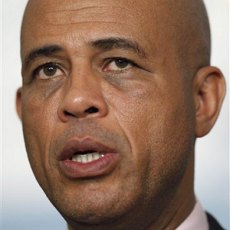 Haiti's President-elect Michel Martelly says he has "huge challenges" ahead of him, as the country recovers from last year's devastating earthquake, and faces the threat of more natural disasters in the months to come.
Martelly spoke alongside U.S. Secretary of State Hillary Clinton in Washington Wednesday, less than a month before he is set to take office.
He said reconstruction is "despairingly slow" 15 months after the earthquake left much of the Haitian capital, Port-au-Prince, in ruins and killed more than 200,000 people.
Clinton said that although 20 percent of the rubble has been cleared, there is still a lot more to remove and hundreds of thousands of people are still living in camps.
Martelly also warned that a cholera epidemic that has already killed thousands could spread to the entire country during the upcoming rainy and hurricane season if it is not contained. He said the country is expected to face up to 16 hurricanes when the season starts June 1.
He pledged to work relentlessly to reconstruct the country, including restructuring foreign aid, giving new life to the business sector and developing the capability of government institutions and civil society.
Clinton said the U.S. wants to do everything it can to be a good partner for Haiti as it takes the steps it must take.
Martelly's three-day U.S. visit is aimed at promoting his agenda of job creation, education, security, reconstruction and health.
The popular singer-turned-politician met Tuesday with the heads of the World Bank and the International Monetary Fund. He meets at the Embassy of Haiti Wednesday with members of the Haitian community and holds a press conference on Thursday.
Haiti's electoral council has declared Martelly the winner of the country's March 20 presidential runoff, but there have been repeated delays in announcing the official results, which are now expected on Wednesday.
Martelly is to take over from President Rene Preval on May 14.
The president-elect says his goals for Haiti include free tuition for all children nationwide, housing for earthquake victims living in tent camps, and strengthening agriculture so Haiti can become more self-sufficient.
Raul Castro Named Head of Cuba's Communist Party
 Cuban President Raul Castro has been named the head of the nation's ruling Communist Party, officially replacing his brother, former President Fidel Castro, who held the post since the party's founding 46 years ago.
President Raul Castro was named First Secretary Tuesday during a Communist Party Congress in Havana.
Despite raising hopes during the gathering that a new generation of leaders could step up to top posts, the 79-year-old president said 80-year-old Vice President Jose Ramon Machado Ventura would be his No. 2 in the party.
Raul Castro has introduced economic reforms in Cuba, but told the party congress that he will never allow the return of capitalism.
Fidel Castro, 84, making a rare public appearance, also attended the event, wearing a blue tracksuit and looking unsteady on his feet.
Fidel Castro has faced severe problems with his health during the past few years.
In an opinion article in state-run media last month, Fidel Castro said he resigned five years ago from all his official positions, including as head of the Communist Party, when intestinal bleeding nearly killed him in 2006.
Even though it was widely known that Fidel Castro was not working as the day-to-day head of the party, the article was the first time he acknowledged resigning from the post.
Fidel Castro ceded power to Raul Castro in 2006, and in 2008, the younger Castro officially took office as president.
On Monday, Cuban state-run media reported that the Communist Party had approved economic reforms offered by President Raul Castro.
About 1,000 delegates convened for the four-day party convention, which is only the sixth time the party has met in its nearly 50-year history. The last gathering was in 1997.
Raul Castro's proposed reforms come during tough economic times for Cuba.
The reforms include significant changes to Cuba's economic system, including decentralization of the island nation's economy, a shift toward private enterprise and the eventual elimination of ration books and other subsidies. Reforms also include two, five-year term limits for politicians.