
Jamaicans to pay billions in Air Jamaica divestment costs
Finance and Public Service Minister Audley Shaw said $7.2 billion has been set aside in the Budget for divestment legacy payments. Of this amount, he said $4.5 billion represented payments associated with Air Jamaica, and the Sugar Company of Jamaica, $2.6 billion.
"It should be noted, however, that in respect of Air Jamaica, that is not the fulsome amount of money that has to be paid for Air Jamaica for this fiscal year. The total amount of support for Air Jamaica, in terms of legacy payments, interest payments and servicing existing bonds on the international bond market, ... will be about $10 billion."
He was making his opening presentation yesterday at a meeting of the Standing Finance Committee of Parliament in Gordon House.
Air Jamaica was divested in May 2010 to Trinidad's Caribbean Airlines.
The legacy payments represented money owing from aircraft that the airline had leased.

Bahamas tightens immigration rules
The Bahamas has tightened its immigration rules in favour of wealthier investors.
Prime Minister Hubert Ingraham announced Monday that those applying for permanent residency will now have to spend at least US$1.5 million on a Bahamian home to get fast-tracked by the Immigration Department.
Previously, a policy designed to attract foreign investors allowed a person owning a home worth US$500,000 or more to receive speedy consideration by immigration officials.
Foreigners who spend less than the new US$1.5 million threshold are still eligible to apply for permanent residency status, but the process could take years.
Ingraham pointed out to lawmakers that the local economy is driven by tourism and financial services, sectors which both require foreign investment.
Apple profits nearly double as iPhone sales soar
 Latest profits for the computer giant Apple beat hopes, including a higher-than-expected rise in iPhone sales.
Net income for the three months to March jumped 85% on the same period a year ago, with iPhone sales of 18.65m - a rise of 113%.
The figures are the latest in a string of good results from the US's technology companies.
Intel's figures, released on Wednesday, were also well above hopes and helped share prices to a three-year high.
Apple reported quarterly net profits of $5.99bn (£3.6bn), 95% up on the $3bn it made a year ago. Revenue was $24.67bn, a rise of 83%.
Sales of the company's computers were strongly higher, up by 28% from a year ago.
Apple's figures were not uniformly positive. It sold 4.69m iPad tablet computers in the quarter, below expectations.
Another disappointment was sales of its one-time star, the iPod, down by 17% on the year at 9m units.
Most analysts were enthusiastic about the figures.
Channing Smith, portfolio manager at Capital Advisors growth fund, said: "Dynamite numbers across the board. The only hiccup is lower than expected iPad numbers."
Apple chief executive Steve Jobs said in a statement: "With quarterly revenue growth of 83% and profit growth of 95% we're firing on all cylinders."
Mr Jobs, who went on medical leave in January with an undisclosed illness, continued: "We will continue to innovate on all fronts throughout the remainder of the year."
The day-to-day running of Apple is currently being done by chief operating officer Tim Cook.
US Stocks Close Higher in Trading Wednesday
U.S. stock indexes closed higher in trading Wednesday.
The Dow Jones Industrial Average was up 1.52 percent to close at 12,454. The broader S&P 500 index rose 1.35 percent to 1,330, while the NASDAQ climbed 2.1 percent to end the day at 2,803.
European stock indexes also closed higher Wednesday.
London's Financial Times index ended up 2.1 percent to close at 6,022. The CAC-40 in Paris finished ahead 2.5 percent to end the day's trading at 4,005. The DAX index in Frankfurt advanced 3 percent to close at 7,249.
In Asia Wednesday, Tokyo's Nikkei index gained one-and-three-quarters percent to close at 9,607. Hong Kong's Hang Seng index advanced 1.6 percent to finish the day's trading at 23,896.
Gold closed at $1,498.30 an ounce, up $3.80 from late Tuesday.
The dollar traded down against both the yen and euro.
China to build 55 airports in five years
China plans to increase its total number of airports from 175 to 230 over the next five years, according to senior aviation officials in China.
Li Jiaxiang, head of the Civil Aviation Administration of China (CAAC), commented on the aviation development in Beijing, saying, "450 million to 500 million passenger trips" are expected to be made annually by the end of the 12th Five-Year Plan (2011-15) period, up from 230 million in 2009.
Beijing Capital International is now the second busiest airport in the world, overtaking London Heathrow which has slipped to fourth place. According to Airports Council International, passenger numbers in the Chinese capital jumped 13 percent to 73.9 million in 2010.
The extra 55 airports will relieve pressure on the existing 175. The number of Chinese international passengers, according to the International Air Transport Association (IATA), is forecast to increase by 66.87 percent to 82.1 million by 2014 from 49.2 million in 2009.
"There are now two distinct travel markets ... Asia and China," said CNN’s business travel expert Richard Quest.
" When it comes to China, it’s a bit like asking where the 500-pound gorilla fits -– the answer is wherever it wants. People are awed by the statistics and China completely skews the Asia travel market."
Li Jiaxiang added that investment in China's aviation industry is likely to reach 1.5 trillion yuan (about US$230 billion) in the next five years."
Nick Cunningham, an analyst at Agency Partners in London explained that air travel typically expands at twice the pace of the economy and China's rapidly growing gross domestic product expanded to 10.3 percent in 2010.
Currently, the world's largest economy is the United States and it is home to 15,095 airports and 300 million citizens. In contrast, China has 1.3 billion people and only 175 airports.
Toyota making drastic production cuts after Japan quake, tsunami
 Toyota has announced drastic production cuts in North America and China due to difficulty in supplying parts following the massive earthquake and tsunami in Japan.
Previously, Toyota Motor Engineering and Manufacturing North America, Inc. (TEMA), had said it would suspend production on Mondays and Fridays between April 15 and April 25. That will continue through June 3, the company said in a statement.
"During the same period, production will run at 50% on Tuesday, Wednesday and Thursday," the statement said.
In addition, Canadian production will be suspended for the week beginning May 23, and U.S. production for the week starting May 30.
No decisions have been made for production after June 3, according to Toyota Motor Corp.
No layoffs are planned during this period," the statement said. "Team members will utilize nonproduction time for training and plant improvement activities."
"We are trying to continue production as much as possible and keep our work force intact in order to facilitate a smooth transition back to full production when all parts are available," said Steve St. Angelo, executive vice president of TEMA.
Last month, Toyota told its U.S. plants to prepare to shut down because of parts supply problems.
Toyota employs 25,000 workers in North America. It operates nine plants in the United States in Kentucky, Indiana, Texas, Tennessee, Alabama, West Virginia, California and Mississippi. It also operates three plants in Canada and one in Mexico.
In China, the company plans to go to 30% to 50% production from Thursday through June 3 because of difficulties delivering parts.
Toyota had already announced that it dropped production in its manufacturing facilities in Japan to 50%.
Officials said Tuesday that the drop in production would continue and that Toyota would stop production all together between the dates of April 28 to May 9.
The earthquake and subsequent tsunami struck Japan on March 11, leaving thousands dead.
Italy, France sending troops to advise Libyan rebels
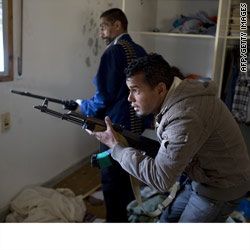 France and Italy announced Wednesday that they will send military officers to advise rebels fighting for the ouster of Libyan leader Moammar Gadhafi's regime.
Following a similar announcement by the British government Tuesday, French government spokesman Francois Baroin said a "small number" of French troops were being sent to advise the rebels' Transitional National Council.
French Defense Minister Gerard Longuet again ruled out sending ground troops to fight alongside the rebels. "This is a real issue that deserves an international debate," he said, adding, "We are working within the framework of the 1973 resolution," a reference to the U.N. resolution that authorized action in Libya. "You cannot please everyone all the time," he said.
Italy will send military advisers to train the rebels in self-defense tactics, Italian Foreign Ministry spokesman Maurizio Massari announced.
ritain said Tuesday it is sending a contingent of experienced military officers to the rebel stronghold of Benghazi in an advisory role. The team will work with the Transitional National Council on how the opposition can improve military organizational structures, communications and logistics, the British Foreign Office said. It will also assist in the delivery of critically needed aid.
"This deployment is fully within the terms of UNSCR 1973 both in respect of civilian protection and its provision expressly ruling out a foreign occupation force on Libyan soil," Foreign Secretary William Hague said.
The United States is not moving toward sending military advisers, according to a U.S. military official with knowledge of ongoing discussions inside the U.S. military. The White House remains adamant there will be no U.S. "boots on the ground," although U.S. intelligence operatives remain in Libya, the source said.
The official pointed out there is a mixed record for U.S. military advisers in past conflicts. Perhaps the most obvious example, the official said, was the initial years of the Vietnam conflict when the U.S. military began with an advisory role that later grew. And if the United States sent advisory troops to Libya, it would then have to provide security, transportation, supplies and other gear, and would have to have units on standby for emergency extraction if they ran into trouble, the source said.
U.S. Secretary of State Hillary Clinton has recommended that President Barack Obama authorize the U.S. government sending up to $25 million in non-lethal commodities and services to support Libyan rebels, including the Transitional National Council, two senior administration officials said Wednesday.
In Libya, rebel spokesman Jalal al Gallal called Wednesday's announcements by France and Italy "positive."
"We are pleased with the results, and I think it's a prelude to more cooperation," he said. "The more advisers we have on the ground, the better coordination we'll have on the battlefield."
The announcements from the European nations came as Transitional National Council President Mustafa Abdul Jalil was in Europe for meetings with leaders.
"I would like to take this opportunity to thank all the Arabic countries, in particular Qatar and the United Arab Emirates. Every Arab country has its own issues and maybe some were later than others in giving their support but we would like to thank the Arabic countries and the European countries, NATO, the U.S., Australia and Canada and all those countries that are supporting this Libyan revolution."
Qatar and the UAE are among the countries contributing to the international effort in Libya.
Libyan Foreign Minister Abdul Ati al-Obeidi on Tuesday blasted Britain's announcement that it was sending military advisers. In an interview with ITN, he called it a step toward "confrontation."
The efforts to bolster the rebellion come as Libya's main opposition body pleaded for an international military intervention.
Libyans are "being slaughtered every day by the Gadhafi forces," rebel spokesman Shamsiddin Abdulmolah told CNN Tuesday.
In the besieged city of Misrata, four people were killed Wednesday as Gadhafi's forces indiscriminately shelled residential areas, according to an opposition spokesman who wanted to be identified only as "Mohammed" for safety reasons. On Tuesday, nine people in Misrata were killed and 42 were wounded, he said.
At least 27 people have been killed and 142 have been injured this week, Mohammed said.
The U.N. High Commissioner for Human Rights Wednesday said some of the Libyan government's attacks on Misrata could constitute international crimes.
A statement from Navi Pillay's office said she condemned "the reported repeated use of cluster munitions and heavy weaponry by Libyan government forces in their attempt to regain control of the besieged city of Misrata, and said that such attacks on densely populated urban areas, resulting in substantial civilian casualties, could amount to international crimes."
"The pro-government forces besieging the city, including their commanders and all other personnel, should be aware that -- with the International Criminal Court investigating possible crimes -- their orders and actions will be subject to intense scrutiny," Pillay said in the statement. "Under international law, the deliberate targeting of medical facilities is a war crime, and the deliberate targeting or reckless endangerment of civilians may also amount to serious violations of international human rights law or international humanitarian law."
Libyan leaders have repeatedly denied targeting civilians and insisted that the rebels are criminals wreaking havoc on the country.
UNICEF, the U.N. children's agency, said Wednesday that 20 children have been killed and "countless others injured" in Misrata alone.
Among rebels, calls for help have been increasing each day.
Aid agencies are afraid of going to areas such as Misrata, which is being targeted by Gadhafi troops, opposition activist Mohamed Ibrahim said. "Some of them, they come. But most of them, they come near ... they hear the shelling and everything and they go back," he said.
At least 27 people have been killed and 142 have been injured this week, according to an opposition spokesman who wanted to be identified only as "Mohammed" for safety reasons.
Aid groups have been attempting to pluck desperate people from Misrata, which is hemmed in by Gadhafi's forces on three sides.
The only escape route is by the city's port -- an area witnesses said has also been shelled by Gadhafi's forces.
For those left behind, witnesses say, the dire situation continues to deteriorate. The city is still without water, electricity, and telecommunications, Mohammed said Tuesday. "Shelling has moved out of the industrial areas to the residential areas, and it is still going on."
Rebel spokesman Abdulmolah said the opposition's Transitional National Council is not opposed to a humanitarian mission on the ground.
"Something needs to be done so we can stop the bloodshed of our people," he said.
But "we do not want any foreign military presence or any international fighters along with our rebels," he added.
Libyan Foreign Minister al-Obeidi said the government would consider a cease-fire in Misrata if it was on both sides. "I think the only way is give peace a chance" through a general cease-fire, he told ITN.
NATO is leading an international military operation that includes targeting Gadhafi's military resources with airstrikes.
NATO said the operation has destroyed seven ammunition bunkers in the Tripoli area as well as equipment in several other parts of the country this week.
NATO attacked three regime battle tanks and a vehicle-mounted artillery piece in and around Misrata on Tuesday, British military spokesman Maj. Gen. John Lorimer said in a statement Wednesday.
Abdulmolah said NATO strikes may have also prevented more destruction in eastern Libya, particularly near Benghazi.
"We received reports that Gadhafi forces were mobilizing their troops and their mobile missiles/rockets systems from Brega towards Ajdabiya to bomb Benghazi. They were stopped by (Tuesday's) NATO strikes," he said.
But he said the opposition wants "technical assistance" and weapons "because we are facing a merciless tyrant who wants to slaughter his own people just because they asked for freedom and liberty."
Mohammed, opposition spokesman in Misrata,
Afghan Officials Try to Recoup Kabul Bank Loan Money
Afghanistan's top banker says officials have increased efforts to recover hundreds of millions of dollars in loans made by the country's biggest lender, Kabul Bank, but they have only collected about five percent of the total so far.
Kabul Bank lost more than $900 million in funds and nearly collapsed last year due to alleged mismanagement, cronyism and questionable lending.
Central Bank Governor Abdul Qadir Fitrat said Wednesday they have recouped $47 million in loan money. He added the Afghan government is overseeing efforts to get bank executives, shareholders and others who received illicit loans to repay the money.
Fitrat said the Central Bank is dividing Kabul Bank in two to isolate the hundreds of millions of dollars in “bad” loans and create a new bank that handles the good loans and assets.
The move appears intended to appease the International Monetary Fund, which has suspended financial assistance to Afghanistan and has called for Kabul Bank to be put into receivership.
Afghanistan's Central Bank took over Kabul Bank after the scandal caused a run on deposits there.
Kabul Bank handles the salaries of Afghan soldiers, police and teachers.
Last week, Afghan President Hamid Karzai blamed the international community for contributing to the near collapse of Kabul Bank.
Mr. Karzai told reporters that foreign advisers gave misleading information on the status of the bank, and that any misconduct would be prosecuted.
The financial fiasco has caused some international donors to question the stability of Afghanistan's financial system, just as the country is trying to take on more responsibility for security and development.
Gold Again Tops $1,500 an Ounce
The price of gold set a record high for a second straight day Wednesday as investors looked for an alternative to a weakening U.S. dollar.
Various unsettling events in the world in the last few months — such as the political unrest in the Middle East and then the earthquake and tsunami in Japan — have pushed some investors to look for what they view as a secure commodity. Increasingly, they have bought gold and other precious metals in what analysts call a “flight to quality.”
The price of gold edged just above the $1,500 mark Tuesday, after the Standard & Poor's financial services firm lowered its economic outlook for the United States from “stable” to “negative” on fears that the country's leaders will not be able to reach a deal to rein in the growing U.S. governmental debt. Wednesday, the price of gold topped $1,506 an ounce.
Some analysts say the price of gold could increase further. Investors have also bought another much cheaper precious metal — silver. It has risen to more than $45 an ounce for the first time since 1980 when its price reached a record $50.35. Prices for palladium and platinum have also been increasing over the last year.
Eritreans Rally in Ethiopia to Demand Afwerki Ouster
Hundreds of Eritrean exiles rallied in neighboring Ethiopia Wednesday to demand the ouster of what they call Eritrea's repressive government.
More than 600 Eritreans gathered in the Ethiopian capital, Addis Ababa, wearing hats printed with the word “Enough” to show they want no more of Eritrean President Isaias Afwerki's 18-year rule.
Organizers say other Eritrean exiles held similar rallies in at least four refugee camps in northern Ethiopia's Tigray and Afar regions, which border Eritrea.
Some protesters called for an end to the Eritrean government's policy of forcibly conscripting citizens into military service. Others appealed to the international community to impose sanctions on Asmara.
Ethiopia and Eritrea fought a border war from 1998 to 2000 and their relations remain hostile. About 60,000 Eritrean refugees live in Ethiopia, whose government approved Wednesday's rallies.
Rally organizer Kibrom Sibhatu says his Eritrean Urban Refugees Association wants to bring down Mr. Afwerki's government through peaceful protests inspired by other recent uprisings against autocratic rulers in the Middle East.
Ethiopian Prime Minister Meles Zenawi also faces the prospect of protests against his government in the coming weeks, organized by Ethiopian activists who see him as authoritarian.
Next month marks the 20th anniversary of the coup that brought Mr. Meles' Tigrayan Marxist rebel group to power.