
Pakistani PM Urges End to US Drone Strikes
Pakistani Prime Minister Yousuf Raza Gilani is calling for an end to U.S. drone strikes, saying the United States should share intelligence information so Pakistan can take action against terrorists on its own soil.
Mr. Gilani made the remarks Monday to the speaker of the U.S. House of Representatives, John Boehner, who led a congressional delegation to Islamabad.
The U.S. official's visit comes amid strained relations between the U.S. and Pakistan following the arrest of a CIA contractor in Pakistan, a series of deadly U.S. drone attacks in Pakistan's northwest, and the release of a White House report criticizing Pakistan's counterterrorism efforts.
The Pakistani prime minister reportedly told Boehner that a single incident should not hold relations between the United States and Pakistan “hostage.”
Following Monday's talks, Boehner's office issued a statement, emphasizing the importance of working through “challenges” and renewing the partnership between the two countries.
The Republican congressman also recognized the sacrifices of the Pakistani military in the fight against extremism and terrorism. He said al-Qaida has made Pakistan a target, and the nation has suffered deeply as a result.
Boehner met with Pakistani Army Chief General Ashfaq Kayani and U.S. Ambassador to Islamabad, Cameron Munter.
The United States does not publicly acknowledge launching missile strikes from unmanned aircraft in Pakistan, but regional experts say it is a common tactic and goes on with assistance from Islamabad. However, Pakistan publicly denounces the strikes as infringing on its sovereignty

Japan’s Parliament Questions PM, Power Company Chief Over Nuclear Disaster
The prime minister of Japan and the president of the Tokyo Electric Power Company appeared before parliament Monday to answer questions about their response to the March 11 earthquake and tsunami, and the resulting nuclear crisis.
Their appearance followed by one day a TEPCO announcement that it could be year's end before a “cold shutdown” is achieved at the Fukushima Daiichi power plant that might allow the tens of thousands forced to evacuate to return to their homes.
Opinions polls released on Monday show that more than two-thirds of Japanese voters disapprove of the way the government of Prime Minister Naoto Kan has handled the country's nuclear disaster, and they want a new leader for the massive cleanup of the tsunami's destruction.
Mr. Kan told parliament his government will conduct a thorough review of its nuclear policy, saying all “preconceived, conventional views should be put aside.” TEPCO president Masataka Shimizu apologized for his company's performance, saying the devastating tsunami was beyond expectations.
Japanese nuclear regulators said on Monday that a pair of robots sent into the damaged nuclear reactor on Japan's northeastern coast recorded evidence of a “harsh” environment that is too radioactive for workers to return for more than just brief periods of time.
AIR T&C NOT FOR SALE
 Air Turks and Caicos, is still locally owned.
Chairman Lyndon Gardiner told the public that is absolutely not the case. The company recently reached a long term lease agreement for its two Dehavilland Twin Otter aircraft with an airline in the Pacific, a move that should help improve the financial picture for the airline.
Gardiner pointed out that the recent revenue raising exercises by the interim government have increased his costs beyond the break even point. He notes that in addition to the Royalty Tax on Fuel, (the airline’s single largest cost after maintenance), there is now the imposition of the 4% new Customs Processing Fee on fuel and on spare parts (both formerly exempt from additional Customs fees for scheduled airlines) will hike the operating cost of the airline and make operating more of a challenge as price will have to rise.
Elaborating on increased costs and market conditions Gardiner says the cost to operate the airline has skyrocketed over the last year whilst the number of passengers needed on the flights to break even have steadily declined to numbers less than he carried two and a half years ago on his aircraft before the buyout of Skyking.
Gardiner says the airline has little choice but to resort to cost cutting measures of selling or leasing out aircraft and as is inevitable with the departure of these aircraft, laying off staff.
At the same time, the airline has suffered 'consequential loss' of business owing to the significant decline in travel on our international routes due to the time it takes to process Work Permit applications and the non-issue of Travel Letters.
He is calling on Government to provide relief from some of the new increases in order to allow him to continue providing essential air services.
WINE CELLAR GIVES BACK TO LOCAL ORGANISATIONS
The Wine Cellar’s 1st Annual Wine Cellar Golf and Fishing Tournament was held from March 25-27, 2011 and was dubbed a smashing success by residents and visitors from all over.
The event kicked off on Friday, 25th March with the much-anticipated fishing tournament at the Turtle Cove Marina, where excitement and skills blended perfectly. The weekend of activities culminated at the world-renowned Provo Golf Club with an ever so competitive Golf Tournament. A prize giving ceremony was also held and highlighted the best of the best in several different categories.
In sticking with their objective of giving back to local communities by being a good corporate citizen, the Wine Cellar decided to contribute to the development of two important organisations by donating a portion of the funds that were made during the 1st Annual Wine Cellar Golf and Fishing Tournament. The Edward Gartland Youth Centre and the Provo Hockey League were the two well deserving organisations chosen and were each presented with a cheque of $5000 to assist in meeting their daily goals and objectives, which benefit the local communities of the Turks and Caicos Islands.
Sales and Marketing Representative, Mr. Desmond Williams, commented that, “The Wine Cellar is excited to support the initiatives of both the Edward Gartland Youth Centre and the Provo Hockey League. We hope that these donations allow both parties to further their efforts as they relate to sports and youth activities locally. The community of Providenciales has been patronising and supporting us since we entered this market in 1984 and we feel that it is only fitting that the Wine Cellar does the same by giving back. ”
Mr. Williams further went on to say that, “We are looking forward to hosting the 2nd Annual Wine Cellar Golf and Fishing Tournament next year and encourage other corporate partners to come on board as we aim to keep fun community events alive in Providenciales. More supporters will mean larger donations for charitable organisations, so let’s all work together.”
Royal Turks & Caicos Police Begins Recruitment
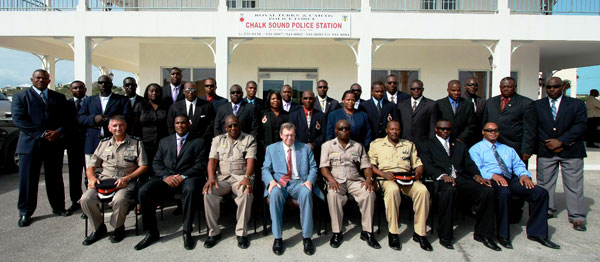 The Royal Turks and Caicos Islands Police Force begins its recruitment exercise for 2011
The Royal Turks and Caicos Islands Police Force (RTCIPF), has commenced its recruitment exercise for 2011 for those persons who are desirous of making a difference in their community.
A recruitment notice from the Human Resources Department of the RTCIPF, says it is looking for young men and women, with integrity, courage and determination, who thrive on challenges and who are willing to work hard to learn the skills necessary for this challenging but critical role.
We are looking for future leaders with the initiative and willingness to learn new methods for combating crime and violence here in the Turks and Caicos. After your 6 month initial training course at the newly opened Police Training School in Grand Turk, you will learn to appreciate the hard work and selfless service provided to our country by dedicated police officers, the HRD said in its recruitment ad.
According to the Human Resources Department, quote:- 'there's no sugarcoating here
this can be a tough and unpredictable job
.but it is
also the most rewarding position you will ever have. Every day when you put on that uniform or report for duty, you will be making the Turks and Caicos Islands a safer place for your family, friends and community to live and to grow old; and to be honest
. There's nothing more rewarding than that.' End quote.
For those persons who might be tempted to question "What's in it for me?"the Human Resources Department says, it's all up to the individual.
Besides having a safe and secure job in these hard economic times, you'll also be constantly challenged and always learning. Not to mention the fact that you'll be well paid. Also, there is always training available in specialized areas as well as other opportunities for advancement, the HRD said.
The HRD challenges those young men and women who are interested in becoming a Police officer to contact its department to find out more about the policing opportunity, pick up an application form from any one of the police stations throughout the islands to sign up and learn more about the opportunities available in the Royal Turks & Caicos Islands Police Force.
Stiff penality for rewards says Dect.Chase
Advertisement of a reward for the return of stolen goods, is an offense.
Information reaching our newsdesk from the Royal Turks and Caicos Islands Police Force is that any advertisement of a reward for the return of any stolen goods, is an offense and carries with it a stiff penalty.
According to a section carried in the Turks and Caicos Weekly News, entitled 'Police Reminders,' with Detective Sargeant Calvin Chase, if ones personal belongings are lost or stolen and one advertises a reward for its return, that person is commiting a crime as it is an offense and that
person can be charged with 'advertising rewards for return of goods stolen or lost.
Chase notes in his column that the law prohibits the use of phrases such as 'no questions will be asked' or that the person producing the goods
will be safe from apprehension or enquiry, or that any money paid for the purchase of the stolen item or advanced by way of a loan on them, will be paid.
Chase said the publishers of such an advertisement could face a hefty fine of $500 upon conviction.
Turks and Caicos Islands Community College in Provo to relocate
The Providenciales campus of the Turks and Caicos Islands Community College, adjacent to Williams Plaza on Old Airport Road, is to be relocated in time for the start of the 2011/2012 school year.
That'saccording to President of the College, Rev. Julia Williams. While Mrs. Williams was not in a position to divulge the future location
of the institution, she said negotiations are still being worked out with the prospective landlords as to the dynamics of the future site.
Regarding to talk on the street that the Community College could be housed on the grounds of the New Age Academy and Language Centre, downtown Providenciales, Rev. Williams did not confirm nor deny this, only to say that it would be premature to make a public statement on the matter at this time and that an announcement to the effect , as well as the reason for the Providenciales College relocating from its present location, would be made soon. She did however say that they are looking forward to relocating for the September school year.
Rumors have been circulating throughout the community that the Providenciales branch of the TCI Community College could possibly house the Providenciales Police Department Headquarters, which has been operating from a building condemned by the authorities more than a decade now.
The Providenciales Police Headquarters is slated to move to the Myrtle Rigby Complex which once housed Provo's only public health facility.
However, according to the SUN's report, some influential persons in the community, are not pleased with the move, basing their disagreement on the understanding that the original plan was for the Myrtle Rigby facility to be transformed into living quarters for employees of the hospital, following the opening of the Cheshire Hall Medical Centre.
It is not clear at this point what Government would do with the facility, but new Commissioner of Police Colin Farquar, told media professionals at a recent press conference that one of the challenges confronting him is the working condition that Police officers have been subjected to for a very long time and it is the hope of he and his deputy, that they can vacate their current location in as short a time as possible as conditions are not conducive to work.
Bottle deposit on way for TCI

The Environmental Health Department recently revealed plans to institute a deposit scheme on recyclable glass, aluminum cans and bottles that aims to keep trash off the streets and out of the environment.
The government estimates a staggering 20 million beverage containers per year are imported into the country, landing at the dump site or thrown alongside the roadsides, beaches, parks and neighborhoods.
Coming soon, consumers will have to pay an additional surcharge on these items upon purchase at retailers across the country. A levy of 8 cents is expected on beverage container up to 16 ounces and 13 cents per container in excess of 16 ounces.
The money will be partially refunded, 5 cents and 10 cents respectively, when the items are returned to Redemption Centers located throughout the islands. The remainder will be used to operate the redemption centers and administer the scheme.
Refunds are expected to be made via cash or by electronically printed vouchers that can be redeemed at the adjacent supermarket.
The Redemption Centers will collect, compact and transport the collected materials to a recycler in the islands for further processing.
While details have not yet not officially been released, the Environmental Health Department sent out a request for tender recently looking for parties interested in operating the centers.
According to the tender, the Environmental Health Department has so far identified and secured two locations for Redemption Centers on Providenciales, including in the IGA Graceway supermarket car park on Leeward Highway, and in the Butterfield Square Car Park in downtown Providenciales.
Other centers are expected to be put into operation on North Caicos (covering Middle Caicos, Parrot and Pine Cay) and Grand Turk (covering Salt Cay and South Caicos).
The Redemption Centers will be operated seven days a week for approximately 25 hours. The center operator will accept the bottles for return and place them into one of three compartments to hold metal, glass and plastic, which use a battery powered compactor to achieve a 12-1 compaction of aluminum, plastic and glass beverage containers.
Royal Advice from LisaRaye??
Estranged ex-wife of former Premier of the Turks and Caicos Islands, actress LisaRaye McCoy is at it again.
McCoy is giving advice to Kate Middleton, who will also be marrying into royalty when she and Prince William say "I do" on April 29. According to McCoy who considered herself to be royalty when she married the then Premier- “Everything that you do is in the spotlight; everywhere you go is in the spotlight. This marriage is going to be huge. This wedding will be huge and she cannot step in the shoes of Princess Diana. She's going to be able to do the best that she can do. So I wish them nothing but luck, communication and help and a lot of babies."
The now reality show star even suggested that Queen Elizabeth herself had some suggestions for McCoy's wedding.
"It became bigger than what I really wanted it to be," she says of her nuptials. "I wanted a medium-sized wedding and it grew and grew and grew. And then Queen Elizabeth heard about it and then it was more flowers and more dignitaries and more people that needed to be there and then the trumpets -- and I was like I didn't really want trumpets - but I had to have the 'duh duh duh duh duh duh duh duh duh.' And it was oh okay."
McCoy says her wedding was fit for a princess -- and she even wore Princess Grace's tiara.
"My wedding dress was phenomenal," she says. "I looked like a Barbie doll if I must say. The bodice was fitted and it came out at the waist and train was long and I just I had my head up high and just floated towards him and I didn't see anybody."
Sadly, the fairy tale didn't last for McCoy and Michael. The couple split in 2008.
Ex-convict advising TCI on taxes
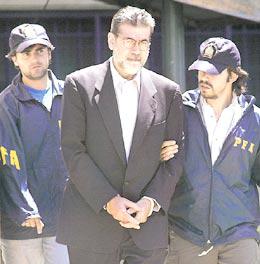 A former Minister of Government who was charged and convicted in his native Peru on various accounts of high-level corruption, is now one of the chief advisors to the Turks and Caicos Islands Government (TCIG) on tax and revenue matters.
The man is Jorge Baca Campodonico, who was Minister of Economy during former President Alberto Fujimori's notoriously corrupt Government in Peru.
Peru’s Supreme Court convicted Baca for misappropriating state funds by diverting US$59.4 million from Government money to bail out a private bank, ordered him to repay US$666,000 to the state and barred him from holding public office for three years.
Campodonico is one of the European Union (EU) team of experts, who is advising government on how to impose and establish the Value Added Tax (TAX) and other revenue measures. He recently addressed a meeting of the Turks and Caicos Islands Chamber of Commerce in Providenciales.
Campodonico, who was arrested by INTERPOL in Argentina in February 2003, while working for the International Monetary Fund (IMF), was slapped with a four-year suspended sentence in 2008 for having protected the affidavits of former presidential advisor Vladimiro Montesinos and for other corrupt matters.
Montesinos was the main collaborator of the Peruvian President Alberto Fujimori (1990 - 2000) and is now in jail in Peru for criminal actions against the public administration. Montesinos has also been prosecuted in connection with narco-trafficking, corruption and political assassinations.
The SUN contacted the TCIG for a statement on the matter and they said they did not know of Campodonico’s past criminal record at the time he was hired.
The statement from TCIG said: “TCIG were unaware of Mr Baca’s background; had they been, TCIG would not have considered him suitable for this role. TCIG wish to stress, however, that his analysis was carried out as one member of a team, and that we do not believe the revenue work, which was the result of the whole team's efforts and which is now complete, to be invalidated. The TCIG view is that the entire team conducted itself in a completely professional and credible manner throughout their period of work in the TCI.”
When he was arrested, Campodonico was part of an IMF technical mission visiting Argentina to examine aspects of a new IMF programme. The IMF and the World Bank had sent a mission to Buenos Aires in order to survey public accounts.
Campodonico’s arrest was regarded as a serious incident and is a blow to the IMF's credibility, especially to its increasing tendency to lecture borrowing countries about a good governance agenda. Similar concerns and suggestions of double-standards are likely to be raised here in the Turks and Caicos Islands.
Baca, as he is popularly known, was accused of having links to the former chief of the Peruvian intelligence services, Vladimiro Montesinos.
The TCIG adviser is an expert on taxation systems and conducted the reform of the Peruvian tax collection department. It is said that the reform has serious irregularities as excluded from control hundreds of politicians and public officials connected with Fujimori's administration.
In June 2001 a parliamentary investigation concluded Baca had illegally countersigned decrees authorising weapons purchases with revenues from state enterprise privatisations that were intended for poverty reduction.
Baca, was also was prosecuted by the Special Criminal Chamber of the Supreme Court, for having supported the illegal bailout of Banco Latino in 1998 during the Fujimori administration.
Fujimori is now serving 25 years in prison after he was arrested and tried for a number of crimes related to corruption and human rights abuses that occurred during his government.
It is reported that in 1999 Baca joined the Inter-American Development Bank after leaving the government, and that he was then hired by the IMF in April 2001 to work as an adviser on fiscal issues, for a $10,000 monthly salary.
In September of that year he had to testify in a Peruvian court about his links with former President Fujimori's spy chief Vladimir Montesinos, who was sentenced to five years in prison for human rights abuses, money laundering, embezzlement and arms deals. Baca was then prohibited to leave the country but fled to the US. In December 2001 he was found guilty of contempt of court. An international warrant was issued on 5 February 2002 and in May 2002 he was arrested in Miami, but extradition efforts failed.
The IMF provided legal assistance to Baca after his arrest in Argentina and expressed "concern". The judge in charge of the case questioned whether IMF concerns had to do with the fact that "[she had] made effective an international warrant or because they are employing a person wanted by Interpol".
Baca had a UN passport and the immunity normally granted to IMF staffers, but this only applies to acts performed by employees in their official capacity. The judge said it would be juridical nonsense if "[the IMF] could deny one of its member states the possibility to exercise its rights as a sovereign state on one of its citizens". Baca was released after a $10,000 bail was paid, but he could not leave the country.
When questioned about whether due diligence was done on Bacca, IMF external relations chief, Tom Dawson, said at a press briefing in Washington: “We do extensive reference checks on individuals when they are hired. It's not quite clear that he was on any kind of list at the time that he was hired at the Fund".
Baca says he later informed the Fund that he was a fugitive and that an international warrant had been issued for his arrest. According to Baca the Fund asked the FBI to send agents to Peru to investigate the charges; their assessment was that they were unfounded and that Baca was being persecuted by the new government. Apparently the Fund decided to retain Baca and ignore the international warrant.
Source:TCI SUN