
Lakers' road to repeat may go through Chicago
Kobe Bryant has all that championship experience, and perhaps the NBA's best supporting cast. The Miami Heat have the promise of what LeBron James and Dwyane Wade can deliver in their first post-season together, and the Boston Celtics think their play-off-tested group can do it again.
"You don't ever know if you're going to win a championship until you get there, but you know you have the pieces that can compete for one,'' Wade said. "That's where we're at right now.''
But to win an NBA title, those teams may have to go past Michael Jordan.
Well, past his likeness anyway.
The Chicago Bulls, with dynamite point guard Derrick Rose, earned home-court advantage by finishing with the league's best record for the first time since Jordan ruled the NBA. Keep on winning, and the Bulls would open the finals at the United Center, with its statue of Jordan outside.
Jackson eying title
And what a story it would be if his old coach was on the opposing sideline.
Phil Jackson, who led Jordan and the Bulls to six NBA titles, is expected to retire after this season. The Lakers would love to send him off with a sixth title in Los Angeles and a remarkable fourth three-peat.
They are the No. 2 seed in the Western Conference and endured a five-game losing streak late in the season. But they still have Bryant, seeking to tie Jordan with a sixth ring, and loads of interior depth with Pau Gasol, Lamar Odom and they hope a healthy Andrew Bynum.
And they might be back on track after closing the regular season with two straight victories.
"Maybe we turned a corner the last two nights,'' Jackson said. "We can't do anything easy. We're bipolar.''
The play-offs start today with Chicago hosting Indiana in the opener. Also today the Heat play Philadelphia; Atlanta and Orlando meet in a post-season rematch, and Portland visit Dallas.
The Lakers get started tomorrow against New Orleans, after West No. 1 seed San Antonio welcome the Memphis Grizzlies. The Celtics drew the New York Knicks, in their first post-season since 2004 and confident they are dangerous with the Carmelo Anthony-Amare Stoudemire tandem; before scoring leader Kevin Durant and the Oklahoma City Thunder face the new-look Denver Nuggets in the nightcap.
rose for MVP
The Bulls may lack the star power of some other heavyweights, but they've spent the last few months making believers of all of them. Led by Rose, perhaps the MVP favourite, Chicago went 62-20 for its best record since finishing with the same mark in 1997-98, Jordan's final season.
"Chicago's a good team and there's a reason why can they keep coming at you in waves,'' Knicks coach Mike D'Antoni said, "and they play hard.''
Carlos Boozer and Joakim Noah provide a strong tandem inside and the Bulls, not surprisingly, were a top defensive club under coach Tom Thibodeau, the architect of the Boston defence that knocked out Wade, then James in last year's play-offs on the way to the finals.
That duo then joined Chris Bosh in Miami, and after some early struggles and more scrutiny than any team, should endure, the Heat surged into the post-season with 15 wins in their last 18 games and perhaps can still meet the expectations that were raised last July.
"All these teams we're talking about, they're all flawed. There's no perfect team, to be honest with you. So if you've got two of the five best players, they are very dangerous,'' Hall of Famer and TNT analyst Charles Barkley said.
The two most intriguing first-round series could involve Anthony's current and former teams.
New York struggled last month as it adjusted to the trade with Denver, but won seven straight down the stretch to set up the 14th Celtics-Knicks series. Boston had their own problems since dealing centre Kendrick Perkins to the Thunder, and though the Celtics quickly put things together last year after a lacklustre finish to the regular season, there are questions if they can do it again following such a major change to their roster.
Doc Rivers said his team will be ready.
"I think this is what our guys have been playing for all year,'' he said. "You know, when you lose a Game 7, it sticks with you and that's very difficult to get back through the regular season because the whole season you're thinking about, 'Gosh, we've got to go through 82 of these just to have a chance to get back to where we were at last year' and now all that part is gone. And now we can start trying to get back to, and finish the job.''
The Nuggets went 18-7 after trading their All-Star forward along with Chauncey Billups, moving up to the No. 5 seed by getting balanced contributions throughout the roster. Oklahoma City provided a tough first-round test for the Lakers last year and believes it's better equipped to compete with the champs with Perkins patrolling the paint.
The winners of that series might have to play the Spurs, then the Lakers just to reach the finals.
"When you're in the Western Conference, if you're looking for something easy, you've come to the wrong place,'' Dallas coach Rick Carlisle said. "In this conference, it's a lot different than it's been in the East. A lot of their playoff positioning has been settled for days and weeks. Out West, it's been the epitome of high-level competition all year. It's only going to be more competitive now.''
The Lakers believe they can be the team to emerge from it.
"Every team we can match up with in the play-offs, especially defensively,'' Odom said.

Nicolas Cage arrested for 'drunken' New Orleans row
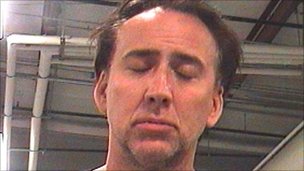 Hollywood actor Nicolas Cage has been arrested after an alleged drunken argument with his wife in New Orleans.
Mr Cage has been charged with domestic abuse, disturbing the peace and public drunkenness.
He and his wife Alice Kim were arguing outside a house in the French Quarter that the 47-year-old star said they were renting, a police statement says.
Ms Kim said it was not theirs and the Oscar winner grabbed her arm, and started hitting cars, it adds.
He then shouted at a police officer who had seen his behaviour.
Mr Cage is being held in the Orleans Parish Prison before an initial court appearance later on Saturday, police say.
Mr Cage won the 1995 Best Actor Award for Leaving Las Vegas, in which he played an alcoholic with a death wish.
An agent for Mr Cage has not commented on the arrest.
Reports say the actor once owned a house in New Orleans and has previously shot films in the city.
Barrington Levy to release final album
Having had several albums to his name, Barrington Levy says that his latest project will be his last.
The album, which is to be titled It's About Time, will be available for purchase this Fall.
Speaking with The Jamaican STAR, Levy said, "It's my final album that I'll be putting out. I'll still be touring, I'll be singing and putting out singles, but I don't think I'm going to put out any album."
The album will feature several collaborations with local and international artistes such as Beres Hammond, Buju Banton, Wyclef Jean, Snoop Dogg, Lil Wayne, Busta Rhymes and Jadakiss.
Levy also recently teamed with Vybz Kartel and Khago on the track Gangsters, which is the soundtrack for an upcoming movie Gangstas in which he plays a lead role.
He spoke of how the collaboration came about saying, "I did the song in Philadelphia and after I finished my hook, then I said, who we going have on the song? we said Kartel, and Khago is showing that he's a good artiste, so they were perfect."
Overseas Artiste
A remix for Gangsters is also being done with another overseas artiste.
He said he will continue to work with the younger generations of artistes as he thinks they have a lot of potential.
"I don't look at myself as no veteran artiste, I see myself as a singer in the business who love what I do. All these times you say you not hearing from Barrington Levy, is not like I'm not doing nothing because I've been voicing a lot. Believe you me, see the next generation of artistes after Kartel, if I'm up and healthy, I'm going to do something with them because there is no boundary," he said.
According to Levy, the song has been getting better reception overseas than in Jamaica as it has been receiving a lot of airplay on Hot 97, among other radio stations throughout areas such as Boston, Philadelphia and New York.
It is also on a few overseas charts.
"People have been calling in and requesting the song on the radio over there a lot. We not talking about the average Jamaican person, we're talking white people," said Levy.
He also hinted that because the song is fairly new to Jamaican listeners they are not yet accustomed to it. It has been doing well in the Jamaican streets, however, and they have also been busy promoting the song.
The filming of Gangstas is scheduled to begin in May, and Levy is excited.
"The movie is coming along quite fine. I'm actually looking forward to start shooting the movie," he said.
He went on to say that this is his first movie venture and he is very excited about it because he has wanted to do a movie for quite a while.
"I'm definitely looking forward to this," said Levy.
'The movie is coming along quite fine. I'm actually looking forward to start shooting the movie'
Former BET Employee Sues Network Over Sexual Harassment Claims
BET has been hit with a sexual discrimination lawsuit by a former employee, over incidents that occurred while producing segments for BET.com.
The lawsuit was filed April 13th in The Supreme Court in the State of New York County of Bronx by Tameika Dorman.
According to the complaint, in February of 2009, Ms. Dorman was editing a video session with a male camera operator named Derek Clarke, who works in the graphics department for BET.
The pair were putting together a previously taped segment that Ms. Dorman was hosting and producing.
"During this editing session, Clarke subjected Ms. Dorman to acts of sexual harassment by repeatedly re-playing video footage of her rear end while she was dressed in a short skirt while walking up a set of stairs."
According to Ms. Dorman's lawsuit, she asked Clarke why he kept replaying the footage of her butt.
"Clarke grabbed and repeatedly rubbed his crotch, began to moan and said it was because he loved her butt, that she was sexy and that she did not know what he was going to do [to] her."
Ms. Dorman complained to a supervisor over the incident, who said she would never have to work with Clarke again.
When Clarke was assigned to work on a Nicki Minaj segment with Ms. Dorman, she complained to Human Resources.
Ms. Dorman claimed she was eventually removed from producing the BET Hip-Hop Honors show and fired for reporting her claim of sexual harassment.
She also claims her termination was "both retaliatory and based on her gender, including her pregnancy."
Ms. Dorman seeks monetary damages, discriminatory practices, unlawful termination and lawyer fees.
Bone Thugs Release Statement On Krayzie Bone's Departure
Bone Thugs-n-Harmony issued an exclusive statement regarding the abrupt departure of founding member Krayzie Bone.
In the statement, the remaining group members recognize the loss of Krayzie Bone, but also state that the group will continue on.
"Let's be clear, Bone Thugs n Harmony the band/brand did not and does not break up. A single member has parted ways on another mission in life and we wish him love and success," a spokes person told AllHipHop.com exclusively. "BTNH World Wide the brand continues to functions 307 days a year globally, and will continue to do so with respect to its business partners and the great Fan Family."
The group members will continue to perform as well, they relayed in the statement.
Are You Being Served? star Trevor Bannister dies at 76
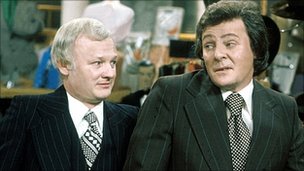 Are You Being Served? star Trevor Bannister has died aged 76, his brother has confirmed.
The actor suffered a heart attack on Thursday at his allotment in Thames Ditton, Surrey, John Bannister said.
The actor was best known for his role as ladies' man Mr Lucas in the 1970s BBC sitcom set in a department store but he also worked in the theatre.
"He was a good lad, we were all very fond of him," Mr Bannister told BBC News.
He added his brother had been doing some repair work on his shed when he became ill.
Frank Thornton, who appeared as Captain Peacock in Are You Being Served?, told the BBC he had "many, many happy memories" of his co-star.
"He was a very good friend over a long time," he said.
"We often met with him and his wife - he was recently at my 90th birthday celebrations in January and that was the last time we saw him. We shall miss him sorely."
Born in Durrington, Wiltshire, and the youngest of three children, Bannister did two year's National Service before going to the London Academy of Music and Dramatic Arts.
During his career which spanned five decades, he appeared in TV shows including The Avengers, Dixon of Dock Green, The Saint and Z Cars.
He also made regular appearances in the theatre and in pantomime.
More recently, the actor had a stint in the long-running BBC series Last of the Summer Wine.
In 2009, the actor led the tributes to his Are You Being Served? co-star Wendy Richard and gave a reading at her funeral.
Speaking to the BBC at the time about his experiences of working on the sitcom, he said: "The joy of that particular show was the fact that most of us had known each other before we came to do it.
"We loved working with each other and had a lot of respect for each other. I think that fun and enjoyment conveyed itself through the screen."
He is survived by his second wife Pam and three sons Simon, Timothy and Jeremy.
Raul Castro pushes Cuban Communist Party 'rejuvenation'
 Cuban President Raul Castro has said top political positions should be limited to two five-year terms, and promised "systematic rejuvenation" of the government.
President Castro was speaking at the start of the first congress of Cuba's ruling Communist Party in 14 years.
He said the party leadership was in need of renewal and should subject itself to severe self-criticism.
The term limits proposal is unprecedented under Cuban Communism.
Raul Castro, 79, took over from his brother Fidel in 2008. Between them they have ruled Cuba for 52 years.
Mr Castro acknowledged that "the confidence of the majority of Cubans had been tested, with regard to the party and the revolution".
He said Cubans would have to overcome a "mentality of inertia" and said the only thing that could threaten the revolution was "our inability to rectify errors".
Economic change
Much of President Castro's speech focused on his plans to reduce the role of the state in the economy and encourage private enterprise.
He said it would take at least five years to update Cuba's economic model.
Free education and healthcare would still be guaranteed, but mass subsidies of basic goods would be removed and social spending would be "rationalised".
President Castro said 200,000 people had already registered as self-employed since the changes were announced last October, doubling the number of Cubans working for themselves.
But he insisted the socialist character of Cuba would be "irreversible" and accumulation of property would not be allowed.
Historic triumph
The Communist Party Congress was preceded by a one of the largest military parades Cuba has seen in years, marking the 50th anniversary of the failed Bay of Pigs invasion by US-backed exile groups.
Troops and armoured vehicles paraded through Havana's Revolution Square, followed by hundreds of thousands of civilians waving flags and chanting slogans.
The parade and Congress also celebrate 50 years since Fidel Castro proclaimed that his was a socialist revolution.
In 1961, Cuban exile groups armed and trained by the American CIA came ashore at the Bay of Pigs, 100 miles (160 km) southeast of Havana, in an attempt to overthrow him.
But after 72 hours of combat the invasion was defeated, in what Cuba celebrates as the "first great defeat for US imperialism in Latin America".
Raul Castro, who is a general, donned military fatigues for the parade. There was no sign of his brother, ex-President Fidel Castro, who is now 84 years old.
The four-day party congress is expected to see 1,000 delegates back all or part of a package of nearly 300 reforms.
It will also elect a new 100-member Central Committee and 19-member Politburo and 10-member Secretariat.
1.2 million bootleg CDs destroyed
ANTI-piracy campaigners yesterday organised the destruction of 1.2 million bootleg CDs and 212,000 DVDs confiscated by the police.
As part of Intellectual Property Week 2011, the Jamaica Anti-Piracy Alliance (JAPA) hopes that the destruction, carried out at the Riverton City Dump in St Andrew, will help convince Jamaicans of the importance of respecting intellectual property rights and combating piracy, which also helps fund organised crime.
Carol A Newman, general manager of the Jamaica Copyright Licensing Association (JAMCOPY), warned persons, including those who produce creative works — such as entertainers — that they do not stand to benefit from piracy.
"The importance of this today is to bring an awareness to the public of the harmful effects of piracy," Newman told the Jamaica Observer. "Piracy in all forms have a rehabilitating effect on not only the creators of intellectual property but also on our economy because the trade in pirated goods does not contribute to the legitimate economy," she added.
Head of the police's Organised Crime Division Superintendent Fitz Bailey said that the Jamaica Constabulary Force (JCF) would continue to pursue those who flout anti-piracy laws, warning that members of the public, both buyers and sellers were liable for prosecution.
"We will continue to enforce the law; we'll be very aggressive in our pursuit to identify those people who continue to pirate people's intellectual property," said Bailey. He said, too, that the police would be engaging in zero-tolerance efforts in their quest to support the artistes and other persons who are involved in the whole issue of intellectual property rights.
JAPA, which has been in existence since 2005, is a partnership of local organisations that represent or manage intellectual property rights.
Members include the Jamaica Intellectual Property Office; Jamaica Association of Composers, Authors and Publishers; JAMCOPY; Jamaica Music Society; the JCF; Palace Amusement Company; the Ministry of Culture, Youth and Sports; and the Business Software Alliance.
Source: jamaicaobserver
Mexico arrests suspect over Tamaulipas mass graves
The Mexican navy says it has captured the main suspect in the murder of 145 people whose bodies were found in mass graves in the northern state of Tamaulipas earlier this month.
Omar Martin Estrada - known as El Kilo - is accused of being the local leader of the Zetas drug cartel in San Fernando, where the bodies were found.
A $1.2m (£735,000) reward had been offered for his arrest.
Most of the victims are thought to have been abducted from buses.
Mr Estrada is also accused of being involved in the murder of 72 Central and South American migrants whose bodies were found in the same area last year.
Five other suspects were also arrested.
Security forces had already arrested at least 16 suspected members of the Zetas in connection with the mass graves.
They have also been questioning 16 local police officers accused of protecting the criminals.
Most of the victims are thought to have been abducted from long-distance buses travelling north to the US border.
The motive for the murders is unclear, but there is speculation the cartel gunmen may have killed men who refused to join their ranks.
Missing
San Fernando near the US border is one of the deadliest spots in Mexico's drugs war, says the BBC's Julian Miglierini in Mexico City.
It is thought that the Zetas and their former allies, the Gulf cartel, have been fighting for control of the area because it is a route for smuggling drugs into the US, our correspondent adds.
Forensic scientists have been working to identify the bodies, some of which have been taken to Mexico City.
Hundreds of people whose relatives have gone missing have gone to see if they can identify their family members among the dead.
The Mexican government says around 35,000 people have been killed in drug-related violence since President Felipe Calderon began deploying troops to fight the cartels in December 2006.
More than 5,000 people have been reported missing, according to Mexico's human rights commission.
Bolivia protests challenge Evo Morales
Protesters in Bolivia have blocked main roads and clashed with police, on the ninth day of nationwide demonstrations against the government.
Police used tear gas to clear the main road south of La Paz, and protesters fought back with stones and slingshots.
Teachers and health workers are on strike to demand a 15% pay increase.
The unrest is the worst yet faced by President Evo Morales, who once led similar protests that forced two previous presidents from power.
There have also been street protests and road blockades in cities across Bolivia, including Cochabamba, Santa Cruz and Tarija.
The biggest clashes happened 45km south of La Paz, Bolivia's main city, where around 2,000 rural teachers used rocks to block the main road to the rest of the country.
Several people were reported injured as riot police moved in to reopen the road.
The protests are being led by Bolivia's main trade union federation, the COB, which is demanding a 15% pay rise for all workers.
The government has already approved a 10% increase for teachers, soldiers and police, and says it cannot afford any more.
"The president and government have always been prepared for dialogue with all sectors, and so the means of pressure they have adopted are not justified," Information Minister Ivan Canelas said.
The COB is demanding direct talks with President Morales rather than his ministers.
""The mobilisations will continue, there will be no truce," COB leader Pedro Montes told reporters.
Mr Morales has been visiting the southern city of Tarija, but pulled out of a public appearance there because of protests.
Bolivia's trade union movement was until recently a close ally of Mr Morales, and helped him win election in 2005 and 2009.
The left-wing Bolivian president is himself a trade union leader, and some of his ministers are former leaders of the COB.
But his popularity fell sharply last December when he attempted to cut fuel price subsidies, only to back down in the face of nationwide protests.
Since then, rising transport and food prices and shortages of some basic goods, such as sugar, have caused rising discontent.
Bolivia's last two presidents were forced from office by mass demonstrations and road blockades which Evo Morales helped to lead.