
Dawes, Russell move Jamaica closer
Jason Dawes and Andre Russell enhanced Jamaica's chances of reaching the final of the WICB Regional first-class championship after their batsmen, led by Wavell Hinds, piled-up the runs against Trinidad and Tobago yesterday.
Dawes snared two wickets for 28 runs from 11 overs, and West Indies fast bowler Russell collected two for 49 from 10 overs, as T&T, replying to Jamaica's record first-innings total of 664, reached 198 for four at the close on the third day of their semi-final at the UWI Sports & Physical Education Complex.
The Jamaicans have not had it all their way, with T&T captain Daren Ganga striking seven fours in an unbeaten 69 from 141 balls in a little over 3 1/2 hours.
Out-of-favour West Indies wicketkeeper-batsman Denesh Ramdin was not out on 49, and Daren's younger brother, Sherwin, supported with 42.
Jamaica, starting the day on 574 for seven, chose to bat until they were dismissed for their highest total in the modern regional first-class championship (1966 onwards) about half-hour after lunch.
Ironically, Jamaica's previous highest total in this competition was 563 for nine declared against the same opponents 34 years ago at Jarrett Park in their homeland.
Hinds anchored them to the landmark with resolute batting to finish with 165. He struck 15 fours and one six from 280 balls in just over 6 1/2 hours.
Unimaginative batting from the tail-enders ensured that the T&T bowlers would hardly finish with flattering figures, but off-spinner Amit Jaggernauth was the most successful with three for 115 from 47.4 overs.
The start of play was delayed by 15 minutes, following a discussion between match referee Hayden Bruce, the elder Ganga, T&T manager Omar Khan, Jamaica captain Tamar Lambert, and Jamaica coach Gus Logie concerning the determination of the qualification rule for the final in case the match ends in a no-result on Monday.
In the end, it was determined in such a case that the qualifier will be the team which gained more points from the head-to-head clash between the two sides in the league phase, which means that Jamaica are highly favoured in this regard.
Hinds then proceeded to add 75 for the eighth wicket with Andre Russell, who was bowled by West Indies World Cup teammate Ravi Rampaul for 27.
But neither Odean Brown nor Dawes passed 20, as the Jamaicans continued to rub salt into T&T's wounds.

Janet Jackson to Attend AIDS Charity Event in Vienna
 Janet Jackson is booked to attend the annual AIDS charity event Life Ball, to be held May 21 in Vienna — 30 years after the disease was first discovered, organizers announced today.
Jackson will be present in her capacity as representative of the Foundation for AIDS Research (amFAR).
“HIV/AIDS is a pandemic which requires our immediate and continued attention,” the singer says in a statement.
“Combination therapy has made HIV a maintainable disease, but sadly, there is still no cure and it continues to spread at alarming rates. HIV/AIDS is a continuing hazard, both in the Unites States and abroad.”
The Life Ball is held annually by AIDS LIFE, an independent non-profit organization that raises funds for people living with HIV.
Last year, the ball generated $ 2.1 million for AIDS charities.
Idris Elba to Open Health Clinic in Sierra Leone
British actor Idris Elba is planning to open a healthcare clinic in Sierra Leone to provide support for sick families in his father’s homeland.
The actor was born in England to African parents and admits he’s “embarrassed” he’s never visited his father’s birthplace or his mother’s hometown in Ghana. So he’s putting together plans to boost healthcare in Sierra Leone by teaming up with a cousin to fund a medical unit in the country – and he’s even considering helping the region’s arts industry.
“It’s embarrassing. I have to go. There are plans, serious plans! I can’t wait,” Elba tells Britain’s Observer Magazine. “I want to go to Sierra Leone with something – whether it’s some sort of contribution to healthcare, or to the entertainment industry. My cousin is a nurse; we are talking about opening a clinic.
“I would really like to open a studio in Sierra Leone. It’s a country that can actually house and look like many parts of the world. If I could somehow encourage a film community to use Sierra Leone as the studio in West Africa to make films there, that would be really cool.”
Next up for Elba – the role of Heimdal in Marvel Studios’ “Thor,” due in theaters May 6.
The 46th annual Academy of Country Music successful
The 46th annual Academy of Country Music (ACM) Awards were handed out in Las Vegas on April 3. Miranda Lambert led the contenders with seven nominations, including Top Female Vocalist, Album of the Year for “Revolution,” Single Record of the Year, Song of the Year and Video of the Year for “The House That Built Me,” Video of the Year for “Only Prettier” and Entertainer of the Year. Other top nominees included Kenny Chesney, the Zac Brown Band and The Band Perry. Reba McEntire and Blake Shelton co-hosted the ACM Awards.
In related news, the Academy of Country Music has announced several special awards to be presented later this year at the ACM Honors. This year’s Cliffie Stone Pioneer Awards will go to Garth Brooks and The Gatlin Brothers. Taylor Swift will receive the Jim Reeves International Award for spreading the popularity of Country music around the world. Tom T. Hall and the late Hank Cochran are the recipients of the ACM’s Poet’s Award for their songwriting contributions. And Reba McEntire will be given a Career Achievement Award.
Sci-Fi Thriller Gives A Fresh Twist To Time Travel
The new film Source Code starring Jake Gyllenhaal returns to science fiction that is less about futuristic technology and more about how an ordinary character deals with extraordinary circumstances.
The setting is a commuter train speeding toward Chicago. If Sean, the man who just awoke from a fitful nap, seems confused, it's because he is actually Captain Stevens, a military officer sent on a most unusual and critical mission into the mind of another person.
The officer at the other end of the communications link explains that Captain Stevens has been sent into the final memories of a bombing victim through an experimental computer program named Source Code. It allows him to see and hear and interact with the world of this other person for only eight minutes, his last eight minutes. But in that time, he needs to discover clues that could save many more lives.
Jake Gyllenhaal stars as Captain Stevens who struggles with the concept but starts to believe he can change the past that he is sent back to relive over and over again.
"I remember reading the first 15 pages of the script, which is just like watching the first five minutes of the movie, being completely enthralled and then putting it down because I thought there is no way the rest is going to be as good as the first 15 pages. I couldn't help but pick it up again pretty quickly afterward. So I read the rest of it, was just blown away by it and thought to myself 'there is a great character in the middle of this movie and the only way this is going to be worlds beyond other movies in a similar genre is if you have a real character in there," Gyllenhaal said.
Vera Farmiga plays Captain Goodwin, the highly focused officer who is the time traveler's only link with the "real" world. She's a face on a screen who debriefs him, then re-starts the computer program that repeatedly sends him back to the doomed train.
"To me it's not so much what she is saying, but what she is not saying, what is difficult for her to say, what she is trying not to tell him and then making sure the thoughts were precise. I had to be compelled by the character in order for the audience to do the same. And for me that became about thoughts," Farmiga said.
Michelle Monaghan rounds out the triangle of main characters as Christina, the woman on the train who the time traveler encounters every time he is sent back on his mission.
Monaghan believes the science fiction merely provides an avenue into a powerful human drama. "Is it ethical to sacrifice one life to save thousands? After having seen the movie a couple of times and then going to dinner afterward, people were really debating it and I was really surprised by how provocative the material is. I knew when I read it that is was, but people have very strong opinions about it. It's n-o-t just black and white. It's very gray," Monaghan said.
Source Code is the second film for director Duncan Jones, who won acclaim for his 2009 drama Moon, also about solitary man on a dangerous mission.
Jones believes Moon and Source Code represent a return to what sci-fi films used to be like before they were overtaken by special effects.
"What we can do with special effects now has been driving the science fiction renaissance, but once everybody gets over the "whiz-bang" potential of the special effects - and they will, because at some point the explosions and the aliens and all of that are just not going to be the draw any more; you're not going to want to see that again. I am hoping and feeling fairly confident that it's going to be more about ideas and about richer story telling and interesting characters," Jones said.
Jones is at the beginning of his filmmaking career, but he's been exposed to show business his whole life. His father is legendary rock star and occasional actor David Bowie.
Michel Martelly 'defeats' Mirlande Manigat
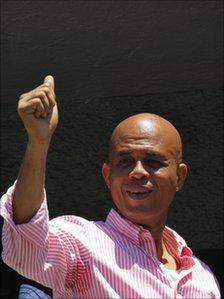 Preliminary results in Haiti's presidential election suggest musician Michel "Sweet Micky" Martelly won the runoff vote on 20 March.
He defeated ex-senator and former first lady Mirlande Manigat, officials quoted by news agencies say.
Turnout in the second round was high and voting was largely peaceful, although still marred by fraud.
Haiti is struggling to rebuild after the January 2010 earthquake and to cope with a cholera epidemic.
Final results are not expected until 16 April at the earliest.
If Mr Martelly, who's promised changed for the Haitian people, becomes the next president he will face some serious challenges, says the BBC's Andy Gallacher.
Hundreds of thousands of earthquake survivors still live in squalid tent cities as the cholera outbreak which has killed thousands remains out of control.
Mr Martelly is politically inexperienced but his message of reform appealed to Haiti's poor and unemployed, our correspondent adds.
'Better organised'
Mr Martelly benefited from the support of five candidates eliminated in the first round. Fellow musician Wyclef Jean, whose own candidacy was ruled invalid, also backed Mr Martelly.
The run-off vote was supposed to take place in January but was delayed.
Observers said the second round was much better organised than the first in November, when turnout was only 23%.
Jude Celestin, who had the backing of outgoing President Rene Preval, was initially placed second in the first round but withdrew from the race after international monitors found there had been widespread fraud in his favour.
Two people were shot dead during second-round voting in clashes between rival political factions in different rural areas.
The electoral commission extended voting by an hour because some polling stations were missing voting materials.
But the head of the commission said at the time that reports of irregularities would have "no impact on the electoral process as a whole".
Mr Preval's mandate formally ended on 7 February but he has parliamentary approval to stay in office until 14 May.
Anguilla to seek independence
Anguilla Chief Minister Hubert Hughes said that Britain's approval of his December 2010 budget is a little too late and signalled his intention to seek independence for the British Overseas Territory.
"We lost out on so much revenue, we have lost out on the deal we had with the European Union, on the EDF 10 fiscal package, we have lost out on support from the Caribbean Development Bank because these institutions will not do business with Anguilla as long as Anguilla cannot produce a proper, credible budget," Hughes told the Caribbean Media Corporation (CMC).
Governor Alistair Harrison said that the Queen, through the Secretary of State for Foreign and Commonwealth Affairs, had assented to the island's Appropriation Act, which contains the 2011 budget.
He gave no details of the amount contained in the budget, but Harrison also announced that he had approved the legislation introducing the interim Stabilization Levy; as well as amendments to the Customs surcharge and the Petroleum Levy passed earlier by the House of Assembly.
"These three measures constitute the new measures necessary to implement the budget settlement for 2011," Harrison said.
The Chief Minister said that Britain's action has underscored the need for his government to pursue independence.
“I feel very disillusioned and frustrated with British administration for Anguilla. My commitment now is to press on with my programme for self determination," he added.
Guyana ruling party selects presidential candidate
As expected, the general secretary of Guyana’s ruling People’s Progressive Party Civic (PPPC), Donald Ramotar, has been elected as the party's presidential candidate, but what came as surprise at Monday's meeting was that he was unopposed.
The other three candidates in the final stage of the race, Ralph Ramkarran, Clement Rohee and Gail Teixeira, all withdrew their candidacy.
The fifth candidate, Moses Nagamootoo did not attend Saturday's Central Executive Meeting and as a result he was not eligible to contest Monday's elections. The announcement of Ramotar's victory was made by Cabinet Secretary Roger Luncheon.
Nagamootoo, who had vehemently opposed Ramotar, said that since the general secretary's election was consensual, he would accede and support him.
The opposition People's National Congress Reform candidate is David Granger, who was elected three weeks ago.
No date for the general or municipal elections has yet been announced, but they must be held before year end.
Trinidad PM has busy week ahead in Washington
Trinidad and Tobago Prime Minister Kamla Persad Bissessar is now in Washington. She will spend the next five days holding a series of meetings and addressing organisations. On Sunday night she dined with President Barack Obama and Mrs Obama.
She will on Monday address the Brookings Institute, a non public policy organisation that aims to strengthen democracy in the United States and secure a more open, safe, prosperous and cooperative system.
The Brookings Institute is ranked as the world's top "think tank" and is considered a trusted source of independent research. Persad Bissessar's address at this forum will focus on the strengthening and diversification of Trinidad and Tobago's economy and on social development issues.
She will also hold talks with OAS Secretary General, Jose Miguel Insulza, and Assistant Secretary General, Albert Ramdin.
On Tuesday, she will deliver a keynote address at the Public Sector Leaders Forum hosted by Microsoft, which aims to bring government leaders and influential thinkers to discuss the role of information technology on an economic and educational level.
The prime minister will also hold meetings with the Trinidad and Tobago community at Howard University and on Wednesday meet with UNDP Administrator, Helen Clarke. Discussions will centre on the women leaders as agents of change programme, constitutional reform, UNDP's Citizen Security in the Caribbean and the UN system and UNDP's activities in Trinidad and Tobago.
She will also discuss security matters with Stuart Levey, the US Treasury Undersecretary for Terrorism and Financial Intelligence.
Foreign Affairs Minister, Dr Surujrattan Rambachan, Culture Minister, Winston Peters and Gender Affairs Minister, Mary King, are accompanying the prime minister.
Works Minister, Jack Warner, is acting as prime minister during her absence.
Ivory Coast: Presidential residence 'taken' in Abidjan
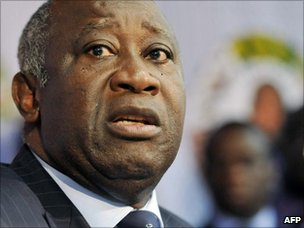 Fighting in Ivory Coast's main city, Abidjan, has taken a new turn with reports that entrenched ruler Laurent Gbagbo's residence has been captured.
Forces loyal to Alassane Ouattara, the country's internationally recognised president, said they had taken the building after a day of fierce combat.
A spokesman for Mr Ouattara, Patrick Achi, told the BBC it was not yet clear whether Mr Gbagbo had been inside.
Earlier, UN and French helicopters attacked targets near the residence.
UN Secretary General Ban Ki-moon said the attacks were ordered to defend civilians and were not a declaration of war on Mr Gbagbo.
He said Mr Gbagbo's forces had stepped up the use of mortars, rocket-propelled grenades and heavy machine-guns against civilians.
Millions of civilians have been trapped by five days of fighting in the city, where Mr Gbagbo is refusing to leave office despite UN-approved results saying Mr Ouattara won November's presidential election.
Forces loyal to Mr Ouattara began a dramatic military offensive last week, sweeping in from the north and west.
Patrick Achi, a spokesman for Mr Ouattara, said the recognised president's forces were in control of the residence and searching for Mr Gbagbo.
The residence is on many levels," he told the BBC.
"People have seen that Gbagbo was in the residence but they are still looking for him."
Asked what would happen if Mr Gbagbo was captured, he said he would be arrested and "brought to justice".
There was no word from Mr Gbagbo's camp in Ivory Coast but one of his advisers in London, Abdon George Bayeto, expressed doubt about news the residence had fallen.
"This is all propaganda and it is all a war of psychology," he said.
Earlier, UN and French helicopters attacked Mr Gbagbo's arsenal, firing missiles at his heavy weapons and military camps.
A senior peacekeeping official, Alain Le Roy, said the decision had been based on a strongly worded UN Security Council resolution authorising such action to protect civilians.
The use and calibre of heavy weapons by Gbagbo forces had, he said, escalated sharply in recent days.
The UN mission had been under almost continuous attack and had been forced to act, he said.
However, the air strikes coincided with what looked like a final assault on Mr Gbagbo's last strongholds by forces loyal to his rival Mr Ouattara, the BBC's Barbara Plett reports from the UN in New York.
Observers said the timing might not have been a coincidence as there was a sense that the months-long stand-off between the two presidential claimants was nearing its end.