
Japan earthquake: Radiation tests in Fukushima schools
Officials in the Fukushima region of Japan have started an emergency programme to measure radiation levels in school playgrounds.
More than 1,400 schools and nurseries will be tested over two days amid anxiety among parents over leaks at the Fukushima Daiichi nuclear plant.
The plant was crippled by last month's earthquake and tsunami.
Officials say there should be no risk to children if they keep outside a 30-km (19-mile) exclusion zone.
Workers at the plant have begun dumping water with low levels of contamination into the sea to free up room to store more highly radioactive water leaking at the site.
About 11,500 tonnes of water will be released.
The official death toll from the 9.0-magnitude earthquake and tsunami which struck north-east Japan on 11 March stands at 12,157, with nearly 15,500 people still unaccounted for.
More than 80% of the victims have been identified and their bodies returned to their families.
A three-day joint operation by the Japanese and US militaries to find the missing recovered 78 bodies.
More than 161,000 people from quake-ravaged areas are living in evacuation centres, officials say.

Italy Recognizes Libyan Rebel Council
Italy has become the third nation to declare the Libyan rebel interim council as the only legitimate government in the North African country, dealing a blow to separate diplomatic efforts by Moammar Gadhafi's government, as well as by two of his sons.
In Rome Monday, Foreign Minister Franco Frattini said Italy has decided to recognize the Transitional National Council as the only legitimate representative of the Libyan people. He said Italy plans to send an envoy to the eastern city of Benghazi – where the rebels' government is based – within days.
Italy follows France and Qatar in recognizing the rebel council. Frattini welcomed rebel envoy Ali al-Essawi, who said an idea to replace Mr. Gadhafi with one of his sons is unacceptable.
The New York Times has reported that at least two of the Libyan leader's sons have proposed Mr. Gadhafi relinquish power for a transition to constitutional democracy under the direction of his son, Seif al-Islam Gadhafi.
But government spokesman Mussa Ibrahim said Monday that while Libya is ready for a “political solution” with world powers, Mr. Gadhafi's future is non-negotiable. He said Libya could have “elections, referendums, anything” – but that Mr. Gadhafi must lead any political transition.
State television showed the Libyan leader briefly waving to supporters Monday outside his compound in Tripoli. It was Mr. Gadhafi's first public appearance in more than a week.
In Ankara, acting Libyan Foreign Minister Abdul-Ati al-Obeidi held talks with senior Turkish officials on brokering a cease-fire with opposition forces. Turkey said it expects to host representatives from the rebel national council in the next few days.
Meanwhile, Libyan rebels made tenuous gains Monday in the battle for a key oil town. Anti-Gadhafi fighters seized control of a largely residential area in the eastern city of Brega, where rival forces have been in a standoff for days.
But heavily armed loyalist troops later repulsed opposition attempts to advance from the New Brega section. Residents said the bulk of pro-Gadhafi forces were in strongly defended positions near the city's oil infrastructure and other strategic points.
On the western front, troops loyal to leader Moammar Gadhafi used tanks and snipers to keep the city of Misrata under siege. The International Committee of the Red Cross is appealing to combatants to allow it access to the country's third largest city, where dozens of injuries and deaths are reported from fierce fighting.
No air power was visible over Libya on Monday. As part of the planned transition to NATO command, the U.S. military withdrew its warplanes from lead missions and took a support role. In Washington, a military spokesman said American fighter jets would now fly only when requested by NATO and approved by the Pentagon.
Also Monday, Britain announced it will provide anti-government rebels with telecommunications equipment. Foreign Secretary William Hague said Britain was not arming the rebels but had responded to their requests for the shipments. He refused to disclose the exact nature of the equipment.
Hague added that an international group coordinating a political response for Libya will gather in the Qatari capital, Doha, next week.
More corpses located on NY beach
Investigators have found three more sets of human remains on a beach near New York City, bringing to eight the number of corpses found there.
Police in Suffolk County, New York suspect a serial killer.
Four dead prostitutes were found nearby in December; a fifth corpse found last week has not been identified.
The latest bodies were found in a patch of dense brush on Gilgo Beach, a barrier island south of Long Island, about 45 miles (70km) east of New York.
Police scouring the beach on foot, from helicopters and at the end of fire engine ladders discovered the three newest bodies on Monday, about a mile east of where the first group of bodies were discovered.
Officials cautioned they had yet to link the newest discoveries conclusively with the five bodies previously found.
The remains were separated by about 500m. The search was expected to continue on Tuesday.
It took investigators a month to identify the first group of remains using DNA and dental records as prostitutes who had arranged to meet clients through Craigslist and other websites, police have said.
Investigators continue to search for the remains of Shannan Gilbert, a New Jersey woman who was last seen in May at nearby Oak Beach, where she had arranged to meet a client she had met through Craigslist.
A resident of the beach told authorities a woman believed to Ms Gilbert came to his door at 0445 pleading for help, then fled.
H.E Governor Wetherell responds to No Budget Debate
Minutes after receving the Consulative Forums email today from Lilian Missick, H.E Governor Gordon Wetherell responded by saying: 
I was sorry to learn from the Chair of the Consultative Forum that tomorrow’s Budget session has now been cancelled. As the Chair has explained in her statement earlier today, there are revenue measures which must be addressed immediately if the Government is to meet its obligations and to reach one of the milestones set out in the Written Ministerial Statement of 9 December 2010 (‘implementation of budget measures to put the Turks and Caicos Islands Government on track to achieve a fiscal surplus in the financial year ending March 2013’).
Ministers made clear in that statement that the holding of elections in 2012 would depend on the milestones being reached. The public debate on the Budget in the Forum has already been postponed once. Any further delay in enactment of the budget would cost the Government money in lost revenue: money that we cannot afford to lose. In such circumstances, the Government would have to identify ways to recoup the lost income; for example, by increasing the level at which we propose to introduce the Customs Processing Fee.
I regret that the Forum is missing the opportunity for a serious debate on the Budget measures. It would have also been an opportunity for the Forum to present their final recommendations to the Ministry of Finance. But, in the absence of tomorrow’s Consultative Forum meeting, I have no choice but to take the necessary steps now enact the Budget. I have asked the Permanent Secretary for Finance to publish the statement he would have given to the Forum tomorrow. I hope that this will enable the public to see for themselves the Budget measures which are being introduced, the reasons for them and their impact.
The statement will also show the extent to which the comments made in closed session by Forum members (as also in meetings of the Advisory Council) have, wherever possible, been taken into account; for example, with respect to proposals for a sales tax on electricity and water. To further help the public, I have also asked for a summary of the budget measures to be published tomorrow.
I am grateful to the Chair of the Forum for her efforts to ensure that members of the Forum have been kept informed of, and able to comment on, the Government’s developing thinking on necessary revenue and expenditure measures if we are to meet our targets with respect to the milestones and achieving a budget surplus; and were afforded the opportunity to make any final recommendations in public session.
I regret that her wise counsel on the importance of tomorrow’s planned meeting has not been heeded by all members.
GORDON WETHERELL
RTC News will have more on this story.
Chair of the Consultative Forum cancels Budgetdebate for 2011/12
With just a day before the budget debate scheduled for Tuesday morning, RTC News received an email from the Consulative Forum Chair on the cancellation of the annual meeting.
In Miss Lillian Missick letter she states the following reasons:
During the course of the weekend, I was notified by several members of the Consultative Forum that they will not take part in the 2011/12 Budget debate due to be held on Tuesday 5 April. The effect of their absence would be to render the meeting inquorate. I have advised the Governor accordingly, and have cancelled the meeting.
It is regrettable that this move has been necessary and that the opportunity for public discussion has been missed by the Forum. Some members have argued that they will not be adequately prepared for tomorrow’s meeting. However, as I reminded all members, they have already received two extensive briefings from the Ministry of Finance in closed sessions, and have had the opportunity to offer their views which were taken into consideration.
At our meeting on 28 March, members received a Summary Sheet of the budget. I have been assured by the Ministry of Finance that the Budget Booklet, which was circulated to members on Friday, and which sets out in greater detail the particulars of the Estimate of Recurrent Revenue and Expenditure for April 2011 – March 2012, is consistent with the Summary Sheet presented to us by the Permanent Secretary, Finance. I believe, therefore, that having had the benefit of the discussions with the PS/Finance and this assurance, we were in a position to proceed with the public Budget session which had already been postponed once for our benefit.
I have also pointed out to members that, given the current state of the country's financial affairs, there are revenue measures that must be addressed immediately for the Government to meet its obligations and for us to achieve the milestones within the stated timeframe to enable elections to take place in 2012. I am therefore disappointed that the public will not have the opportunity to hear the Permanent Secretary Finance read the 2011/12 Budget statement to the Forum or the ensuing debate as planned on 5 April.
Notwithstanding the foregoing, I wish to register my appreciation to the Budget Team for their sterling efforts.
Lillian Misick
Polluters shall pay…..
The Department of Environment and Coastal Resources (DECR) has said its courtroom victory last week against the TCI Fuel Giant Sun Oil Limited, previously known as Shell Bahamas, signals its strong commitment to prosecuting big businesses for pollution in the Turks and Caicos Islands.
“These islands are beautiful by natures, and the DECR has a mammoth task to ensure that the environment is not destroyed. Armed with newly established anti-pollution ordinances, the DECR will take all steps necessary to ensure that all polluters pay, it makes perfect sense that if you pollute this environment then you should pay the cost” explained the Director of the DECR, Mr. Wesley Clerveaux.
On December 30, 2010, there was a spill of approximately 721 gallons of diesel fuel at the Sun Oil pump facility on South Dock, Providenciales. Although much of the spill was absorbed into the soil, approximately 100 gallons of the offensive substance reached the marine environment.
The DECR presented evidence which showed that numerous inspections of the facility were conducted by staff of the DECR in collaboration with the Fire and Rescue Department on November 17, 18, and 19, prior to the spill. Following these inspections, a report was prepared of the findings and the departments concerns over the rusted pipes as a potential source of leakage was shared with the company. The DECR urged the company to take urgent remedial actions to avoid an eminent accident or disaster.
The defendants explained that the spill occurred as a result of repair works which were being undertaken at the pump station, and as such offered apologies to the court for the miss-hap. Since the spill, the company was able to show that they took immediate action to clean-up the environment and fast-track repair and remedial work to the fuel pump station.
The Magistrate in considering the matter took into account the circumstances which led to the spill and the remedial actions which were undertaken by Sun Oil, and ordered a fine of $10,000.00 or six months imprisonment.
The Coastal Protection Ordinance 1992 states that “every person who places or deposits …..any offensive substance on the coast, or who causes of allows any offensive substance to be deposited in the sea…..shall be guilty of an offence and liable on conviction to compensate the owner or owners of such coast for all damage done as a direct or indirect result of the offence and shall be further liable on summary conviction to a fine of $25,000.00 or to a term of imprisonment for two years.”
Afghanistan: Ban Ki-moon condemns UN staff killings
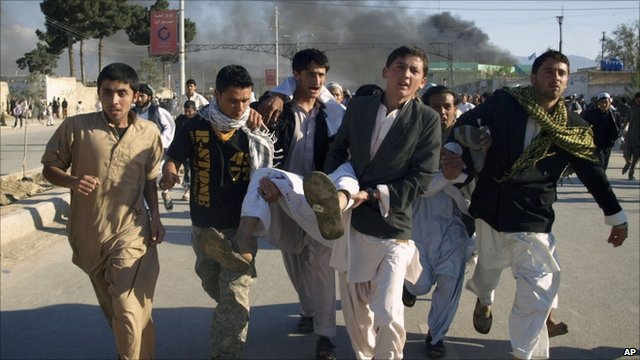 UN Secretary General Ban Ki-moon has condemned an attack on a UN building in Afghanistan as "outrageous and cowardly".
At least 12 people were killed when demonstrators torched the building in the city of Mazar-e Sharif.
Three UN workers and four Nepalese guards were among the dead.
Local officials said clerics had urged people to protest over last month's burning of a copy of the Koran in the presence of US pastor Terry Jones.
He has denied responsibility for the violence in Afghanistan.
Witnesses said the protest began peacefully but suddenly turned violent.
Several demonstrators were killed by guards, who were then overpowered by the mob.
Local police told the BBC that 27 people had subsequently been arrested.
Dan McNorton, spokesman for the UN mission in Afghanistan, said: "Three international Unama (United Nations Assistance Mission in Afghanistan) staff members were killed, and four international armed security guards were killed."
Initial reports said eight foreign UN workers had died.
Swedish Foreign Minister Carl Bildt later confirmed that one of the dead was a Swede, 27-year-old UN worker Joakim Dungel.
The Norwegian defence ministry said another of those killed was Lt Col Siri Skare, a 53-year-old female pilot. The other foreign victims are believed to be a Romanian and four Nepalese guards.
US President Barack Obama condemned the attack "in the strongest possible terms", saying the work of the UN "is essential to building a stronger Afghanistan".
The top UN representative in Afghanistan, Staffan De Mistura, has flown to the area to handle the matter.
Weapons seized
Witnesses said a crowd of several hundred staged a protest outside the Blue Mosque in the city after Friday prayers.
The crowds moved to outside the UN compound, where a small group broke away.
Munir Ahmad Farhad, a spokesman for Balkh province, said the group seized weapons from the guards and opened fire before storming the building.
Local police spokesman Lal Mohammad Ahmadzai told reporters that two of the UN staff had been beheaded.
However, police Gen Abdul Rafu Taj said that "according to the initial reports... none were beheaded". He said they were shot in the head.
Kieran Dwyer, director of communications for the UN mission in Afghanistan, said the UN workers had been trapped inside the compound and "hunted down" in what was an "overwhelming situation".
"These are civilian people, unarmed, here to do human rights work, to work for peace in Afghanistan - they were not prepared for this situation," he told the BBC.
Mr Dwyer said it was too early to tell how the attack happened or why the UN was targeted, but that the organisation would now take extra security measures.
But he added: "The UN is here to stay. We're here to work with the people to help them achieve peace, and this sort of thing just highlights how important that is."
On 20 March, Pastor Wayne Sapp set light to a copy of the Koran at a church in Florida.
The burning took place under the supervision of Pastor Jones, who last year drew condemnation over his aborted plan to burn copies of the Koran on the anniversary of the 9/11 attacks.
Protests were held in several other Afghan cities on Friday which demonstrators in Herat had called a "day of anger", Afghanistan's Noor TV channel reports.
Gaza: Hamas militants killed in Israeli air strike
The Palestinian Islamist group, Hamas, has warned Israel of "consequences" after an air strike in Gaza killed three members of its military wing.
The Izz al-Din Qassam Brigades militants were killed near the southern town of Khan Younis, a statement said.
Medics and witnesses said the men had been travelling in a car at the time, and that one person was also injured.
An Israeli military spokeswoman said it was a pre-emptive strike against militants planning to kidnap Israelis.
The "terror squad" was plotting attacks in Egypt's Sinai Peninsula and in Israel during the Jewish festival of Passover later this month, she added.
Sinai is a popular destination for Israelis during the week-long holiday.
Militants in Gaza are still holding the Israeli soldier Sgt Gilad Shalit, who was captured in a cross-border raid in 2006. Hamas is demanding hundreds of Palestinian prisoners are freed in return for his release.
'Serious escalation'
The missile hit the militants' car as it was travelling between Khan Younis and the Deir al-Balah refugee camp, south of Gaza City, just before 0200 on Friday (2300 GMT on Thursday), witnesses said.
Three charred bodies were later pulled from the vehicle, they added.
Medical officials said one Palestinian was also wounded in the strike.
Hamas, which controls the Gaza Strip, described the strike as a crime and "serious escalation" of the recent violence, and vowed that Israel would "bear all the consequences".
There has been a spike in violence along the Gaza-Israel border in recent weeks, but both sides have said they want to avoid a major confrontation.
Libya air raid 'killed civilians'
Seven civilians died and 25 were hurt in a coalition air strike on a pro-Gaddafi convoy in eastern Libya, a doctor there has told the BBC.
Dr Suleiman Refardi said Wednesday's raid happened in the village of Zawia el Argobe, 15km (9 miles) from Brega.
The strike hit a truck carrying ammunition, and the resulting explosion destroyed two nearby homes.
All the dead were between the ages of 12 and 20, Dr Refardi said. Nato says it is investigating the claim.
The news comes as the chairman of the rebel Transitional National Council, Mustafa Abdul Jalil, said it would agree to a ceasefire if Col Muammar Gaddafi's troops withdrew from cities.
"We agree on a ceasefire on the condition that our brothers in the western cities have freedom of expression and also that the forces that are besieging the cities withdraw," he told a news conference in the eastern rebel stronghold of Benghazi.
But he said the rebels would not back down on their demand that Col Gaddafi must go.
Libyan government spokesman Moussa Ibrahim dismissed the offer by its former justice minister, telling reporters: "The rebels never offered peace. They don't offer peace. They are making impossible demands."
"We will not leave our cities. We are the government, not them."
'No anger'
Dr Refardi told the BBC that the Libyan government convoy had included tanks, artillery and trucks carrying ammunition.
A direct hit on an ammunition truck and trailer in a street in Zawia el Argobe sent a hail of shrapnel into nearby houses, he said.
Four of the dead were female, including three children from the same family, aged between 12 and 16, the BBC's Ben Brown reports from Brega.
Three boys, aged between 14 and 20, were also killed.
Dr Refardi said he had spoken to the family of the girls who had been killed and "there was no anger" at the coalition forces.
"If these tanks had entered Ajdabiya it would have been a massacre," he said.
"They [the Libyan people] are expecting more than this, because they know the Gaddafi forces are using civilians as a shield."
Nato officials told the BBC they were making inquiries "down our operations chain to find out if indeed there is any information on the operation side that would support this claim".
Later, Libyan government spokesman Moussa Ibrahim said six civilians had been killed by the "immoral" air strike, and described it as a "crime against humanity".
"Some mad and criminal prime ministers and presidents of Europe are leading a crusade against an Arab Muslim nation," he told a news conference in Tripoli. "Sounds familiar? It's a crime against humanity."
Meanwhile, the BBC's Wyre Davies in Ajdabiya says rebel forces there are pressing on to the front line around the oil town of Brega.
Plenty of enthusiastic, if disorganised, insurgents are driving through in pick-up trucks with heavy-duty machine-guns mounted on the back, he reports.
The BBC's Nick Springate in Brega says the flagging morale of rebel fighters - in general poorly equipped and untrained - has been boosted by a number of well-armed, apparently well-trained soldiers in full military uniform. It is not clear where they have come from, our correspondent adds.
Gen Abdel-Fatah Younis, the former Libyan interior minister who defected to the rebels, has also addressed rebels outside Brega.
Earlier, the BBC learned that a Libyan government envoy, Mohammed Ismail, had been in London in the past few days for talks with UK authorities.
The UK Foreign Office says that in all its contacts with Libyan officials, it had made it clear that "Gaddafi has to go".
News of the visit emerged after former Libyan Foreign Minister Moussa Koussa flew to Britain and was said to have resigned his post.
There have since been other unconfirmed reports that more senior Libyans are defecting.
Al-Jazeera TV said the intelligence minister, deputy foreign minister and General People's Congress speaker were awaiting flights in Tunisia.
Oil minister Shukri Ghanim has denied reports he is to leave Libya.
Ivory Coast: '800 die in Ivory Coast ethnic violence'
At least 800 people have been killed in the western Ivory Coast city of Duekoue this week, the International Committee of the Red Cross (ICRC) has said.
They died in inter-communal violence in one district of the city, it added.
The head of the ICRC delegation in the country said the event was particularly shocking in its scale and brutality.
Fighting has continued in Abidjan between forces loyal to the UN-recognised president Alassane Ouattara and the incumbent, Laurent Gbagbo.
Mr Ouattara was internationally recognised as president last year after the electoral commission declared him the winner of a November run-off vote, but Mr Gbagbo also claimed victory and refused to leave office.
'Fearing for their lives'
The ICRC said delegates and volunteers from the Ivorian Red Cross had visited Duekoue on Thursday and Friday to gather evidence of the killings, which are believed to have taken place on Tuesday.
There is no doubt that something on a large scale took place in this city, on which the ICRC is continuing to gather information," ICRC spokeswoman Dorothea Krimitsas told the AFP News agency.
She said the Red Cross representatives had "themselves seen a very large number of bodies". They took 28 bodies to the local morgue and more would be removed in the coming days, she added.
"Everything seems to indicate that this was inter-ethnic violence."
The head of the ICRC delegation, Dominique Liengme, said in a statement: "This incident is particularly shocking in its size and brutality."
"The ICRC condemns direct attacks on civilians and reminds the parties to the conflict to make sure that people in the territory under their control must be protected under all circumstances," she added.
The Geneva-based organisation said tens of thousands of women, men and children had fled fighting in Duekoue since Monday.
The city lies on a strategic crossroads in the west of Ivory Coast and has been under the control of forces loyal to Mr Ouattara since Tuesday.
The International Organisation for Migration (IOM) said many Duekoue residents were heading to the nearby town of Guiglo "fearing for their lives".
Gbagbo 'going nowhere'
The national army has put up almost no resistance since Mr Ouattara's supporters launched an offensive to oust Mr Gbagbo on Monday, sweeping down from the north to capture the capital, Yamoussoukro, and the key port of San Pedro.
However, they have been unable to defeat those still loyal to the former president in parts of Ivory Coast's main city, Abidjan.
There have been fierce clashes outside the presidential palace and the headquarters of state television in the upmarket district of Cocody. Fighting has also been reported in Plateau and Agban areas.