
Japan quake: Explosion at Fukushima nuclear plant
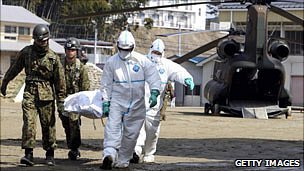 A second explosion has hit the nuclear plant in Japan which was damaged in Friday's earthquake, but officials said it had resisted the blast.
TV footage showed smoke rising from Fukushima plant's reactor 3, a day after an explosion hit reactor 1.
Japan's nuclear safety agency said the blast was believed to have been caused by the build-up of hydrogen.
However, the agency said it could not confirm whether there had been an uncontrolled leak of radioactivity.
Technicians have been battling to cool three reactors at the Fukushima 1 plant since Friday, when the quake and tsunami combined to knock out the cooling system.
The natural disaster killed hundreds and left thousands missing, sparking a huge rescue operation.
The government has pumped 7 trillion yen ($86bn; £54bn) into the economy to prop up the markets - which slumped on opening.
Japanese broadcaster NHK says the total number of confirmed deaths caused by the disaster now stands at 1,596.

Japan's Nikkei falls 4.5% in first session after quake
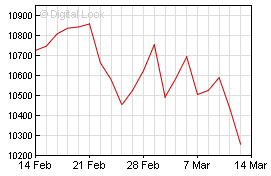 Japanese shares have tumbled on the first trading day after the massive earthquake and tsunami that hit the country's northeast shore.
The benchmark Nikkei 225 Index fell 4.5%, while the broader Topix index was trading 6% lower.
At one point the Nikkei dropped by almost 6%, knocking more than $150bn off its total market value.
The Bank of Japan will inject 7 trillion yen ($85bn; £52.9bn) into the banking system to stabilise markets.
Immediately after the quake, the central bank pledged to "do its utmost" to limit its impact, including providing liquidity to money and banking markets.
The deadly quake and subsequent tsunami hit Japan just before the markets closed on Friday.
"The recent major earthquake is bound to exert downward pressure on Japanese equities as a whole over the near term," Nomura said in a note to investors.
Elsewhere in the region, the main markets have also fallen on Monday, though the declines were smaller than those seen in Japan.
South Korea's Kospi share index slid 0.9%. Singapore's STI index shed more than 0.4% and Taiwan's main index dropped 0.8%.
Production troubles
Japanese carmakers and electronics firms led the declines on Monday.
Early trading was complicated because many sellers of shares struggled to find buyers. As a result, a number of stocks remained untraded once the markets had opened.
Shares of Toyota Motors, the world's biggest automaker, fell 8.9% after it suspend operations at all of its 12 Japanese factories.
Japanese factories account for 38% of Toyota's overall production.
Honda, Japan's third-largest automaker, fell 9.1%. The company makes about a quarter of all its cars in Japan.
Electronics companies including Hitachi and Toshiba also dropped, shedding more than 15%.
Japanese Economics Minister Kaoru Yosano was quoted by the Jiji news agency saying that he was keeping a close eye on the movement of Japan's currency, the yen, which has strengthened.
Economists said that a stronger yen may make it harder for companies to sell their goods abroad, further hurting their earnings.
'Weakened Japan'
Analysts said that there were concerns about the speed with which Japan's economy could rebound from the problems.
Last month Japan was overtaken by China as the world's second-largest economy.
"In the short term, the market will almost surely suffer and stocks will plunge," said Koetsu Aizawa, economics professor at Saitama University.
"People might see an already weakened Japan, overshadowed by a growing China, getting dealt the finishing blow from this quake."
Some analysts have forecast that Japan's economy may lose as much as a percentage point in growth this year because of the quake.
Japan's economy contracted by a more-than-expected 1.3% in the final three months of 2010.
Rebuilding effort
However, while there are concerns about the short-term impact on the economy, there are industries where investors are looking to increase their holdings.
Shares in Japanese construction firms have surged in value on Monday as they are expected to play a central role in rebuilding the country in coming months.
Foreign firms have also been in focus, notably technology producers and carmakers, where shares have been gaining.
Investors, for example, are expecting an increase in orders for Korean goods because production has been suspended in many of Japan's factories.
Chevron appeals against Ecuador Amazon pollution fine
US oil giant Chevron has launched a legal appeal against a $9.5bn (£5.9bn) fine by an Ecuador court for polluting much of the country's Amazon region.
Chevron accused lawyers and supporters of the indigenous groups who brought the case of "corrupting" the trial.
It said the judgement contained "numerous legal and factual defects".
The oil firm Texaco, which merged with Chevron in 2001, was accused of dumping billions of gallons of toxic materials into unlined pits and rivers.
Protesters said the company had destroyed their livelihood. Crops were damaged, farm animals killed and cancer increased among the local population, they said.
Drawn-out fight
An appeal by Chevron had been widely expected. A statement by Chevron said the firm would pursue efforts at an international tribunal and in the US courts to prevent the ruling from being enforced.
No payment can be made during the appeals process, which could drag on for years.
The appeal is the latest twist in the case, which was brought on behalf of 30,000 Ecuadoreans nearly two decades ago.
Ecuadorean Indian groups said Texaco dumped more than 18 billion gallons (68 billion litres) of toxic materials into the unlined pits and rivers between 1972 and 1992.
The plaintiffs said the company's activities had destroyed large areas of rainforest and also led to an increased risk of cancer among the local population.
The trial began in 2003 after almost a decade of legal battles in the US. At that time, a US appeals court ruled that the case should be heard in Ecuador.
Environmentalists hope the case will set a precedent, forcing companies operating in developing countries to comply with the same anti-pollution standards as in the industrialised world.
Greece, Portugal Face New Credit Warning
A leading financial services company says it could further downgrade the credit standing of Greece and Portugal as the two countries struggle to control the finances of their debt-ridden governments.
Standard & Poor's said Wednesday it is keeping both nations on a credit watch with "negative implications." The credit-rating firm said it is watching to see whether European leaders later this month reshape the continent's mechanism to bail out governments with large debts.
Greece accepted a $146 billion bailout last year from other European countries, while Ireland took $113 billion in outside aid. Portugal might be next to seek international assistance, although its leaders have vowed that would not be necessary.
Countries with lower credit ratings are forced to pay substantially higher costs to borrow money to finance government operations. That makes it even more difficult to erase debt problems. Germany has Europe's strongest economy and its bonds carry the lowest interest rate, about 3 percent. By contrast, debt-burdened Greece pays 12 percent.
Some financial analysts and European government leaders think Spain might also have to seek international financial aid. Spain, Ireland and Greece are the only three of the 27 European Union nations that had shrinking economies last year.
Spain has the highest unemployment rate in the industrialized world, more than 20 percent. Its jobless rate hit a 15-year high in February. As more unemployed workers seek unemployment compensation, it further squeezes government spending for other programs.
European Leaders Agree to Closer Economic Cooperation
Leaders of the 17 European nations that use the euro have agreed “in principle” to limit public debt and coordinate their economic policies.
The so-called “pact for the euro” is to be formally adopted at a summit of all 27 European Union members later in the month .
The president of the European Council, Herman Van Rompuy, said though there has been an agreement in principle, other elements of the package are still being discussed.
The agreement is designed to fulfill a German demand that the EU's weaker economies accept national debt limits in the wake of last year's bailouts for Greece and Ireland.
In spite of the bailouts, both countries are facing higher interest rates from lenders worried about getting paid back.
Just before the Brussels meeting, Portugal, which also has a weak economy, announced another round of tax increases and spending cuts in an effort to reduce its deficit and improve government finances.
Obama to Face Reporters on High US Gasoline Prices
The White House says President Barack Obama will hold a news conference Friday morning to answer questions about rising U.S. gasoline prices.
Officials say he likely will be asked about the turmoil in Libya, which has been a major cause of high oil prices.
The cost of a barrel of oil fell Thursday in London and New York, where it dropped $1.68 to $102.70 on worries that slow economic growth would cut energy demand.
Prices were up for a while Thursday on concerns that supplies might fall short after more fighting in Libya and a report that police shot at demonstrators in Saudi Arabia.
Traders are nervous that the unrest that toppled governments in Egypt and Tunisia and fighting in Libya could spread to Saudi Arabia, the world's largest oil exporter.
Japan quake: Fukushima plant alarming, says Naoto Kan
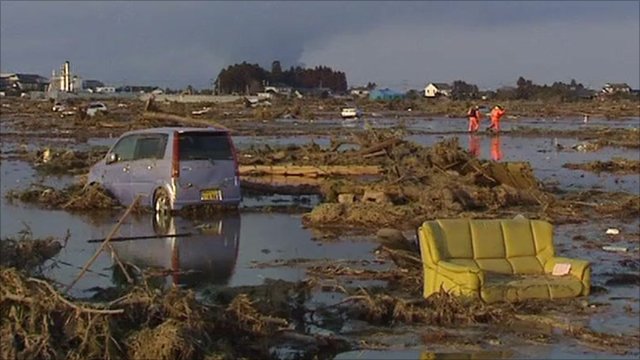 A nuclear plant damaged in Friday's quake remains in an alarming state, Japan's Prime Minister Naoto Kan says.
The casing of a reactor at Fukushima 1 plant exploded on Saturday, and another faces meltdown, but officials said only minimal radiation had been released.
The authorities ordered nationwide power outages after being forced to close all the country's nuclear plants.
The quake and a tsunami killed hundreds and left thousands missing, sparking a huge rescue operation.
The government has pumped 7 trillion yen ($86bn; £54bn) into the economy to prop up the markets - which slumped on opening.
Cooling malfunction
Japanese broadcaster NHK says the total number of confirmed deaths caused by the disaster now stands at 1,596.
Local officials have suggested many thousands more are missing across the north-east of Honshu island, but the situation remains unclear.
Japan's nuclear plants closed down automatically when the earthquake struck, and appear to have withstood the tremor.
But experts believe the massive tsunami that followed damaged cooling systems and wrecked the back-up power supply at Fukushima 1.
Technicians have been battling to control the pressure and temperature in the reactors for days, pumping in seawater and releasing vapour containing radioactive elements.
But the casing around one reactor exploded on Saturday, and senior officials conceded late on Sunday that a similar explosion was still possible at another reactor.
Tens of thousands of people have been evacuated from the area around the plant.
At least 22 people are now said to be being treated for the effects of exposure to radiation.
But the government says the amount of radioactive material released from the plant is so far still minimal.
And experts say the risk of a disaster on the scale of Chernobyl in the 1980s is highly unlikely because the reactors are built to a much higher standard and have much more rigorous safety measures.
Economic blow
Earlier, Mr Kan said the earthquake had thown Japan into "the most severe crisis since World War II".
He announced that from Monday, the country would have to endure rolling power cuts, and urged citizens to conserve energy.
The BBC's Mariko Oi in Tokyo says it is still not clear when the power outages will begin.
But she says the government has advised people not to go to work or school on Monday because the transport network cannot deal with demand.
And the capital is also still experiencing regular powerful aftershocks.
Meanwhile, tens of thousands of relief workers, soldiers and police have been deployed to the disaster area.
Rescue workers have found scenes of total devastation in isolated coastal towns north-east of the main port city of Sendai, which was itself partially destroyed by the waves.
Preliminary estimates put repair costs from the earthquake and tsunami in the tens of billions of dollars, a huge blow for the Japanese economy that - while the world's third largest - has been ailing for two decades.
Japan’s Quake Could Be Most Expensive
The full extent of the economic impact of Friday's earthquake and tsunami in Japan is not yet clear, but some experts say it could be the most expensive in history.
Hundreds of factories across Japan, including carmakers Toyota and Nissan, are closed as a result of damage or power outages. Energy providers are warning of blackouts throughout the country in the coming days, because they are unable to meet the demand.
Thousands of homes have been destroyed. About two million are left without electricity and water.
A U.S.-based consulting group, AIR Worldwide, said Sunday that insured property loses from the earthquake alone could be between $15 billion and $35 billion.
Risk consultancy Equecat has estimated that the economic cost from the 8.9-magnitude earthquake will total more than $100 billion. That estimate does not include the cost of the clean-up and long-term monitoring of nuclear reactors for radiation leaks.
The Bank of Japan said Monday it will inject $86 billion into the financial system to help stabilize the country's export-led economy.
The 1995 earthquake in Kobe was one of the world's most expensive natural disasters. It killed more than 6,000 people and caused more than $132 billion worth of damage.
Wikileaks row: US spokesman Crowley quits over gaffe
US state department spokesman PJ Crowley has resigned after calling the treatment of the man accused of leaking secret cables to Wikileaks "stupid".
He said he was taking responsibility for the impact of his remarks about Bradley Manning.
Private Manning is being held in solitary confinement at a maximum security US military jail.
He has been on suicide watch at the Quantico marine base in Virginia and is shackled at all times.
He faces 34 charges relating to the leaking of 720,000 diplomatic and military documents.
Secretary of State Hillary Clinton said she accepted Mr Crowley's resignation "with regret".
She said he had served his nation "with distinction", "motivated by a deep devotion to public policy and public diplomacy".
Mr Crowley was speaking to an audience at the Massachusetts Institute of Technology about new media and foreign policy when he made the controversial remarks.
He was asked by a participant about the "the elephant in the room" - Wikileaks - and, in the questioner's words, "torturing a prisoner in a military brig".
"I spent 26 years in the air force," Mr Crowley reportedly replied.
"What is happening to Manning is ridiculous, counterproductive and stupid, and I don't know why the DoD [Department of Defense] is doing it. Nevertheless, Manning is in the right place."
He said his comments were on the record, though he later added that they were his own opinion.
In his resignation letter he said: "Given the impact of my remarks, for which I take full responsibility, I have submitted my resignation."
His remarks were revealed in a blog by the BBC's Philippa Thomas, who attended the event.
President Barack Obama later insisted he had received assurances that the terms of Pte Manning's confinement were "appropriate".
Earlier this year, rights organisation Amnesty International expressed concern about the conditions in which Mr Manning was being held.
It said he had been held "for 23 hours a day in a sparsely furnished solitary cell and deprived of a pillow, sheets, and personal possessions since July 2010".
He was also reportedly forced to disrobe on a daily basis.
Bahrain unrest: Manama erupts in violence
Bahraini police and protesters have clashed in several areas of the capital, Manama, in some of the worst unrest for weeks.
Security forces used tear gas and rubber bullets to battle protesters who had managed to blockade main roads into the financial district.
Clashes were also reported in the city's main square and university.
Mainly Shia protesters, inspired by the uprisings in Egypt and Tunisia, want the reform of the Sunni monarchy.
They have threatened to march on the royal palace if their demands are not met.
Roadblocks
Police killed seven protesters last month at the height of the unrest, but since then, clashes with the security forces have been rare.
But on Sunday - which is a normal working day in many countries in the region - clashes broke out in three areas of Manama.
First, protesters blocked roads into the financial district, and were tackled by police using tear gas.
"No-one was able to go to work today. Thugs and protesters were blocking the highway," one worker, Sawsan Mohammed, told the AP news agency.
Then security forces moved to try to clear protesters from Pearl Square, which has been largely occupied by demonstrators for a month.
They fired tear gas and rubber bullets, but witnesses said thousands of protesters swarmed into the square and eventually forced the police to retreat.
There were also clashes between pro- and anti-government demonstrators at Bahrain University.
Bahrain's royals renewed their offers of dialogue, but moments later a speaker at Pearl Square said "no dialogue, no dialogue" to cheers from the crowd.
Bahrain - home to the US Navy's Fifth Fleet - is the first Gulf country to be thrown into turmoil by the wave of unrest sweeping the Arab world.
The US called for the government to have "peaceful and meaningful dialogue with the opposition rather than resorting to the use of force".
The UK government, which is warning its citizens to stay away from Bahrain, said there were fresh reports that Saudi soldiers were about to enter the country.
Shia account for about 70% of the country's 525,000 people, but the country has been ruled by a Sunni monarchy for hundreds of years.