
Guyana opposition presidential candidate agrees to coalition
Retired Brigadier David Granger, who was last weekend elected as the presidential candidate for Guyana’s main opposition People's National Congress Reform (PNCR), said he remains committed to his party's position to an opposition coalition to contest the 2011 general elections.
However, he wants to know on what basis the coalition presidential candidate would be named, and if and why he should cede his presidential candidacy.
He made the comment at his party's news conference on Friday.
Party leader Robert Corbin, who was present at Friday's briefing, reiterated his party's commitment to a coalition. He disclosed that he entered into discussions on coalition with the other parties without touching on the presidential candidate for the coalition forces.
Corbin said that he is having more meetings with the opposition parties next week.
Granger, in response to a question about his running mate, said that the Central Executive Committee and the General Council of the PNCR will make that decision in due course.

Cuba puts American on trial
The trial of an American telecommunications contractor started in Cuba on Friday.
The contractor, Alan Gross, faces a possible 20-year sentence for what the Cuban government calls an "act against the integrity and independence" of the country.
He is accused of trying to build communications networks among the Cuban opposition.
BBC Caribbean reported that it's a case that some observers believe could have a profound impact on relations between Cuba and the United States.
Sixty-one year old Gross was carrying out work for the US government's foreign aid and democracy agency, USAID, when he was arrested in December 2009.
His family, American and company officials, say he was bringing communications equipment to Cuba's 15,000 strong Jewish community. But Cuban Jewish groups deny having anything to do with him.
The American civil rights leader Jesse Jackson this week offered to intervene to see Gross's release.
Jamaica's 44 magistrates on strike for better remuneration and working conditions
Jamaica's 44 resident magistrates stayed off of the job on Thursday in a rare protest against working conditions, including security, and remuneration. The strike kept clerks of court across the island busy rescheduling cases and extending bail for scores of people who had turned up to have their cases dealt with.
The Jamaica Observer reported that "the judges are upset and frustrated that long standing concerns by the justice ministry have not been addressed."
One magistrate told the Observer on condition of anonymity, "The issues include personal security, which is not provided for resident magistrates, improvements in their compensation package to include higher salaries, faster payment of allowances like travelling and subsistence, some of which are between four and six months in arrears, a greater scope for upward mobility, and recognition of RMs as members of the judiciary, rather than as civil servants."
According to the magistrate, there was no plan to have the sick-out coincide with Justice Minister Dorothy Lightbourne's appearance on Thursday at the Commission of Enquiry into the government's handling of the United States' extradition request for Christopher ‘Dudus’ Coke.
The magistrate said that the industrial action was originally planned for two days.

Oil prices in Asia stick near their recent high levels
Oil prices are hovering near recent highs after an air strike in Libya and fresh clashes between government forces and rebels fanned supply fears.
Brent crude was 0.2% higher at $116.58 in Asian trade. Earlier in US trading, it had almost touched $118 a barrel.
US light, sweet crude was 0.4% higher in Asia at $102.61.
Analysts warned prices would climb further if conditions in Libya and the Middle East worsened, fuelling inflation and slowing global growth.
"Any time oil moves higher, it gets people nervous about future growth and inflation," said Bart Melek of TD Bank Financial Group.
Short-term solution?
Stock markets in Asia were mixed as investors priced in a better-than-expected industrial output figure from South Korea.
Seoul's main Kospi index added 1% in early trading, while Japan's Nikkei 225 index gained 0.5%.
However, analysts warned that markets would remain volatile in the near future.
Robert Lutts of Cabot Money Management said that stock markets were adjusting to the new environment of high oil prices and beginning to realise that there was no short-term solution.
"We are going to live with this uncertainty for a some time," he said.
Japanese and Korean firms look to Brazil for rare earth
A consortium of Japanese and South Korean firms are to take a share of a Brazilian rare earth miner.
The group includes Japan's Nippon Steel and South Korea's Posco and National Pension Service (NPS).
They will pay $1.95bn (£1.19bn) for a 15% stake in Brazil's Companhia Brasileira de Metalurgie e Mineracao (CBMM).
Japan and South Korea are joining up to secure supplies of valuable minerals for the manufacture of hi-tech goods.
China, which currently controls 90% of the world's rare earth supply, has recently reduced exports because of growing domestic demand.
Reducing reliance
Japan and South Korea are both big users of the rare earth minerals that are key in the manufacture of goods like flat screen televisions and hybrid cars.
In February, Japan said it would reduce its reliance on imports from China of rare-earth metals by a third.
A spokesman for South Korea's National Pension Service said that Japanese investors including Nippon Steel, JFE Holdings and Sojitz Corp will buy a 10% stake in CBMM.
Whilst South Korea's Posco and NPS will jointly buy 5% of the unlisted Brazilian company.
CBMM produces niobium, a rare metal used in the manufacture of high-grade steel for cars and other products.
Congress delays US government shutdown over budget cuts
The US Congress has passed a bill extending funding for the federal government by two weeks, staving off a possible government shutdown.
It comes as politicians continue to tussle over Republican plans to cut federal domestic spending by a quarter.
The bill contains $4bn (£2.5bn) in agreed cuts, well short of the $60bn targeted by Republicans.
Meanwhile, Federal Reserve chairman Ben Bernanke said the cuts plan would cost the US economy 200,000 jobs.
"I would like to see job creation," said Mr Bernanke, speaking to the House Financial Services Committee, adding that the impact was "not trivial".
'Modest' growth
The 200,000 figure he cited is equivalent to about 0.13% of the US labour force.
His estimate was well below the 700,000 potential job losses cited by some Democrats, but conflicted with Republicans' claims that their cuts plans would be job-creating.
In contrast, the Fed chairman said the likely impact of the cuts on growth would only be about 0.2% this year and 0.1% next.
His comments came as the Fed announced that the US economy had grown in the last two months at a "modest to moderate rate".
The monetary authority's "Beige Book" - which collates anecdotal evidence and leading indicators about the economy - said wage growth remains weak.
However, it also noted that job prospects "modestly improved across the economy" in January and early February.
Republicans control the House of Representatives - the lower chamber of Congress - but not the Senate.
They have been threatening Washington DC with an effective shutdown if the cuts are not passed, by refusing to raise the federal government's borrowing limit.
Although the government cannot exceed its borrowing cap by law, perversely that does not prevent Congress passing legislation that creates unfunded spending commitments.
House Representatives endorsed a tax-cutting package at the end of last year that significantly increased the current US budget deficit.
The extension bill only postpones the day of reckoning by two weeks, to 18 March, with Democrats claiming that is not enough time to reach an agreement over the budget.
Counter-proposal
"We cannot keep doing business this way," said President Barack Obama, shortly before he signed the stop-gap bill into law.
"Living with the threat of a shut-down every few weeks is not responsible, and it puts our economic progress in jeopardy."
Senate Democrats are preparing their own counter-proposal to the Republicans' cuts.
Mr Obama has asked Vice-President Joe Biden to broker an agreement between the two sides.
The federal government last experienced a shut-down in the mid-90s during Bill Clinton's presidency.
On that occasion, most voters blamed Newt Gingrich's Republicans.
But this time round it is unclear whose electoral prospects would be damaged if a deal is not reached.
Brazil raises interest rates to 11.75%
Brazil's central bank has raised its key interest rate to 11.75% in a bid to hold down inflation in one of the world's fastest-growing economies.
The rise, from 11.25%, is the second half-point increase since the start of the year.
It is also the second under President Dilma Rousseff and central bank head Alexandre Tombini, both of whom took office in January.
Inflation was 5.91% last year and is forecast to remain above 5% in 2011.
The rate rise came on the same day as news of a modest rebound in Brazilian industrial production, which increased by 0.2% in January from the previous month.
This was far better than the consensus forecast of a 0.7% decline and came after a 0.8% month-on-month decline in December.
Currency headache
Although the rate rise may help to curb inflation, it risks sucking in foreign money, increasing upward pressure on the already overvalued Brazilian real.
Capital inflows from outside Brazil have soared as investors flee record-low rates in more developed countries.
The strengthening of the real has hit Brazil's manufacturers hard because their exports have become more expensive.
"Despite the improving picture for industry in the very latest data, the bigger picture is that manufacturers are still struggling to live with the effects of a stronger currency," said Neil Shearing, senior emerging markets economist at Capital Economics.
Last month, in another effort to stop the economy overheating, the government said it would implement 50bn reais ($30bn; £19bn) of spending cuts.
But Brazil should do more to rein in a massive consumer credit boom that has helped fuel the economy's rapid expansion, analysts say.
Mr Shearing at Capital Economics said the government needed further fiscal tightening to ensure more balanced growth.
"This, in turn, will require a radical, and politically very difficult, overhaul of the public finances that goes well beyond the 50bn reais of spending cuts that were recently announced," he said.
The Brazilian economy, Latin America's largest, grew more than 7% in 2010 and is expected to grow between 4.5% and 5% this year.
Other anti-inflation measures have included a big increase in banks' reserve requirements to hold back lending.
Serena Williams seeks summer return after emergency op
 Wimbledon women's champion Serena Williams has targeted "early summer" as her return date following emergency surgery for a blood clot on her lung.
She is recuperating at home under medical supervision after suffering a haematoma following treatment last week for a pulmonary embolism.
In a statement, the 29-year-old said it had been a "hard, scary" experience.
"While I can't make any promises now on my return, I hope to be back by early summer," she added.
"That said, my main goal is to make sure I get there safely."
It means that the race is on for her to be fit for the French Open at Roland Garros from 22 May to 5 June.
Failing that the next target would be the defence of her Wimbledon title, with the championships starting on 20 June and running to 3 July.
A spokeswoman for Williams said that the player had suffered the embolism last week and that the haematoma was "another unexpected scare".
"Thankfully everything was caught in time," the spokeswoman continued. "With continued doctor visits to monitor her situation, she is recuperating at home under strict medical supervision."
Williams added: "Thank you everyone for all of your prayers, concerns, and support. This has been extremely hard, scary, and disappointing.
"I am doing better, I'm at home now and working with my doctors to keep everything under control.
"I know I will be ok, but am praying and hoping this will all be behind me soon."
Former world number one Williams has not played competitively since winning Wimbledon in July 2010.
The American has been unable to compete after cutting her foot on glass in a restaurant when celebrating her Wimbledon triumph.
According to spokesperson Nicole Chabot in an interview with People magazine, Williams underwent emergency treatment for a haematoma she suffered "as a result of treatment for a more critical situation".
Chabot explained that Williams, a former world number one, was discovered to have been suffering from a pulmonary embolism following her return to Los Angeles.
"She had been in New York for doctor appointments for the ongoing issues with her foot," added Chabot.
Williams can count four Wimbledon titles among her 13 Grand Slam victories, making her the sixth most successful Grand Slam player in women's tennis history.
She has won all four of the world's major tournaments - the US, French and Australian Opens and Wimbledon - and also won a gold medal at the 2000 Olympics in Sydney.
Belgium's Kim Clijsters and the WTA were quick to wish the Wimbledon champion a speedy recovery.
"We are very heartened to hear that despite the serious medical situation that she had to deal with, Serena is now recovering and on the road to full health and a possible return to professional tennis in early summer," said the WTA in a statement.
"Serena is a champion on and off the court, and we along with her millions of fans around the world wish her a speedy recovery."
Cricket World Cup: Brilliant Ireland shock England
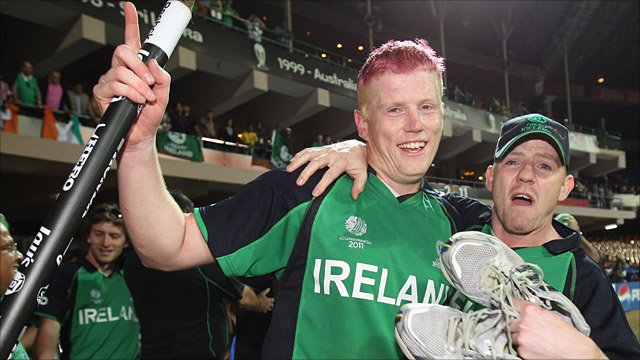 Kevin O'Brien blazed the fastest century in Cricket World Cup history as Ireland pulled off an astonishing victory over England in Bangalore.
He smashed 113 off 63 balls as Ireland recovered from 111-5 to overhaul their target of 328 with five balls to spare and three wickets in hand.
Earlier, fifties from Kevin Pietersen, Jonathan Trott and Ian Bell had driven England to an imposing 327-8.
But O'Brien's stunning assault powered Ireland to a famous triumph.
Only three days after England's thrilling tie with India, Bangalore's M Chinnaswamy Stadium played host to another of one-day cricket's most dramatic encounters as Ireland produced the highest run chase ever at the World Cup.
O'Brien, a 26-year-old all-rounder who had never made a fifty in nine previous World Cup innings, turned the match on its head with a brutal display of hitting featuring 13 fours and six sixes and a partnership of 162 with Alex Cusack.
Dropped on 91 by England captain Andrew Strauss, he went on to reach his century off 50 balls, 16 fewer than the previous tournament record set by former Australia opener Matthew Hayden.
And although O'Brien was run out in the penultimate over, John Mooney was on hand to smash the first ball of the last over for four and spark delirious celebrations in the Ireland camp.
"To see any team win from that position is quite something but when they are the underdogs it is something truly special," said BBC Cricket Correspondent Jonathan Agnew on Test Match Special.
Former England batsman Geoffrey Boycott added: "It's disappointing if you are an England supporter but Ireland were absolutely fantastic. Not only did O'Brien produce an incredible knock, the tail-enders held their nerve to see them home."
For England, the defeat will lead to plenty of soul-searching as they look back on another disappointing bowling and fielding display.
Even before Strauss's drop ruined the England skipper's 34th birthday celebrations, Matt Prior, James Anderson and Michael Yardy had all spilled chances that should have been taken.
In the batting department, England's top four laid a formidable platform but once again the middle order failed to keep up the momentum when a score in excess of 350 looked on the cards.
Despite those misgivings, few will have given Ireland a chance of chasing down 328 to win and even fewer will have been backing them after they lost a wicket from the very first ball of their reply.
Anderson - under pressure after conceding 163 runs in the first two matches - had Will Porterfield bowled off an inside edge.
The Irish made an impressive recovery and kept up with the required run rate for the first 10 overs thanks largely to some lusty blows from Paul Stirling.
The 20-year-old opener smashed five fours and a six before a top-edged pull off Tim Bresnan was well-held by Pietersen.
Niall O'Brien and Ed Joyce rode their luck in seeing Ireland to 103-2 before a devastating burst from Graeme Swann put England in total control.
O'Brien missed a slog-sweep and was bowled, Gary Wilson was trapped leg-before-wicket and Joyce was stumped for 32 to leave Ireland seemingly in tatters at 111-5.
But then came the Kevin O'Brien show as the all-rounder - whose only county cricket experience came with Nottinghamshire in 2009 - treated the crowd to a brutal display of power hitting.
His half-century off 30 balls featured successive sixes off Swann and a pull off Anderson that cleared the ropes by some distance.
And it did not stop there as a ball from Bresnan was drilled over cover point for another maximum, and Anderson was heaved over long-on for the biggest six of the tournament so far as O'Brien added 30 more runs of his next nine deliveries.
At the other end, Cusack played a brilliant supporting role as Ireland started to think the unthinkable.
Cusack's run out for 47 in the 42nd over briefly gave England hope but Mooney kept the momentum going with some sensible batting.
O'Brien's dismissal brought Trent Johnston to the crease and the veteran all-rounder smashed his first ball for four to move the Irish within seven of victory, paving the way for Mooney to crack the winning runs.
Earlier, Strauss and Pietersen had made the most of some relatively tame bowling in steaming to 72-0 off 10 overs.
England lost their first wicket in the 14th over when Strauss attempted an elaborate pull off 18-year-old left-arm spinner George Dockrell but missed the ball and was bowled round his legs.
Pietersen breezed to his 21st one-day fifty before emulating his captain by succumbing to a dismissal that was entirely of his own-making.
Slightly off balance as he attempted a reverse sweep to off-spinner Stirling, he simply dabbed the ball into the air, gifting wicketkeeper Niall O'Brien the simplest of catches.
Bell made a curious start to his innings, struggling for his characteristic timing before finding the boundary with a pair of lofted drives and accelerating past 50.
Just as against India, Bell's demise came during the batting powerplay as he tried to force the pace and cracked a low full-toss to midwicket, where Stirling claimed a low diving catch to his left.
Trott, having played his normal no-frills game to reach 92, took his first risk with a wild swing at a full delivery from Mooney and was bowled.
In an untidy finish to the innings, Paul Collingwood found his range with a huge six over long-on before attempting to repeat the shot and getting caught on the boundary before Prior and Yardy both had their stumps re-arranged.
Some textbook death bowling from the Irish restricted England to 15 runs from the last three overs, with Bresnan caught in the deep off the final ball of the innings.
Libya: Spending oil money across the globe
 In the span of a few years, Libya's financial tendrils have reached across oceans, across borders and across continents.
The United States, the United Kingdom, Switzerland and the European Union recently moved to freeze billions of dollars of assets belonging to Libya's government and its leader Moammar Gadhafi and his family, as the violence and chaos spread across the country.
Libya shares little about its financial dealings, but there are some things we do know about the types of assets that were frozen and where Libya has invested its oil-rich wealth.
Through various financial institutions, Libya has spread its wealth across at least 35 nations on four continents. The country owns a bizarre mix of investments, ranging from luxury real estate and publishing companies in Britain, to hotels in the Middle East, to a small stake in Italy's Juventus football franchise.
Libya has also invested hundreds of millions of dollars in poor and, in some cases, unstable African nations. The Libyan Foreign Bank even owns a stake in the Commercial Bank of Zimbabwe.
All of that comes on top of the billions of dollars that Libya has socked away in the United States' largest and most influential investment banks.
"Libya is just getting used to the fact they have a lot of cash on hand to invest," said Ashby Monk, a research with Oxford University who specializes in sovereign wealth.
Oil prices are too high. Period
Libya has always had large amounts of cash to throw around because of its massive reserves of high-quality crude oil.
But when the United Nations lifted its economic sanctions in 2003, Libya created its own $60 billion sovereign wealth fund. Today, the Libyan Investment Authority ranks among the world's largest sovereign wealth funds.
The country also uses the Libyan Central Bank and the Libyan Foreign Bank as channels to invest as well, primarily focusing on domestic and African investments.