
New Ambulances for Providenciales
 TWO brand new ambulances are set to hit the streets of Providenciales.
The state of the art vehicles have arrived on island and are expected to go into service by the end of the February.
Both are compact with the latest medical equipment, including high tech stretchers and anti-bacterial fittings.
Permanent Secretary for the Ministry of Health and Human Services, Judith Campbell, said: “We are delighted to have obtained these brand new vehicles, which will be a huge asset to heath care sector."
“It’s a key milestone for the Ministry of Health and a positive outcome to what has been a priority issue." She continued,
“But more importantly it’s about the benefits the ambulances bring to the people of the TCI.
“Modern, extensively equipped vehicles such as these will ultimately help save lives – something that is simply priceless.”
The purchase of the ambulances, which cost $85,000 each, brings to an end an embarrassing chapter for the TCI Government
Over recent months, the country’s existing medical response vehicles have been beset by mechanical problems, forcing them off the road for long periods.
In fact, as recently as December, a hired mini-bus with blacked out windows was being used.
“These have been trying times for the Turks and Caicos Emergency Medical Services (EMS)”, said Campbell, “and I’d like to thank its staff for their hard work and patience over recent months.
“We have all been frustrated by the lack of working equipment, but we can now look forward with confidence and pride.”
The flame red Ford diesel E350’s, which comes with 12 months warranty, had originally been ordered from Canadian suppliers, Demers, for military duty in the Middle East.
But after the customer changed its mind, the TCI Government was able to purchase them at a much-reduced price.
EMS paramedic supervisor, Pat Riel, said he and his staff were looking forward to operating the new ambulances.
He explained: “This is a wonderful day for the TCI and I am so pleased we have these fantastic vehicles.
“They really are state of the art and they even include specially treated walls, floors and ceilings that make it almost impossible for bacteria to breed and that is certainly an amazing development in terms of modern day ambulances.
“All EMS staff are now undertaking mandatory driver training, after the vehicles will be freshly sign-written and then go into service on the streets of Provo.”
He added: “Beyond that, the current stock of ambulances in the TCI will now undergo rigorous repairs and maintenance and the plan is to then ensure that every other island has an emergency response vehicle at its disposal.”
Meanwhile bosses at the Cheshire Hall Medical Centre have also welcomed the arrival of the new vehicles.
InterHealth Canada TC CEO, Roger Cheesman, said: “The EMS teams provide sterling service to the community and have proven extremely flexible in working under difficult circumstances.
“These purchases by the TCI Government and the executive team at the Ministry of Health will enable the EMS teams to serve with even greater efficiency and moves the overall healthcare system of country one step forward.”

Ministry of Finance announces strengthening of Payroll process
PS of Finance, Delton Jones has issued a press release in support of the Turks and Caicos Island’s Government’s commitment to strengthen public financial management review which is now being undertaken of the public sector payroll system for waged employees.
According to Mr. Jones,"The review is designed to ensure that both waged employee personnel records and their payment details are accurate and up-to-date." Their will be specific dates in February and March and the review will include procedures for confirming the identity of all waged employees and taking copies of identification documents to be kept on file for future reference. The PS lamented that these steps will help improve internal controls for the payment of wages in the future.
Accordingly, all TCIG waged employees are asked to note the payment dates when they must provide proof of their identity. They are also asked to note the following requirements: On the dates specified for each island community, you must collect your wage cheque in person.
You must provide photographic identification (ideally your NHIP card): this will be photocopied by Treasury staff and held on file.
Only under special circumstances can arrangements be made for another person to collect your wage. This must be requested in advance of your payment date by speaking to your local Treasury office according to the release.
Mr. Jones told RTC News that individuals collecting a wage cheque on behalf of someone else must provide a signed letter from the employee authorizing collection on his/her behalf and must also bring a copy of the employee’s photographic identification.
The release further stated that wage cheques will not be released from Treasury until you have provided the required information. If you do not posses photographic identification please contract your local Treasury
office to discuss alternative identifications.
These procedures for confirming the identity of all waged employees will take place on Friday 11th February in Grand Turk & in Providenciales on Friday 25th February in South Caicos, Middle Caicos & North Caicos. The final excerise will take place in Salt Cay on Friday 11th March 2011.
TCI marks World Wetlands Day 2011
On February 2nd of each year the world celebrates its wetlands. This day marks the signing of the Convention on Wetlands that took place in the Iranian City of Ramsar in 1971. However, Wetlands Day was not celebrated until 1997. The purpose of this day is to raise awareness and appreciation of the significance of the wetlands and of their contributions to the world ecosystem.
The international theme for World Wetlands Day 2011 is "wetlands and forests - forests for water and wetlands" in celebration of the United Nations International Year of Forests.
Forests play a crucial role in the hydrological cycle and as a consequence, in the health of wetlands. Forested wetlands include habitats such as mangroves, nipah swamps, freshwater swamp forests, forested peatlands and seasonally flooded forests. These wetlands are important as they deliver significant ecosystem services, are cradles of biological diversity, and support populations of birds, mammals, reptiles, amphibians, fish and invertebrates.
Wetlands are habitats that fall in the environmental spectrum between land and water. They lie at the interface between terrestrial and aquatic habitats. Wetlands are highly productive communities and provide homes, food and resources for an extensive assortment of species. The high levels of nutrients coupled with the ready availability of water provide the perfect home for many plants and animals.
The Turks and Caicos Islands are made up of over 50% wetlands. The biological diversity found within these wetlands is irreplaceable. The TCI has many variations of wetlands; coastal regions, mangroves, seasonal freshwater ponds and marshes, Salinas, pine, palmetto, and buttonwood swamps and salt marshes.
Until recent decades, wetlands were largely considered disposable portions of land and very little thought of conservation and protection was placed on them. However, recently the invaluable services that wetlands provide have been realised. The wetlands of the TCI provide much more than just a habitat for plants and animals – they also act as a barrier for land protection, a natural filtering system, and flood protection.
As the population increased over the years, many wetland areas have been in-filled to accommodate homes, businesses and other infrastructural developments. The loss of wetland areas has adverse implications for both the natural and human environment in the TCI. With development expanding every day, wetlands are increasingly at risk.
This year, the DECR will conduct various activities that will promote environmental sustainability in the wetlands to ensure that wetlands will provide continuous service and productive functions of the wetland ecosystem.
One or more of the following activities will be spearheaded by DECR Grand Turk, South Caicos and Providenciales:
(1) red mangrove planting in areas with low population density;
(2) bird watching in wetlands;
(3) mahogany planting along roads;
(4) nature photography with emphasis on wetland ecosystem; and
(5) coastal cleanup.
The public (individuals or corporate groups) is invited to take part in the above-mentioned activities by contacting the local DECR office.
Contractor poised to sue government for $13 million
Herzog Caribbean Construction is threatening to file a law suit to collect millions owed the company for pavement they provided to the Turks and Caicos Islands (TCI) government during the period 2006 through 2008.
This appears to be the hot asphalt surfacing Herzog installed on North and Middle Caicos during this period.
When British direct rule came to the islands in August 2009 it was learned that Herzog had previously submitted invoices totaling $13 million. Later reports indicated the amount due was $16 million. While it is unclear which figure is correct, Herzog is now asking for $13 million.
When a stop gap loan was put in place last year some contractors received partial payments, which may account for the reduction from $16 to $13 million. In fact, it has been reported that a 2009 payment plan was in place but has not been maintained.
Late in the Progressive National Party (PNP) government, after Premier Michael Misick resigned, it was discovered that millions more in unpaid invoices were hidden in office drawers. This was revealed by then financel minister and deputy premier, Royal Robinson.
Robinson himself had drawn attention when it was learned that he was receiving a $10,000 honorarium from a proposed vendor to the new national Health program. The honorarium payment(s) to the minister were revealed on the financial disclosure statements Robinson filed.
At that time, the Commission of Inquiry had been completed and lack of financial disclosures by the previous government of which Robinson was part were an issue. In fact the, Interim administration continued to employ Robison as liaison officer for the hospital construction until early 2010. Robinson had previously been assigned responsibility for the Provo dump site which remains an unresolved issue.
While the Herzog-installed pavement is the best seen to date on the islands, it has also been the source of complaints by many.
In the area of North Caicos approaching the Causeway between North and Middle Caicos, the previously unpaved roadbed was filled and raised in the area that had previously often been submerged. However, the new elevation appeared to be insufficient, as the new pavement floated away, disappearing from much of a two-mile section when the wet storm Hanna visited in August 2008. While the damaged sections are in some places a quarter-mile inland from the shore, the roadbed is only slightly above sea level at average tide levels.
The pavement was not provided with any berms or shoulders, making drop offs at every business and residential driveway. In some cases, this has caused the pavement to break away as vehicles enter and exit the road.
It is unknown if a specification was issued by the Ministry of Works to control the quality of the road. Jeffrey Hall was the minister of works during that period.
Late last week, it was learned that the interim government is negotiating with the contractor to hold off their legal claims while payment arrangements are being negotiated. While initially Herzog was represented by the law firm of Misick and Stanbrook, the interim government is being addressed by attorneys from Dunn and Davison on behalf of Herzog.
The pavement installed by Herzog and the stadiums were the only significant public works projects completed under the six-year administration of the Progressive National Party.
During the years PNP ruled the TCI, over $700 million of normal reoccurring revenue, $243 million of Crown land sales, $201 million in stamp duty collected and $28 million in grants and cash left over from the previous government run by the Peoples Democratic Movement (PDM) were spent. However, an additional $135 million of debt was run up by the PNP.
Grand Turk John Glenn Exhibit opens
Grand Turk, which hosts the deep water Carnival Cruise ship facility, recently celebrated the opening of a new exhibit pertaining to the February 21, 1962 return to earth of astronaut John Glenn.
Following the first full orbit space flight by a US astronaut, Glenn, after being picked up at sea by a US aircraft carrier, was transported to the US military installation on the TCI capital island. Glenn, now serving as a US senator from Ohio, traveled around the Earth three times in his Friendship 7 capsule, which was launched atop an Atlas rocket.
Dignitaries at the event included American astronaut Captain Winston Scott; Janet Petro, deputy director of the John F Kennedy Space Center; and Glora Israel of Carnival Cruise Lines. Also taking the microphone was Governor Gordon Wetherell, who reminded attendees that then Vice President Lyndon B. Johnson also arrived in Grand Turk to escort Glenn home.
Chavez financed Bouterse's election campaign in Suriname, claims leaked cable
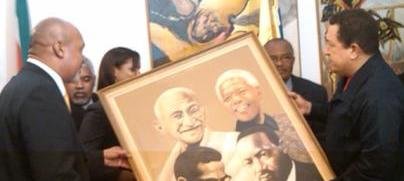 According to documents recently published on the WikiLeaks website, United States diplomats claimed that Venezuelan President Hugo Chavez financially supported Desi Bouterse’s political campaign leading to his election as president of Suriname.
A “reliable” source told US diplomats that Bouterse even made several clandestine trips to Venezuela to secure the funds. It was also alleged that Chavez and Bouterse made a pact to overthrow the Venetiaan-administration.
“A member of Desi Bouterse’s National Democratic Party (NDP) claims Bouterse is receiving funding and tacit political support from Venezuela. A member of the Mission has been told by a self described member of the NDP that former military dictator Desi Bouterse has made a number of recent trips to Venezuela; that he is receiving financial support from Venezuela; and that President Chavez has promised him recognition and support should Bouterse succeed in his stated goal of bringing down the government of President Venetiaan,” a US top diplomat wrote in 2005 in a cable to Washington.
Responding to the alleged Venezuelan meddling, former president Ronald Venetiaan told reporters that, at that time, his administration had received disturbing reports regarding possible inappropriate behaviour of Venezuela’s ambassador Francisco Simancas.
At the Summit of the Americas in Trinidad and Tobago in April 2009, Venetiaan said he discussed the matter with Chavez. Subsequently, Caracas sent a mission to Suriname to investigate the matter and soon thereafter Simancas was removed from Suriname. Venetiaan further noted that his administration had an excellent relationship with the Venezuela government.
In another cable, the US embassy in Paramaribo warned that “Venezuela’s profile in Suriname is on the rise thanks to economic initiatives such as PetroCaribe, a joint Cuban-Venezuelan health care assistance program, and a steady public relations campaign by its Embassy over the past year. Despite this heightened engagement, Venezuela’s activism is not blindly well received, however, as some recognize the more obtrusive edges of PetroCaribe or are otherwise disappointed by supposed largesse.”
The embassy cable continued by saying that “Venezuelan activism here will likely further increase, and if Chavez ramps up aid to Suriname, his ability to influence may well follow; NDP opposition party leader Desi Bouterse is already a fan.”
US diplomats further alleged that, according to a top official in the ministry of Foreign Affairs of Suriname, Venezuela tried to pressure Suriname to sign the PetroCaribe oil deal. Some Surinamese officials were concerned that it would “lead to increased political indebtedness to Venezuela”.
The Finance Minister was reportedly uncomfortable with the increased debt levels resulting from PetroCaribe’s financing scheme and a proposal of the Surinamese government to use its proceeds to create a social fund designed to provide low interest home mortgages. The director of the state oil company, Staatsolie, also had serious reservations about the role his enterprise was expected to play, as it would be positioned to be a storage and transport facility, undermining its business model to grow as a supplier.
“In its impatience to complete the PetroCaribe deal, Venezuela is refusing to renew a 1986 fisheries agreement that expired in June 2005 until a PetroCaribe delivery schedule is finalized,” the top government official told US diplomats.
Venezuela allegedly declined to sign a fuel clause allowing low cost Venezuelan fuel for Surinamese fishing vessels until Suriname commits to PetroCaribe’s final steps.
During a whirlwind visit to Suriname in November 2010, Bouterse and his Venezuelan counterpart Chavez signed several agreements, including an accord to supply cheap fuel for the Surinamese fisheries industry.
At a meeting with the press, Chavez urged the Surinamese people to support “his brother” Bouterse.
St Vincent PM criticises Trinidad on LIAT
St Vincent and the Grenadines Prime Minister Ralph Gonsalves says he is concerned that officials of Trinidad and Tobago and that country's Caribbean Airlines have been talking as though they own the regional airline, LIAT.
LIAT's three shareholder governments -- St Vincent and the Grenadines, Barbados and Antigua and Barbuda -- met in Kingstown on Wednesday to review the carrier's financial situation.
Gonsalves says discussions were held a year ago with Caribbean Airlines about cooperation between the two carriers.
However, BBC Caribbean reported that Gonsalves said those discussions do not give Trinidad and Tobago the right to behave in a manner suggesting that they have taken over.
St Kitts-Nevis to host climate change conference
Issues relating to climate change and ethical principles in the Caribbean will be discussed in St Kitts and Nevis on March 8-9, 2011, when experts across the region meet for a conference.
Science, ethics and policies will be at the forefront of this meeting being organized by the federal government in collaboration with the cluster office of the United Nations Educational, Scientific and Cultural Organization (UNESCO) based in Jamaica.
“We have the opportunity to bring to the table our own issues in terms of the implications of climate change on the St Kitts-Nevis environment,” said Dr Leighton Naraine, head of the local Steering and Implementation Committee for the meeting. “… We are looking at both the physical and human environment because climate change will affect all types of economic activities … and that will require some research on our part so that we can help to frame the issues and bring that to the table.”
Naraine noted that delegates will look past controversial topics such as the root causes of climate change and the responsibility of industrialized countries in curbing pollution, and instead focus on response mechanisms.
“Our responsibility is to come up with mitigation measures that will reduce the risk of lives and livelihoods,” he stated “It would be prudent for us to plan in that direction and move pass the debate and look at the ethical dimensions of climate change in terms of knowledge gaps, [early warning] monitoring systems and other strategies,” he said.
Narine said the steering committee is on track in planning the meeting and is ready to welcome the experts and policy makers from the Caribbean region and beyond.
The event is being held as a result of a directive in October 2009, which arose from the 35th session of the General Conference of UNESCO, which called for the study on ethical principles associated with climate change. Similar meetings have been held in various regions around the world.
The outcomes of the conference will be added to a document that captures the opinions of other countries and regions and will be considered in formulating recommendations for future policy directions.
Calls to end world's longest running banana trade dispute
The International Trade Committee (ITC) is recommending that Europe should help put an end to the world’s longest running trade dispute, by giving its final consent to the 2009 Geneva deal on banana trade tariffs.
According to a CMC report from Brussels, the ITC said that the European Parliament should approve the accord even though "this deal could not fully reconcile all parties’ legitimate interests."
Under the 2009 deal on banana import tariffs, the European Union (EU) will gradually end its preferential treatment of banana exporters in African, Caribbean and Pacific (ACP) countries. In exchange, Latin American countries have agreed to drop their complaints against the EU and the World Trade Organisation (WTO) and not to seek further tariff cuts in the Doha round talks.
The deal will see the EU gradually cut its import tariff on bananas from Latin America in eight stages, from 176 euros (US$241) a ton to 114 euros (US$156) in 2017.
Bananas from the ACP countries will on the other hand continue to enter the EU market duty free. Furthermore, the main ACP banana producing countries are to receive help from the EU budget, up to 200 million euros (US$274.1million) to help them adjust to stiffer competition between producers.
New gunfire erupts in central Cairo
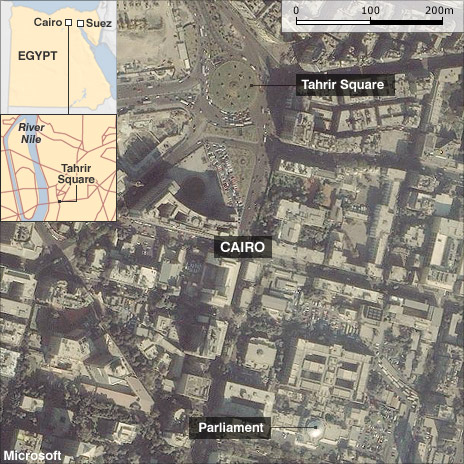
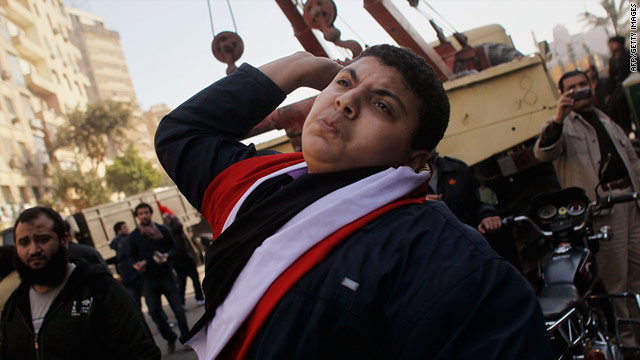 Heavy gunfire reverberated in central Cairo before dawn Thursday as supporters and foes of embattled Egyptian President Hosni Mubarak continued to face off at Tahrir Square, where chunks of concretes and Molotov cocktails were employed as weapons in the escalating crisis.
CNN personnel saw wounded people being carried into Tahrir Square, largely held by anti-regime demonstrators, through an entrance that leads to the nearby Egyptian Museum. Several ambulances entered and left the square shortly before 4 a.m. Thursday.
The source of the gunfire was not immediately known.
Voices were heard chanting a prayer after a day of violent street battles in central Cairo.
Sustained automatic weapons fire, including from what sounded like a heavy machine gun, echoed around the square, the epicenter of nine days of protests calling for Mubarak's ouster.
Anti-government demonstrators hunkered down behind makeshift barricades in the square and outside the nearby national museum against the onslaught, which demonstrators said included plainclothes police officers.
"They're coming in with weapons. They're spreading violence," human rights activist Gigi Ibrahim told CNN on Wednesday. "We've had peaceful protests here since Friday and no violence here. Only today were we faced with this really violent reaction."
The pro-government protesters were not impeded by the army when they entered the square, CNN's Ben Wedeman said early Thursday. Anti-regime protesters are now unhappy with troops, whose commanders had promised Monday not to use force against peaceful demonstrations, for standing by, he said.
Small fires burned in the square early Thursday, some spreading to trees and walls.
Egypt's health ministry reported three people were killed and 639 were wounded in Wednesday's clashes, according to the state television network. Reported fatalities in the previous eight days of demonstrations ranged as high as 300, but CNN has not been able to independently confirm the death toll.
In one surreal moment, whip-wielding Mubarak supporters thundered through the crowd astride horses and camels, and at least one man was pulled off his mount and beaten. A Mubarak supporter who spoke to CNN said the riders were pyramid workers who were protesting the negative economic impact of the crisis.
"What you are seeing is the demonstration of the real Egyptian people who are trying to take back their country, trying to take back their street," said businessman Khaled Ahmed, who described himself as "pro-Egyptian."
But some observers said the pro-Mubarak push Wednesday was likely orchestrated by a regime bent on breaking up peaceful demonstrations.
"These are tactics that are well-known in Egypt," Michele Dunne, a senior associate at the Carnegie Endowment for International Peace, told CNN's John King.
Robert Kagan of the Brookings Institution said the "rent-a-thugs" were likely sanctioned and paid by the government. This is meant to create an image of chaos so the government can move in to restore order, he said.
"Mubarak has -- now, certainly, with the violence today, but even before that -- lost the confidence of the overwhelming number of the Egyptian people," Kagan said.
As night fell, the sound of gunfire reverberated in Tahrir Square, the name of which means "liberation" in Arabic. People hurled verbal insults, Molotov cocktails, rocks and anything else they could find -- shards of metal, sticks, shoes -- at one another.
Desperate for more ammunition, they dismantled sidewalks and picked up chunks of cement to throw. They beat each other in what rapidly spiraled into utter mayhem.
 Hundreds of injured people were treated by doctors and medical staff, who turned to volunteers for assistance.
CNN iReporter Hunter Moore, 26, helped treat the wounded. The U.S. schoolteacher said Tuesday's crowds at Tahrir Square were mostly peaceful. "It went downhill really, really quickly" on Wednesday, he told CNN.
It was unclear whether such confrontations were being repeated elsewhere. Other Cairo neighborhoods were calm, and rallies in Egypt's second-largest city, Alexandria, were largely peaceful.
Mubarak's opponents had stood shoulder to shoulder in Tahrir Square to call for his immediate resignation in a massive rally on Tuesday. The 82-year-old president's announcement that night that he would spend the remaining seven months of his current term working to ensure a "peaceful transition of power" failed to satisfy them, and they vowed to keep up the pressure on him to resign.
The crisis has paralyzed the Egyptian economy, as the government has closed banks, idled trains and shuttered schools. Markets are running short of basic food staples, and the situation is hurting the ability of ordinary citizens to join the demonstrations, opposition activist Ziad Aly told CNN.
"We can't get enough bread. We can't get enough food supplies," he said.
Vice President Omar Suleiman reiterated the government stance that the people have been heard, that they should go home and that they should stop demonstrating. Protesters should respect the curfew and "enable people to return to their jobs and their daily lives, and to allow schools and universities to reopen," he said in a statement.
The state-run television network, Nile TV, sought to portray the unrest as a "foreign conspiracy" fueled by international journalists, several of whom -- including CNN's Anderson Cooper -- were attacked during Wednesday's clashes.
Despite reports that shots had been fired, Nile TV's reporters denied any shooting had taken place or even that violence had broken out in Tahrir Square. The network also said that members of the opposition Muslim Brotherhood were heading to the square "to throw balls of fire and to start acts of riots and violence."
When asked if that were true, Mohamed Morsy, a spokesman for the Muslim Brotherhood, said the action came from all segments of the Egyptian people, "not the Muslim Brotherhood only."
Morsy told CNN's Wolf Blitzer that the time for change is now, not when Mubarak's term ends.
"We need a new era, a new regime," Morsy said. "We have a constitution."
Asked whether Suleiman could lead the government until new elections, Morsy said the head of the country's supreme court should fulfill that role.
In Washington, White House spokesman Robert Gibbs said an end to violence was "imperative."
"It is our hope that what we saw today, we won't see tomorrow or Friday or into the weekend," he said.
But Mubarak's government bluntly told outsiders to mind their own business.
"Our interactions within our country are Egyptian affairs and nothing more than that," Foreign Ministry spokesman Hossam Zaki said. Egypt "will continue to be a beacon of moderation and stability in our region," he said, but its people must settle their differences without "intervention from the outside."
Though Mubarak's concessions were large and remarkable for a man who has held a tight grip on power for three decades, it was too little, too late for many Egyptians.
"He is unfortunately going to continue the agony for another six or seven months," opposition leader Mohamed ElBaradei said Tuesday night.
However, Mubarak supporter Waleed Tawfik told CNN that not all Egyptians agree that Mubarak should step down immediately.
"Change will not happen overnight. There's not a magical button for change. Change will take time," he said.
The Egyptian army can't sit on the sidelines too much longer, or it could risk unraveling, said a foreign policy expert.
The army needs to pick a course of action by Friday, when more mass protests are expected after prayers, Richard Haass, president of the Council on Foreign Relations, told CNN's "Parker Spitzer."
The Egyptian crisis is among the aftershocks of the revolt in Tunisia that forced that nation's longtime strongman to flee to Saudi Arabia in mid-January. In Yemen, President Ali Abdullah Saleh -- who has been in office for 32 years -- said Wednesday he will not run for president nor hand over power to his son once his current term ends in 2013.
SOURCE:CNN