
Australian Open: Novak Djokovic stuns Roger Federer
 Novak Djokovic claimed his second successive Grand Slam semi-final win over reigning champion Roger Federer to reach the final of the Australian Open.
The Serbian, who beat Federer at the US Open in September, saw off the 16-time Grand Slam champion 7-6 (7-3) 7-5 6-4 in the first semi-final in Melbourne.
Andy Murray will play David Ferrer in the second semi at 0830 GMT on Friday.
And for the first time since Australia in 2008, a Grand Slam final will not feature Roger Federer or Rafael Nadal.
That was the year that Djokovic beat Jo-Wilfried Tsonga to win his only major title to date, and then too he had ended Federer's hopes in the semi-finals.
"Overall it was a great performance," said Djokovic. "I am very happy with the way I played. I have been serving well under pressure even though I got tight and made some double faults in the third set when I was up a break.
"That's normal under the circumstances in the late stages of the tournament against Roger."
This latest defeat ends a run of superb form from Federer that followed his five-set loss to Djokovic in New York four months ago, and included victory at the Tour Finals in London and in Doha at the start of this year.
Third seed Djokovic made a nervous start to Thursday's match, double-faulting twice as he offered up a break point in the opening game only to gather himself and see it off with a fine forehand.
The next 45 minutes saw precious little to choose between either man as both dominated on serve in a high-quality battle that had the packed night-time crowd enthralled on Rod Laver Arena.
It was Djokovic who made the initial breakthrough as he took command in the tie-break, grabbing the first mini-break at 2-1 and consolidating it with another after a heavy forehand into the corner for 5-2.
He netted a backhand on his first set point but second seed Federer returned the compliment in the following exchange, and Djokovic headed to the chair to the sound of the large Serbian contingent celebrating noisily.
If the first set had been an exhibition of serving dominance, the second would be the complete opposite.
Djokovic let out a huge roar when he converted his first break point of the match at 1-1, successive backhand errors letting Federer down, and the Swiss appeared rattled as he muttered to umpire Enric Molina at the changeover about the Serbian's team coaching him from the stands.
Now a set and a break down, the four-time Australian Open champion needed to find a way back into the match but, in the event, Djokovic handed it to him with a sloppy game that gave the break straight back for 2-2.
And the momentum shifted, seemingly definitively, in Federer's favour when he played a superb defensive point to break once again for a 4-2 lead, before seeing off two more break points in the following game - the second with the bravest of lob volleys that left Djokovic sprawled on the court.
But the 29-year-old Swiss failed to serve out the set as Djokovic chased down a poor drop shot and guided a forehand down the line to break back, and incredibly he then regained his earlier advantage by breaking for the third time when Federer sliced a backhand into the bottom of the net.
There was to be no wavering when Djokovic served for the set and he sealed it with a blistering backhand winner down the line, prompting Federer to head disconsolately off court, presumably as much to clear his head as take advantage of a bathroom break.
It apparently had some effect as the world number two returned to launch another assault on the Djokovic serve, but the Serbian staved off three break points with some heavy serving and then set about finishing the job.
Again it was the Federer backhand that let him down when successive errors on that side gave Djokovic a potentially decisive break at 2-1, but the Swiss grabbed a lifeline to level at 4-4 when a net cord sat up for him to steer away a forehand winner.
The serving superiority of the first set was long forgotten by now, though, and Djokovic's breathless movement behind the baseline earned him three more break points at 0-40 in the next game, with Federer netting a backhand on the third.
After nearly three hours, Djokovic arrived at the moment of truth as he served for the match, overcoming a nervous double-fault at the start and two missed opportunities on match points to convert his third with a service winner.
"I thought he played a great match," Federer said afterwards. "I didn't think I played bad myself, so it was a match played at a very high intensity for a long period of time.
"Clearly it's disappointing to lose, but what to do if he plays well on the big points and potentially maybe I didn't. It was a tough match."
He added: "I was ready for another two sets easily. Pity I couldn't push him there. I wish I could have won here for the fifth time, but it wasn't possible tonight."
Djokovic might be enjoying back-to-back Slam wins over Federer but he was not about to predict an end to the Swiss player as a threat for the major titles.
"It's much too early to say that," said Djokovic. "Roger is still very much motivated to reclaim the top spot in the rankings and he's playing great.
"Tonight I think I played a better match but he's still up there and in extraordinary form. And then you have Nadal who has been a very, very dominant player.
"We are still behind them and you can't say there is a new era coming up, but there are more players who are able to win majors which is good."

Carifta Games 'will happen' - Bermuda official
Regional officials are contemplating staging a severely scaled-down version of the CARIFTA Games this year.
Donna Watson, president of the Bermuda Track and Field Associa-tion, has indicated that all reports about the demise of the Games are grossly exaggerated.
"I know there has been a lot of information on the Web regarding the hosting of CARIFTA 2011," she told the Royal Gazette.
"I would like to say that this information is not coming out of our official NACAC office. Please be careful of what is written on the Web regarding CARIFTA, as some of it is not entirely true."
She added: "The official word on where CARIFTA 2011 is going to be held, or if it is cancelled, or if dates are changed, will come from our official office and will be immediately passed on to all of the presidents of each association.
"It might have to be scaled down or some other provisions made, but I'm very positive that it will happen."
The North American, Central American and Caribbean Track and Field Association has experienced difficulty in finding a country to host the Games, since St Kitts withdrew from its commitment late last year.
'We can win the World Cup'
The West Indies team's upcoming tour of Sri Lanka is being seen as "good preparation" for next month International Cricket Council (ICC) World Cup to be played in Asia.
Speaking before the team departed from the Caribbean, head coach Ottis Gibson said the three matches in Sri Lanka will give the team a chance to get acclimatised to the conditions, where the 10th Cricket World Cup will also be played.
"It is a good opportunity to put some of the plans in place that we are going to take into the World Cup," said Gibson.
"When we went for the Test series we did really well as a team and we made progress. We also had a chance to get used to the conditions. Now we are heading back to Sri Lanka for these three one-day internationals and we will be looking to put in place the plans that we will be taking into the World Cup," he added.
"The players are fresh out of the Caribbean Twenty20 and all the players are ready for what we have coming up," Gibson said.
The West Indies played to a 0-0 result in the three-match Test series last December. The one-day series was scheduled to be played in December, but was rescheduled due to bad weather.
Gibson expressed optimism in his team's ability to win the World Cup. The Windies have been drawn in Group B alongside South Africa, Netherlands, India, Bangladesh, England and Ireland in the 14-team event.
"I think we have a team that can win the World Cup. We will go there with the expectation of doing very well and putting ourselves in a position that we can reach the semi-finals, which is a very realistic possibility. We would love to win and we will try to win. The aim is to reach the semi-finals and put ourselves in a position to capitalise from there," Gibson said.
"The Cricket World Cup is one of the biggest stages in international sport and we want to make sure we feature during the tournament. We are not listed among the favourites and that could work in our favour," Gibson concluded.
SQUAD: Darren Sammy (captain), Adrian Barath, Carlton Baugh Sulieman Benn, Darren Bravo, Dwayne Bravo, Shiv Chanderpaul, Chris Gayle, Nikita Miller, Kieron Pollard, Ravi Rampaul, Kemar Roach, Andre Russell, Ramnaresh Sarwan, Devon Smith
Golden gymnasts - Jamaicans strike gold at top US event
Jamaica's sporting representatives have consistently produced sterling performances on the international stage. Three young gymnasts - Daniel Williams, Jiovannua Jackson and Jamin Melbourne Levy - are the latest to have done so, as they combined to capture the team gold medal at the 12th staging of the Whitlow Invitational for men.
The competition, which was held in Orlando, Florida, over the weekend, is the top men's gymnastics event in the United States and has produced Olympians.
However, this year's staging marks the first occasion that Jamaica has sent representatives to the contest.
The three boys competed in the men's gymnastics level-eight category. This leaves them with a mere two more levels before reaching the elite level, at which they will be technically qualified to participate in world-class competitions.
Williams, Jackson and Levy, who are all members of Nishida's Gymnastics and Fitness Centre, topped 13 other teams to take the gold medal. They amassed 218.4 points, as they won four out of the six events.
Top scorer
Thirteen-year-old Norman Manley High School student, Williams, who started gymnastics at age seven while attending New Day All Age and Junior High, captured two individual gold medals, a silver and a bronze to finish as the overall top-scoring level-eight competitor from a field of 32. He was also first in the 11-13 age group category with a total of 73.55 points.
Jackson finished runner-up in the 11-13 age group by only 0.10 points, having accumulated 73.45 points in capturing his three individual gold medals, two silver and one bronze. He too, like Williams is 13 years old and started in the sport at age seven while attending New Day All-Age and Junior High. He is currently enrolled at St Joseph's High School.
Fourteen-year-old St George's College student Levy started at age six with Ishimoto's School of Gymnastics. He took second overall in the 14-15 age group from a field of 11 competitors, having garnered a total of 71.4 points in winning four individual gold medals and one silver.
The boys, who returned to the island near mid-day yesterday, competed in a total of six events - parallel bars, high bars, floor, vault, rings and pommel horse.
They will now turn their attention to the 16th Pan American Games, which will take place in October this year in Guadalajara, Mexico.
RBC REINFORCES ITS COMMITMENT TO TURKS AND CAICOS ISLANDS

The Royal Bank of Canada is re-structuring its domestic retail and commercial banking operations in The Turks and Caicos Islands and recently completed restructuring for The Bahamas. Subject to the approval of the TCI Financial Services Commission, RBC Royal Bank (Bahamas) Limited, a new wholly owned subsidiary of Royal Bank of Canada, Toronto, which was incorporated in The Bahamas on November 1, 2010, will acquire and operate the current RBC retail and commercial banking business in Turks and Caicos. The business will be operated under the brand name RBC Royal Bank.
RBC has had a presence in the Caribbean since 1908, and is committed to expanding its business across the region. RBC Royal Bank (Bahamas) Limited is licensed by the Central Bank of The Bahamas and has applied to the TCI Financial Services Commission for National and Oversea Banking Licences. This new legal structure will provide a platform for the future growth RBC anticipates in the market.
Clients will continue to receive the same competent, friendly and helpful service from the employees they have become accustomed to over the years. The change in our structure will not affect the way clients do business with us. Clients will continue to access our products and services and utilize our facilities in the same way as they do currently.
RBC will continue to operate from the Branch premises at Normandy House, Centre Mews, Leeward Highway, Providenciales.
As RBC embarks on this new phase of its development, we remain committed to providing our clients in the Turks and Caicos Islands with a superior banking experience.
PPC LTD’S PARENT COMPANY SUPPORTS DIABETIC ASSOCIATION
Fortis Inc, PPC’s parent company has once again donated $2,000 in lieu of Christmas cards to a TCI non-profit organisation. Donations were made to charities based in each of the countries where Fortis Inc. operates. All employees were given the opportunity to submit the name of a charity to receive this annual donation. Once all names were submitted, we selected the Charity with the most votes. The recipient of the 2011 donation is the Turks and Caicos Diabetic Association, a national voluntary health association whose mission is to improve public and medical awareness about diabetes.
PPC Ltd understands the significance of having such an established association to bring about awareness amoung the people of the Turks and Caicos Islands and has committed to assisting the Diabetes Association in their efforts. Corporate Services Manager, Daphne Penn comments, “members of the association have voluntarily dedicated their time and resources to promote healthy life styles in our local schools and communities while offering support and referrals for individuals suffering from diabetes; hence PPC’s willingness to continue being major sponsors of such a worthy cause.”
Penn also added: “Since Fortis Inc became our parent company they have given an overall total of $10,000 to the Cancer Society, Kidney Association, Provo Children’s Home, Heart Foundation and now the Diabetic Association. Diabetes is a condition that has affected many persons in our communities whether it is directly or indirectly and we need to remain vigilant of this and assist where ever possible in keeping this Association operational.”
President of the Diabetic Association, Elaine Clare, was thrilled to receive the donation and thanked PPC by stating: “When PPC contacted us to advise that we were the recipients of the donation we were extremely surprised and appreciative. The donation will definitely go a long way in helping us continue our Diabetes Awareness campaign. There are many persons in the TCI who can’t afford diabetic testing equipment and the funds from PPC will go towards this purchase. “
Australia floods: PM Julia Gillard unveils new tax
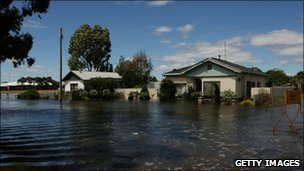
Australia's Prime Minister Julia Gillard has announced a new tax to help pay for devastating floods that she says will cost A$5.6bn ($5.6bn; £3.5bn) in reconstruction.
Ms Gillard said the 12-month tax, starting from 1 July, would be levied on those earning A$50,000 or more, and those affected by floods would not pay.
"We should not put off to tomorrow what we are able to do today," she said.
More than 30 people have been killed since flooding began last month.
"The Treasury's preliminary estimates are that GDP growth in this financial year will be about half a percentage point less due to the floods," Ms Gillard said.
"The best preliminary estimate of the direct cost to the federal budget of the summer's flood disaster is A$5.6bn."
As well as the tax, cuts to government spending will help meet the reconstruction bill.
The BBC's Nick Bryant in Sydney says Ms Gillard has faced criticism for her handling of the floods and has been overshadowed by Queensland's Premier Anna Bligh.
Ms Gillard will be hoping this reconstruction programme will also help rehabilitate her image, he says.
The new tax will charge an extra 0.5% on those earning A$50,000-A$100,000 and 1% more on those earning more than A$100,000.
It is expected to raise about A$1.8bn.
Ms Gillard said that ''in a growing economy, we pay as we go" and said deferring the costs was a "soft option" she was not prepared to take.
Large parts of Queensland, the eastern seaboard and Victoria have been inundated by flooding.
Agriculture, mining and transport infrastructure have been badly hit, along with the massive damage to private homes.
In Victoria, a swathe of floodwater described as an inland sea is still creeping slowly across the south-east of the state, with several communities braced for flooding.
''The great floods of this summer have been a national tragedy, not just a natural disaster because of the awful loss of human life," Ms Gillard said.
She said there would be an immediate payment from the federal government of A$2bn to Queensland, the worst-hit state.
Unemployed Australians who wanted to relocate to reconstruction jobs there would also receive financial support, she said.
Ms Gillard is also delaying or cutting infrastructure projects to save about A$675m and cutting back on spending programmes to save further costs.
These include a number of environmental programmes, including green car and energy initiatives.
The prime minister must get the tax through parliament and as she relies on minor parties and independents in both houses, she faces a tough task given that the main opposition is opposed to the levy.
The Greens said they supported the new tax but added that it "beggars belief that the government would choose to cut climate change" measures.
Opposition leader Tony Abbott, meanwhile, said he opposed the tax and warned that victims of the floods would end up paying.
"This is another government spending programme for which no-one is going to be held accountable if things go wrong," he said.
Microcredit in Bangladesh 'helped 10 million'
Microcredit lifted 10 million Bangladeshis out of poverty between 1990 and 2008, according to a report.
The work of Grameen Bank and others helped many families to raise their income above $1.25 a day, said the US-based Microcredit Summit Campaign.
The report drew on a survey of more than 4,000 households by the Economic Research Group in Dhaka.
Microcredit works by providing small loans to people to invest in generating their own incomes.
Alex Counts of Grameen Bank said: "This survey reminds us that even in difficult circumstances, major progress can be made."
Floods in 1998 and the food crisis of 2008 caused millions of families to fall below the $1.25 threshold.
However, even with these setbacks, nearly 10 million people rose above the poverty level.
But Dr Qazi Kholiquzzaman Ahmad, the chairman of PKSF which loans money to microcredit agencies in Bangladesh, says that his studies in 2006-2007 showed that only 7% of micro-borrowers were able to rise above the poverty line.
"Many borrowers remained where they were, while others suffered setbacks," he told BBC World Service's World Business News.
"In this latest study, only 10% of people have moved up, leaving the other 90% where they are. We cannot conlude that a whole lot has been achieved," he added.
This news comes at a time when microfinance has come under close scrutiny over recent months.
Serious charges emerged about microfinance borrowers taking on multiple loans and too much debt.
Coercive collection practices by microfinance staff, and even suicides among borrowers who were unable to meet their payments.
India's multi-billion dollar industry was on the brink of a mass default until all the major banks in the country agreed to continue lending to microfinance firms.
The evidence for microcredit lifting people out of poverty remains highly contested.
"Bangladesh is the capital of microcredit being used to tackle poverty," said Alun Doran at Oxfam, "but the numerous studies about its effectiveness are conflicting."
He said there was a distinction between poverty alleviation and poverty reduction.
Poverty alleviation involves mechanisms which can help people get out of poverty - and stay out.
"Secure savings are the preferred financial instrument rather than credit," Mr Doran maintained.
Credit Unions hard hit by economic downturn
The current economic environment is taking a serious toll on credit unions as more members face lay-offs and find it difficult to pay their loans on time.
This was revealed by Central Bank Governor Ewart Williams, during yesterday’s launch of the Co-operative Credit Union League’s calender of events at Crowne Plaza, Wrightson Road, Port- of-Spain.
Williams said data suggests that delinquency ratios went up significantly in 2010.
“Many credit unions have not been vigorously addressing delinquency, through adequate provisions, and writing up bad debts,” he said.
He said some credit unions have not recognised the importance of provisions, or still may not know how to provision.
“In some cases it is not clear whether the Board is aware of the problem. Dividend payments are coming out of reserves. If all of this is correct, it is not good financial management,” Williams warned.
Williams in referring to the Clico situation said over 60 credit unions had investments close to $800 million in Clico.
“For some credit unions, the impairment of these investments could threaten their viability. That suggests the management of these unions may not have properly assessed the credit and investment risks, and through insufficient portfolio diversification almost compromised the viability of their organisations,” he said.
He advised that financial literacy should be at the top of the sector’s agenda.
“The Clico crisis underscores the rapid pace of financial innovation required that financial institutions contribute to providing more information, and more financial education to the consumer public,” he said.
Williams noted that the Bank had no intention of stymieing the growth of the sector, or closing down credit unions that do not meet its credential requirement.
Source:Newsday
St Kitts-Nevis Development Bank committed to funding small and medium projects
When the European Investment Bank extended a new line of credit to the tune of US$8 million to the Development Bank of Saint Kitts and Nevis last December, its official observed that the local bank not only commands a leading position and expertise in small and medium sized enterprises financing, but also had the ability to offer technical assistance to its clients.
“Traditionally the Development Bank has always supported small and medium sized enterprises, and we felt honoured when the European Investment Bank recognised that fact,” said the bank’s general manager, Lenworth Harris. “What makes our efforts even more appealing is the fact that we not only support the urban-based projects, but also rural-based projects.”
A support officer with the Development Bank’s Business Support Unit, Kenja Morton, in confirming the general manager’s statement, is of the opinion that no country can achieve meaningful economic development if the rural areas are left out.
As a result, her unit at the bank has ensured that small and medium sized entrepreneurs who are based in rural areas are given special attention. It was for that reason that the bank assisted Maxime Isaiah to open a gift shop on Main Street, Sandy Point.
Isaiah attended the Sandy Point High School and joined the CFBC where he studied electronics. In 1999 he got a student’s loan from the Development Bank to attend the Lindenwood University in Missouri where he finished in 2004 armed with a bachelor’s degree in studio arts with emphasis in multimedia, ceramic sculpture, painting, drawing, graphic design, photography and illustration.
“Since growing up I always loved arts - I was always into arts, I used to always design,” said Isaiah. “For example when I attended high school while still in second form, I used to design for students in fifth form for CXC. I graduated from the Sandy Point High School in 1995.”
He went to Lindenwood University to study electronics engineering technology, but after a month of education he found out that the university had an arts institution and a programme for arts. Since he always wanted to do arts, he went to his advisor and told him that he wanted to switch.
Since his return from university, and apart from his regular job, he also does photography, graphic designs, and illustration
“For example if somebody wants shirts printed, or they want banners designed I can design them; I can do the illustrations to put on shirts, I can also do trophies – so if you need awards like for a queen show, track and field events I can do that too. I buy the components and put them together,” he said.
With a loan from the Development Bank in 2006, he was able to open the gift shop, Smokey’s Solutions, which he says people call a studio, because he has a well equipped studio where he takes pictures. But he does more than take pictures at Smokey’s Solution.
“The loan was a great help because I was able to get some of the machines that cost over US$9,000 and that does not include shipping, handling, and customs,” observed Isaiah. “Through the Development Bank I was able to get the money to buy the equipment and be able to bring them into the country.”
While business traffic cannot be compared with that of Basseterre, he has no regrets operating from the smaller town of Sandy Point. He is contented that he is able to save the people of Sandy Point unnecessary trips to Basseterre to buy gift items or have their pictures taken during occasions like birthdays, or graduation ceremonies and he thanks the Development Bank for having confidence in business persons living in the rural areas.
“I have never had a problem getting a loan from the Development Bank and as far as I am concerned, my future is secured,” said Isaiah. “The first loan I took is the same one that I used to buy the crystal machine and I bought stock. I got a second a loan where I upgraded the studio because everyone is going digital and I did not want to be left behind.”
The bank does not only give loans, said Morton. It assists the clients complete their business plans, or advises those who already have the business plans if their businesses would be viable and advise them on how to improve it.
Once the loan amounts have been released, the bank then monitors the project on a regular basis, a fact that was confirmed and hailed by the Caribbean Development Bank when one of its officials visited Isaiah at Smokey’s Solution in September last year.