
Another AFC leader leaves party over leadership issue in Guyana
Another leading Alliance for Change (AFC) executive, Grehard Ramsaroop has reportedly left the party as infighting widens among factions in that small political party in Guyana.
The Guyana Chronicle reported that several reasons were given for Ramsaroop's resignation from the AFC, with the most popular being his disagreement over the party's 2011 presidential candidacy.
Several high profile members have left the AFC throughout its brief history, citing similar differences with the party's leadership, the most recent being Peter Ramsaroop. In other cases, there have been claims about discrimination and marginalization against a certain section of the party membership.
There is speculation too that Ramsaroop may have decided to put his political life in the backseat in favour of concentrating his efforts on a number of business ventures inherited from his father. Ramsaroop's father, Boyo, who was a PPP stalwart, passed away in March of this year.
Over the last few months there have been signs of growing discontent over the treatment of certain issues in the party, among which is a leadership feud between the party's two top men, Raphael Trotman and Khemraj Ramjattan. The National Executive Committee of the party has since selected Ramjattan as the presidential candidate for the 2011 elections, but has not been able to remove the existing bitterness among factions in the AFC.

Compromise tax deal extends jobless benefits for 1,700 US Virgin Islanders
President Barack Obama's compromise with Republican lawmakers to extend Bush-era tax cuts and unemployment benefits will aid more than 1,700 local recipients of unemployment insurance, V.I. Labor Commissioner Albert Bryan Jr. said.
Unemployment insurance benefits will be extended retroactively in the territory until January 2012, Bryan said in a statement from Government House on Wednesday.
The deal cut earlier this month extended tax cuts first established by former President George W. Bush, as well as unemployment benefits that would have run out for those long-term recipients.
"The passage of this act ensures that over 1,700 individuals and their families have an income stream for an additional 13 months, maintaining the current extended benefit limits, which is 73 weeks of unemployment benefits," Bryan said in the statement.
Currently, four tiers of unemployment compensation -- three of which are for extended benefits -- are available.
A claimant initially is entitled to a maximum of 26 weeks of unemployment benefits, which the territory pays. Once a claimant exhausts the 26 weeks of regular unemployment, they are kicked up to the federally funded extended benefits, which could offer them up to 47 weeks of further benefits.
In all, beneficiaries can receive up to 73 weeks of unemployment.
This tax-cut extension would not extend unemployment benefits for those recipients who have exhausted those 73 weeks, Bryan said.
Initial unemployment claims in the territory have risen throughout the year, as has the unemployment rate -- to 8.2 percent. The latest figures for initial claims in the Virgin Islands were from August, which had 465 claims. It was the highest number of unemployment claims in the territory since September 2009, which had more than 500 claims.
Since 2008, the Labor Department has distributed more than $91 million in unemployment insurance, according to the Government House statement.
"The additional benefit of this act is that it provides an additional period of transition for not only job placement, but for training and retraining opportunities so that at the end of the benefit period employment may be possible," Bryan said.
"This, coupled with the fact that 66 percent of V.I. beneficiaries use all of their regular unemployment, makes the passage of this bill crucial to the territory," the commissioner said.
Copyright (c) 2010, The Virgin Islands Daily News, St. Thomas
Good year for Bahamas tourism despite challenges
Despite a challenging year, the performance of the tourism sector in The Bahamas was impressive in 2010, headlined by an 18 percent increase in cruise arrivals compared to last year, according to director general for tourism David Johnson.
Johnson told Guardian Business recently that the ministry had braced for tough times given the global economic climate, and its proactive approach was a key factor in having a productive year.
“We anticipated that it would be a difficult year for tourism in the region as a whole and we took a very aggressive posture,” he said. “Some of the programs we initiated were successful and a good portion of our business hopefully will rebound in 2011.”
One of the campaigns Johnson deemed a success was the “Companion Fly Free” program, which he said provided a great boost since its launch. It produced such great results that other Caribbean countries tried to duplicate the campaign, but weren’t able to pull it off as effectively, according to Johnson.
“There’s already been some competition that copied our Companion Fly Free program but they weren’t able to deliver it as well as we did, and because of that it makes us hesitant on how soon we reveal our plans for 2011,” Johnson said. “We will be launching a major initiative next spring that will have a tremendous impact on tourism on the other islands outside of New Providence and Grand Bahama.”
Johnson said the tourism figures for 2010 will be available as early as February of next year, which will include arrivals by air and sea to Nassau and the Family Islands. The latest data compiled by the Ministry of Tourism revealed figures for the first 10 months of the year, during which air arrivals increased 4.1 percent compared to last year, with nearly 45,000 additional visitors traveling to the country.
Grand Bahama experienced a 41 percent year-to-date increase in air arrivals, which could be attributed to the 55 percent rise in visitors coming by cruise ships. It was the largest growth for any island during that period, with Nassau seeing a 10.8 improvement in that category.
The Family Islands category grew in both monthly numbers and year-to-date numbers. Air arrivals were up by 36 percent for the month of October and 13.5 percent for the year-to-date period, while sea arrivals jumped by 37 percent for the month and 15 percent for the period. The increases translated to 14.9 percent more passengers traveling to the Family Islands during those 10 months of 2010, compared to the year before.
The Bahamas also recorded 5 million visitors for only the second time in history and it’s possible that a new record may have been reached once the final numbers are tallied, according to Minister of Tourism and Aviation Vincent Vanderpool-Wallace. He also noted that total arrivals will be ahead of last year’s number by 14-15 percent and stopover tourists rose at least 4 percent.
Turks and Caicos Islands New Year Resolutions by David Tapfer
 As the strains of Auld Lang Syne and sugar plums dance through my head, we have to face the traditional exercise of making New Year’s resolutions. As usual I need to shed a few pounds.
What are the resolutions for the Interim Government in the Turks and Caicos Islands (TCI)? The pounds have to come off to improve my health and extend my life. The Interim Government has already lived too long and has not met the people’s expectations.
So what needs to be resolved by this government and London to get the TCI back on its feet?
Number One: Do what you were brought here to do. Weed out the corruption. Bring to justice those who are guilty. Put back the funds Britain's governors let the last government squander.
Number Two: Stop tinkering with the systems. They worked prior to August 2003 so why change them? Representative government will make the adjustments.
Number Three: Transparency was promised. Open up.
Number Four: Set a date for elections and stick to it. Schedule the milestones and meet the schedule. You cannot have milestones without knowing the mileage between them and the speed you will travel. So far this government has only been creeping forward and started out in reverse. Time to shift gears!
Put in place election reform, now. Voter registration cards and party representatives at each polling place are basic. Move now!
Number Five: Fix the civil service and infrastructure .Train them. There are no written rules for anything. Two-and-a-half years after Hurricane Hanna made the causeway impassable all that has happened is that mud was thrown into the breaches. The grantors failed to inspect what the grantees built so they share the blame for that mess The Middle and North Caicos join up is a platform for success. Every day the causeway gets closer to sea level. Fix it!
Number Six: Investigate the TCI Bank closing. Every smelly bit of it and publish the results.
Number Seven: Engage the people, including the politicians who will have to answer to them.
Number Eight. Send Kate Sullivan and Jon Llewellyn home -- their work is over.
Number Nine: Cancel the health care contract and set a budget for TCI people to operate. It was clear from the start we cannot afford a “for profit” contractor used to operating in the oil rich Middle East and nowhere else. Interhealth takes profits and wages home to Canada and we cannot get inexpensive generic blood pressure medications. Audit the hospital builder.
Number Ten: Audit every monopoly in the TCI, including PPC, TCU and Provo Stevedores. A 17 percent profit margin allowed to a major Canadian energy supplier is ridiculous; break the contract.
The perception of this government needs to improve. New development will come with stability and resolve. Tough challenges require strong action. It’s time to get tough!
Happy New Year!
Top 10 NFL stories of 2010
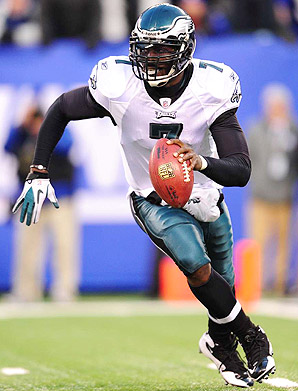 1. The redemption of Michael Vick. There are comebacks, and then there are comebacks, and Vick's career renaissance is in a league of its own. Nothing more than a bit player for the Eagles during the 2009 season -- his first season back in the league after serving almost two years in prison because of his dogfighting conviction -- Vick has electrified the NFL in 2010 like no one else. Though he was a three-time Pro Bowl quarterback for Atlanta, Vick has elevated his game to a new level since he became the Philadelphia starter in Week 2. In a Week 10 Monday-night game at Washington, he put on a tour de force performance, becoming the first QB in league history to pass for 300 yards with four touchdowns and rush for at least 80 yards and two more scores in the same game. Once a pariah, he's now an MVP candidate who has the Eagles on the cusp of a playoff berth.
2. The Saints go marching in to the Super Bowl winner's circle. The feel-good story of the year in the NFL was the Saints' march to the first Super Bowl title in New Orleans' 43-year franchise history, a quest that was as old as the Super Bowl itself. It wasn't just another championship for just another NFL city. The Saints became a living, breathing symbol of the beleaguered but indomitable city of New Orleans and the entire Gulf Coast region, which had been ravaged by Hurricane Katrina in late summer 2005. The Colts were five-point favorites, but the Saints overcame an early 10-point deficit, in part with the help of a daring onside kick to start the second half, and wound up winning 31-17 in Miami behind the MVP performance of quarterback Drew Brees. In a city where the party never ends, New Orleans threw its biggest bash ever in honor of its beloved Saints. Who dat, indeed.
3. A long and painfully slow goodbye for Brett Favre. Like a blackjack player who stays at the table too long, unable to recognize that beating the house is not a forever proposition, Favre's return to Minnesota for a 20th NFL season played out like a doomed adventure almost from the start. Unlike his magic carpet ride of a season last year, when he took the Vikings all the way into overtime of the NFC title game, Favre's winning touch was missing this time around, and he absorbed damaging blows both on and off the field. As Favre went, so went the Vikings' season, and eventually Minnesota's losing ways cost head coach Brad Childress his job. Favre finally incurred an injury he couldn't shake off and saw his cherished starting streak snapped at 297 games. He returned unexpectedly a week later only to leave Monday's game against Chicago with a concussion. Depending on how quickly he recovers, the 41-year-old Favre could end his NFL career watching his losing team play out the string.
4. Randy Moss can't find a home. No one in the NFL traveled a road with more bizarre turns than Moss did in 2010. The 13-year veteran receiver kept running out patterns all season, from New England, to Minnesota, to Tennessee, trying to find both appreciation and remuneration, not to mention someone to throw him the ball. But it was not to be. The Patriots sent him packing in early October after he started spouting off about wanting a new contract, and his stay in Minnesota lasted a mere four weeks, ending after he openly pined for his days in New England. His arrival in Tennessee was much heralded, but his impact has been almost nil, and everywhere he goes, losing ensues. If Vick is the league's comeback story of the year, Moss was just the opposite. He was the Go-Away Player of the Year.
5. The Donovan McNabb trade. When McNabb was traded from the Eagles to the Redskins on Easter night, it ended an era in Philadelphia and began one in Washington. Make that an error in Washington. Nothing about McNabb's time in D.C. has gone as planned, and his presence under center did little to rid the Redskins of the dysfunction and losing that has plagued owner Daniel Snyder's tenure. McNabb's play has been mediocre for the most part, and though he did lead Washington to a vindicating win at Philadelphia in Week 4, by Week 8 new head coach Mike Shanahan had benched him for the final two minutes of a loss at Detroit, setting off a weeklong melodrama. With Washington out of playoff contention by Week 15, McNabb was benched again in favor of the non-descript Rex Grossman, signaling the end of his brief stay in D.C.
6. The Ben Roethlisberger suspension. The Steelers' quarterback won two Super Bowl rings in his first five seasons in the NFL, but his career careened out of control after a Georgia college student accused him of sexually assaulting her in a nightclub bathroom in early March after a night of heavy drinking. Roethlisberger was never charged in the incident, which took place in Milledgeville, Ga., but he suffered heavily in the court of public opinion, and the Steelers reportedly even considered parting ways with their 2004 first-round pick. NFL commissioner Roger Goodell suspended Roethlisberger for the first six games of the 2010 season, later reducing that penalty to four games after the quarterback responded to the punishment by undergoing evaluation and showing contrition for his admittedly boorish and immature behavior.
7. Helmet-to-helmet fallout, high-speed collisions and their impact. In Week 6 of the regular season, some players hit really hard, and the league hit back. The topic of football's level of violence and what kinds of contact should be unacceptable dominated our attention, thanks to the high-profile hits meted that Sunday out by the likes of New England safety Brandon Merriweather, Pittsburgh linebacker James Harrison and Atlanta cornerback Dunta Robinson. The firestorm of alarm that ensued resulted in the NFL adding teeth to its rules concerning illegal hits to the head and neck area, threatening future suspensions and fining the three aforementioned players from $50,000 to $75,000. The issue sparked a raging, weeklong debate about the physical price the game exacts, and whether players or league officials know what's best for football.
8. Cowboys implode, no Super Bowl host for them. With the Dallas area set to host Super Bowl XLV in early February 2011, the Cowboys started the 2010 season with bold talk and such grand designs. Jerry Jones' team made no secret of its intention to become the first team to play a Super Bowl on its own home field -- the eye-catching, two-year-old Cowboys Stadium, in all its state-of-the-artness. But then the games began, and Dallas struggled to avoid embarrassment on a weekly basis. The Cowboys got off to a season-killing 1-7 start, lost starting quarterback Tony Romo to injury along the way and fired fourth-year head coach Wade Phillips after it became clear that his team had quit on him in a Sunday-night drubbing at the hands of Green Bay. Though interim head coach Jason Garrett has infused some life back into the Cowboys season, winning four out of six games since taking over, there will be no Super Bowl berth for Dallas this year. If they want to go to the game, the Cowboys players will have to buy a ticket like everyone else.
9. The Albert Haynesworth-Mike Shanahan showdown in D.C. Theirs has been a bad marriage from the start, on an epic scale of say, Whitney Houston and Bobby Brown. Haynesworth has little use for Shanahan, and vice versa. But while we all saw trouble brewing between the Redskins' high-priced defensive tackle and their new, autocratic head coach, who could have known just how bad the train wreck would be? Haynesworth made it clear he didn't want to play nose tackle in the Redskins' new 3-4 defense, and to drive home the point, he skipped most of the team's offseason workouts. Shanahan responded by making him jump through assorted hoops (almost literally) as part of the conditioning program that Haynesworth had to pass before being allowed to join training camp. Things didn't get a lot better after that, with Haynesworth deactivated for four games during the regular season, loafing his way through plays at times and generally staying locked in a test of wills with Shanahan. The end of the saga was predictable. Haynesworth was suspended for the rest of the season, without pay, and will be playing his football somewhere else in 2011.
10. The overtime debate sparks a rule change. When the Saints beat the Vikings 27-24 on a first-possession field goal in overtime of the NFC title game in New Orleans, denying Favre a chance to even have the ball in his hands in the extra period, it renewed the debate over the inherent fairness of a team being able to win a coin flip and then the game on any score in sudden death. At the league's annual meeting in March in Orlando, NFL owners voted 28-4 to take a half-measure, leaving the OT rules unchanged in the regular season, but adding a new twist for the playoffs. Starting with the 2010 postseason, a team can only win on the first possession of overtime if it scores a touchdown. A field goal merely extends the game and gives the other team the ball, with a chance to either match or beat that score. Ironically, the new OT rule for the playoffs wouldn't have made an impact had it been instituted this regular season. Of the 18 overtime games played through Week 15, 16 of them (or 88.9 percent) have featured at least one possession for each team. Nothing unfair about that.
Source: SI.com
Top 10 NBA stories of 2010
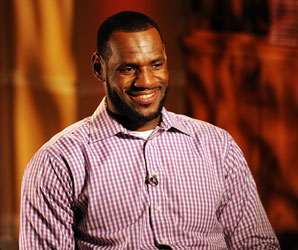 1. "The Decision." Two years of speculation heightened the buzz around the ultimate free-agent destination of LeBron James. And then the self-indulgent idea of crassly announcing his departure from his hometown Cavaliers on live TV detonated the hype at the expense of James' good name. Someday, we will look back and realize the notoriety of last summer served more than anything to raise his profile, which will mean ever more attention for James should he win a championship in Miami alongside fellow free agents Dwyane Wade and Chris Bosh, whose group machinations resulted in an unprecedented coup for Heat president Pat Riley. The whole extended episode of LeBron's escape from Cleveland -- the long build-up, launch and instantaneous crash -- can be viewed as his attempt to leap the Snake River Canyon. It had two results: He lost control of his fame, and he became more famous than ever.
2. Lakers beat Celtics in NBA Finals. The NBA's last rivalry was reconstituted when point guard Rajon Rondo unexpectedly drove Boston out of its regular-season doldrums and through the Eastern Conference tournament. A knee injury to center Kendrick Perkins in Game 6 of the Finals, combined with the lingering ailments of Ray Allen and Kevin Garnett, weakened the Celtics just enough, enabling the cold-shooting but tirelessly rebounding Lakers to overcome a 13-point deficit in the second half of Game 7 for an 83-79 victory and their 16th championship -- one short of Boston's record. Afterward, Kobe Bryant (6-of-24 in Game 7) admitted that beating Boston meant more to him than anything, and that he couldn't have done so without the cold-blooded assistance of Ron Artest (20 points, five steals).
3. Breakout of Kevin Durant. At 21, he became the youngest scoring champion (30.1 points per game) in league history while driving the young and heretofore hopeless Thunder to 50 wins -- more than Durant had totaled over his previous two seasons in Oklahoma City and his team's previous home of Seattle. Then he led a young USA team to its first FIBA World Championship gold medal in 16 years while breaking the American tournament scoring record in the absence of 2008 Olympians Bryant, James and Wade. When Durant quietly signed an extension to remain with Oklahoma City (his only credible option with the 2011 lockout looming), he was cast as the anti-LeBron as well as the main challenger to James' two-year lock as league MVP.
4. Miami's slow start to 2010-11. Years from now, people won't be able to fathom the ruckus created by the 9-8 start of James, Wade and Bosh in Miami. You had to be there and, unfortunately, we were. Each new day turned the least significant detail into breaking news, whether it was Bosh's lingering failure to produce numbers, James' subtle complaints or Wade's impassive support of coach Erik Spoelstra. When James shouldered past Spoelstra during a timeout, "the bump" was replayed and re-examined like a fresh view of the Zapruder film. Funny how the three stars never complained about the excessive attention.
5. Carmelo Anthony's wedding. As first reported by Newsday, New Orleans point guard Chris Paul toasted at Anthony's July wedding in New York that he and the groom would join newly signed Amar'e Stoudemire "and form our own Big Three" with the Knicks. Paul and Anthony would dismiss the toast as a joke inspired by the frenzy of Miami's recent coup. But both stars would spend the rest of the year engaged in LeBronish conjecture that they would be the next to abandon their franchises.
6. Mikhail Prokhorov buys Nets. Commissioner David Stern hopes the arrival of the Russian billionaire oligarch will launch a wave of foreign ownership for the NBA. Prokhorov's $200 million purchase (giving him 80 percent of the team and 45 percent of the new arena ) hinged on the Nets' ability to move to Brooklyn in 2012-13 and challenge the Knicks' hold on New York. This was followed by the acquisition by Ted Leonsis of the remaining 56 percent of the Wizards, the Verizon Center and Ticketmaster in a deal valued altogether at $550 million; the highly competitive (and exorbitant) $450 million sale of the Warriors to a group headed by Joe Lacob and Peter Guber; and the unprecedented takeover of the Hornets for more than $300 million by the NBA itself, positioning Stern to personally ensure that franchise values don't dwindle heading into a potential 2011 lockout.
7. Celtics upset Cavaliers in Eastern semifinal. If the Heat's slow start was epilogue, then this series served as bizarre prologue to "The Decision." It began with innuendo of a serious right elbow injury to James, who shot a free throw left-handed during the top-seeded Cavs' opening-round beating of Chicago. In a performance reminiscent of Kobe Bryant's unhappiest years, James played passively for crucial stretches against Boston, which would lead to speculation by Cavs owner Dan Gilbert and others that James had quit on his team because he'd already decided to leave. An alternative (but inexcusable) possibility is that he was fed up carrying the Cavs and looking forward to sharing responsibility with more talented teammates. Or maybe he was simply having a bad week, for any number of reasons.
8. The Dream Team, 18 years later. The 1992 Olympic team -- the first U.S. team that featured NBA players -- was inducted into the Naismith Hall of Fame as a group, while team members Scottie Pippen and Karl Malone were brought into the Hall as individuals. The team's biggest star, Michael Jordan, whose face launched the NBA into new global markets based on the success of the '92 Games, became majority owner of the Charlotte Bobcats in his native North Carolina -- an unrivaled investment in the league by a star player.
9. Gilbert Arenas' suspension. The Wizards' forlorn point guard made the regrettable error of bringing three unloaded guns into the team's Verizon Center locker room and then revealing them in December 2009 to teammate Javaris Crittenton amid a lingering dispute over gambling debts. Arenas insisted he had committed a prank gone bad, but in January he pleaded guilty to felony gun possession in the District of Columbia and was sentenced to a month in a halfway house, and commissioner David Stern suspended the three-time All-Star and Crittenton for the rest of the season. Arenas began the 2010-11 season with the Wizards before being traded to Orlando in December as Washington moved forward with No. 1 pick John Wall as its new point guard and franchise cornerstone.
10. Lockout speculation. Owners and players spent 2010 looking ahead to the possibility of a 2011 lockout that could wipe out the 2011-12 season. Stern revealed an opening "offer" to the union of shorter contracts and smaller salaries that would cost players close to $800 million annually. Union chief Billy Hunter responded by enlisting players to vote in favor of decertifying the NBPA as a last resort in case of an extended lockout. James' shenanigans had raised TV ratings for the NBA as revenues continued to increase, yet the immediate future looked grim as owners of most franchises claimed to be losing money -- an assertion refuted by players and their agents.
Source:SI.com
Bryant lifts Lakers to 102-98 win over Sixers
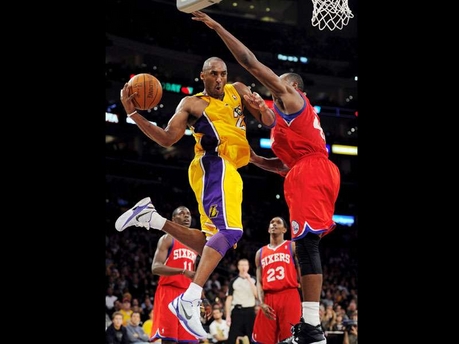
Kobe Bryant scored 33 points and hit a tiebreaking jumper with 1:15 to play, and the Los Angeles Lakers bounced back from consecutive home losses with a 102-98 victory over the pesky Philadelphia 76ers on Friday night.
Pau Gasol had 20 points and eight rebounds for the Lakers, and Lamar Odom scored 18 points off the bench as the defending champions barely hung on to win the NBA's final game of 2010.
Los Angeles never trailed for the sixth time this season, but also could not shake the young Sixers until Philadelphia missed five shots in the final minute.
Jrue Holiday had 19 points and 11 assists and Lou Williams scored 18 points for the Sixers, whose eight-game road trip concludes Monday in New Orleans.
- Warriors 96 Bobcats 95
CHARLOTTE, NC (AP):
Monta Ellis scored 25 points and Golden State held off a late rally to beat Charlotte.
Stephen Curry added 24 points and Dorell Wright 17 for the Warriors, who led by as many as 11 points midway through the third quarter and held a six-point lead with 1:20 remaining.
Stephen Jackson scored 22 points for the Bobcats, but missed a 3-pointer with 2 seconds remaining that could have given Charlotte its third consecutive win under interim head coach Paul Silas.
Gerald Wallace added 20 points, D.J. Augustin 12 and Boris Diaw 10 points for the Bobcats.
- Hornets 83 Celtics 81
BOSTON (AP):
Trevor Ariza made a tiebreaking 3-pointer with 1:34 to play and David West scored four of his 19 points in the final minute to help New Orleans beat injury-riddled Boston.
Chris Paul had 20 points and 11 assists for the Hornets, who won for just the third time in seven games. Emeka Okafor scored 18 points and grabbed 13 rebounds.
Ray Allen led Boston with 18 points, but hit the back rim a desperation 3 in the closing seconds. Paul Pierce had 12 points and seven boards. Nate Robinson scored 11 and had six rebounds.
Boston has lost three of four since winning 14 straight.
- Bulls 90 Nets 81
CHICAGO (AP):
Carlos Boozer scored 20 points and grabbed 15 rebounds, and Chicago won for the 12th time in 14 games.
Luol Deng and Derrick Rose scored 19 apiece, and the Bulls made enough shots down the stretch after struggling from the field for much of the game.
Brook Lopez led New Jersey with 19 points. Travis Outlaw and Stephen Graham each scored 16, but the Nets dropped their fourth straight.
At least they didn't get blown out this time.
Outscored by a combined 51 points over the previous three games, the Nets hung in against the Central division leaders.
- Pacers 95 Wizards 86
INDIANAPOLIS (AP):
Danny Granger and Darren Collison scored 18 points apiece and Indiana pulled away early.
Granger shot 8 of 12 from the field and scored 13 of his points in the first half in helping the Pacers snap a three-game losing streak.
John Wall scored 25 for the Wizards, who are 0-16 on the road this season and 8-7 at home.
The Pacers took control of the game with a 20-4 run in the second quarter, getting eight points from T.J. Ford in a spurt that gave them a 45-26 lead. The Wizards shot 2 of 14 in the quarter.
Washington drew within 83-72 early in the fourth quarter, but got no closer until the final margin.
The Wizards have lost 15 of 18 games, but beat Indiana at home Wednesday, 104-90.
- Rockets 114 Raptors 105
HOUSTON (AP):
Reserve guard Chase Budinger scored a season-high 22 points, Kevin Martin added 20 and Houston won for the eighth time in 10 games.
Rookie Patrick Patterson set career highs in points (15) and rebounds (10) for the Rockets, who shook off a poor first quarter to shoot 48 per cent (44 of 91) and win for the ninth time in 10 home games.
DeMar DeRozan scored a career-high 37 points and Jose Calderon added 11 assists for the Raptors, who have dropped 10 of their last 13 games. Linas Kleiza had 17 points and 12 rebounds and Amir Johnson added 14 points and 11 rebounds for Toronto.
- Thunder 103 Hawks 94
OKLAHOMA CITY (AP):
Kevin Durant hit a season-high five 3-pointers and scored 33 points, and Russell Westbrook finished off a triple-double with his 10th assist in the final seconds to lead Oklahoma City.
Durant went 3 for 3 on 3s during a 16-6 run in the fourth quarter as the Thunder put the game away after Atlanta had pulled within two points.
Westbrook finished with 23 points, 10 rebounds and 10 assists, the last coming when he rushed the ball up to Serge Ibaka for a dunk with 6.9 seconds left instead of running out the clock. Players from both teams stayed on the court for a few moments after the game as the Hawks were apparently upset by the final sequence.
Jamal Crawford led Atlanta with 26 points and Josh Smith scored 23. In another match in Phoenix, the Suns beat the Pistons 92-75.
Source: AP
Europe's Eastern periphery
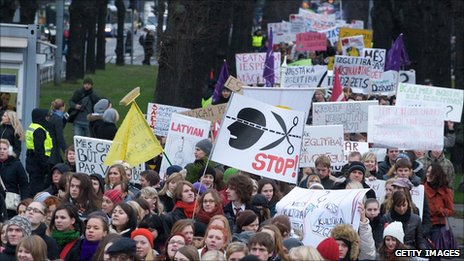 "There are more risks to being inside the eurozone than being outside."
Those were the words of the Polish central bank governor, Marek Belka, earlier in December 2010, echoing the private thoughts of leaders across Central and Eastern Europe.
Many of them are thinking long and hard about the promise to join the euro that they made (or will make) when they signed up for the European Union (EU).
They will certainly be watching the fates of Portugal, Ireland, Italy, Greece and Spain (PIIGS) with some trepidation.
The PIIGS are now caught in a euro-trap. The boom years swelled their labour markets and their public finances.
Now the bust leaves them uncompetitive and with a major debt hangover.
But the usual cheap cure to these ailments, currency devaluation, is not an option inside the euro.
So does this mean the EU's newcomers and wannabes have decided to kick their own euro-membership plans into the long grass?
"The consensus has pushed back right to the end of this decade," says Martin Blum, economist at Ithuba Capital, an Austrian hedge fund that specialises in the region.
The Czech Republic and Poland, countries with notable Eurosceptic politicians, do not especially want to join the eurozone at all, he adds.
Both did very well outside the euro during the 2009 downturn, thanks in part to the sharp drop in their currencies, which helped them keep a competitive edge, he explains.
Poland did not even experience a recession, an almost unique achievement in Europe, though government spending had a lot to do with this.
Devaluation dilemma
But for some East European countries it may already be too late to escape the same euro-trap now afflicting their Mediterranean peers.
Although technically outside the single currency, many have pegged their currencies to the euro.
Estonia, which will join the euro in January, saw its economy shrink by a cumulative 20% in 2008-09, after it slashed government spending and refused to devalue the kroon.
Its Baltic neighbour Latvia fell a whopping 25% over the same period.
For others, notably Hungary, devaluation was not the easy option that it would have liked.
For years, ordinary Hungarians had taken out their mortgages in foreign currencies, such as the euro, Swiss franc or even the yen.
The Hungarian forint was going to join the euro eventually anyway, so why pay the much higher interest rates demanded in their own currency?
The reason, as so many were to discover, is that their foreign currency mortgage payments became unaffordable when the forint lost a quarter of its value.
That gave the authorities in Budapest a nasty dilemma: keep the forint strong and suffer a deeper collapse in exports, or let the forint fall and watch its banking system sink under a mountain of unrepayable mortgage debts.
In the end, they called in the International Monetary Fund (IMF).
Playing catch-up
While playing the devaluation card may have helped some countries in the region ease the short-term pain of the recession, what about the longer term?
"They need to think about other drivers [of competitiveness] than low cost," says Erik Berglof, chief economist at the European Bank for Reconstruction and Development (EBRD).
Romania, for example, whose currency dropped 20% last year, has seen a big rise in labour costs wipe out much of its price advantage.
More importantly, the entire region still suffers from a huge "convergence gap" with the West, marked by lower living standards and poorer infrastructure.
Normally this would create the potential for a lot of catch-up growth.
But Mr Berglof says the crisis in the eurozone, the region's biggest export market by far, is bad news.
What a drag
If Europe's leaders fail to deal with the weaknesses in the single currency exposed by the crisis, the continent could face years of grindingly low growth.
And slow growth in Western Europe will inevitably be a serious drag on Eastern Europe's exports.
Selling their wares to other parts of the world could provide an alternative, but only in theory.
"In our region there's not much of an option," says Mr Berglof. "It's like asking Mexico to diversify away from the United States."
The nearby Russian market may at least be one alternative, as the country has very little manufacturing industry of its own and pays for a lot of imports with all the oil and gas it exports.
But Russia is not a big market, cautions the EBRD economist.
A path already well-trodden by the Central Europeans, such as the Poles, Czechs and Hungarians, is closer integration into the German manufacturing leviathan, says Mr Blum at Ithuba Capital.
"I wouldn't undercut the importance of the German recovery," he advises.
The Central Europeans now do a lot of business selling equipment to West European manufacturers, or playing host to factories that form part of Western companies' supply chains.
As such, a lot of the European demand for these countries' exports is actually driven by global demand for the German export machine.
The biggest crisis may instead be faced by their Balkan cousins, the Romanians and Bulgarians, to the south, according to Peter Brezinschek, chief economist of Austrian bank RZB.
"In Central Europe, most foreign investment went into greenfield sites, promoting exports," says Mr Brezinschek.
But in the Balkans, he says, money poured into sectors such as housing construction, utilities or telephone networks that were oriented towards the domestic economy and did little to improve export competitiveness.
Investment binge
Mr Brezinschek thinks the Balkans would do well to follow the Central Europeans' lead.
But he says there is also still a shortage of basic infrastructure.
"The infrastructure is really terrible," says Mr Brezinschek, who points as an example to the near absence of motorways in Romania.
He says there also need to be major improvements in energy efficiency.
Mr Berglof at the EBRD agrees that serious investment spending is needed across the whole of Eastern Europe, with one big area being education.
"Managers typically list skills as being the number one obstacle they face," he notes.
So could these countries copy China's example, and offset weak export demand by ramping up government investment spending?
"An investment binge is not an option," cautions Mr Berglof. Why? Because the money simply is not there.
Just like their West European counterparts, governments in the region are busy cutting back their spending.
And, says Mr Berglof, private investment spending is also more difficult "in an environment of no very well functioning institutions" - a well-known euphemism for corruption and organised crime.
Home grown
Borrowing from abroad is less of an option these days. It was an abuse of cheap foreign loans that helped push Hungary and others into the arms of the IMF during the 2008 crisis.
Instead, with their own citizens likely to be a lot more cautious with their money in the coming years, governments will need to find better ways of funnelling those savings into local businesses.
Mr Berglof points out that, unlike many of its eastern neighbours, the Czechs have been borrowing and lending to each other in their own currency - the koruna - for years.
Because of this, "the least affected by the financial aspect of the crisis was the Czech Republic", he points out.
In its latest transition report, the EBRD recommends other countries follow the same route of financing themselves in their own currency, using their own domestic savings and home grown capital markets.
So is this a tacit recognition by the multilateral agency that euro membership is now off the cards?
"No," insists Mr Berglof. "It is an important step on the way to the euro."
The Czechs may beg to disagree
Source:
Russia-China oil pipeline opens

The first oil pipeline linking the world's biggest oil producer, Russia, and the world's biggest consumer of energy, China, has begun operating.
The pipeline, running between Siberia and the northeastern Chinese city of Daqing, will allow a rapid increase in oil exports between the two countries.
Until now, Russian oil has been transported to China by rail.
Concentrated in western Siberia, Russia's network of pipelines for oil exports has so far run towards Europe.
Russia is expected to export 15m tonnes of oil through the new pipeline each year during the next two decades - about 300,000 barrels a day.
The project cost $25bn ($16bn) and was partly financed by Chinese loans.
Russia overtook Saudi Arabia as the world's largest oil producer in 2009.
China surpassed the US as the world's largest consumer of energy last year.
"The operation of the China-Russia crude oil pipeline is the start of a new phase in China-Russia energy co-operation," said Yao Wei, general manager of Pipeline Branch of Petro China, as he pushed a button near the Russia-China border to start the flow of oil.
Russian Prime Minister Vladimir Putin has said in the past that the pipeline would help Russia diversify its exports.
A second stage of construction on the pipeline is due to be finished by 2014. It will then span a distance of about 4,700 kms (2,900 miles).
Source: BBC
FirstCaribbean hikes fees on New Year's Day
 FirstCaribbean International Bank Jamaica has slapped huge increases on a range of transactions effective New Year's Day, closing some of the gap between the big- two banks for which fees and commissions are a multibillion-dollar business.
In what appears to be a Caribbean-wide mass mailing out to customers directly from its Barbados office in December, FirstCaribbean advised of the fee hike on some 16 products and services types as of January 1, a move apparently calculated to boost revenues following sizeable income declines on its international and Jamaica operations last year.
The fee hikes range up to 200 per cent in Jamaica. FirstCaribbean Jamaica made J$853.125 million in 'non-interest income' - which incorporates fees and commission - at yearend October 2010, representing a 19 per cent or J$204m slide from the previous year's intake of J$1.06 billion.
Proportionately, non-interest income also fell from 24 per cent to 20 per cent of total net revenue.
For big fee collectors Scotiabank Jamaica and National Commercial Bank, the just under J$5 billion that each take in annually in fee and commission income, represents 14 per cent and 18 per cent of net revenue, respectively.
The new transaction fee increases are spread over FirstCaribbean International and its country operations' range of services in personal and small- business banking, credit card and corporate services at all locations.
Revising its pricing
The bank's December circular to clients advised that it would be revising its pricing on products and services including in-branch/over-the-counter withdrawals, debits and cheques; ABM withdrawals and deposits; printing of ABM mini-statements; replacement of lost ABM cards; incoming wires transfers; drafts; cheque books; stop payments; charge backs; non-sufficient funds; night depository wallets and services; and standing orders. Also attracting higher rates are in-branch bill payments; transfers between accounts; duplicate statements; early account closure; dormancy protection; safekeeping and securities; and confirmation letters.
The website of the bank's local operations, Jamaica's fourth-largest commercial bank, also details the latest fee hike, but gives no reason for the increases.
The fee for replacing a lost ABM card has gone up 201 per cent, from J$205.75 to J$620.
Price changes to personal banking services include a 112 per cent increase to J$150 for over-the-counter withdrawal on regular saving, up from J$70.60.
There is also a more than 52 per cent rise in the cost of local currency standing orders which, following a previous move from J$156 to J$262.24 at the time of the release of the Consumer Affairs Commission's banking fee survey in July, has now risen to J$400.
Withdrawals at FirstCaribbean ABMs now attract a J$20 fee per transaction while the charge for withdrawals at the machines of other banks has risen to J$40.
Bill payment via the branch counter will also now attract a cost of J$200. Charges to corporate accounts have also been adjusted, with the minimum monthly fee on business current account moving to J$450 from J$403.43.
Interest rates and fees payable on credit cards will also move upward, but those changes are to take effect in February.
The issue of banks hiking fees to counteract revenues declines, particularly from the Jamaica Debt Exchange (JDX), has been a contentious matter.
Dialogue is now ongoing with sector players and regulators following the publication of the findings of a survey done by the CAC, which confirmed that banks had in fact hiked rates since the Government's debt reduction scheme.
In that 2010 study, FirstCaribbean Jamaica was among the banks which had imposed the smallest transaction fee increases, with most changes to bank charges reflecting a one per cent move.
Other bank charges at FirstCaribbean, the survey found, had actually gone down.
Since the JDX, fees and commission income has gained importance as a major revenue source for many financial firms, representing the second-largest income stream for banks, the largest being net interest income.