
UN to investigate Ivory Coast violation reports
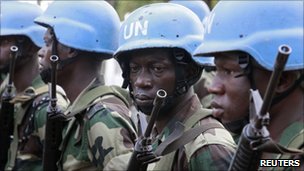 UN peacekeepers have been instructed to do all they can to investigate sites of alleged human rights violations, following November's disputed election.
The UN says it had tried to go to the site of one reported mass grave, but was blocked by security forces loyal to incumbent President Laurent Gbagbo.
Human rights groups claim allies of Mr Gbagbo have been abducting opponents.
Meanwhile, regional group Ecowas and the African Union are due to meet to Mr Gbagbo for more talks on Monday.
So far Mr Gbagbo has refused demands from the world community to stand down in favour of his rival in the 28 November presidential polls, Alassane Ouattara, who is internationally recognised as the victor.
Kenyan Prime Minister Raila Odinga, who is leading AU negotiations, is in the Nigerian capital Abuja, where he had dinner with President Goodluck Jonathan.
Mr Odinga said he would travel to Abidjan on Monday for talks with Mr Gbagbo and Mr Ouattara, before returning to Abuja later in the day to brief President Jonathan.
UN spokeman Martin Nesirky said UN Secretary General Ban Ki-Moon told Mr Ouattara in a phonecall on Saturday that he was "alarmed by the reports of egregious human rights violations".
"He (Mr Ban) said UNOCI had been instructed to do everything possible to gain access to the affected areas both for prevention and to investigate and record the violations so that those responsible will be held accountable," Mr Nesirky said in a statement.
The UN says some 200 people have been killed or have disappeared in the past month - mostly supporters of Mr Ouattara.
It says it has received reports of at least two mass graves and has been repeatedly blocked from investigating one of them, on the outskirts of Abidjan. When investigators tried to go, truckloads of men with guns showed up and forced them to leave.
The other reported site lies in the centre of the country, near Gagnoa.
The Gbagbo government has repeatedly denied the existence of any mass graves.
UN human rights chief Navi Pillay has written to Mr Gbagbo to tell him he could be held criminally accountable for abuses.
Mr Ouattara has asked for the International Criminal Court in the Hague to send a mission to the country to investigate the reports, and reiterated the call on Saturday.
The UN has also expressed concern that some of the homes of opponents to Mr Gbagbo have been marked to identify the ethnicity of their occupants, indicating signs the country could be heading for ethnic violence.
Some of Ivory Coast's neighbours have threatened to oust Mr Gbagbo by force. The UK has said it would back military intervention, if sanctioned by the UN.
In an address for the new year, Mr Gbagbo said the pressure for him to quit amounted to "an attempted coup d'etat carried out under the banner of the international community".
He reiterated a call for the UN peacekeeping mission (UNOCI) to leave the country.
UN peacekeepers are protecting Mr Ouattara, who is holed up in a hotel in the main city, Abidjan.
The election was intended to reunify the country which has been divided since a 2002 conflict.
Mr Ouattara was initially proclaimed the winner by Ivory Coast's election commission, but the Constitutional Council said Mr Gbagbo had won. Both men have been sworn in as president.

Chris Brown’s New Year’s Resolution: ‘Shut the Hell Up’

Chris Brown has learned a lesson from his recent Twitter spat with Raz-B .
The singers became embroiled in a war of words after they exchanged insults on the microblogging site.
Brown later issued an apology to Raz-B to end the feud – and he’s now vowed to tone down his antics in 2011.
He writes on Twitter, “Since new years is coming up my resolution is to shut the hell up.”
Copper enters 2011 at record high

The price of copper has hit a new all-time high, rounding off a year in which industrial metals rebounded strongly.
It peaked at $9,631.75 per metric tonne on the London Metal Exchange, its highest ever level, before falling back slightly.
The metal has risen 30% in value this year, with half of that rise coming in the last month.
The rally has been driven by the global economic recovery and most countries holding low stockpiles.
In demand
Demand for copper and other industrial metals is outstripping supply, as industrial output by the emerging markets economies surges ahead of their pre-recession levels.
Manufacturing in Europe - and even in the US according to recent data - has also picked up, the latest data suggests.
In most parts of the world, future copper prices suggest there will be further near-term rises in the metal's value.
Global copper inventories are down by about a third this year, and traders say that with supplies so tight, the risk is that prices could rise more rapidly if the recovery gathers pace.
The major exception to this trend is China, which is sitting on a large stockpile that it built up during 2009, but is expected to be used up during the coming months.
Prices in dollars have also been supported by the relative weakness of the US currency, compared with the euro and particularly the Chinese yuan.
Copper is not the only industrial metal to do well this year. The price of nickel is up by a quarter, while tin has risen more than 55% in 2010.
'Bullish trend'
And other commodities have also been climbing in what has been a particularly strong year, though most prices still remain well short of levels seen during the commodities surge of 2007-08 that helped precipitate the global recession.
Energy prices, led by a 13% rise this year in the price of oil, have hit new post-recession highs, also driven by the global recovery, as well as the oil cartel Opec's apparent unwillingness to increase supply.
Meanwhile, precious metals have shot up amid fears over the debts and loose monetary policies in Europe and the US.
Palladium - a precious metal that is also used industrially in the production of car exhaust catalytic converters - rose 94% this year.
"It is still a positive picture for metals next year," said Darren Heathcote, head of trading at Investec in Sydney.
"There is sufficient demand from investment perspective to maintain a relatively bullish trend, in gold in particular."
Other commodities which are also well up include wheat, which rose 44% this year, as well as corn and soybean.
The long-term trend of rising demand for these crops is part of the reason for such strong price growth, but so too were short-term supply problems this year due to poor weather conditions, including a drought that forced Russia to suspend wheat exports.
LeBron torn on entering All-Star dunk contest

LeBron James wants to be part of the dunk contest at All-Star weekend. He's just not sure it's a smart idea.
One of the game's best dunkers, James acknowledged Friday that he often considers committing to be part of the field, then finds himself waffling.
James said at some points he tells himself, "Yeah, I'm going to do it," but then he thinks about the wear and tear on his body and reconsiders.
At the 2009 All-Star weekend in Phoenix, James said he planned to enter the 2010 contest, then eventually backed off. This year's dunk contest is Feb. 19 in Los Angeles.
James noted that competing against the likes of Blake Griffin would be a challenge and says, "he's already got the home court advantage."
Carmelo rejoins Nuggets after sister's death
Carmelo Anthony practiced with the Denver Nuggets Friday, returning to the team after taking eight days to mourn the death of his sister.
The Nuggets' star forward left the team Dec. 22 and missed five games while helping his family deal with its loss. He was expected to play Saturday when the Nuggets host the Sacramento Kings.
Anthony was glad to be back on the court with his teammates.
"There's no place like the gym, especially when you go through tough times like I just went through,'' he said. "But I'm glad to be back, glad to be here. My spirits are up. The worst is over with and I'm back here and I can just focus on basketball.''
Michelle Anthony, a 38-year-old mother of four, died on Dec. 21 in Baltimore. The cause of the death was not disclosed, though the Nuggets released a statement that she had died of a "pre-existing condition.''
Anthony and his family attended the funeral of Michelle Anthony on Monday and he returned to the Denver area Wednesday. He worked out on his own Thursday.
Anthony had been extremely close to his sister and felt the loss keenly.
"My sister was somebody who actually raised me with my mother,'' Anthony told a small group of reporters after the Nuggets' practice session. "We've been through thick and thin. Everybody's who had a sister knows the type of relationship a brother and sister have.''
The two had talked over the phone all the time after his games.
"I'm going to miss her calling me after every game, telling me what I did wrong, telling me what I did good and giving me some encouragement. But I know she's watching,'' Anthony said. "I know she's looking down. I'm going to try to keep my head up high, do what I've got to do on the basketball court and continue playing like I've been playing trying to get some wins.''
Anthony also thanked his teammates, members of the organization and fans for their support and encouragement in recent days.
Coach George Karl said it was good to have Anthony back and that he also had the impression that Anthony felt the same way.
"His body seemed like it wanted to be here,'' Karl said. "We ran a lot because we wanted to get him back into shape. He was feeling like he could run up and down the court and he played well. Practice was good because I think everybody was fresh. Hopefully, he'll be able to help us win some games very quickly.''
Karl, who has dealt with throat and neck cancer over the last year, also recognized that sometimes the practice and game-day ritual take a backseat to the real-life issues that come along.
"I think we do get pulled back to the reality of life,'' Karl said. "And that's a pretty tough one - that young and having children and trying to figure out your family responsibilities. I just hope Melo's OK, he stays strong through it and celebrates his sister's life along the way.''
Fireworks herald opening of Festival Village
 The Crucian Christmas Festival Village opened with majorettes and fireworks Thursday night, as hundreds of people gathered to pay tribute to the honoree, Corrine Milligan, and to taste the traditional favorites served up around the grounds.
Music blasted from speakers. People mingled and tried the johnny cake and passion fruit available from the booths. The cruise ship Ocean Regatta - a 500-passenger ship - still was docked at the Ann Abramson Pier and was a brightly lit backdrop to the ribbon-cutting ceremony.
Milligan lined up alongside Miss St. Croix Taryn Mashburn, Festival Prince Shakiem Crosley, Festival Princess Quanisha Christensen, Festival Duchess Kleshelle Gaskin and a number of politicians to cut the ribbon just before 7:30 p.m.
"We're getting ready to start 11 big days of Crucian Christmas Festival," said festival spokeswoman Melody Rames, as things were about to begin.
The Festival Village was named the "Corrine Pate Palace," in honor of Milligan's booth - No. 13 - where she has served up food at festival for almost 30 years.
"I think I deserve it," Milligan said. "I work hard."
But Thursday night, Milligan said she was going to take it easy.
"I'm going to be relaxed tonight," she said. "I'm the queen tonight."
After the ribbon-cutting, the group made their way down to the stage, where Milligan was honored with plaques, certificates and flowers.
Crucian Christmas Festival President Davidson Charlemagne said he was very happy that the festival was able to come together after the heavy rains that flooded the area in November
Parties and fireworks as the world ushers in new year
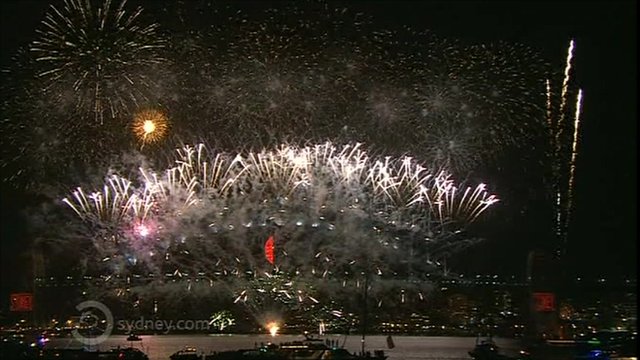
Firework displays, parties and other celebrations are taking place around the world to usher in the new year.
Festivities ranged from the release of thousands of silver balloons in Toyko in Japan, to the first countdown of a western new year in Hanoi, Vietnam.
In Sydney, crowds watched what is hailed as the world's biggest New Year's Eve fireworks display.
Earlier, thousands of revellers took to the streets in New Zealand - the first major country to see in 2011.
Meanwhile, party-goers in Europe are gearing up for firework displays and other events planned across the continent.
A musical and fireworks are planned at the UK's London Eye big wheel - which is marking its 10th anniversary.
Crowds have also gathered in Madrid's Puerta del Sol square to take part in "Las Uvas" (The Grapes), a tradition in which people eat a grape for each of the 12 chimes of midnight.
And in the US, up to a million people are expected in New York to see the famous Times Square Ball drop at midnight.
The municipal authorities and warmer weather have combined to clear the streets following the snowstorm which blanketed the city this week
In Hong Kong, hundreds of thousands of people gathered along Victoria Harbour to watch fireworks explode from the roofs of the city's most prominent buildings.
At the Zojoji temple in central Tokyo, Japan, monks chanted as visitors packed in to count down until midnight. Thousands released a mass of silver balloons carrying notes with their hopes for the future.
And in Taipei, the capital of Taiwan, fireworks formed the shape of a dragon spiralling up the tallest skyscraper.
This year's display is the country's biggest ever, costing $2m (£1.3m), to mark the beginning of year 100 on the Taiwan calendar.
In Sydney, about 1.5 million people came out with blankets and camping equipment ahead of the seven-tonne fireworks display above the Harbour Bridge.
Crowds began arriving more than 12 hours before the main display, with new visitors turned away as early as 1500 (0400 GMT), the Associated Press news agency reports.
"We know how to party on new year back home, but Sydney is a bigger and better party than anywhere else," Marcio Motta, a 26-year-old spectator from Brazil, told the Press Association.
This year, meanwhile, marked the first time Vietnam's capital, Hanoi, officially celebrated a Western-style countdown. In previous years, the city authorities have focused on Tet, the holiday marking the lunar new year, which begins on 3 February.
In the Philippines, safety officials urged caution after firecrackers injured at least 245 people in recent days. According to tradition, many believe noisy celebrations drive away evil and misfortune.
In Burma, however, the military government has banned all fireworks and said severe action would be taken against anyone using them.
Political activist Aung San Suu Kyi, who was released from house arrest in November, called for the Burmese people "to struggle together with new strengths, new force and new words in the auspicious new year".
The tiny Pacific nation of Kiribati was the first to welcome in the new year at 1000 GMT. The religious island nation was set to mark the event with church and village services.
Top Stories of 2010 in the Turks & Caicos Islands
 As 2010 comes to a close, the time has come to look back at a very eventful year in the Turks and Caicos Islands (TCI). One filled with unexpected events and disappointments -- a shift in British politics, which could affect the news in 2011/2012, and the beginning of the long awaited fallout from the Commission of Inquiry, which will soon mark its two-year anniversary.
Number One: The Unity March
Without any doubt, the top news story of 2010 was the Unity March. Splashed across the headlines of all three newspapers, prompting numerous news reports by television, radio and internet media, and invoking comment by all the opinion columnists, The March stands alone as the biggest story in 2010. Blythe Duncanson, editor of the leading newspaper, the TCI Weekly News, called the march historic and the biggest, best organized demonstration he could remember.
The event, started by Peoples Democratic Movement (PDM) leader Douglas Parnell, occurred in March 2010, and inheriting a second name The March in March, was misunderstood by non native residents, criticised by some expats and embraced by virtually the entire belonger population.
The police had no choice but to accommodate it by closing off a long section of Leeward Highway, including the busiest section in the heart of downtown Providenciales (Provo), as marchers strolled peacefully 8 and 10 abreast. The professional stagecraft company who provided the stage from which speeches were delivered estimated the crowd to be at least 2,500
people.
These numbers were later confirmed by the number of signatures on a petition forwarded to the British government.
The march was a non political, cross party event to demonstrate for the right of self determination. It was perceived by most islanders that these rights were in jeopardy when Colin Roberts, the British Director of Overseas Territories, spoke out in favour of the enlargement of the voting franchise and massive constitutional reform with minimal consultation with
islanders.
March speeches were delivered by leading members of the clergy and politicians from both parties. With one exception, they all spoke to the self determination human rights issues. Only former Premier Galmo Williams, himself displaced by the British direct rule takeover, spoke off subject, calling for independence.
Number Two: The TCI Bank Failure
The failure of the TCI Bank appears to have affected every family in the TCI. Losses to 4,000 depositors and upwards of $22.5 million in pension funds have thrown the spotlight on the Financial Services Commission,which found the bank lacking in management but failed to act. Questions have also been raised about the policies of the officers of the National
Insurance Fund, who not only purchased stock in what was viewed as a risky venture, but then followed up by making deposits of $19.5 million of pensioners contributions.
Rushed into liquidation, two financial groups ready to take over the bank and save the depositors funds were largely ignored.
Unanswered questions still loom about the countrys first indigenous bank, which some said was designed to fail: will depositors lose everything or recoup 10 cents or more on the dollar and why is the TCI Bank failure not being investigated by the Interim Government.
Number Three: Change of Government in Britain This story had multiple angles and is possibly the story that could have
the most serious effect on events in the TCI in the immediate and long term future. This event did not occur in the TCI.
In May 2010, British voters overturned the 13-year-old Labour Party government of Tony Blair and Gordon Brown, who were replaced by a David Cameron/Conservative-led coalition with third party Liberal Democrats.
Leading up to and during the PNP years of 2003 to 2009 Chief Minister and later Premier Michael Misick lobbied extensively with Britains Foreign and Commonwealth Office (FCO) Ministry for Overseas Territories (OT). As it now turns out, the Turks and Caicos Islands, with its small size but promising potential, has also become the biggest challenge for the FCO's
OT department.
The British Labour Party imposed policy of hands off the Overseas Territories was in the later years managed not only by Minister Meg Munn, herself the target of allegations of misdeeds in Britain, but by three temporary ministers since 2008, all of whom served amazingly short terms.
The longest serving of these was Chris Bryant. Bryant and Colin Roberts, who replaced Leigh Turner as Director of Overseas Territories, had announced a policy of making the TCI pay for problems spelled out in a 2009 Commission of Inquiry.
The Commission of Inquiry came into being due to the efforts of Conservative Member of Parliament Sir John Stanley and two other members of the Foreign Affairs Committee (FAC), who visited TCI and found a climate of intimidation and signs of corruption while Misick was premier. Stanley and the FAC put Munn and the FCOs overseas territories department
on the hot seat at a subsequent hearing in London.
Now Stanley's Conservative Party is calling the shots in the FCO, with Conservative Henry Bellingham serving as Minister. Another Conservative, Andrew Rosindell, a member of the Foreign Affairs Committee and chairing the British All Party Group, is now speaking out on the challenges in restoring TCI to its potential and responsible internal government.
Governor Gordon Wetherell and CEO Mark Capes were both appointed by the Labour government, who, while still ruling the FCO, refused to fund the investigations into the alleged corruption reported by the Inquiry. This has seemingly delayed the expected prosecutions called for by the Inquiry and to be undertaken by the British special prosecution team.
Wetherell, a career diplomat, is perceived by most TCIslanders as a well meaning leader who is facing massive financial challenges left in the wake of the removal of the Misick/Williams-led PNP government.
Number Four: The Crime Wave
Over the course of the last administration, crime has steadily climbed, with the Royal Turks and Caicos Police Force seemingly unable to find solutions to the problem and also unable bring the culprits to justice.
Police Commissioner Edward Hall, who has led the department since his appointment in 2005, and two other police leaders have now been retired early. Eight unsolved murders, face to face hold ups with automatic weapons, a local mastermind advising criminals have all been keeping both the police and judiciary at bay until recently.
Missing drugs and weapons from the police impound area and an officer with cuts and bruises after a double murder attempt left one dead and another seriously beaten in December 2009 have all been part of the notorious crime wave, which only recently seems to be diminishing.
Officers from the Royal Canadian Mounted Police (RCMP) will now take over the top posts for two years, and possibly additional British assistance will be on the way.
Number Five: TCI Election Cancelled
Making headlines only weeks ago was the delay in elections. This was announced by Britains new Minister of Overseas Territories Henry Bellingham during an overnight visit to the TCI.
As Bellingham slipped out of town, PNP demonstrators rushed to try to intercept him at the Provo airport, but instead encountered constitutional reform specialist Kate Sullivan and Governor Wetherell.
Shouting demonstrators blocked their automobile and farced police to escort Sullivan and Wetherell to their waiting plane.
Following up on the election delay, Clayton Greene, who now heads the PNP, has spoken out against the withdrawal of elections, which were anticipated for July 2011. Green has attacked the delay based on Bellingham's call for a number of required milestones, one of which will see prosecutions before the election is rescheduled. Greene said this is unnecessary.
PDM leader Douglas Parnell also expressed his disappointment, saying that some of the milestones set down by Bellingham have been or will soon be met.
Female Santa Euwonka Selver visits Cheshire Hall Medical Centre
Christmas is a great timefor traditions.
Some families make a giant turkey, some roasted chestnuts while others tear open presents at the crack of dawn.
Euwonka Selver too has a festive tradition and that is upholding every year, without fail gift giving.
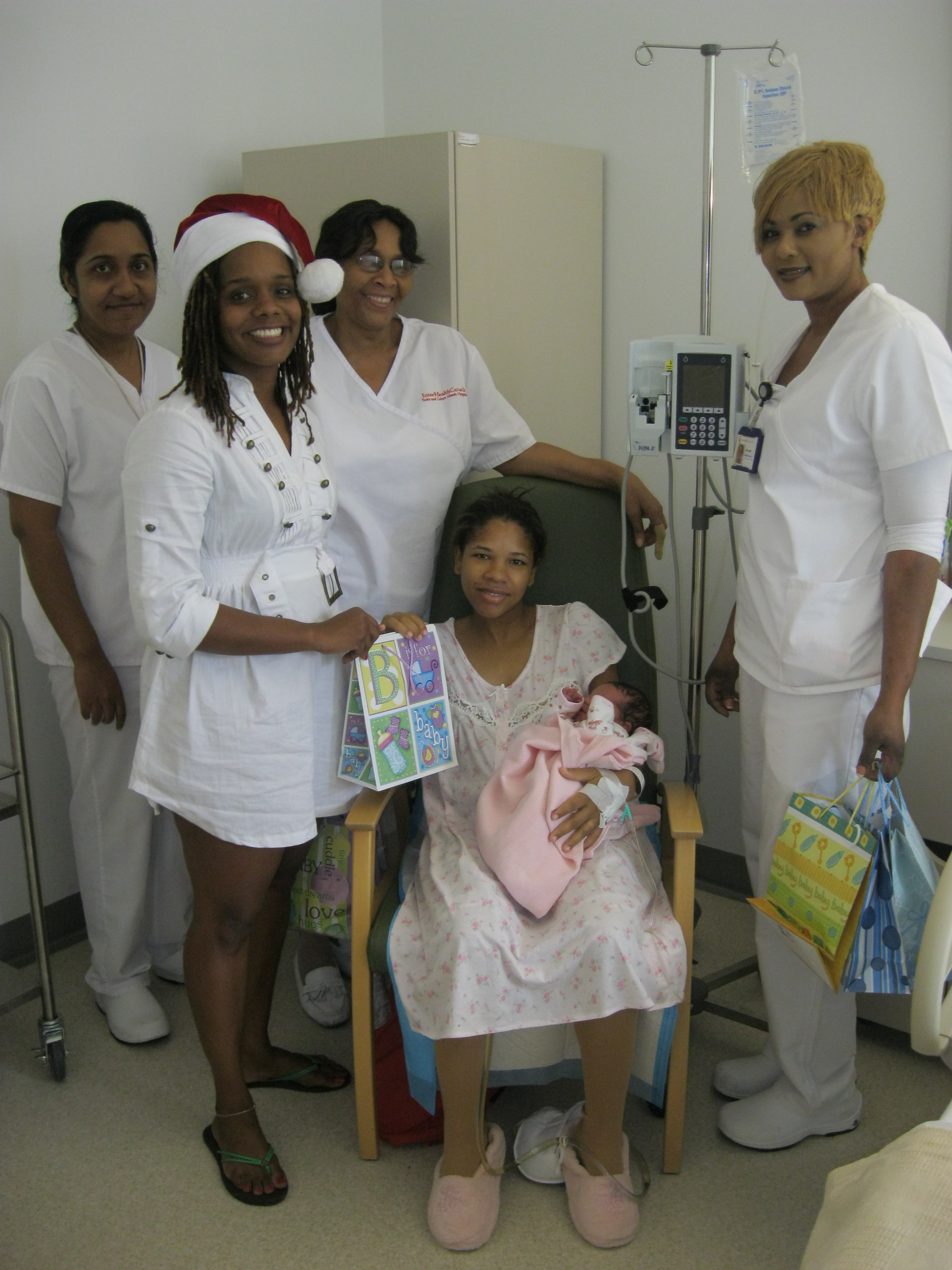
The Provo mother of two spends every Christmas day handing out gifts to newborn babies at the hospital.
In an interview Ms. Selver was asked about the reasons for her generosity?
“It goes back to my childhood”, Euwonka explains. “When I was about seven I spent Christmas in a hospital in Grand Turk.
“It was a horrible experience, in terms of being away from my family and no one would wish anyone Christmas cheer. It was miserable, scary and very lonely. When you are a child, you just don’t understand what’s happening around you.
“I never want a child to feel that way I did at Christmas time, so every year I visit the hospital and give little gifts to every newborn baby. That way, whatever their circumstances are, they are guaranteed at least one present.”
Euwonka handed out gifts at the Cheshire Hall Medical Centre where eight newborn baby girls and five boys spent their first Christmas.
She added: “It’s something I do every year and have done for a very long time. But it’s still a good feeling after all these years.
Ms. Selver continued “It’s a small gesture on my part and I hope it helps brighten the lives of others. As a family, it’s important to keep up this tradition and for us it helps remind children, especially my children, just how lucky they are to have the wonderful lives they do.”
A spokesman from Interhealth Canada, said: “It’s never easy when people have to spend Christmas in a hospital and so gestures like these are very welcoming.
He told RTC News “Euwonka’s kindness was much appreciated and it just shows what a caring community we have here in the TCI.”
Support for the SNAP Centre in Providenciales drops
Normal 0 false false false MicrosoftInternetExplorer4
st1\:*{behavior:url(#ieooui) }
/* Style Definitions */
table.MsoNormalTable
{mso-style-name:"Table Normal";
mso-tstyle-rowband-size:0;
mso-tstyle-colband-size:0;
mso-style-noshow:yes;
mso-style-parent:"";
mso-padding-alt:0in 5.4pt 0in 5.4pt;
mso-para-margin:0in;
mso-para-margin-bottom:.0001pt;
mso-pagination:widow-orphan;
font-size:10.0pt;
font-family:"Times New Roman";
mso-ansi-language:#0400;
mso-fareast-language:#0400;
mso-bidi-language:#0400;}
The SNAP Centre, located in Kew Town, Providenciales says it has seen its support dropped and is therefore appealing to the general public for assistance.
Caregiver of the Centre, Paulette Simmons is quoted as telling the SUN Newspaper that financial support from the community has plummeted, but said she and other caregivers at the institution are thankful that some entities continued to give.
Speaking with the newspaper while on a tour with the children at the Enid Capron Primary School during World Disabilities Day earlier this month, Ms Simmons said “We get a lot of support, but not much as we have been expecting. It could be the economy, because before the recession, we had much more support, but now things have dropped. We are still thankful to God that persons still remember us at the centre and would still come, just to visit and at times, bring gifts for the children.
Ms. Simmons also called for more focus on special needs awareness, especially from the general public. She noted that children with special needs are not being treated with the same level of adoration and love as those that are able bodied. According to her, children with disabilities are no less worthy than those born without disabilities.
“There are a lot of people in the community not focusing on children with special needs, but I would encourage each and everyone in the community to let us focus on them, because they are special like our normal kids; they are special in their own way that God had created them,” Simmons noted.
Currently there are six students at the SNAP Centre, ranging from ages 7 to 16 years. Ms. Simmons said the SNAP Centre operates as a regular learning institution, starting each morning with regular devotion, before delving into the curriculum.
She said students with speech impediment are taught how to call and identify words and activities that happen in their school, home and community. Students are also taught how to pronounce their names, identify places in and around their surroundings.
She said those with the capacity to learn like normal children, but are at lower levels such as K1, when they should have been at grade two, are taught how to read, call words and are given basic math problems.
Meanwhile, Special Education Teacher at the Enid Capron Primary School, Carolyn Johnson, said each year on World Disabilities Day, children and students from that institution would visit the SNAP Centre, to have lunch and interact with the students, but the SNAP Centre decided that they would be the guests this time around. She said the children enjoyed themselves, since they spent the day interacting with children at Enid Capron and visited their playground where they had a great deal of fun.