
Lucky kick earns $380K for rugby fan
 A British rugby fan has received an unexpected late Christmas present after winning $380,000 in a competition during halftime at a match.
Matthew Rouse produced the kick of his life to hit the crossbar of a rugby post at London's Wembley Stadium and pocket a huge festive bonus.
The 33-year-old was at the venue to watch Sunday's English Premiership clash between Saracens and London Wasps when he decided to enter a competition sponsored by a pizza company via text message.
Rouse was one of three lucky participants selected, and he was handed his shot at glory with a kick from 30 meters (32 yards) during the interval.
Far from thinking he would walk away with the £250,000 prize, Rouse revealed he was more focused on not humiliating himself in front of 38,000 onlookers.
"I haven't played rugby since school and even then I used the warm the replacements' bench," he told the Saracens website.
"All I could think about when I got out there was to try to make a good contact with the ball and try not to embarrass myself. Nobody in the ground was more surprised than me when it hit the crossbar."
Rouse, who lives in the Hertfordshire town of Tring, revealed that the thought of victory had crossed his mind prior to the match.
"I joked to the family before I left for the game that I'd enter the competition and try to come home with the check, but this is like a dream," he said.
"I've no idea what we will spend the money on. My wife will decide that, but we certainly will be looking to have a fantastic holiday with the children. It's been a special day and one I will never forget."

Would you pay $500K to go to LeBron James' birthday party?
 He earns millions of dollars every year, but basketball star LeBron James wants investors to splash out up to $500,000 each to sponsor his lavish 26th birthday celebrations.
The Miami Heat player has hired a marketing firm to find backers willing to help fund his December 30 party, dubbed the "Full Court Birthday Celebration."
James, who earned a reported $14.5 million in salary this year, enlisted SA Global Plus -- whose website shows slides from a presentation given to potential investors.
The sponsorship opportunities range from $10,000 for a single event on his 11-stop "LeBron James Dinner Party Tour" to $500,000 for a season package.
Next week's A-list party will take place at the Coco De Ville Lounge in Miami Beach's Gansevoort Hotel, and the presentation promises an array of stars including athletes, musicians and political figures who "reinvent and set the tone for a chic lifestyle."
The celebrity bash "is royal themed fitting for a birthday celebration of a king, channeling an ambience of extravagant court life."
Potential sponsors will have further chances to catch a glimpse of the self-styled "King" as his celebrations -- which started in New York this month -- keep going until the final date in Atlanta on April 10.
But for someone who pays so much attention to the finer details, his name is spelled "Lebron" throughout the presentation -- at odds with his own website's preference.
It is not the first time the former Cleveland Cavaliers guard, who calls himself "King James" on his Twitter account, has attracted attention away from the basketball court.
The six-time NBA All-Star ended months of speculation about his future in July, when he announced he would be joining the Heat on a live television special called "The Decision."
The broadcast, which led to James becoming a pariah among Cavaliers fans, attracted a reported 10 million viewers.
AIG secures $4.3B in credit lines
 AIG, took a step closer to independence from government as it said it had secured $4.3 billion in credit facilities.
The U.S. insurer bailed out by Washington during the financial crisis is is in the process of repaying the $95 billion the U.S. Treasury and the Federal Reserve Bank of New York lent following its disastrous decision to insure billions of dollars worth of securities backed by mortgages, and.
Under the facilities arranged by 36 banks and administered by JPMorgan Chase, AIG can borrow $1.5 billion over three years and an additional $1.5 billion over 364 days, according to a regulatory filing.
Separately, Chartis, an AIG division, obtained a $1.3 billion credit line.
The agreements are based on conditions outlined in the regulatory filing, including AIG's previously announced plan to pay back a $20 billion Federal Reserve Bank of New York credit line by March 31.
Robert Benmosche, AIG's chief executive, said securing these credit agreements was "another important vote of confidence by the market in AIG"
He said: "As we approach year's end, we believe we are close enough to completing our recapitalization plan that we can see the finish line".
The credit facilities are the latest steps taken by AIG to return to normalized operations.
In September, the insurer outlined a plan to use the proceeds from asset sales and equity offerings to repay the credit line with the Fed and remove the U.S. Treasury's stake, which it had received as part of the bail-out.
AIG has since raised $37 billion from the sale of Alico, its foreign life insurance company, which was sold to MetLife, and the initial public offering of AIA, its Asian life insurance operations.
AIG also is in the process of selling its AIG Star and AIG Edison life insurance companies for $4.3 billion.
AIG is working on a plan that would allow the Treasury to convert its preferred stock to common shares, increasing the government's ownership to 92 per cent.
The Treasury would then sell most of those shares in a public offering worth up to $20 billion, probably in the first half of 2011. The investment bank Greenhill is advising the Treasury on the sale of its stake.
As part of that deal, AIG would be allowed to raise as much as $3 billion of equity in the market and another $4 billion with Treasury approval.
In December, AIG sold $2 billion in debt, including $500 million in three-year notes and $1.5 billion in 10-year notes, on the private market. The company has also established a $500 million contingent liquidity facility.
The credit facilities announced on Monday will help reassure credit rating agencies that AIG will be able to borrow at sustainable levels in future.
Source: FT.com
Dow finishes up, Nasdaq down amid thin trading
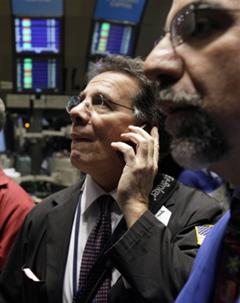
Stocks closed barely changed Tuesday amid light trading ahead of the New Year's holiday.
The blue-chip Dow Jones industrial average finished slightly higher, though stocks had dipped earlier on disappointing consumer confidence and home prices reports.
The Dow edged up after Treasury prices fell in the wake of a weak bond auction in the afternoon. Fewer than expected buyers emerged for the government's auction of $35 billion five-year bonds. The yield on the 10-year Treasury note rose to 3.49 percent from 3.34 percent late Monday.
The Dow closed the day higher by 20.51 points, or 0.2 percent, to 11,575.54. It was the highest close for the index since August 28, 2008.
The Standard and Poor's 500 index was up 0.97, or less than 0.1 percent, to 1,258.51. The technology-focused Nasdaq composite index lost 4.39, or 0.2 percent, to 2,662.88.
Earlier in the day, the Conference Board announced that consumer confidence in the economy slid to a level of 52.5 in December, down from 54.3 in November, as Americans continued to fret about the high rate of unemployment. The market was expecting a slightly higher reading because of signs of improved consumer spending in the Christmas holiday season this year.
"The spending patterns this Christmas looks better, but unemployment continues to be a big question," said Kim Caughey Forrest, senior equity research analyst at Fort Pitt Capital Group.
Another factor weighing on the minds of traders is fear that the housing market will continue to fall. Standard & Poor's/Case-Shiller said Tuesday that home prices fell 1.3 percent in October from a month earlier.
Home prices slid across the country, including the biggest cities. Prices were down 2.9 percent in Atlanta, 2 percent in Chicago, and 1.9 percent in San Francisco.
Energy and materials companies were posting gains as the price of crude oil gained. Chevron Corp. led Dow gainers, rising 1.2 percent to finish at $91.19.
American Express Co. had the largest fall, losing 0.6 percent to $42.79.
In corporate news, General Motors Co. gained 2.1 percent to close at $35.32 after a handful of analysts from investment banks that underwrote the automaker's IPO initiated coverage with favorable ratings.
Home builder Beazer Homes USA Inc. fell 4.5 percent to $5.37 on the disappointing home prices report.
The dollar slid to a 7-week low versus the Japanese yen Tuesday in thin post-Christmas trading, but rose against the euro and pound.
Consolidated volume on the New York Stock Exchange was 2.2 billion shares, about half the usual volume on Wall Street. Trading is expected to be light for most of the week as many investors have already closed their books for the year.
Falling shares narrowly outpaced rising ones on the New York Stock Exchange.
Source:AP
China to cut crucial rare earths export quotas
China said it is reducing the amount of rare earths it will export for the first half of the year by more than 10 percent -- likely to be an unpopular move worldwide since the minerals are vital to the manufacture of high-tech products.
China accounts for 97 percent of the global production of rare earths, which are essential to devices as varied as cell phones, computer drives and hybrid cars. Countries were alarmed when Beijing blocked shipments of the minerals to Japan earlier this year amid a dispute over islands claimed by both countries.
Concerns over China's grip on rare earths has led countries on a hunt for alternative sources. A number of companies in North America -- notably Molycorp Inc. in the U.S. and Thompson Creek Metals Co. in Canada -- are hurrying to open or reopen rare earth mines. Two Australian companies are also preparing to mine rare earths.
China has been reducing export quotas of rare earths over the past several years to cope with growing demand at home. A Commerce Ministry spokesman has also said that China is cutting its exploration, production and exports out of environmental concerns.
Numbers released Tuesday by China's Commerce Ministry show export quotas of the rare minerals will be down 11 percent next year as compared to the same period this year. China usually issues a second batch of quotas during the year, and it is not known how the figures will change later in 2011.
The new numbers say China is allocating 14,446 tons (13,105 metric tons) of rare earths among 31 companies. China allocated 16,304 tons (14,790 metric tons) among 22 companies in the first batch of quotas this year.
The ministry said in a online statement late Tuesday that the quotas for the rest of the year were still under discussion and would be released later. The statement also cautioned that it wasn't appropriate to guess the trend of future quotas based on the first allocation.
Earlier this month, state media reported that China plans to raise duties on some rare earth exports starting next year, but it did not say which minerals would be affected or how much the tax would be.
A state media report Tuesday said China is preparing to set up a rare earths association that would include nearly all of the country's leading rare earth companies, and could help them to coordinate their negotiating position. The report posted on the Sina Corp. portal said the association should be set up in May.
The United States last week threatened to go to the World Trade Organization with its concerns over China and rare earths. When asked for comment during a regular press briefing Tuesday, China Foreign Ministry spokeswoman Jiang Yu declined to answer.
But China has had to address the global concerns numerous times since the spat with Japan.
"China is not using rare earth as a bargaining chip," Wen Jiabao, China's top economic official, told a China-European Union business summit in Brussels in October.
Airlines raise fares on many US routes
Passengers whose travel plans were wrecked this week when thousands of flights were canceled might not want to hear it, but airfares are going up again.
Several airlines confirmed Tuesday that they are raising prices on many domestic routes by $10 one way and $20 per round trip, even as snowbound passengers remained stranded at New York City-area airports.
United, Continental and Delta said they're raising prices effective immediately. Travel website FareCompare.com said American was too, but the airline didn't respond to a request for comment.
Southwest did not immediately go along with the higher prices, which raised the possibility that the other airlines might back down, FareCompare suggested.
The airlines posted strong profits in the third quarter, and traffic has been running higher than a year ago as travel demand slowly recovers from the recession. They didn't offer a reason for the fare hikes.
But FareCompare noted that they are facing rising fuel costs. Oil prices have climbed this year and analysts predict they will rise again in 2011 due to strong demand from developing countries such as China and India.
The fare hikes and surcharges came as airlines were still digging out from a storm that shut down airports in New York, Boston and Philadelphia, leading to at least 7,000 canceled flights. Airlines were adding a few extra flights Tuesday to handle the backlog of stranded passengers, but it was expected to take several days to accommodate all the travelers.
"In the midst of one of the worst travel disruptions of the year that saw thousands of passengers stranded at airports along the Eastern seaboard due to blizzard conditions, airfare prices are on the rise," said FareCompare's Graeme Wallace.
Many passengers on canceled flights are rebooking, but the airlines are likely to lose some revenue to passengers who instead request refunds. An analyst for Dahlman Rose & Co. estimates that the industry could lose $100 million in revenue from this week's cancellations.
Source: AP
Nearly 10,000 flights canceled since holiday blizzard began
Close to 10,000 total flights have been canceled since the beginning of a holiday blizzard that blanketed much of the U.S. northeast with snow and left thousands stranded.
Airline representatives from AirTran, American, Continental, Delta Air Lines, JetBlue, United, U.S. Airways, Spirit and Southwest reported a total of at least 9,726 trips were called off due to weather since Saturday.
Of those, at least 1,335 flights were canceled on Tuesday as major airports across the region slowly got back to normal.
"With all the cancellations and delays, it'll be two to three days before the airlines are at a regular schedule," said Thomas Bosco, general manager of New York's LaGuardia Airport.
By early Tuesday evening, LaGuardia was still operating well below its normal 70 flights per hour, he said.
John F. Kennedy Airport, in the New York City borough of Queens, and Newark Liberty International, in northern New Jersey, opened to incoming and departing traffic at 6 p.m. Monday, Port Authority spokeswoman Sara Joren said.
AirTran spokesman Christopher White said his airline didn't plan any more cancellations Tuesday after dropping 81 flights on Monday. Instead, White said, AirTran planned to operate additional flights out of LaGuardia, Boston's Logan Airport and White Plains, New York's Westchester County Airport to get people home.
Delta Air Lines canceled 300 flights on Tuesday and was still facing reduced operations at JFK and Newark because of runway issues, according to spokesman Trebor Banstetter.
"We're hoping to return to a full schedule at JFK by tomorrow morning, and at Newark by midday tomorrow," Banstetter said.
But the slow recovery left many passengers anxious to get home.
Zarmeen Hussain and her family knew their flight home to New Jersey -- scheduled for Monday evening -- might get canceled. But they didn't expect a four-day delay.
"We were very confused and like, 'Oh, my God,'" Hussain said from an Atlanta hotel Tuesday morning. She, her husband and daughter were in Georgia for a college reunion and were told the earliest available flight will be on Friday.
"We were thinking of the option of driving, but the car rental company gave us a quote of $2,000," Hussain said, laughing. She said many rental car companies are out of vehicles.
Julie Stratton is in a similar predicament. She was scheduled to fly from New York to Indianapolis, Indiana, on Sunday, and ended up sleeping at LaGuardia Airport. Stratton said Monday she was told she might not be able to fly out until Thursday.
"It's not the best of scenarios, no," she said. "But you just have to make the best of it. There's nothing else you can do."
The storm that has unnerved domestic and international travelers produced blinding snow and wreaked havoc from the Carolinas to Maine. By Monday night, more than 4,155 flights had been canceled, up to 32 inches of snow piled up in areas and wind gusts blew as strong as 80 mph.
Several dozen people were trapped and others were thrown to the ground Tuesday when a ski lift at Sugarloaf Mountain in Maine came to an abrupt stop after a cable malfunctioned. CNN meteorologist Jacqui Jeras said wind gusts of up to 50 mph were blowing in the area at the time.
"I felt a jerk," said CNN employee Robb Atkinson, who was among those trapped on the lift. He described hearing "screams from skiers below" as he watched at least three chairs drop 20 to 30 feet to the ground. Atkinson said he and other trapped skiers were watching the injured being carried from the mountain.
"This storm was one of the most challenging storms we've had in a decade or two," Bosco said Monday.
Jeras said the onslaught of snow had stopped, but the storm's impact was still being felt. "The strong winds will be prevalent today," she said Tuesday morning.
And in another move back toward normalcy, New Jersey Senate President Stephen Sweeney -- stepping in as acting governor -- rescinded the state of emergency in that state shortly after 10 p.m. Monday. Several emergency declarations were made in states and cities as the storm barrelled up the East Coast and officials executed emergency plans in an effort to expedite assistance.
On Monday, New York Mayor Michael Bloomberg urged residents not to dial 911 unless calling about a life-saving emergency as the city grappled with the fifth-largest storm in New York history.
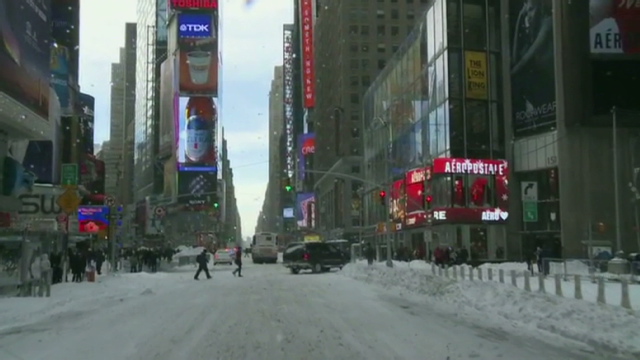
Parts of Brooklyn had 24 inches of snow, according to the National Weather Service -- shy of the 32 inches reported in Rahway, New Jersey. High winds were also a problem, including gusts as strong as 80 mph in Wellfleet on Cape Cod, Massachusetts.
The Federal Transportation Security Administration has been coordinating with airports and airlines to bolster staffing as necessary as flights resume, according to spokeswoman Sterling Payne.
Authorities were also investigating an incident that occurred at Lambert-St. Louis International Airport on Tuesday when
the wing of an Airbus jet clipped the horizontal bar near the tail section of another jet while it was being de-iced, according to airport Director Rhonda Hamm-Niebruegge.
Both planes returned to the gate and were undergoing inspection, she said.
Stranded travelers in New York slept on cots and atop luggage carousels Sunday night, while less-fortunate people bedded down on airport floors.
"It looked like everybody was camping inside," said Jacob Chmielecki, who was stranded with his family at New York's LaGuardia airport.
Antonio Christopher said he spent two nights sleeping at Heathrow Airport in London, where snow caused major delays earlier this month. On Monday, he found himself in a similar situation across the pond.
"It's one of those things," he said. "You have to keep up about these things. It was a blizzard. There's nothing you can do about it."
Other travel -- by rail and road -- was snarled as well. Hundreds of people were left stranded at New York's Pennsylvania railroad station after Long Island Railroad canceled trains. Amtrak said it would resume normal service Wednesday between Boston and Washington, but passengers could see some delays.
By Tuesday, police had removed more than 1,000 abandoned vehicles from New York's Van Wyck Expressway and Cross Bronx Expressway, according to Bloomberg, who called the operation "the biggest effort to clear snow our city has ever seen."
"Because the snow fell so quickly and in such great amounts, and because the wind blew so forcefully -- creating whiteouts -- many motorists got stuck and abandoned their vehicles in the middle of streets," the New York mayor said Tuesday.
Bloomberg said the states of New York and New Jersey loaned the city 35 ambulances, helping reduce the backlog of emergency medical services requests.
The city has requested private tow companies to assist in cleanup efforts
Bloomberg noted that New York City is also facing blood-supply shortages and asked residents to donate, saying, "We need your help now more than ever."
According to Connecticut Light & Power's website, the number of its customers affected by the storm dropped dramatically from 33,712 on Monday to 753 by Tuesday afternoon. CL&P services 1.2 million Connecticut residents, so less than 1% of customers state-wide were affected.
Some 10,000 customers in Westchester County and New York City lost power due to storm and tree damage, according to a Consolidated Edison statement.
By Tuesday, 500 households remained without power, ConEd said.
CNN
African leaders meet with Gbagbo to deal with Ivory Coast crisis
Three African presidents met with their defiant counterpart in Ivory Coast Tuesday in an effort to defuse the country's political crisis.
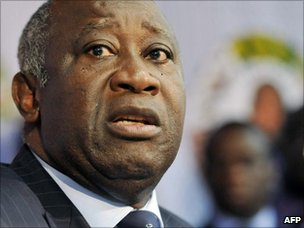
No details of the meeting in Abidjan, the administrative center of the conflict-torn country, were immediately available. But incumbent President Laurent Gbagbo's ministers had already signaled that the man who believed he had won Ivory Coast's presidential election had no intention of stepping down.
Presidents Yayi Boni of Benin, Ernest Bai Koroma of Sierra Leone and Pedro Pires of Cape Verde were next meeting with Gbagbo's challenger, Alassane Ouattara, who also claimed victory at the polls and who has the international community's support as Ivory Coast's legitimate leader.
The three heads of state represent the 15-member Economic Community of West African States (ECOWAS), which held an emergency meeting last Friday in Nigeria and delivered an ultimatum to Gbagbo: Step down or face the threat of military force.
Gbagbo's Minister of Interior Emile Guirieoulou said Sunday the three leaders would be "received as brothers, friends."
"We will listen to them, listen to the message they are carrying," he said. "If they abide to our constitution, we're going to talk ... our constitution is not negotiable."
However, Foreign Affairs Minister Alcide Djedje said Gbagbo would not step down.
The ECOWAS delegation met earlier Tuesday with Young-Jin Choi, United Nations Secretary-General Ban Ki-moon's special envoy; and a representative of the African Union.
It's unclear if ECOWAS intends to make good on its threat or what kind of force would be used. It has intervened before in Liberia and Sierra Leone.
Ivory Coast's Independent Electoral Commission, backed by the United Nations, declared opposition leader Ouattara the winner of a November runoff. But its Constitutional Council invalidated those results and declared incumbent Gbagbo the winner.
The international community, including the United States, the United Nations and the African Union, has recognized Ouattara as the winner and urged Gbagbo to cede power.
The incumbent government on Tuesday threatened to expel ambassadors of countries that recognize Ouattara's ambassadors, according to Ahoua Don Melo, the government spokesman.
Speaking on national television, he said the move would be a measure of reciprocity. The threat seems to take aim at France and Belgium. France has said it would review the credentials of an ambassador appointed by Ouattara, while Belgium has said it would recognize the Ouattara appointee.
The political stalemate has thrown Ivory Coast into crisis and scores of people have died in related violence.
A convoy of Bangladeshi peacekeepers came under attack Tuesday in Abidjan, the United Nations said. The U.N. peacekeeping mission said one soldier was slashed in the arm by a machete and a U.N. vehicle was burned.
The African Union has suspended Ivory Coast from the organization "until such a time the democratically elected president effectively assumes state power." And the World Bank has halted lending and disbursing funds to Ivory Coast and has closed its office in the country.
The U.S. Department of Defense currently has a group in Abidjan looking into the possible evacuation of U.S. citizens. State Department spokesman Mark Toner confirmed it was a "small DoD assessment team on the ground at the embassy in Abidjan to help with contingency planning."
More than 15,000 refugees have fled for neighboring Liberia, according to the U.N. High Commissioner on Refugees, a large number of them women and children.
CNN
Russia defends verdict against oil tycoon
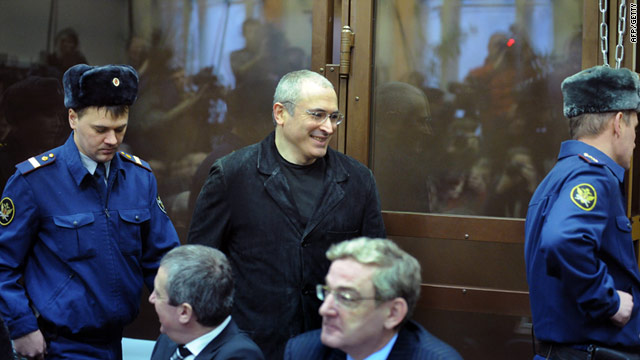 Russia on Tuesday responded to international criticism over the conviction of a former Russian oil tycoon and his business partner on corruption charges.
A judge in Moscow found Mikhail Khodorkovsky, the former head of the Yukos oil company, and his partner guilty Monday.
The United States in particular criticized the court proceeding, calling it a case of selective prosecution.
The Russian Foreign Ministry issued a statement dismissing Western criticism over the verdict.
"The attempts at pressuring the court are unacceptable," the statement said, adding that the case falls wholly within the Russian legal system.
Money laundering and tax evasion charges would similarly be criminally prosecuted in any other country, the statement said.
"Allegations about some kind of selective prosecution in Russia are groundless. Russian courts deal with thousands of cases where entrepreneurs are prosecuted," the statement said.
It concluded, "We are expecting that everyone will mind their own business, both at home and in the international arena."
Khodorkovsky's son, Pavel, told CNN that his father will appeal the verdict.
"Of course there will be an appeal," Pavel Khodorkovsky said. "What I'm hoping for right now is the shortest sentence possible, because I'm really hoping to see my dad as soon as possible a free man."
The trial on money laundering and embezzlement charges, which began in March 2009, was the second for the two men. Khodorkovsky, who is already imprisoned after being convicted on other charges, could be sentenced to prison until 2017.
"The trial was a charade of justice, the charges were absolutely false, but I fear the sentencing will be very real," lead defense lawyer Vadim Klyuvgant said in a written statement.
Khodorkovsky and partner Platon Lebedev were accused of stealing billions of dollars' worth of oil from Yukos production subsidiaries from 1998 to 2003. Khodorkovsky has already been convicted of underpaying taxes on the oil and is serving an eight-year sentence for fraud and tax evasion.
Ahead of the verdict, hundreds of supporters gathered outside the central Moscow courthouse.
Security officers, who maintained a heavy presence outside the building, whisked several people away while others stood in below-freezing temperatures chanting "Freedom" and "Russia without Putin" -- referring to the prime minister.
Khodorkovsky had expressed a desire to run for office at one time and funded opposition political parties. He has said the trial was part of a Kremlin campaign to destroy him and take the company he built from privatization deals of the 1990s.
The Kremlin has denied any role.
Pavel Khodorkovsky said that he had been expecting a guilty verdict for his father, but also "had hoped that President (Dmitry) Medvedev's rhetoric about judicial system reform would actually bear some fruit."
"However, today, I realize that the judge is completely subservient and is a slave to the political will of Mr. (Russian Prime Minister Vladimir) Putin and other bureaucrats in the Kremlin," the younger Khodorkovsky said.
A White House statement Monday also criticized the case, saying it "appears to be an abusive use of the legal system for improper ends."
"The apparent selective application of the law to these individuals undermines Russia's reputation as a country committed to deepening the rule of law," said the statement from White House Press Secretary Robert Gibbs,. The statement added that the United States would continue monitoring developments in the case.
In a separate statement, U.S. Secretary of State Hillary Clinton said the conviction "raises serious questions about selective prosecution -- and about the rule of law being overshadowed by political considerations."
"This and similar cases have a negative impact on Russia's reputation for fulfilling its international human rights obligations and improving its investment climate," Clinton's statement said.
The court was originally scheduled to read the verdict in the trial on December 15, but it was unexpectedly postponed.
The Yukos oil company was once Russia's largest oil producer. It was later broken up and absorbed by the state.
Khodorkovsky previously told the Moscow court that its decision will have an impact far beyond him and Lebedev.
"There is much more than just the fates of two people in your hands," Khodorkovsky said. "Right here and right now, the fate of every citizen of our country is being decided."
In October, prosecutors asked for a 14-year prison sentence but said it should include the eight-year term that Khodorkovsky is already serving, which will end in October 2011.
The former oil magnate was previously incarcerated in a work camp near the town of Krasnokamensk, 6,500 kilometers (4,000 miles) from his native Moscow, but when the new charges were brought against the two men, both were moved to Moscow last year to stand trial.
The court also ordered Khodorkovsky and Lebedev to pay about $600 million in back taxes.
Few doubt that Khodorkovsky's prosecution has taken on a symbolism far beyond his own innocence or guilt. Critics say the embezzlement charges against him are absurd; analysts say Russia itself, and its commitment to the rule of law, is on trial.
"This verdict will be a verdict on whether Russia is a law-governed state, or whether it ever aspires to become one," said Masha Lipman of the Carnegie Endowment, "because currently it is not a law-governed state and the trial of Khodorkovsky and his partner Lebedev is the most striking example of it."
In his final address to the court, Khodorkovsky made a last impassioned appeal.
"For me, as for anybody, it is hard to live in jail, and I do not want to die there. But if I have to, I will not hesitate. The things I believe in are worth dying for," he said.
Chinese officials fired over deadly road accident
Six education and traffic officials were fired Tuesday, a day after 14 children died when a three-wheeled vehicle plunged into a creek in central China, according to state media.
The vehicle was carrying 20 children, according to the Xinhua news agency. Several others were injured in the Monday crash in China's Hunan province.
The cause of the accident was under investigation Monday, but a spokesman with the city government's information office said the weather was very foggy when the vehicle plunged into the body of water, Xinhua said.
The incident happened in the Songjiang Township of Hengnan County, a county education bureau spokesman told Xinhua.