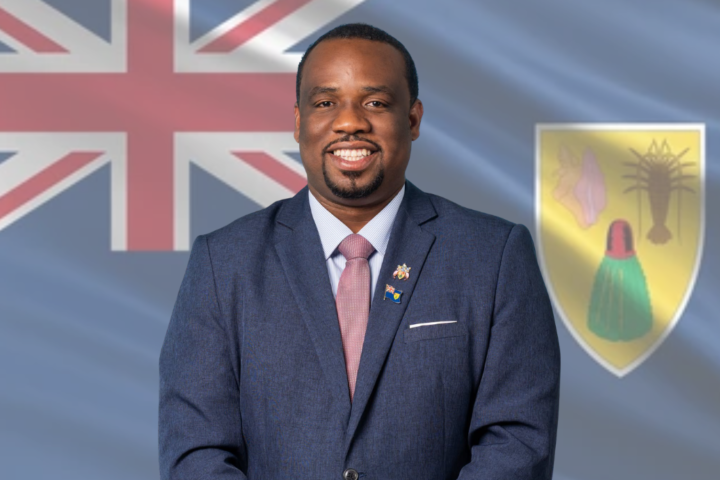

RTC’s Damian Wilson, spoke to the Deputy Premier and Minister of Finance, Investment and Trade, Honorable Erwin Jay Saunders on Tuesday, 19th April. Hon. Saunders gave a detailed explanation of what a broad-based consumption tax is and how it would affect citizens and residents should TCIG choose to introduce said tax.
The International Monetary Fund (IMF) and its affiliate Caribbean Regional Technical Assistance Center (CARTAC) were invited by the Turks and Caicos Islands government to review the existing tax structures within the Turks and Caicos Islands. The IMF & CARTAC held a discussion with private stakeholders and prominent figures within TCIG, including the Ministry of Tourism.
The IMF is yet to give their official report following this discussion.
The Deputy Premier mentioned to RTC News, that the country’s revenue has grown exponentially within the last year, and there are taxes in place which attribute to this growth.
He said on March 31st, 2021, the TCI went from a deficit to a huge plus in one year as stamp duties did very well. Stamp duties, however, are unpredictable and there is nothing that TCIG can do to keep it stable,
according to the Minister. The government cannot rely solely on import/stamp duties to as a stable stream of revenue for the country.
Therefore, the main focus of the government, by inviting the IMF to the country is to find solutions to stabilizing the economy and predict on a yearly basis the expected revenue flowing into the Turks and Caicos Islands.
Hon. Saunders explained that in some countries, the Government introduced a broad-based tax to stabilize their economy. However, a broad-based consumption tax is doable, and is different from a value added tax (VAT). He explained that a value added tax cannot work in our country as we do not have an efficient manufacturing industry to add a VAT to.
Hon. Saunders explained that a broad-based consumption tax will define how the government can reduce the tax on the most vulnerable and spread the wealth to those who can afford it. He explained that currently the tax structure charges workers the same on import fees despite the significant difference in salaries among persons across various sectors.
Hon. Saunders also stated that if the broad-based consumption tax is passed by Cabinet and introduced into the TCI’s tax structure, it will force transparency from the private sector. Entities such as Grace-way Supermarket will have to disclose their pricing structure which is something he believes the company doesn’t want to do. Additionally,
hotels will have to report what their revenues are which he said will cause push back from entities in the private sector.
Hon. Saunders explained that because of the differences in salaries, once the IMF publishes their official report, persons may see a recommendation to have different tax brackets created to divide the social and economical structure of the people.
RTC News also spoke to local entrepreneur and host of Financially Speaking, Mr. Drexwell Seymour on Thursday, 14th April. Mr. Seymour spoke about the discussion with the IMF & CARTAC which he was invited to be a part of, and his overall point of view on broad-based consumption tax.
Mr. Seymour wrote an article where he reviewed the present tax structure and the importance of the country’s Tourism Industry despite its volatile nature. He stated that he thinks a broad-based consumption tax in not needed at this time given the fact that cost of living is currently at its highest.
Mr. Seymour said that in his opinion residents of the Turks and Caicos are overly taxed as there are taxes included at grocery stores, restaurants, and hotels, telecommunications, and airports. He stated that he doesn’t know how a broad-based tax will work when you consider stamp duties.
Hon. Saunders also spoke to this point, stating that the government knows that taxes are high, which is why they are actively looking at ways to reduce it. He explained that the strategy which the government is working on now, is to remove certain taxes before replacing them with ones that are more feasible to spread wealth in a balanced way.
Mr. Seymour stated that a broad-based consumption tax is like value added tax (VAT) or a sales tax, which will be introduced because of the difference in salaries
However, the Deputy Premier stated in his interview with RTC News, that small businesses may be exempted from paying the consumption tax or having to be totally transparent if the tax were to be introduced. Therefore, the tax wouldn’t be a burden for the common man.
Speaking to the IMF & CARTAC’s statement that the Tourism Industry is volatile, he stated that while that statement may be true, it is not a reason to introduce a broad-based consumption tax, as most residents have benefitted from the Tourism Industry.
The Deputy Premier stated, however, that the government has not settled on a decision after the review of the tax policy, since they have
not seen the official report from the IMF. He said the main focus is simply to reach a point where revenue streams can be predictable.