
Bulls Rose signs $94M extension
Derrick Rose says there isn't much that excites him. A maximum contract extension, though, just might.
The reigning MVP agreed to a five-year contract extension with the Chicago Bulls worth approximately $94 million, a person familiar with the situation said.
The Chicago Tribune, citing sources, first reported the deal.
The person spoke to the Associated Press on the condition of anonymity Tuesday night because the deal had not been finalized. The extension will start in the 2012-13 season, when Rose is eligible to make about $16 million.
Rose wouldn't say anything specific after the Bulls' preseason game Tuesday night.
"It's something big, but I think I want to talk more about it (Wednesday), with my family and everybody being there," the Bulls' star point guard said. "But it's definitely something big."
And, teammates say, it was well-earned.
"We're all very excited for him," Carlos Boozer said. "He deserves it. He puts in a lot of effort. I wish the contract was for 10 years."
The chance to join Rose in the backcourt was a big draw for Richard Hamilton. The veteran shooting guard signed with the Bulls last week after being bought out by the Detroit Pistons, and so far, he likes what he sees.
"He works hard," Hamilton said. "He's young. He's 23 years old and the way he plays on the floor is the way he practices. In order to be great in this league, you just can't turn it on (during) games. He really has a great work ethic."
The deal is more of a formality than a surprise.
Rose and general manager Gar Forman had indicated it would get done, and it was not hard to see why they wanted to stay together.
The Chicago product went from Rookie of the Year to All-Star to MVP in his first three seasons, becoming the youngest player to win that award. About the only thing he doesn't have is a championship ring, and that's what weighs on him as he enters his fourth season - not the money.
"I think I live a humble life," Rose said. "Of course, I know I'll be able to afford whatever I want, but other than that, there aren't too many things that excite me. Me winning is one of the things. Me being around my family, that's another. Money, that's the last thing I think about."
The Bulls came close to winning it all last season, winning a league-high 62 games and advancing all the way to the Eastern Conference finals before losing to the Miami Heat.
Now, they're looking for more.
Rose has repeatedly pointed the finger at himself for the Bulls coming up short against the Heat in the playoffs. He worked on his inside game in the offseason after expanding his shooting range in previous years, but it's hard to imagine him accomplishing much more than he did last season.
Rose delivered one of the best seasons by a point guard. He also joined Michael Jordan as the only Bulls players to win the MVP award.
The South Side product established himself as one of the league's best players, averaging 25 points and 7.7 assists while leading Chicago to its best season since the championship era with Jordan and Scottie Pippen.
For Rose, the contract extension is just another milestone in a rapid rise from the city's rough Englewood neighborhood to a starring role with his hometown team.
He helped Simeon Career Academy become the first Chicago Public League team to win back-to-back state championships, then led Memphis to the NCAA championship game before the Bulls drafted him with the No. 1 pick in 2008 after defying long odds to win the lottery.
"The Bulls are loyal," Rose said. "They've stayed loyal with me, showed that they trusted me by picking me to come here. I just feel blessed, and I'm just happy that I'm here."
AP

Iraqi PM urges Kurds to hand over VP al-Hashemi
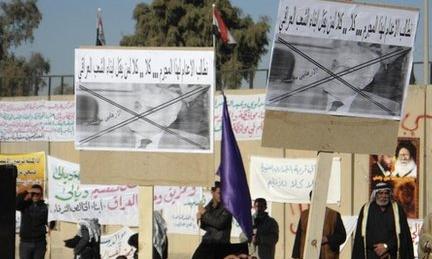 The Iraqi Prime Minister Nouri al-Maliki has called on the autonomous Kurdish region to hand over Iraq's Sunni Vice-President, Tariq al-Hashemi.
An arrest warrant was issued for Mr Hashemi on Monday over terror charges.
Tariq al-Hashemi is Iraq's most senior Sunni Arab politician. He says the allegations are "fabricated".
Mr Hashemi is currently in the region of northern Iraq controlled by Kurdish authorities. The warrant was issued a day after US troops pulled out.
The US Vice-President Joe Biden has urged Iraqi leaders to work together to avert renewed sectarian strife.
In a news conference broadcast live on Iraqi television, Mr Maliki, a Shia, said he would dismiss ministers belonging to the main Sunni political grouping, Iraqiyya, if they did not lift their boycott of parliament and cabinet.
The prime minister offered an invitation to all political factions to hold talks to try to resolve the crisis. But if that did not work out he said that in the future Iraq could have a majority government which any person or bloc would be welcome to join, to "take the country forward in a positive direction".
Asked about Mr Hashemi's call for the Arab League to oversee any process against him, Mr Maliki said this was a criminal issue in Iraq. He saw no reason why the Arab League or the United Nations should intervene in an Iraqi criminal case, he said.
Cuba and Venezuela sign $1.6 billion in cooperation accords
 Venezuela and Cuba have signed 47 new cooperation accords, valued at $1.6 billion, Venezuelan oil and mining minister Rafael Ramirez announced on Monday.
Upon the closing of the 12th Cuba-Venezuela Joint Intergovernmental Commission, Ramirez underscored the significantly positive impact by the current bilateral cooperation on his country through the implementation of social missions.
All these projects constitute a qualitatively higher stage of bilateral relations, whose commercial value has increased to $11 billion, the minister said.
Meanwhile, the vice-president of the Cuban Council of Ministers Ricardo Cabrisas stressed the success of the joint Commission, which he described as a scenario reaffirming the political will of both governments to implement all approved projects since the year 2000 in tune with the bilateral framework cooperation accord.
During the Commission’s closing session, both parties signed six new contracts in the context of the 2012 program, which are aimed at maintaining technical assistance and services for social missions in Venezuela, continuing to provide the South American nation with pharmaceuticals, contributing to the sectors of health, sports, culture, food sovereignty, as well as supporting the recovery of the Venezuelan electric power generation system.
Over the past few days, Cuban and Venezuelan ministers in nine sectors gathered at Havana´s Conventions Hall to look at projects already under implementation and they approved 47 new projects aimed at improving the wellbeing of the peoples of Cuba and Venezuela.
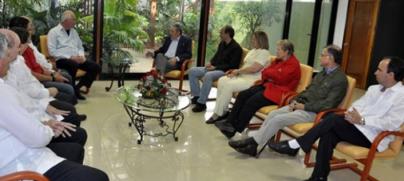
On Monday afternoon, Cuban President Raul Castro received the Venezuelan delegation that took part in the 12 Joint Intergovernmental Commissions. During the talks, Rafael Ramirez and Ricardo Cabrisas briefed the Cuban president about the major outcomes of the meeting, which will allow strengthening bilateral cooperation and economic integration relations.
Both ministers ratified the determination to work for the increase of efficiency in the use of resources and maximize the social and economic impact of the projects, which include the areas of health, education, culture, sports, agriculture, industry, mining and oil, among others.
The meeting was also attended by the vice-president of the Venezuelan government Ricardo Menendez and several ministers from both countries.
Several major projects to start or be completed in 2012 in St Kitts-Nevis
Construction on several projects, including a world class private jet terminal, a mega-yacht marina and a resort, is to begin and continue in 2012, Prime Minister and Minister of Finance, Dr Denzil Douglas has disclosed.
He said, in an effort to further expand arrivals from the higher end of the air passenger market, construction of a world class private jet terminal will begin in January 2012 and it is scheduled to be completed by October 2012.
“This project is synergistic with other premium facilities which are already being developed to serve a more upscale clientele,” said Douglas.
He said the private jet terminal will target clients from a number of ongoing developments such as Christophe Harbour, which recently opened The Pavilion at Sandy Bank Bay.
Work he said is also continuing on the mega yacht marina at the South East Peninsula, which is expected to host its first vessels in January 2012.
“Development is also now progressing at Kittitian Hill, with construction underway on the golf course and 36 resort cottages and 10 villas. It is anticipated that Phase One which is the opening of a 90-room hotel, spa and golf resort will take place in December 2012,” said Douglas.
He said Phase Two of the Silver Reef luxury apartment complex will also be completed by June of next year.
“We are seeing the positive impact from the completion of the final 22 units of the 88-unit Marriott Vacation Club International (MVCI), which has timeshare owners that visit year-round therefore providing a balance between the seasonal lows and highs of leisure travel,” said Douglas.
C.News Now
Former Trinidad Police Service Commission boss appeals his dismissal
The former chairman of the Police Service Commission who was fired in early April following controversial statements about the ethnic composition of the force has challenged the matter in court.
Nizam Mohammed has filed a constitutional motion asking that the revocation of his appointment by President George Maxwell Richards be declared null and void.
The former PSC boss argues that the president’s decision was due to political pressure and he did not have a chance to defend himself, according to the Trinidad Express newspaper.
The Attorney General has been named as the defendant.
Mohammed stated that comments concerning the ethnic composition of the top-most level of the Police Service and the Promotions Advisory Board of the Police Service should be protected by parliamentary privilege as they were made during a meeting of the Joint Select Committee appointed to consider and report to the Parliament on Service Commissions.
Mohammed’s statements were denounced by the Office of the Prime Minister and the Leader of the Opposition.
In the suit, the former PSC chairman said both the opposition leader and Prime Minister Kamla Persad-Bissessar held separate meetings with the president.
Mohammed explained that he subsequently met with President Richards who notified him of letters of complaint from three of his colleagues on the commission about his chairmanship.
Mohammed insists he was not given reasonable opportunity to respond to the matters raised by the president, and had his appointment revoked several days later.
Caribbean 360 News
Edwards aiming to be fastest bowler on earth
Batsmen around the world may start to shiver in their boots after Fidel Edwards threatened to touch the 160 kilometre-an-hour mark in the next year.
The 29-year-old West Indies fastbowler, who is playing for Sydney Thunder in the Big Bash, said he would like to get closer to the fastest delivery ever unleashed by Pakistani Shoaib Akhtar and Australian Shaun Tait.
“One of my aims is to be the fastest and regarded as the best fastbowler in the world,” said Edwards.
“Hopefully, I’m not too far off that (goal) and it could be by the end of next year. That’s my goal.
“Patrick Cummins is fast, Shaun Tait bowls quick and Kemar Roach bowls fast as well. Depending on how the body holds up, who knows, you could see some fast speeds in the Big Bash.”
Edwards has enjoyed a year free of serious injury, after being sidelined for most of the previous two years with a career-threatening back injury that required surgery.
“I’ve been doing a lot of strength work lately and I’ve been holding up well,” he said.
“There are still a couple of things I need to work on with my action, but hopefully you’ll see me bowl faster,” he asaid
“I loved watching (West Indian greats) Curtly Ambrose, Courtney Walsh, Malcolm Marshall and those sorts of guys…. I’m also a very big fan of Brett Lee, just the way he approaches his game, the way he runs in and bowls fast and scares batsmen. I love to watch him bowl,” said Edwards.
The Barbadian speedster failed to take a wicket on Sunday, when the Thunder opened their Big Bash campaign with a six-wicket victory over the Melbourne Stars.
Jamaica Observer
Boxing star remanded
SOBBING LOUDLY that he did not want to go to prison, Barbados’ boxing star, Anderson Fitzgerald Emmanuel, was remanded to Her Majesty’s Prisons Dodds yesterday when he appeared in court charged with committing robbery.
The 26-year-old heavyweight boxer, who was the National Sports Personality 2006, was not allowed to plead to the indictable charge that on July 24, he robbed Russell Whyte, of four bracelets valued $4 500, two rings valued $8 400, a chain valued $2 000 and $3 000 in cash, when he appeared in the District “A” Magistrates’ Court before Magistrate Graveney Bannister.
Emmanuel, a Commonwealth, CAC and Pan Am medallist, resides at Fairway Gardens, Christ Church. In October he secured a Pan Am bronze medal for Barbados.
Prosecutor Sergeant Rudy Alleyne objected to bail for Emmanuel on the grounds that the offence was of a serious nature; that Emmanuel had recently been taken into police custody; another person was being sought and that if he was given bail the possibility existed that he would interfere with the virtual complainant; and he might not turn up for his trial. (MB)
Nation News
Jamaica 50 celebrations blast off on New Year's Day
Plans for the country's 50th anniversary celebrations next year are well advanced, with the activities set to begin on January 1, with fireworks on the waterfront, downtown Kingston, and at various locations across the island.
The celebrations, with the slogan 'Jamaica 50: Feel the heart and soul of a nation', will culminate in a similar manner on December 31, 2012.
"It is what we call blast off Jamaica 50 celebrations. It is going to happen as has happened over the last four to five years on the Kingston waterfront. It's a fantastic event, pulling about 100,000 Jamaicans at the waterfront," Project Director of Jamaica 50 Secretariat, Lenford Salmon, said yesterday at a Jamaica Information Service (JIS) 'Think Tank', held at the agency's head office in Kingston.
Jamaica 50 is being led by a National Planning Committee, chaired by Minister of Youth, Sports and Culture, Olivia Grange, with membership from various sectors, including culture, tourism and other government groups; the Opposition, the private sector, youth organisations; religious and civic groups and other sectors. The committee is supported by the Jamaica 50 Secretariat, which is co-ordinating and implementing the programme of activities.
Praise and worship session
Salmon said a series of entertainment activities would take place at the waterfront event, including a praise and worship session at midnight.
"It is really to give thanks to the one above for taking us through the 50 years and to give us strength and courage to embark on the journey in going forward," he said, adding that the programme would last until 1:30 a.m. to herald the beginning of Jamaica 50.
He pointed out that the main highlights of the year-long celebrations will be in August 2012, the month Jamaica gained independence from Great Britain in 1962.
Argentine minister Ivan Heyn dies at Mercosur summit
A senior Argentine official has been found dead at the Mercosur summit in the Uruguayan capital, Montevideo.
Undersecretary for foreign trade Ivan Heyn was found hanged in his hotel room, police said. He is thought to have taken his own life.
Mr Heyn, 33, was a rising star in the government of President Cristina Fernandez de Kirchner.
President Fernandez left a meeting in distress on hearing the news and was given medical treatment.
Mr Heyn's death appeared to be a suicide but the investigation was continuing, Uruguayan police spokesman Jose Luis Roldan said.
An economist and former student leader, Mr Heyn was appointed undersecretary for foreign trade following Ms Fernandez's reelection in October.
Trade agenda
Mercosur is a South American trade bloc comprising Argentina, Brazil, Paraguay and Uruguay.
The leaders of Venezuela and Ecuador are also attending the summit.
The main issue on the agenda is whether to admit Venezuela as a full member, a move that has long been blocked by opposition in the Paraguayan parliament.
South American leaders are also discussing how to protect their economies from global instability.
In its first act, the summit approved a free-trade deal with the Palestinian Authority (PA).
The agreement is the first between the PA and a trading bloc outside the Arab world.
Mercosur members have already recognised Palestine as an independent state.
Former Miss Venezuela dies of breast cancer at 28
Former Miss Venezuela Eva Ekvall, whose struggle with breast cancer was closely followed by Venezuelans, has died at age 28.
Her family said Ekvall died Saturday at a hospital in Houston.Ekvall's father, Eric Ekvall, is an American of Swedish-Hungarian descent,who has lived in Venezuela since the early 1980s and worked as a political analyst.Her mother, Dawn Johnson, was born in Jamaica, and once ran a small modelling agency in Alaska, where she met Ekvall's father.
Ekvall was crowned Miss Venezuela at age 17 in 2000, and the following year she was third runner-up in the Miss Universe pageant in Puerto Rico. She went on to work as a model, actress and television news anchor.
She also authored a book, "Fuera de Foco" ("Out of Focus"), about her struggle with cancer, which included images by Venezuelan photographer Roberto Mata.
She told the newspaper El Nacional in an interview last year after the book was published that "I needed to send the message of the need for cancer prevention."
Ekvall's family said in a statement Sunday that her remains were being cremated in Houston on Monday and that a service is to be held in Venezuela once her remains are returned to the country.
Ekvall said in a 2007 interview published in Venezuelan news media that although her mother is Jamaican and her father is American of Swedish and Hungarian descent, "I feel more Venezuelan than anybody."
She was married to radio producer John Fabio Bermudez and had a 2-year-old daughter.
In her book, Ekvall had described her joy at the birth of her daughter saying "that happiness, although (the daughter) may not know it or understand it, keeps me alive today."
Her death brought an outpouring of condolences from Venezuelans, including from some prominent artists and politicians who praised her in messages on Twitter.
One drawing posted online depicted her as an angel with white wings and a pink ribbon on her chest.
Ekvall's husband posted a photo on Twitter Sunday showing a close-up of his hand holding hers, resting on a bed, with the words "Always together ... I love you wife."