
Obama, Boehner square off in payroll tax fight
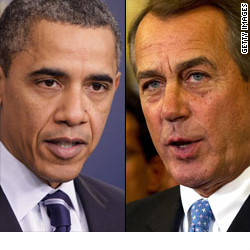 The congressional impasse over extending the payroll tax cut became a showdown Tuesday between President Barack Obama and House Speaker John Boehner.
After the Republican-controlled House passed a measure calling for more negotiations, Boehner made public a letter to Obama that urged him to order the Senate back from its holiday break to take part in further talks.
Leaders in the Democratic-controlled Senate reject that idea, and Obama agreed with them, telling reporters in a previously unscheduled appearance that the House must approve a two-month extension passed by an 89-10 vote in the Senate.
"The bipartisan compromise that was reached on Saturday is the only viable way to prevent a tax hike on January 1," Obama said. "It's the only one."
The House motion, passed Tuesday with no Democratic support on a 229-193 vote, expressed the chamber's disagreement with the Senate plan and called for the dispute to be immediately taken up by a House-Senate conference committee -- something already ruled out by Senate Majority Leader Harry Reid, D-Nevada.
However, Boehner and the Republican leadership prevented a direct vote on the Senate's two-month extension, signaling they may lack enough GOP support to defeat it in the face of unrelenting pressure from the White House, Democrats and some Senate Republicans.
Instead, the House approved a separate resolution supporting a yearlong extension of both the payroll tax cut and emergency federal unemployment benefits. House Republicans are also pushing for a new, two-year "doc fix," or delay in significant scheduled pay cuts to Medicare physicians.
All three measures are set to expire December 31.
Meanwhile, House members headed out of town for their holiday break after legislative business ended Tuesday.
The Senate measure approved Saturday called for a two-month extension of the payroll tax cut, unemployment benefits and the "doc fix" spending. It was a fallback plan designed to give both sides more time to negotiate.
Now that short-term compromise has slammed into a conservative roadblock in the House, where rank-and-file Republicans are fuming over the two-month time period of the plan, among other things.
The lingering dispute is hurting his party, veteran Republican Sen. John McCain of Arizona told CNN, adding that the reality of the issue is that the payroll tax cut must be extended to help out Americans still struggling in the economic recovery.
"It is harming the Republican Party," McCain said. "It is harming the view, if it's possible any more, of the American people about Congress."
As the clock ticks down, nobody appears willing to bend and neither side seems to know how to break the logjam. Boehner, R-Ohio, appointed House GOP negotiators for a conference committee, but Democrats say they have no plans to do the same.
According to House Republican sources, their strategy is to generate as much news coverage as possible of their appointed conferees in coming days to keep the pressure on Democrats to negotiate.
"We are going to try to remind people that we are still in town ready to work," said one House GOP leadership aide.
One of the House negotiators, Rep. Fred Upton, R-Michigan, told CNN that he has already notified his wife that he will be in Washington for Christmas.
Boehner called for Obama to order the Senate to return from its holiday recess and appoint negotiators. The House already has come back from its holiday break to respond to the Senate's two-month proposal.
In a letter to Obama made public by Boehner's office, the speaker said, "I ask you to call on the Senate to return to appoint negotiators so that we can provide the American people the economic certainty they need."
"Who doesn't believe that if we don't do this now that when we get to February 28th, guess where we'll be? We'll be right here doing the same thing that we are doing right now. I just think the American people expect us to do our work," Boehner said during debate on the House floor.
White House spokesman Jay Carney told reporters Tuesday that the House needs to pass the Senate two-month extension so that a full one-year extension can be worked out.
"In order for it to get done, it has to pass the House," Carney said, adding that Obama "cannot order the extension of the payroll tax cut. Congress has to take action."
Obama then made his surprise appearance in the White House briefing room and called for Boehner to allow an up-or-down vote on the Senate proposal.
"House Republicans refuse to allow a vote," Obama said, noting that Senate leaders from both parties had agreed to the short-term extension in order to guarantee that taxes don't increase for working Americans while negotiations continue early next year on the one-year extension that House Republicans say they support.
"What they're really holding out for is to wring concessions from Democrats on issues that have nothing to do with the payroll tax cut," Obama said of House Republicans.
Neither Reid nor House Minority Leader Nancy Pelosi, D-California, would appoint Democratic negotiators for the conference committee proposed by House Republicans. Boehner named eight House Republicans as his representatives, but there was no word on Senate Republican conferees.
The mistrust between the parties was palpable. When asked if Democrats were to blame for the impasse by refusing to name conference committee negotiators, Pelosi said the issue was the refusal by House Republicans to go along with the bipartisan support for the Senate plan.
"Whatever they say is irrelevant," Pelosi declared about Republican claims of wanting a one-year payroll tax cut extension. "What they do is what's important, and what they're doing is not giving a payroll tax cut to 160 million Americans."
House Republicans, meanwhile, repeatedly suggested the 60-day extension in the Senate plan would be the limit of action on the issue if it passed, rejecting insistence by Obama and Reid that they wanted to continue working for a longer deal during the first two months of 2012.
"We're going to drag them kicking and screaming to a conference," said Rep. Andy Harris, R-Maryland.
A failure to act could have major economic and political fallout. The payroll tax break alone is worth roughly $1,000 a year for an average family and affects about 160 million Americans.
Numerous observers believe Obama is preparing to parrot Harry Truman's 1948 campaign next year by running against an unpopular, dysfunctional Congress controlled partly by the GOP.
"This effort is more toward securing votes than toward securing economic growth," said conservative Republican Rep. Jeff Flake of Arizona.
The House GOP leaders' decision not to hold a direct up-or-down vote on the $33 billion Senate plan -- an apparent reversal of earlier plans -- came after a two-hour meeting of the entire House Republican caucus late Monday.
Pelosi told reporters that the change probably meant that Boehner and his lieutenants lacked enough support from their own members to guarantee a defeat for the Senate bill.
In the 434-member House chamber -- one seat is currently vacant -- the 242-seat Republican majority can only afford 26 defections to overcome a unified 192-seat Democratic minority.
A House GOP leadership aide conceded to CNN that it is a "cleaner message" to simply vote to affirm the House position on extending the payroll tax cut for a year, instead of opposing a two-month extension.
"We outright reject the attempt by the Senate to kick the can down for 60 days," Cantor said after Monday night's caucus meeting.
Carney emphasized that the bipartisan support in the Senate showed it was House Republicans in the minority on the issue, with the White House, Democrats and Senate Republicans all calling for the two-month extension.
Democratic legislators, meanwhile, said it was Republicans blocking progress in Congress. Senate Republicans objected to a floor vote on the House GOP payroll tax plan, while House Republicans now have prevented an up-or-down vote on the Senate measure that had broad GOP support, they said.
Boehner, however, said Monday night that "we disagreed with what the Senate produced."
"They did their job," he said of his call last week for the Senate to send the House a proposal. "They produced a bill, and the House disagreed with it."
While there are sharp differences over how to proceed, both the House and Senate versions of the legislation extend the tax cut, unemployment benefits and the doc fix. Both measures also would push for presidential action on the proposed Keystone XL oil pipeline from Canada to the Gulf of Mexico -- something demanded by Republicans.
Meanwhile, five mostly moderate Republican senators have called for the House to support the Senate's two-month extension. The group consists of Sen. Scott Brown of Massachusetts, Sens. Olympia Snowe and Susan Collins of Maine, Sen. Richard Lugar of Indiana and Sen. Dean Heller of Nevada.
Brown issued a statement after Tuesday's House vote that said House Republicans "would rather continue playing politics than find solutions."
"Their actions will hurt American families and be detrimental to our fragile economy," said Brown, who is facing a stiff re-election challenge in heavily Democratic Massachusetts next year. "We are Americans first; now is not the time for drawing lines in the sand."
Meanwhile, five Democratic senators called on House Republicans to pass the Senate plan in order to speed up approval of the Keystone pipeline.
Boehner appears to have reversed himself since a conference call with caucus members Saturday, when he was the only House Republican leader to express support for the Senate plan, according to a GOP source.
The source said Boehner described the Senate vote as "a good deal" and "a victory" in the conference call. For his part, the speaker insisted Tuesday that he raised concerns about the Senate plan when he first heard of it.
"The rank-and-file members are extremely opposed" to the Senate plan, a GOP source stressed, adding that most members were concerned about the uncertainty caused by just a two-month extension, as well as the political benefit the White House could gain in the national dialogue over taxes.
The Senate's two-month measure would reduce the deficit by nearly $3 billion, according to the Congressional Budget Office.
Under the plan, the $33 billion in costs would be offset by an increase in the fees that new homeowners with federally backed mortgages would pay to Fannie Mae, Freddie Mac and the Federal Housing Administration. Those entities would then turn that money over to the U.S. Treasury.
The bump would amount to about $15 per month for every $200,000 borrowed, Senate aides estimated.
Most senators agreed on a two-month extension as a fallback position after Democrats and Republicans were unable to reach a more long-term, comprehensive agreement.
CNN

ECB offers banks three-year loans for the first time
The European Central Bank is offering three-year loans to banks for the first time in an attempt to shore up investor confidence in the eurozone.
The central bank hopes to sell up to 450bn euros ($590bn; £375bn) of loans.
When the plan was announced, French President Nicholas Sarkozy said that the banks could use the money to invest in eurozone sovereign debt.
However, analysts are not sure if banks will go on to use the money in this way.
Some suggest the money will be used to boost bank balance sheets, especially since the ECB lowered its collateral requirements when it announced the loans, enabling weaker banks to apply for the funds.
"A cash for trash mechanism allowing banks to access cheap funds and buy up more sovereign debt - or more likely just shore up their own finances," said Justin Urquhart Stewart of Seven Investment Management.
Carsten Brzeski, economist at ING, said: "The good news is that banks won't have to worry about liquidity for three years and that it has already pushed down government yields as banks are buying them to use as collateral.
"However, whether the ECB's hopes that the money will filter through to the real economy will be fulfilled remains to be seen."
There are hopes that the banks taking the loans from the ECB at low interest rates will then buy sovereign bonds from countries such as Italy and Spain which offer a much higher yield.
In a sign of the market's interest in the offer, demand for ECB one-week refinancing halved as investors waited to take advantage of the issue.
Prosecutors raid the HQ of Olympus in earnings probe
Japanese prosecutors have raided the headquarters of camera and medical equipment maker Olympus as part of an ongoing investigation.
Olympus is being probed over its accounting practices and the admission that it hid losses.
The issue came to light after former chief executive Michael Woodford claimed he was fired for questioning payments relating to mergers.
Olympus admitted it hid $1.5bn (£968m) of losses over the past two decades.
'New twist'
Last week Olympus filed its revised earning reports with the Tokyo Stock Exchange.
In its latest accounts for the six months to the end of September the company declared a loss of 32.3bn yen ($414m; £267m).
It also revised down the value of its net assets to just 46bn yen, down from the 225bn yen it stated in March 2007.
Analysts said the raid on its headquarters just days after the filing of the report was a significant development.
"I would suspect that any documents needed by the prosecutors could have been just requested for and delivered by Olympus," Martin Schulz of Fujitsu Research Institute told the BBC.
"But the fact their offices have been raided seems to indicate that there are new developments in the investigation that might add a new twist to the story," he added.
'A good thing'
The developments at Olympus had also raised concerns about corporate governance in Japan and how the affair will impact the country's image globally.
The fears were fanned further by contradictory statements by Olympus when the scandal broke out.
It first denied the allegations levelled by the Mr Woodford, but later admitted that it had been hiding losses for as long as two decades.
Analysts said the raid on Olympus was a signal by the authorities that they wanted to ensure that all corporations work within the given framework of rules and regulations.
"In a way it is a good thing that this has happened, as there were fears that this affair may be brushed under the carpet," said Gerhard Fasol of Eurotechnology Japan.
"This raid will ease any such concerns," he added.
Cuban banks begin offering loans to private businesses
Banks in Cuba have begun offering loans to individual citizens, in the latest free-market reform in the communist-run island.
The loans are aimed at the growing number of small businesses and the self-employed, as well as farmers and people building their own homes.
It is not clear what interest rates or other conditions will apply.
Over the past year Cuba's government has implemented a series of reforms designed to boost private enterprise.
Around 500 banks across the island will offer loans, according to the official Communist Party newspaper Granma.
Officials will assess each application on the basis of what the loan is to be used for and how it will be repaid, the paper said.
Potential borrowers should find out if their applications have been approved within 20 days.
Interest rates will depend on the length of the loan and will be within a range set by Cuba's Central Bank.
The minimum loan for the self-employed will be around $125 (£80), while for farmers it will be around $40 (£25).
Cubans will also be able to open current accounts and use cheques, debit cards and bank transfers to make payments.
Radical change
The banking reform is the latest in a series of measures introduced by President Raul Castro in an effort to revive Cuba's struggling socialist economy by boosting private enterprise.
Large numbers of state employees have been made redundant and encouraged instead to set up as self-employed.
Over the past 18 months, rules restricting private business have been relaxed and people are now allowed to buy and sell property and cars.
The reforms represent a dramatic change in Cuba, which for nearly half a century was been run as a command economy, with almost all activity controlled by the state.
President Castro says the changes represent an effort to update rather than abandon the socialist model.
Japanese exports fall on strong yen and euro troubles
Japanese exports have fallen again as demand for the country's goods continues to suffer.
Overseas shipments fell 4.5% in November from a year earlier, Ministry of Finance data showed.
The strength of the Japanese yen as well as the ongoing European debt crisis have weighed on external demand.
Meanwhile the Bank of Japan has decided to keep its key interest rate on hold at between zero and 0.1%.
'Adverse effects'
Japan's economy recovered from a recession that was sparked by the devastating tsunami and earthquake in March.
However in recent months the boost from recovering supply chains and restored production facilities has started to diminish.
Japanese exports came in at 5.2 trillion yen ($66.8bn; £42.6bn) in November, falling for the second straight month.
Imports rose 11.4% to 5.88tn yen, the ministry said. That lead to an expansion in the trade balance deficit to 684.7bn yen.
Analysts said adding to the problems was the effect of the weakness in the global economy.
"The adverse effect of the slowdown in Europe through a drop in Europe-bound exports and possible spillover onto demand in Asia has begun to emerge," said Naoki Iizuka from Mizuho Securities in Tokyo.
Battling the yen
The other challenge that the global economic uncertainty brings is that investors are turning to the yen as a safer investment.
That has boosted the currency making Japanese exports more expensive overseas.
The problem is such a concern that the government has intervened in the currency markets to try and reduce the impact.
On Tuesday authorities said they will expand the funds available for more currency interventions in the future.
Syria crisis: Nearly 200 lives lost' in last two days
Almost 200 people have died in two days of clashes in Syria, activists say, as the violence there intensifies.
Two activist groups put Tuesday's toll at 84 - the majority in Idlib province in the north-west.
Video has emerged of a young boy, whose body was apparently torn in half by shelling in the city of Homs.
The bloodshed comes a day before an advance group of Arab League monitors is due to arrive to oversee the implementation of a peace initiative.
The UN said earlier this month that more than 5,000 people had been killed across Syria since protests against President Bashar al-Assad erupted in March.
Damascus says it is fighting "armed terrorist gangs", who want to destabilise the country.
Surge in violence
In violence on Monday, activists said as many as 110 people may have died in fighting across the country - including 60-70 army deserters apparently gunned down by machine-gun fire close to a village called Kafr Oued in Idlib province.
Activist groups reported fresh violence in this town on Tuesday, with the Local Co-ordination Committees saying 25 people had died there by heavy machine-gun fire and shelling.
Another 34 people died in Idlib province, 14 in Homs, four in Zabadani and Jebeh close to Damascus, three in Hama and two each in Deraa and Aleppo, the group said - bringing the total toll to 84. Another activist group reported the same toll.
The claims have not been independently verified, as foreign media are banned from reporting in Syria - but all the activist groups reporting agree that there has been a surge in violence, says the BBC's Jim Muir in Beirut, neighbouring Lebanon, with particular concentrations of bloodshed in mountainous parts of Idlib province and the country's third city of Homs.
Video footage emerged on Tuesday, allegedly showing the body of a young boy torn in half in the ruins of two houses hit by army shelling in Homs.
Meanwhile, Syria's air and naval forces conducted live-fire manoeuvres aimed testing their readiness to repulse "any aggression against the homeland," the official Sana news agency reported.
Syrian opposition sources said the army was intensifying its campaign in Idlib ahead of the expected deployment of observers who will monitor the Syrian government's implementation of an Arab League peace initiative.
League officials have said that the first monitors could be in the country as early as Thursday.
Peace plan
This follows the announcement that Damascus had agreed to the observer mission on Monday.
Syrian Foreign Minister Walid Muallem said the country's sovereignty would be protected because the Arab League had agreed to amendments to the deal, which also calls for all violence to be halted, for the withdrawal of troops from the streets, and the release of detainees.
The observers would be "free" in their movements and "under the protection of the Syrian government", Mr Muallem added, but would not be allowed to visit sensitive military sites.
The observers will have a one-month mandate that can be extended by another month if both sides agree.
The leader of the Syrian National Council, an opposition umbrella group, has dismissed the government's decision as "just a ploy".
Activists say that if the government does withdraw the army, many areas will immediately fall out of its control.
Indian Activist Threatens Hunger Strike Over Corruption Bill
Veteran Indian activist Anna Hazare says he is opposed to a landmark anti-corruption bill that is set to be introduced to parliament later this week.
India's Cabinet on Tuesday approved the legislation, which would create a nine-member oversight agency tasked with investigating and prosecuting senior politicians and civil servants suspected of graft. The bill is expected to be presented in parliament Thursday.
But Hazare, who held a public 12-day hunger strike in August to protest an initial draft of the legislation, on Wednesday threatened to start a new three-day fast unless parliament passes a stronger version of the bill by the end of its current session.
“It is not a strong anti-graft bill. It is deceiving the people. They are cheating the people and the public will someday teach a lesson to these people.”
Hazare says the legislation is watered down because it does not place India's top investigative agency, the Central Bureau of Investigation, under ombudsman review.
The main opposition Bharatiya Janata Party has also insisted that the ombudsman have jurisdiction over the prime minister, judiciary and lower-level civil servants.
Under the proposed bill, the prime minister would be brought under the ombudsman's authority, except on issues pertaining to national security, international relations, atomic energy and space.
On Wednesday, Indian Law Minister Salman Khurshid criticized what he viewed as premature opposition to the bill by Hazare and others.
“I have one request – that whatever draft we are presenting in the Parliament, they should read it first. Just imagining the draft and raising questions on it is not correct.”
Hazare's August hunger strike in support of the new ombudsman, or lokpal, brought millions of Indians onto the streets across the country to protest widespread bribery in Indian society.
The public response was a shock for Prime Minister Manmohan Singh's coalition government, which has been tainted by a series of high-profile corruption scandals.
Chinese Villagers Win Rare Compromise In Standoff Against Provincial Government
Southern Chinese officials have given into the demands of protesting villagers in southern China in a rare agreement to release several detained village leaders.
Protest leaders in Wukan, in the southern Guangdong province, say a senior provincial official told them in a meeting Wednesday that three detained village leaders will be released in the coming days.
In recent weeks, enraged villagers have driven local authorities out of the area in Guangdong and have effectively been governing themselves.
They have been demanding the release of the detained village leaders and protesting the death of one of them while in police custody.
Villagers say he was beaten, while police are saying he died of heart failure.
Tensions first flared in the fishing village in September, when villagers began protesting what they viewed as illegal land grabs and local government corruption. They are demanding the government return the land.
In another sign tensions are easing, the government agreed to lift roadblocks containing protesting Wukan residents in recent weeks.
The actions of the small fishing village have attracted international attention. In rare move on Wednesday, deputy provincial party secretary Zhu Mingguo called the villagers' demands reasonable.
In a separate incident on Tuesday, thousands of protesters in a fishing town in coastal China blocked an expressway in a tense standoff with riot police over pollution from a planned coal-fired power plant.
Witnesses in the Guangdong provincial town of Haimen say riot police used tear gas to disperse the angry crowds gathered near government buildings. The Associated Press reported demonstrators hurled rocks and bricks at the security force, and photos circulating on the Internet showed protesters and police injured and bleeding.
Protests in China over corruption, pollution, wages and land seizures have become more common in recent years, in part, analysts say, because of the spiraling growth of the Internet. China currently ranks first in Internet use, with more than 450 million Internet users.
Activists Say Syrian Troops Kill More Than 100 Civilians
Syrian rights activists say government troops killed more than 100 civilians and dozens of army defectors Tuesday, in one of the deadliest days since an anti-government uprising began in March.
The London-based Syrian Observatory for Human Rights said Wednesday that government troops killed 111 people after surrounding civilians in Kafruwed, a village in the northwestern province of Idlib.
The reported attack Tuesday came as foreign observers prepare to enter Syria in an effort to end the nine months of bloody unrest.
Witnesses also told the Observatory that troops besieged a group of army deserters in Idlib, killing or wounding as many as 100. Civilian deaths were reported in other areas as well.
The Observatory's claims could not be independently confirmed because Syria has restricted foreign journalists in the country.
Arab League officials say an advance team will arrive in Syria Thursday to prepare for the observer mission, which will eventually involve hundreds of monitors. The team will include security, legal and human rights experts.
Syria agreed to allow the observers into the country under global pressure to stop the bloody crackdown on anti-government protesters.
Critics have said the move is a stalling tactic. Ian Lustick, a Mideast analyst with the University of Pennsylvania, told VOA that similar scenarios have played out in other countries in the region, and that he doubts the observer mission will occur as planned.
U.S. State Department spokeswoman Victoria Nuland says the Arab League monitors will be crucial to monitor the protection of innocent civilians and to give the world an accurate picture of what is going on in Syria.
The United Nations says at least 5,000 people have been killed during the nine-month uprising against the government of President Bashar al-Assad. Syrian authorities blame the violence on “armed terrorist groups.”
Voting in Egypt Continues AfterViolence
Voters in nine Egyptian provinces have begun voting in runoff elections in the country's multi-stage parliamentary poll, which comes after days of deadly clashes between protesters and security forces in the capital.
The voting Wednesday is taking place in mostly rural areas to decide contests in which there was no absolute winner in elections held last week.
Five days of clashes between security forces and protesters in Cairo's Tahrir Square have killed at least 14 people, as demonstrators call for an end to Egypt's military rule.
The military council is overseeing a three-month parliamentary election process and has promised to hand power to an elected president by July.
Medical officials said two of the deaths happened Tuesday after security forces launched a raid on the square. Later in the day thousands of Egyptians rallied to protests the security forces' treatment of women.
Television video has shown soldiers beating female protesters, dragging them by their hair, and in some cases, pulling off their clothing.
The violence has drawn U.S. condemnation. U.S. Secretary of State Hillary Clinton said Monday that the recent events in Egypt were “shocking,” particularly the treatment of women.
“Women protesters have been rounded up and subjected to horrific abuse,” said Clinton. “Journalists have been sexually assaulted. And now, women are being attacked, stripped, and beaten in the streets. This systematic degradation of Egyptian women dishonors the revolution, disgraces the state and its uniform, and is not worthy of a great people.”
The military council said Tuesday that it regretted the attacks on women, and said it would take legal action against those responsible for the abuse.
The military said some protesters had been provoking soldiers and destroying government property.
Demonstrators have accused the ruling military council of manipulating the country's transition process to retain permanent powers.
The party of Egypt's main Islamist group, the Muslim Brotherhood, and the ultra-conservative Islamist Al-Nur party dominated the first stage of voting for the lower house of parliament last month, which included Cairo.
Each stage includes a third of Egypt's provinces, with the final group set to vote in early January.