
Burma Recognizes Suu Kyi’s NLD Party
Burmese authorities have officially recognized opposition leader Aung San Suu Kyi's National League for Democracy, allowing the party to re-enter the mainstream political process ahead of an upcoming parliamentary election.
State media said Tuesday that the country's election commission had approved the NLD's application for registration as an official political party.
The party was dissolved after boycotting elections in November 2010 because of a law that prevented Aung San Suu Kyi, then under house arrest, from running.
Last month, the Nobel laureate Suu Kyi confirmed that she plans to run for parliament in the next Burmese election, which is expected to take place sometime early next year.
The National League for Democracy won a landslide election victory in 1990, but the military refused to relinquish power.
Aung San Suu Kyi was freed from house arrest last year after spending much of the previous 20 years in detention.
Since taking power in March, Burma's new nominally civilian government has made a series of unexpected conciliatory gestures toward the country's opposition.
In the past year, Burma has halted a controversial Chinese-backed dam project, passed a bill that allows citizens to stage peaceful protests, and begun releasing some of the country's political prisoners. It has also eased some press restrictions and started talks with key opposition groups.

PNG Political Stalemate over PM Post Continues
Papua New Guinea's parliamentary speaker has refused to comply with a Supreme Court order reinstating independence leader Michael Somare as prime minister.
Speaker Jeffery Nape said Tuesday that he would only recognize the government of Peter O'Neill, who was elected by lawmakers in August while Mr. Somare was out of the country receiving medical treatment.
On Monday, Papua New Guinea's attorney general announced the supreme court had ruled the election was unconstitutional, saying there was no vacancy in the prime minister's office at the time.
“The legitimate government of Sir Michael [Somare] as at the second of August has now been fully restored by the due process of law.”
Mr. Somare, 75, was removed from office by a majority of lawmakers after spending five months in Singapore undergoing several heart surgeries. When he returned in September, Mr. Somare insisted he was still prime minister, saying his family had announced his resignation without his consent.
Mr. Somare is expected to be sworn in Tuesday amid heavy police presence in the capital, Port Moresby.
Australian Foreign Minister Kevin Rudd on Tuesday called for calm, saying that “violence would help nobody.”
“The situation on the ground is calm….but this is still a tense situation and we are deeply concerned about it. We're monitoring it very closely and we are in contact with all the relevant authorities.”
Mr. Rudd told Australia's ABC Radio that political tensions were high because the country essentially had two “alternative prime ministers.”
Mr. Somare led Papua New Guinea to independence in 1975 and was serving his third term as prime minister when he took a medical leave of absence in December 2010.
Iranian president targeted by shoe thrower
A 45-year-old textile worker who has been out of work for a year threw his shoes Monday at Iranian President Mahmoud Ahmadinejad to protest not having received unemployment benefits, an Iranian website reported.
He missed, striking a banner behind the president instead, said Ghased News, an unofficial website. CNN has not been able to confirm the report independently.
Ghased News said the incident occurred in the northern city of Sari during a memorial ceremony for a former oil minister who died last year.
Attendees beat the man until security forces intervened, the site reported. The man had been fired from his job at a weaving factory and said he had not received unemployment benefits for a year, it said.
Ghased News identified the man as Rashid S., a resident of Sari who was once jailed for throwing eggs and tomatoes at former President Mohammad Khatami.
The audience apologized to Ahmadinejad and chanted slogans in his support, Ghased News said.
Ahmadinejad's website, www.president.ir, posted a picture of the president at the event but made no mention of the flying footwear.
Throwing shoes is a sign of profound disrespect in Arab countries, but not in Iran. In December 2008, an Iraqi journalist threw his shoes at President George W. Bush during a news conference in Baghdad. He, too, missed. As he was pushed to the floor, the reporter shouted that his act was a "farewell kiss" to the "dog" who launched the 2003 invasion of Iraq.
The reporter, Muntadhar al-Zaidi, was released after nine months in jail.
Though many Iraqis hold Bush in low esteem, opinions were mixed in Iraq following the incident. Some viewed al-Zaidi as a hero, with thousands taking to the streets calling for his release; others said his act went against Arab traditions of honoring guests.
According to the CIA World Factbook, citing official government figures, Iran's unemployment rate last year was 13.2%. But many Iranians believe the true figure to be much higher.
West Coast Occupy Protestors Disrupt US, Canadian Ports
Hundreds of anti-Wall Street protestors blocked gates at some of the West Coast's busiest ports in the U.S. and Canada, as part of a nearly three-month-old movement against what they say is corporate greed.
Monday's protests caused a partial shut down of operations at some of the terminals in Oakland, California, and Portland, Oregon.
In Portland, hundreds of protesters blocked entrances at two terminals preventing trucks from entering. Employees of the terminals were told to stay home from work. In Oakland, unions representing dock workers and longshoremen sent workers home after hundreds of protesters blocked an entrance to the port. An International Longshore workers union official said 150 of the 200 workers were sent home. No workers were asked to work Monday night. Typically the night shift employs as many as 200 workers.
Similar demonstrations took place in Anchorage , Los Angeles , San Diego , and Seattle , as well as in the Canadian city of Vancouver.
Port of San Diego officials said the protest caused minimal disruptions to business, but did result in four Occupy protestors being arrested.
The demonstrations are called “Wall Street on the Waterfront” and are targeting SSA Marine, a shipping company that is partially owned by investment bank Goldman Sachs. Protesters accuse the company of unfair labor practices and union busting.
Goldman Sachs has been a regular target of the anti-Wall Street campaign.
The Occupy Wall Street movement began in New York in September. It says it represents the “99 percent” — those outside the top 1 percent of wealth holders.
Last week, Occupy protesters in Washington joined thousands of people, including jobless and underemployed Americans, for three days of demonstrations to press an agenda of jobs and economic equality.
Syria Crackdown Death Toll Exceeds 5,000: UN
The United Nations says the death toll from months of unrest in Syria has now surpassed 5,000 people.
U.N. human rights chief Navi Pillay said Monday her office has received credible reports from a variety of sources that indicate the death toll since the unrest began in March “probably exceeds 5,000.”
She released the statement shortly after a meeting with U.N. Security Council representatives in New York, where she said the violence should be examined by the International Criminal Court.
Pillay also warned that sources fear a major assault on the flashpoint city of Homs may be imminent.
Meanwhile, Syrians voted Monday in municipal elections amid a general strike and an escalating crackdown on anti-government protesters. The elections cover more than 17,000 seats on local councils across the country's 14 provinces. Witnesses say turnout was low.
The opposition does not consider the vote a legitimate concession by President Bashar al-Assad's government, which has promised a series of political reforms to appease demonstrators.
Fierce clashes between Syrian security forces and army defectors continued in several parts of the country Monday.
The London-based Syrian Observatory for Human Rights also said seven people were reported killed Monday in the flashpoint regions of Homs and Idlib.
A general strike continued for a second day in several regions across Syria as activists push for an end to Mr. Assad's rule through a campaign of civil disobedience.
The opposition Local Coordination Committee has urged citizens to gradually escalate the protests by holding sit-ins, closing facilities and refusing to work in the public sector.
In Homs, an opposition leader said the government has warned protesters to hand in weapons and surrender defecting military members by Monday night or face bombardment.
CNN quoted Lieutenant Colonel Mohamed Hamdo of the Free Syrian Army as saying the 72-hour warning was given Saturday.
Also Monday, the United Nations High Commissioner for Refugees said it is preparing for an influx of refugees to Jordan as the number of Syrian asylum seekers increases and violence in neighboring Syria shows no sign of abating.
Mr. Assad has been facing mounting international pressure to end a crackdown on dissent.
The uprising has turned increasingly violent in recent months, with defecting soldiers fighting back against the army and once-peaceful protesters taking up arms to protect themselves.
Gingrich's 'mind boggling' tax plan
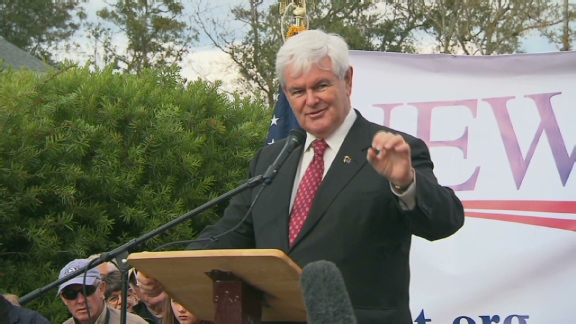 Every Republican presidential hopeful has a plan to cut taxes.
But one candidate's plan has been described as so aggressive that it would blow a hole in the federal budget, lead to huge deficits and give the richest Americans a gigantic tax break.
That candidate is current frontrunner Newt Gingrich.
According a new analysis, Gingrich's tax plan would reduce government revenue by a staggering $1.3 trillion -- or 35% -- in 2015, the first year the plan could be fully implemented.
"It's mind boggling. It's a very large tax cut," said Roberton Williams, a senior fellow at the non-partisan Tax Policy Center, which performed the analysis.
What would Gingrich's plan do?
Gingrich wants to add to the current tax code by putting an optional 15% flat tax on income in place, with a $12,000 per-person deduction. And Gingrich would like to eliminate the estate and capital gains taxes.
Swing state economies complicate 2012 picture
For businesses, Gingrich wants to reduce the corporate tax rate from 35% to 12.5% -- a move that would take the rate from one of the highest in the industrialized world to one of the lowest.
All those tax cuts mean the federal government would take in much less money. In order to balance the budget -- or get even remotely close -- government spending would have to be slashed by huge amounts.
And that, as the current Congress has made clear, is near impossible.
The super committee, for example, was trying to find $1.2 trillion in savings over a ten-year period. They failed. The Gingrich plan would create a gap of $1.3 trillion in just a single year.
"This plan means big deficits," Williams said. "Or huge forced spending cuts. Or both."
But taxes would definitely go down. A lot.
Billionaires with 1% tax rates
A full 70% of Americans would pay lower taxes under the Gingrich plan, according to the analysis, an average savings of over $7,000 compared to current policy.
The highest-income individuals would see the greatest benefit. A full 99.9% of Americans with more than $1 million in income would get a tax cut. The average savings: $613,000, for an after-tax income boost of 28.7%.
The tax rate paid by those individuals would fall to 11.9%, a reduction of almost 20%. Meanwhile, Americans making less than $100,000 would see their rates drop by between 0.5% and 3.1%.
The Gingrich campaign did not respond to a request for comment.
The Gingrich tax plan was not heavily scrutinized when first released, but as the former long-shot candidate's fortunes have improved, his plans for the economy have received more attention.
The plan is similar in some respects to that of Texas Governor Rick Perry, but Gingrich's proposed rate cuts go even further.
For example, Perry would add a 20% optional flat tax and cut the corporate rate to the same level, while Gingrich wants to take the flat tax down to 15%, and the corporate rate to 12.5%.
Similar to the plan proposed by Rick Perry, taxpayers would be able to choose whether to pay the flat tax, or file under the existing tax code.
Both Perry and Gingrich have touted their optional flat taxes as a way to simplify the tax preparation process.
But tax experts have thrown cold water on that idea -- arguing that adding an additional tax option would necessitate the preparation of multiple returns to ensure the lowest rate.
"It's not tax reform," Williams said. "As long as you leave the old code in place, you're not doing tax reform. This would absolutely make it more complex."
And if Gingrich survives the primary process and emerges as the Republican nominee, his tax plan could provide ammo for the White House, which has signaled in recent days that income inequality will be central to its general campaign message.
After all, the top 1% of earners would get a tax break of more than $340,000 under Gingrich's plan, even if you assume the Bush tax cuts are extended.
CNN
Asian chipmakers fall after Intel cuts sales forecast
Shares in Asian makers of computer chips fell on Tuesday, after Intel cut its revenue forecast.
Intel, the world's largest maker of microprocessors, said on Monday it was due to a shortage of hard disk drives.
Severe flooding in Thailand, which has killed more than 600 people, has disrupted production there.
Shares in South Korea's Samsung Electronics fell by 1.29%, while Hynix Semiconductor was 2.02% lower.
In Japan, semiconductor shares were lower by 2% to 3%.
Disk shortage
Because of its size, Intel's forecasts often act as a bellwether for the entire sector.
Thailand is a manufacturing centre for technology and heavy industry.
The floods in the country have also affected global production of cars and personal computers.
Intel said its main customers, computer makers, were cutting orders because of the hard disk drive shortage.
Euro pact faces UK hurdle, ebbing market faith
Doubts rebounded yesterday over Europe’s ability to solve its debt crisis and rescue the imperiled euro, as investors worried that plans for closer fiscal unity will bring little immediate relief and exposed the continent’s deep political divisions. British Prime Minister David Cameron was the only leader among the European Union's 27 members to refuse last week to join a plan under which nations submit their budgets for central EU review and limit the deficits they can run.
As the rift between Britain, which has its own currency, and the 17 nations that use the euro created uncertainty about the deal's implementation, ratings agencies Moody's and Fitch warned the plan did not even properly address the problem of lowering existing European debt.
Stocks and the euro fell sharply yesterday — to US$1.3183 from US$1.3370 — as market confidence in the plan and Europe's ability to end the crisis ebbed. In Italy, one of the continent's most troubled economies, workers angry about government austerity reforms went on strike and held nationwide rallies. Germany’s DAX ended the day 3.4 per cent lower, Milan's stock index was down 2 percent and Italy's borrowing rates rose, indicating growing fears about its financial future. (AP)
WTO brings changes to foreign trade companies
With both delicate hand-carving and efficient machinery, a Chinese furniture and arts and crafts exporting company is trying to shape the industry. After ten years in the business, the owner, Yu Heqin, is busy designing new products in the hope of becoming more competitive.
Yu Heqin, general manager of Beijing Heyixing Furniture Company, said, "Starting from the second half of 2008, we have encountered difficulties on the overseas market due to the financial crisis. So I decided to hire designers from Italy to make new designs, adding modern elements to the traditional chinese style. I think this would add extra value to our products and increase our competitiveness."
Mr Yu has also received advice from his long-time partner, Tian Wenhua. Mr Tian has been exporting products to Europe since 2001, when China first became a member of the WTO. He understands the need for change.
Tian Wenhua, general manager of Beijing Gongmei CO., Ltd, said, "The difficulty is that we are facing more and more direct challenges to meet the demand of consumers in the west. Also the technical standards for export products are getting tougher and stricter. So we must adjust to the new rules and standards of the countries we are exporting to."
In the hay days, Tian’s company saw its export volume triple, from 10 million US dollars before 2001 to 30 million in 2007. All this thanks to the WTO membership. But the 2008 financial crisis cut profit margins, and so it’s time to change business model, and that starts with improving designs.
Li Yong works for the China Association of International Trade and he agrees companies need to evolve.
Li Yong, vice chairman of China Association of International Trade, said, "The companies should focus on chang of their value-added process. For example, from the old equation of “raw material+labor+ manufacturing" process, to the new equation of "knowledge+innovation+design". The export should not be only low-cost product, but also service and solution. I think they should also consider a shift from their market focus to diversify from developed market to developing markets."
For Mr Yu, change means new modern assembly lines and facilities. With these, he can produce new products better adapted to the international markets.
China is now the world’s second largest economy, the biggest exporter and the second-biggest importer. Despite all the titles, Chinese traders and businessmen are still learning to fit in the global competition. As for the future, Mr Tian and his colleagues like to remain confident and cautious because the changing role from ’student’ to ’participant’ in the WTO requires knowledge and experience and it means a lot of work to do.
Occupy protests disrupt ports across US West Coast
Hundreds of anti-Wall Street protesters have blocked gates and delayed lorries at three ports on the US West Coast.
The partial shutdown of harbours in California, Oregon and Washington states resulted in a handful of arrests, but no major clashes.
From early on Monday, activists picketed gates, beat drums and carried signs with slogans such as "Shut Down Wall St on the Waterfront".
The rallies come a month after police dismantled Occupy camps across the US.
Demonstrators said they hoped to hit the profits of the corporations that run the harbours.
'Mission accomplished'
In Oakland, California, about 150 workers were sent home as a result of the demonstrations, effectively closing two terminals.
Scott Olsen, the Marine veteran who was injured during a clash between police and Occupy Oakland protesters in October, joined nearly 1,000 people marching to the city's port on Monday evening.
At Long Beach port, near Los Angeles, up to 300 protesters rallied at a terminal facility and scuffled with police.
Two terminals were also shut in Portland, Oregon, where two people carrying a gun and a sword were arrested. Occupy spokeswoman Kari Koch said they were not affiliated with the rallies.
Workers in Portland and at the port of Longview, Washington, were sent home over health and safety concerns.
The longshoremen's union did not officially back the protests, but employees were allowed to stay off the job if they felt conditions were unsafe.
Demonstrators have previously targeted companies such as port operator SSA Marine, in which Goldman Sachs holds a large stake, and grain exporter EGT.
In Vancouver, Canada, about a dozen people protested at that city's port and a handful of people in Anchorage, in the US state of Alaska, also held a demonstration.
Monday's demonstrations were the largest co-ordinated action by the Occupy movement since encampments were removed in cities across the US in recent weeks.
Although they attracted far fewer people than the 10,000 who turned out at the beginning of November to shut Oakland's port, organisers declared victory.
Protester Boots Riley said. "We shut down the Port of Oakland for the daytime shift and we're coming back in the evening. Mission accomplished."
But others said the action would hurt workers.
"Disrupting port activities makes it harder for US manufacturing, the farm community and countless others to sell to customers and contribute to our nation's economic recovery," said EGT chief executive Larry Clarke.
And Christian Vega, 32, who was stuck with a lorry-load of recycled paper at the port of Oakland, said the disruption would cost him several hundred dollars.
"It only hurts me and the other drivers," he told the Associated Press news agency.
"We have jobs and families to support and feed. Most of them [protesters] don't."