
Drug point
SECURITY at Grantley Adams International Airport (GAIA) has been called into question as two recent drug cases – one in the United States and one in Britain – revealed it as a smuggling point for illegal drugs out of Barbados.
A New York Times story last Friday reported testimony in the case against Barbadian Victor Bourne, who lived in the United States, indicating that some baggage handlers at GAIA were involved in concealing dope aboard American Airlines Flight 1384 to the United States.
Bourne, 34, who worked as a baggage handler for American Airlines at John F. Kennedy International Airport, was convicted last October of importing and distributing narcotics, as well as conspiring to do so; wire fraud conspiracy, conspiring to avoid financial reporting requirements through structural financial transactions and operating a continuing criminal enterprise. He faces a life sentence.
The story noted testimony of several American Airlines employees that he “had criminal connections in Barbados, bought cocaine in bulk and arranged for baggage handlers in Barbados to hide it on planes bound for New York”. (MB)
Nation News

Lindsay Lohan misses "Ellen" but on track for court hearing
 Lindsay Lohan missed her flight back home from a Hawaiian vacation, but she will be back in Los Angeles in time for an important court appearance Wednesday, her spokesman said.
Los Angeles County Judge Stephanie Sautner ordered Lohan to appear in court so she can determine whether the actress is keeping up with her probation provisions, including the requirement that she work at least 12 days a month at the county morgue.
"Lindsay was delayed in Hawaii due to a travel-related issue," Lohan spokesman Steve Honig said on Tuesday. "She will be heading back this evening in time to appear in court tomorrow."
The missed flight, however, forced the cancellation of Lohan's interview with talk show host Ellen DeGeneres, which was set to be taped Tuesday.
"Lindsay offered to tape 'Ellen' tomorrow, but the show was unable to shift things around, and tomorrow is their last day of taping for the season," Honig said.
The "Ellen" interview was to be Lohan's only planned appearance to promote her just-published Playboy magazine photo spread.
There is no indication that Lohan, 25, will have any difficulty in court Wednesday, compared with many of her numerous appearances in the past two years.
Sautner sentenced Lohan to 30 days in jail last month after she admitted that she violated her probation on a necklace theft conviction, but the sheriff sent her home after a few hours because of jail overcrowding.
The judge also ordered the actress to work at least 12 days a month at the Los Angeles County morgue until she completes the 53 remaining days on her court-ordered community service. She must also attend 18 psychotherapy sessions.
If the actress stays on track, her probation would be eased March 29, Sautner said. If she doesn't keep up with the requirements, she will serve the additional 270 days behind bars, the judge said.
"This is what we really call putting the keys to the jail in the defendant's hands," Sautner told Lohan.
When Sautner sentenced Lohan to 120 days in jail in May, she ended up serving 35 days of home confinement instead, because of jail overcrowding and state rules that give prisoners credit for good behavior.
Prosecutors said Lohan missed 12 of 20 scheduled workdays at a downtown Los Angeles women's center, part of the court-ordered community service imposed in May when she pleaded guilty to stealing a necklace from a Venice, California, jewelry store.
Lohan was already on probation for two drunken driving convictions from 2007.
She also canceled 14 of 19 scheduled appointments for court-ordered psychotherapy, they said.
"From what I see of you, you need a structure," Sautner told Lohan last month, instructing her to return to court each month, starting December 14, to show she is complying with the schedule.
Lindsay Lohan's legal woes, which began four years ago with two drunken driving arrests, have been compounded by her failure to attend counseling classes, and alcohol and drug test failures.
Her probation is scheduled to end within a year unless Lohan breaks any laws before then. It has been extended several times because of violations, including the failed alcohol and drug tests.
CNN
Charli Baltimore Planning First Solo Album In 2012
Female rap veteran Charlie Baltimore is poised to make a return to hip-hop with an upcoming album due to be released next year.
The Grammy Award nominated rapper, born Tiffany Lane, recently dropped a new single titled “Machine Gun,” featuring Sally Anthony.
The track is meant to reintroduce Charli Baltimore before the release of her solo album, which is due in stores this April.
Although she’s a rap veteran through her affiliation with rappers like Notorious B.I.G., Jay-Z, Cam’ron, Ja Rule, Game and others, Charli Baltimore has never released
a solo album.
Her first album Cold As Ice was supposed to be released in 1999, but the album never saw the light of day.
In 2003, her next album The Diary (You Think You Know was supposed to be released through Murder Inc., but the release was also shelved.
“Machine Gun” is due in stores on iTunes on December 20.
Katie Couric and Brooks Perlin split
Katie Couric and her boyfriend, entrepreneur Brooks Perlin, have called it quits after five years together, a rep for Couric confirms to PEOPLE.
The couple were "at different stages in their careers," says a friend of Couric's, who adds, "the split was inevitable."
Couric, 54, and Perlin, 37, met at a 2006 fundraising event for cancer research. Couric's husband, Jay Monahan, died of colon cancer in 1998, at age 42.
After her breakup, Couric, who hosts ABC's "The Year," a two-hour special collaboration with PEOPLE that airs December 15 and looks back at the newsmakers of 2011, is "full of energy and just as active and engaged as always," says the friend.
"Brooks is a good guy," the friend continues, "but there is a time for each relationship -- and the time is past for this one."
In May, Couric, whose new syndicated ABC daytime talk show will begin next September, told PEOPLE her relationship with Perlin was "complicated," and that much had been made of the fact that she was dating someone 17 years her junior.
"I'm in the process of figuring out the future, and so is he," she said at the time.
News of the breakup was first reported by the New York Post.
People
Drake Announces Tour Dates for 2012 Club Paradise Tour
Drake has announced tour dates for his 2012 Club Paradise Tour, which kicks off on Valentines Day 2012.
The Club Paradise Tour starts off in Miami, FL and ends in San Diego, CA and will feature A$AP Rocky, along with a host of other artists throughout the tour.
Drake, who is promoting his new album Take Care, will hit 17 different cities, with the tour rapping up the second week of March.
“I spent a lot of time out there [in Toronto]; that’s what this album is about,” Drake told MTV News. “That’s what I’m gonna showcase. It’s the same thing with the tour: I wanna bring Kendrick, I wanna bring A$AP, those are guys that I love. It has nothing to do with people on my label,” he explained.
The Young Money/Cash Money Records artist wanted to make this tour more intimate as opposed to performing in large stadiums, in hopes of giving back to the fans that have supported him from his earliest days.
Drake’s North American Club Paradise Tour 2012:
» February 14 – Miami, FL @ Bank United Center
» February 15 – Gainesville, FL @ Stephen C. O’Connell Center
» February 17 – Nashville, TN @ Bridgestone Arena
» February 18 – Columbus, OH @ Schottenstein Center
» February 21 – Columbia, SC @ Colonial Life Arena
» February 22 – Lexington, KY @ Rupp Arena
» February 24 – Tallahassee, FL @ Tallahassee-Leon County Civic Center
» February 25 – New Orleans, LA @ UNO Lakefront Arena
» February 27 – Austin, TX @ Frank Erwin Center
» February 28 – Oklahoma City, OK @ Chesapeake Energy Arena
» March 1 – Kansas City, MO @ Sprint Center
» March 2 – Arlington, TX @ College Park Center
» March 4 – Tuscon, AZ @ Tucson Arena
» March 5 – Los Angeles, CA @ Galen Center
» March 8 – Fresno, CA @ Save Mart Center
» March 10 – San Jose, CA @ Event Center
» March 11 – San Diego, CA @ Viejas Arena
Music executive John Atterberry shot dead in LA
US music executive John Atterberry has died after being shot in a random gun attack in Los Angeles on Friday.
Atterberry, 40, worked with artists including Michael Jackson, the Spice Girls, Christina Aguilera and Jessica Simpson.
He was shot at close range by a gunman, later named as Tyler Brehm, who opened fire on Sunset Boulevard, Hollywood.
Brehm repeatedly shot at pedestrians and vehicles and was killed by an off-duty police officer.
Brehm, 26, had allegedly just broken up with his girlfriend of four years.
Atterberry had just left a bank and was returning to his car when he was shot.
He was taken to Cedars-Sinai hospital, where he remained in a critical condition until he died on Monday afternoon.
He was a senior partner and chief financial officer at the GridLock Group, an event promotions company.
Previously, Atterberry was vice president of Death Row Records, a record label that was founded in 1991 by Dr Dre and Suge Knight, and was once home to some of rap's biggest names, including Tupac Shakur and Snoop Dogg.
Iraq PM Nouri al-Maliki calls for US investment
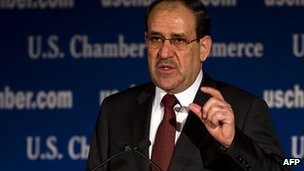 Iraqi Prime Minister Nouri al-Maliki, has called on US business leaders to invest in his country to help it recover from years of war.
The call comes as the last US troops prepare to pull out of Iraq.
Speaking during a visit to Washington, Mr Maliki said security had improved and corporations rather than generals were now leading Iraq's future.
The US currently accounts for slightly more than a tenth of total foreign investment in Iraq.
Mr Maliki is in Washington with some 40 Iraqi business leaders hoping to sign business and trade deals.
He told potential investors at the US Chamber of Commerce that as well as oil, there were many other sectors which could be of interest, including healthcare, telecommunications, construction and financial services.
He said the possibilities for US firms were "limitless" and that they best-placed to help Iraq diversify its economy.
"It is not now the generals but the businessmen and the corporations that are at the forefront," he said.
"All sectors of the economy are there, open for business for American business."
After meeting Mr Maliki on Monday, US President Barack Obama said he believed the Iraqi economy would grow at an even faster rate than that of India or China.
He confirmed that no US bases or troops would remain in the country next year but said the US would maintain a strong relationship with the country.mark mardell
"We've got an enormous investment of blood and treasure in Iraq," Mr Obama said.
"And we want to make sure that even as we bring the last troops out, that it's well understood, both in Iraq and here in the United States, that our commitment to Iraq's success is going to be enduring."
Foreign investment in Iraq has this year totalled $70bn (£45bn).
But the BBC's Steve Kingstone in Washington says there are lingering concerns in the US about security and about Iraq's sometimes confusing regulation of key sectors.
Olympus submits earnings to try and avoid delisting
Japan's scandal-hit camera maker Olympus has filed revised earnings reports to try and avoid being delisted by the Tokyo Stock Exchange.
The firm filed reports going back five years, three hours before a deadline passed which would have seen it automatically delisted.
However, Olympus has not yet filed earnings for the year to March 2011.
The company could still be delisted because of its accounting irregularities.
In early November Olympus admitted that it had been hiding $1.5bn (£968m) in investment losses for almost two decades.
The deception came to light when former president and chief executive Michael Woodford challenged payments at the company.
Elaborate deception
Mr Woodford was fired in October after raising doubts about massive fees paid in the purchase of British medical equipment maker Gyrus Group in 2008.
He returned to Japan this week to meet investors to try and head a turnaround at the company.
Olympus has seen its fortunes slide after it fired Mr Woodford.
The ensuing investigation caused Olympus shares to plunge and forced its chairman Tsuyoshi Kikukawa to step down.
No one has yet been charged in the scandal.
Olympus has said several top executives were involved in the scheme and has promised to investigate former and current executives and auditors, and to pursue possible criminal charges.
Fees for financial advice and acquisitions were part of an elaborate deception to keep the massive losses off the company's books.
Euro drops below $1.31 for first time since January
The euro has dropped to an 11-month low against the dollar as concerns continue over the future of the eurozone.
The euro fell below $1.31 for the first time since January. Against the pound, one euro bought 84.20 pence.
Last week, 26 of the 27 members of the European Union backed new fiscal rules, with only the UK abstaining.
But many fear that the budget pact will still not be enough to prevent more countries from seeking a bailout.
Stocks were higher and remained so in the US, but turned lower in Germany and France towards the end of the day.
Jose Manuel Barroso, head of the European Commission, told the European Parliament the UK's stance had made compromise impossible at last week's EU summit on economic integration.
He said the "greatest" risk of the summit, a split between the 17 euro states and the other 10, had been avoided.
"This is not an agreement at 17-plus, but an agreement at 27-minus," Mr Barroso said.
Spain also managed to borrow 4.941bn euros of short-term debt at lower rates than recently.
But the president of the European Council, Herman Van Rompuy, said the new fiscal deal would not be signed by most EU states before March.
US Federal Reserve continues 'Operation Twist' stimulus
The US Federal Reserve has left interest rates unchanged and said that it will continue with its bond-buying stimulus programme.
However, one member of the Fed's rate-setting dissented and wanted more stimulus to the economy.
The Fed said it "continues to expect a moderate pace of economic growth over coming quarters".
Rates in the US are at a record low of between zero and 0.25%, and have been that way for three years.
The US unemployment rate dropped sharply to 8.6% in November, its lowest level in two-and-a-half years, from 9% the month before.
"While indicators point to some improvement in overall labor market conditions, the unemployment rate remains elevated," the Fed said in a statement.
Referring to the eurozone debt crisis, the Fed said: "Strains in global financial markets continue to pose significant downside risks to the economic outlook."
In September, the Fed announced a $400bn (£254bn) bond programme, dubbed "Operation Twist" by observers.
Under the programme, the Fed said it would sell about $400bn of short-term bonds and buy longer-term debt. Buying bonds pushes the price up and lowers the interest rate, or yield.
The Fed hopes the move will help to keep long-term interest rates low, thereby boosting mortgage lending and loans to businesses.
Unlike quantitative easing, the policy does not inject any new money into the economy.