
LIME strikes deal with CARICOM
Telecommunications firm LIME has signed an agreement with the CARICOM secretariat to provide videoconferencing equipment and services to Jamaica and seven other member countries, as well as five other territories in the region.
In a statement, LIME said the regional body appointed the company, following a request for proposal to supply and install the equipment in Antigua, Barbados, Dominica, Grenada, Jamaica, St Kitts, St Lucia, St Vincent, and five other territories, namely, Belize, Guyana, Suriname, Trinidad, and Haiti.
Earlier this year, LIME revealed that the company would be offering videoconferencing solutions to the public for corporate, enterprise and government organisations.
LIME said it would be working in collaboration with Polycom, a global leader in unified com-munications solutions with the industry's broadest portfolio of telepresence and video-communications infrastructure.
"The solutions being offered range in size, features and capa-bilities from smaller scale, flat screen, transportable systems to high-definition virtual telepresence conference suites, which closely simulate most elements of face-to-face meetings," the company said.
It added that the multifaceted systems include a range of useful and novel features, including collaboration tools for sharing graphics, presentations and rich-media content.
Lime product enhanced
In addition to sourcing and installing videoconferencing solutions, LIME said it would also provide user training to ensure its customers were fully versed with the capabilities of the systems.
LIME said it was already reaping the benefits of videoconferencing as the company has equipped its own offices in Jamaica, Barbados, Cayman and other Caribbean locations with a Polycom RealPresence high-definition system. The immersive telepresence solution is used for various purposes, including multi-location meetings, employee training and client consultations.
Among LIME's first local clients was the International Monetary Fund (IMF). LIME installed a Polycom HDX 7000 movable system at the IMF's local headquarters at the Bank of Jamaica building in downtown Kingston.
"The high-definition video system facilitates content sharing, allowing for the collaborative creation and discussion of diagrams, graphics, project plans and multimedia presentations," said the statement from LIME. "The system also features stereo surround, Polycoms' unique audio technology."
The statement quoted LIME's managing director for customer solutions, Dr David McBean, as saying that "With advances in technology, videoconferencing is no longer a futuristic novelty but a useful business tool that can help to curtail travel and other costs, while reducing the impact of distance and multi-location operations.
"Videoconferencing has enhanced LIME's already extensive product and service portfolio and underscore our position as the region's best and preferred provider of communications services for organisations of any size," he added.
Source- The Gleaner

EU entering 'critical period' to resolve debt crisis
 EU finance ministers are meeting in Brussels after a top official said the region had just days to take decisive action to resolve the crisis.
EU Monetary Affairs Commissioner Olli Rehn said: "We are now entering the critical period of 10 days to complete and conclude the crisis response".
The meeting comes a day after eurozone ministers agreed measures to expand the region's bailout fund.
But they said it was unlikely to hit its 1tn euro ($1.3tn; £860bn) target.
Meanwhile, the latest figures from the European Central Bank (ECB) show that eurozone banks are becoming increasingly nervous about lending to each other.
Banks deposited 300bn euros with the ECB on Tuesday night, a rise of 100bn euros over the past two weeks.
The increase "shows that parts of the eurozone are close to a credit crunch, if not already in one," said the BBC's business editor Robert Peston.
Higher rates
Eurogroup chief Jean-Claude Juncker said the expansion of the bailout fund, known as the European Financial Stability Facility (EFSF), would still be "substantial".
European leaders want to bolster the EFSF, which currently has a lending capacity of 440bn euros, in case large economies such as Italy or Spain need to call for bailout money.
Fears that Italy in particular may need financial assistance were raised on Tuesday when the government was forced to pay much higher interest rates in a bond auction.
Ministers did agree to allow the bailout fund to partially guarantee potential losses investors might incur on the purchase of government bonds.
In a statement, the EFSF said the guarantee would give a bondholder "an amount of fixed credit protection of 20% to 30% of the principal amount of the sovereign bond".
Ministers also decided to create co-investment funds to allow public and private investors to participate in the EFSF. But fund chief Karl Regling said it was impossible to give a figure at this stage.
Ministers also agreed to release the latest 8bn euro tranche of bailout money to Greece.
Earlier this week, France and Germany proposed closer ties between eurozone economies, including binding limits on borrowing.
Meanwhile, reports suggest the EU will unveil proposals on Wednesday to split the so-called big four accountancy firms - PricewaterhouseCoopers, Deloitte, Ernst & Young and KPMG - into separate audit and consulting units.
Eurozone unemployment rate rises to 10.3%
The eurozone unemployment rate rose slightly to 10.3% in October, up from a revised 10.2% in September, official figures have shown.
The number of people unemployed rose by 126,000 from September to 16.3 million.
The rate in Germany fell to 5.5% from 5.7%, while that in Spain rose to 22.8% from 22.5%, Eurostat said. Youth unemployment in Spain rose to 48.9%.
Separate figures also released by Eurostat showed the eurozone inflation rate unchanged at 3% in November.
Earlier this month, the European Central Bank cut eurozone interest rates to 1.25% from 1.5%, and at the time said the inflation rate would remain at "elevated levels" for a number of months.
However, the bank forecast that inflation would fall to below 2% next year.
The latest figures come as EU finance ministers prepare to meet to discuss ways to resolve the eurozone debt crisis.
Ahead of the meeting, EU Monetary Affairs Commissioner Olli Rehn said ministers were "entering the critical period of 10 days to complete and conclude the crisis response".
An EU summit is scheduled to take place on 9 December.
Largest project in Haiti nears reality
THE biggest international project aimed at helping Haiti rebound from the 2010 earthquake eased closer to reality at a ceremony Monday.
Former US President Bill Clinton and Haitian President Michel Martelly broke ground for an ambitious US$224 million industrial park in northern Haiti that they hope will generate tens of thousands of jobs, house 5,000 of the workers and educate 500 of their children in a new school.
Those involved hope the South Korean garment manufacturer Sae-A Trading Co Ltd will set an example and urge other foreign businesses to invest in Haiti, a country long ignored by outsiders because of its cumbersome laws, heaps of red tape and occasional political tumult.
"Investors still do not believe or understand the value and potential of Haiti as we do," Kim Woong-ki, chairman of Sae-A, said through an interpreter in the northern town of Caracol. "Let's open this closed door and mind set toward Haiti and highlight the true value and potential of Haiti."
The project on the 617-acre (250-hectare) site was in the works long before the January 2010 earthquake but became a priority after Clinton was named the United Nations' special envoy for Haiti in 2009 and given responsibility for spurring private investment.
On the eve of the quake's first anniversary, the Haitian government and Sae-A signed an agreement to create the industrial park, which will export clothing to the United States. Among the company's 20 existing factories are plants in Nicaragua, Guatemala, Indonesia, and Vietnam.
The United States has provided US$120 million for generating electricity, housing for workers and improvements to a port in the north. The Inter-American Development Bank will provide US$50 million for building factory shells and infrastructure.
The Caracol industrial park is intended to be Haiti's largest private employer, with a goal of providing 20,000 jobs at the park and creating 133,000 in all through cottage industries.
The first T-shirts are scheduled be made in May or June of next year.
"This is the kind of change we need," Martelly said from a stage surrounded by bulldozers and other heavy machinery. "This is the kind of development we need."
Workers will be paid Haiti's minimum wage, which is US$5 a day, and will be eligible for bonuses based on performance.
Clinton said the industrial park will eventually improve the lives of about 500,000 people as the complex brings in other tenants and small businesses emerge around the plant.
Thirty percent of Sae-A's jobs will be set aside for women.
Nella Felix hopes to be among them. She's a sometime street vendor who makes up the 60 per cent of the population that makes about US$2 a day.
"For me, it's a real way for the youth of the community to live, to find jobs and work," Felix, 42, said after the ceremony. "I'm waiting to see what they can do for us."
Critics of the industrial park argue that Haiti would be better off investing money in its long-neglected agriculture sector instead of the garment sector, which has stumbled along because of sporadic political upheaval.
Rudy Boulos, a business leader and former senator for the region, acknowledged the shortcomings but said the thousands of jobs will stimulate the area's economy, allowing parents to send their children to school.
"I don't think an industrial plant is the best way to create jobs," Boulos said before the ceremony started. "But it's a beginning. It's a first step to being self-sufficient."
Separately, Clinton and Martelly announced Monday that the Digicel phone company will help build a US$45-million, 173-room hotel with Marriott International. The new franchise is expected to create 175 jobs.
Construction is expected to begin next year in Turgeau, one of the few middle-class neighbourhoods in Port-au-Prince proper. Opening is scheduled for mid-2014.
S&P downgrades credit rating of major banks
Ratings agency Standard & Poor's has downgraded the long-term credit grades of a string of major financial firms.
Wall Street titans Bank of America and Goldman Sachs, along with Barclays, HSBC, and some firms in Germany and France were affected.
Downgrades can increase banks' borrowing costs and put further pressure on their shaky finances.
However, it upgraded ratings on two Chinese banks, Bank of China Ltd. and China Construction Bank Corp.
S&P said its move reflects new criteria for banks, based on changes in market trends and government support.
Bank of America, Goldman Sachs, and Citigroup had long-term ratings downgraded to A- from A.
Morgan Stanley, Barclays, HSBC, Commerzbank, and UBS also had ratings cut by one notch, according to S&P's statement.
S&P's move hit the shares of US banks in after-hours trading on Wall Street, with Goldman Sachs down 1% Morgan Stanley down 1.7%.
Ratings for several big European banks, including Credit Suisse, Deutsche, ING and Societe Generale were unchanged.
Low risk
The upgrade for the Chinese banks has come at a time when there have been increased concerns about the health of the country's banking sector.
Chinese banks lent out record sums of money in the past few years in a bid to ensure a healthy pace of growth for the economy during the global financial crisis.
However, a slowdown in global economy has led to concerns about China's growth, prompting fears about an increase in bad debts at the banks.
Analysts said while the Chinese banks were prone to the risk of accumulating bad debt, they still remain a safe bet.
"The key factor is that they are largely government owned, that means the risk to shareholders of these banks is quite low," Stephen Joske of the Economist Intelligence Unit in Beijing told the BBC.
Mr Joske added that the Chinese government's was in a strong financial position to help its banks, should it need to step in.
"If there were to be a run on domestic banks, the authorities have plenty of resources to bail them out," he said.
EU plans new consumer watchdog for disputes
Shoppers who get into disputes with European traders should find it easier to get an out-of-court settlement in future, under new EU proposals.
The European Commission proposes an EU-wide online platform for consumers to "solve contractual disputes entirely online within 30 days".
Often mechanisms for resolving customer complaints only exist in some regions or sectors, the commission says.
Standardised rules could save consumers 22.5bn euros (£19bn) annually, it says.
A leading UK Conservative MEP, Malcolm Harbour, welcomed the commission draft directive, saying it should enable problems to be dealt with "simply and cheaply, without long and complicated legal action".
The European Parliament and EU governments aim to adopt the package by the end of next year. The single EU-wide platform for resolving disputes online should be in place by early 2015, the commission says.
In 2010, one in five European consumers encountered problems when buying goods and services in the EU's single market, the commission says.
The new Directive on Alternative Dispute Resolution (ADR) aims to set up a network of neutral, professional mediators "to deal with any contractual dispute between a consumer and a business".
EU Health and Consumer Affairs Commissioner John Dalli said "it is unacceptable that so many consumer problems are left unresolved because consumers have no real effective means of solving disputes with traders".
Public sector strike to be 'largest for a generation'
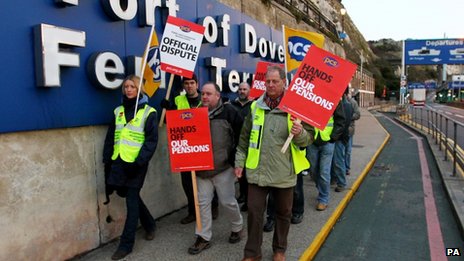 Public sector workers are staging a strike over pensions in what unions say is set to be the biggest walkout for a generation.
Schools, hospitals, courts and government offices around the UK are among services being disrupted, as more than 1,000 demonstrations take place.
The chancellor urged more talks, saying strikes would not achieve anything.
Unions object to government plans to make their members pay more and work longer to earn their pensions.
The strike is having the following effects:
- The Department of Education says it is expecting 13% of state-funded schools in England, including academies and free schools, to open and 13% to be partially open. The status of 16% of schools is unknown
- In Scotland, 30 of the 2,700 council-run schools are believed to be open, says local authority body Cosla
- Plane arrivals and take-offs at Britain's two biggest airports - Heathrow and Gatwick - are largely unaffected with only a few cancellations of in-bound transatlantic flights to Heathrow
- Heathrow operator BAA, and its busiest carrier, British Airways, have both reported near normal services, with queues at immigration no longer than usual
- At Heathrow, the 10 EU desks at Terminal 3's immigration services are being manned by a mix of Home Office staff and police officers who have been trained. Five non-EU desks are open as airport sources suggest immigration controls are at two-thirds of normal staffing levels
- In Northern Ireland, no bus or train services will be operating and two-thirds of schools and colleges will be closed
- Unions estimate about 300,000 public sector workers are on strike in Scotland while 170,000 workers in Wales are taking action
- NHS managers say contingency measures have been put in place to protect services such as A&E units, cancer treatment and end-of-life care
- In England, the government estimates about 400,000 nurses and healthcare assistants, paramedics, physiotherapists and support staff like cleaners and administrators are joining the action. It says about 60,000 non-urgent operations, out-patient appointments, tests and follow-up appointments have been postponed
- BBC News Channel's chief political correspondent Norman Smith tweeted: "(Health Secretary) Andrew Lansley says patients who have ops cancelled today will still be seen within 18-week limit."
- London Ambulance Service tells BBC London it is "struggling" and said people not in a life-threatening condition may not get an ambulance while South East Coast Ambulance Service says it is now only responding to "life-threatening emergencies"
- In Scotland, at least 3,000 operations and thousands more hospital appointments are affected
- Union leaders say although court staff are taking action, the trial of two men accused of killing of teenager Stephen Lawrence will not be disrupted
- The BBC's Ross Hawkins tweeted that strike placards had been seen outside the Royal Courts of Justice but said the Leveson Inquiry is going ahead as planned
- BBC political correspondent Mike Sergeant tweeted: "Union official outside HMRC in Whitehall predicting 70% of those who work in the building will strike."
'Negotiating table'
Unions say up to two million public sector workers are to take part in the strike.
Speaking from Brussels, Chancellor George Osborne told BBC Breakfast: "The strike is not going to achieve anything, it's not going to change anything. It is only going to make our economy weaker and potentially cost jobs."
He said unions should be holding talks with the government to resolve the pension dispute, rather than taking strike action.
He added that without making difficult choices about dealing with the UK's debts the country "would be bankrupt".
Labour leader Ed Miliband said he had "huge sympathy" for people whose lives are disrupted by the strike.
But he said he was "not going to condemn the dinner ladies, nurses, teachers who have made the decision to go on strike because they feel they have been put in an impossible position by a government that has refused to negotiate properly".
Shadow chancellor Ed Balls told BBC Breakfast the pensions row should have been resolved by the government.
Liberal Democrat Party president Tim Farron told the BBC News Channel the unions were wrong to strike because workers on low to middle incomes would get a "better, or certainly no worse" pension when they retire than is currently the case.
Earlier on Tuesday, union leaders reacted angrily to Mr Osborne's Autumn Statement announcements of a public sector pay cap of 1% for two years, as well as bringing forward to 2026 the rise in the state pension age to 67.
'Failure to negotiate'
Unison general secretary Dave Prentis told BBC Radio 4's Today Programme that industrial action by his union was rare but public sector workers "were annoyed". Millions of workers - mainly low-paid women - were being unfairly affected by changes to pensions, he said.
"That is when people say enough is enough," he added.
Mr Prentis said the last time unions met the Treasury ministers was 2 November, adding "this idea that negotiations are continuing is just not true."
However Cabinet Minister Francis Maude disputed this claim, saying formal discussions with the civil service unions happened on Tuesday and that talks will take place with teaching unions on Thursday and with health unions on Friday.
Brendan Barber, general secretary of the TUC, said the public sector was "under attack" by the government, adding that the action was justified.
"With the scale of change the government are trying to force through, making people work much, much longer and get much, much less, that's the call people have made," he said.
Paul Noon, leader of civil service union Prospect, said members felt the chancellor was "aiming yet another punch at them".
Courts, job centres, driving tests and council services, such as libraries, community centres and refuse collections have been affected by the strike.
Education Secretary Michael Gove has said it is "unfair and unrealistic" to expect taxpayers to foot the growing public sector pensions bill.
Schools Minister Nick Gibb told BBC Radio 4's Today Programme: "We have to be fair to all taxpayers not just those who work in the public sector. If we're going to sustain these kind of high quality pensions in the long run there does have to be reform."
Contingency plans
Public and Commercial Services (PCS) union members who work for the UK Border Agency have gone on strike however airport sources suggested to the BBC that immigration controls are at two thirds of normal staffing levels - more than the 30-50% predicted previously.
The government has said no border controls will be relaxed to ease queues.
Gatwick's chief operating officer Scott Stanley said: "Whilst passengers have so far not experienced delays at the border zones we do expect delays to occur at some point today as the rate of arriving flights increases."
Weather forecasting staff at the Met Office, catering staff in the House of Commons and museum curators are also among those due to walk out on Wednesday.
Simon Walker, of the Institute of Directors, told the BBC News Channel the strike was doing "significant damage" to the economy.
"If you're damaging the productive capacity of this country you're really doing huge damage to the fabric of the economy and that will last a long time and impact on all of us," he said.
Source-BBC
Britain Withdraws Some Diplomats from Iran After Embassy Assaults
Britain says it is withdrawing some of its embassy staff from Iran following Tuesday's mob assaults on British diplomatic compounds in the capital, Tehran.
In a statement Wednesday, the British foreign office says the safety of British embassy personnel and their families is London's immediate priority. It did not say how many staff are leaving Iran or when.
Western diplomats told the French news agency that the first group of British evacuees were at Tehran's airport Wednesday, waiting to be flown to Dubai.
British Prime Minister David Cameron said Tuesday Iran faces "serious consequences" for failing to defend the British compounds from Islamists who barged into them as police looked on. The protesters chanted "Death to Britain" as they smashed windows of the main embassy building, threw documents outside and set fire to a car. Another group of Iranians stormed a British diplomatic complex in northern Tehran. The assaults followed followed Britain's decision to impose new economic sanctions against Iran over its alleged nuclear weapons program
The attacks drew more international criticism Wednesday. U.N. Secretary-General Ban Ki-moon's office said he expressed shock and outrage as he met with a British official on the sidelines of an aid conference in Busan, South Korea. The U.N. chief called on Iran to investigate the British embassy break-in and take measures to avoid any repetition there or at other diplomatic missions.
Secretary of State Hillary Clinton, also in Busan, strongly condemned the assaults as an "affront not only to the British people but also to the international community." She said Washington expects Iran to protect the lives and properties of diplomats in accordance with international conventions.
The Iranian protesters were angry about Britain's decision to cut business dealings with all Iranian banks as part of coordinated sanctions with the United States and Canada announced last week. The Western powers said the sanctions were a response to Iran's pursuit of a nuclear program that U.N. experts say appears designed to build nuclear weapons. Iran says its nuclear program is peaceful.
Iran's parliament responded to the British sanctions on Sunday by approving a measure to reduce diplomatic and economic ties with Britain.
The U.N. Security Council issued a statement condemning the embassy assaults on Tuesday.
Some information for this report was provided by AFP and Reuters.
Biden Says US Pullout from Iraq Marks New Phase in Relations
U.S. Vice President Joe Biden has told Iraqi leaders in Baghdad that the two countries are embarking on a “new path” as the United States prepares to complete a troop pullout by the end of December.
Biden was speaking Wednesday in a meeting with Iraqi Prime Minister Nouri al-Maliki. The vice president said the United States is keeping its promise under a 2008 agreement with Iraq to withdraw U.S. forces before an end-of-2011 deadline. The pullout will end a military presence that began with the 2003 U.S.-led invasion that toppled former dictator Saddam Hussein.
The U.S. military has about 13,000 troops remaining in Iraq. Biden told Mr. Maliki that the completion of that pullout is in the best interests of the United States and Iraq and will mark a new phase in a relationship between “two sovereign nations.”
The vice president also said the U.S. and Iraqi governments will build the relationship by cooperating on security issues such as training, intelligence and counter-terrorism. U.S.-Iraqi negotiations on allowing some U.S. trainers to remain in Iraq beyond the deadline failed earlier this year because of a dispute about whether such trainers would have immunity from Iraqi law.
The visit is Biden's eighth to Iraq since taking office in 2009. He also was due to attend a ceremony commemorating the sacrifices of U.S. and Iraqi troops in the eight-year-long conflict. Violence in Iraq has declined from the peak of sectarian fighting in 2006 and 2007, but insurgent attacks remain common.
In the latest violence, Iraqi officials say gunmen killed five people in a raid on a home in the central city of Samarra late Tuesday. The dead include a man, his wife, son and two other people who were in the house. The motive for the attack was not clear.
Turkey Imposes Asset Freeze, Other Sanctions on Syrian Leaders
Turkey says it is freezing the assets of Syrian leaders and taking other steps to pressure them into stopping a deadly government crackdown on an eight-month pro-democracy uprising.
Turkish Foreign Minister Ahmet Davutoglu announced the sanctions in a news conference Wednesday. The measures include cutting off links with Syria's central bank, banning the delivery of weapons to the country and suspending the two neighbors' strategic cooperation agreement.
Turkey had been a close friend of Syrian President Bashar al-Assad's government prior to the start of the uprising in March. Davutoglu said that regime now has come to the “end of the road.”
Turkey's decision to impose sanctions on Syria follows the Arab League's approval of unprecedented financial and political penalties against Damascus on Sunday. Only Iraq and Lebanon refused to support the measures, leaving the Syrian government increasingly isolated in the region.
Syrian Information Minister Adnan Mahmoud said Tuesday the country is self-sufficient and has a stockpile of food and basic supplies to withstand the sanctions.
Turkey said Tuesday it may shift its Middle East trade routes to go through Iraq – cutting out Syria as a transit country if unrest there worsens and embargoes against Damascus go into effect.
Onetime allies Turkey and Syria abolished visa requirements in 2009 and had planned to raise their trade volume from the current $2.5 billion to $5 billion in 2012.
Also Tuesday, Turkish Foreign Minister Ahmet Davutoglu said Ankara may set up a buffer zone along its border with Syria in coordination with the international community if hundreds of thousands of people attempt to flee the unrest there for Turkey.
The United Nations says violence related to the uprising has killed at least 3,500 people, mostly civilians.
Syria has refused to end the crackdown, calling it a necessary response to attacks by “armed terrorists” on civilians and security personnel.